Top 10 Real World Assets (RWA) Crypto Projects Dominating 2026
Listen to the Audio :
Would you believe me if I said every asset that exists in the real world can be traded live in a virtual market? Yes. Real world assets crypto projects are making this a reality through the RWA tokenization concept, bringing tangible assets on-chain with new possibilities for global traders within the ecosystem.
By removing traditional barriers, these crypto projects are redefining who can invest and how they can trade. What once demanded a million-dollar investment, such as commercial renovation or a private credit fund, is now accessible through fractional ownership, making large-scale investments more inclusive, efficient, and widely available in the Web3 landscape.
What Are Real World Assets (RWA) Crypto Projects?
Real-World Assets Crypto projects are representations of real-world assets that can be tokenized. The projects convert the ownership rights of any physical or traditional financial assets, such as equities, government bonds, mutual funds, gold, etc., into digital tradable tokens.
Operating on-chain, smart contracts automatically manage fund transfers, payments, and compliance processes. This bridges TradFi and decentralized systems, creating fresh investment opportunities through fractional ownership, instant settlement, and 24/7 trading for global investors.
The RWA market reached over $230 billion by mid-2025, with fiat-backed coins being a major contributor. By 2026, it is expected to surpass this milestone, driven by increased organizational adoption and integration within the DeFi ecosystem.
Wondering how much it costs to tokenize your assets? Check out our complete RWA Tokenization Cost Breakdown Guide →
Top 10 Real World Assets Crypto (RWA) Projects in 2026
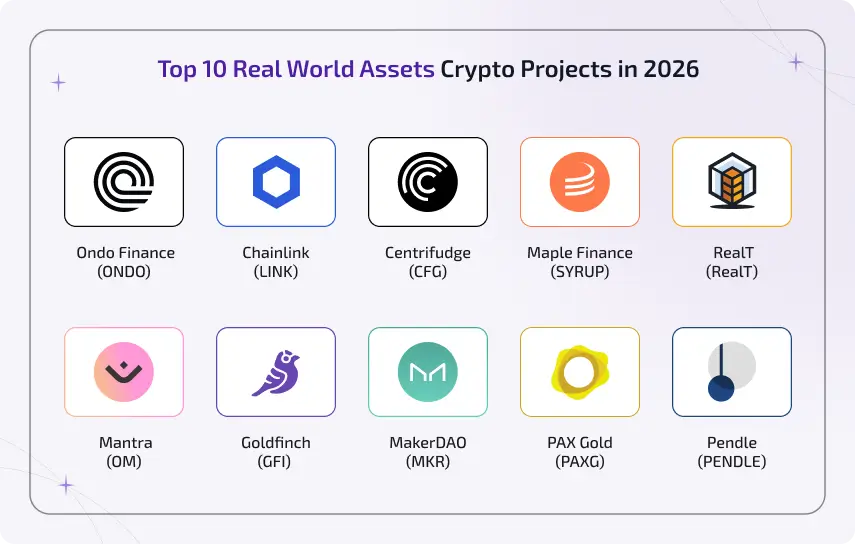
RWA crypto projects are redefining how traditional finance operates by bridging assets such as bonds, credits, and real estate onto the blockchain. In 2026, these projects stand out for delivering real value, stable yield, and stronger institutional adoption. Here is the list of real world assets crypto projects leading the evolution.
1. Ondo Finance (ONDO)
Ondo Finance is the finest RWA token real world assets crypto projects dominating the industry in 2026. Traditionally, only big institutions were allowed to invest in U.S. treasuries, but Ondo brings forth traditional financial assets on blockchain for real-time investment. In addition, it enables token holders to be a part of platform protocol decisions and fee systems.
Focus Category: Tokenized RWAs such as U.S. Treasuries and Funds
Develop institutionally trusted on-chain financial assets and platforms
Highly regulated and compliance-built tokenized asset
Backed by the government’s financial stability
Accepts tokenized securities like OUSG, USDY, and ETFs as margin collateral
2. Chainlink (LINK)
Chainlink, one of the top real world assets crypto projects 2026, is typically a decentralized oracle system that blends on-chain applications with verifiable data. They serve as a cohesive interface that ensures data flow and operational scalability across blockchain systems.
Major financial institutions and DeFi protocols, including SWIFT, Lido, etc., rely on this for secure data infrastructure.
Focus Category: Oracle protocol bridging on-chain and off-chain ecosystem
Offers comprehensive standards for blockchain applications via one platform
Multi-chain interoperability across various on-chain networks
Aligned with compliance and privacy protocols for user credibility
The CRE system allows smooth integration of data and services into the workflow
3. Centrifudge (CFG)
Centrifudge (CFG) is a financial network, operating on a Polkadot parachain, that converts invoices or loans into digital tradeable tokens. This is an initiative to help small businesses with instant funding from DeFi investors instead of long-term waiting while providing investors with measurable income streams. The current price of Centrifuge is $0.245 at present.
Focus Category: Offers tokenized bank loans or private loans
Offers a stable and steady income to crypto investors
Used in governance, staking, and reward incentive programs
Easy access to liquidity via DeFi protocol integrations
Automated token issuance and reporting operations
4. Maple Finance (SYRUP)
Unlike traditional DeFi, Maple Finance is a DEX lending pool that uses an undercollateralized system, offering institutional enterprises with high capital based on partial collateral and reputation. It maintained zero defaults through early 2026 despite market vulnerability.
The SYRUP token backed by Maple is trading around $0.23 with a market capitalization of approximately $270M-$280M.
Focus Category: Institutional DeFi lending & On-chain asset management
Offers products like a cash management pool for investing directly in treasury bills
Provides accessible, high-quality yield and capital for enterprises
Availability of round-the-clock funding services for investors and users
Allows permissionless retail access to institutional yields, mainly for stablecoins
5. RealT (RealT)
The main idea of RealT is to bring high-value real estate property on-chain, making it easily accessible for every investor. It is one of the leading RWA crypto real world assets projects in the crypto industry. Users can buy small portions of a real estate property as digital tokens.
Every property is held under a legal SPV structure, with tokens representing legal ownership shares in that specific entity. The ones who own a RealT token can engage in the governance decisions of the LLC.
Focus Category: Converts high-scale real estate property on blockchain
Allows fractional ownership of real estate, making it accessible to a wider audience
Users can sell their tokens back to the platform or DEX exchange anytime
Traders can use their property tokens as collateral to buy stablecoins via RMM
Rent generated is reinvested to compound property ownership over time
6. Mantra (OM)
Mantra (OM) is a security-first, layer-1 on-chain system built specifically for tokenizing real-world assets (RWA), such as real estate, art, and commodities. Originally launched in 2020 as MANTRA DAO, it has evolved into a vertically integrated “OMuniverse” that bridges traditional finance with DeFi through a regulatory-compliant infrastructure.
Focus Category: Converts on-chain traditional & physical financial RWA assets
It is EVM-compatible in nature, enabling support for both ETH and Cosmos native applications
Permissionless protocol allowance with permissioned applications
Designed to handle high-throughput transactions at minimal costs
Enables businesses to create, manage, and distribute regulated digital assets
7. Goldfinch (GFI)
Unlike other DeFi platforms, Goldfinch is one of the best real world assets crypto projects 2026, operating on a trust-based model without the requirement of crypto collateral. It aims to expand its access to capital by bringing real-world private credit to on-chain financing. They use stablecoins to avoid slow and expensive cross-border transfer or payment rails.
Focus Category: Private credit funds for real-world assets (RWAs)
This is an undercollateralized lending platform that enables borrowing without collateral
Uses a UID non-transferable token that proves a compliance check, ensuring the protocol is verified
Provides investor access to multi-billion-dollar private credit funds in one pool system
Primary focus on the non-accrual loan interest rate of less than 0.75%
8. MakerDAO (MKR)
MakerDAO is one of the oldest real world assets crypto projects operating on the Ethereum blockchain. Often referred to as the “Central Bank of DeFi," it is responsible for issuing its native stablecoin, DAI, the first over-collateralized stablecoin in the market.
As of April, MKR has transitioned into the Sky ecosystem, introducing SKY as an upgraded token with a 1:24,000 conversion ratio, designed to enhance governance accessibility.
Focus Category: DEX lending, borrowing, and stablecoin issuance
Established dual-token upgrade, which focuses on USDS and SKY
Sky Stars functions as an independent module, used for risk management
Enables users to earn capital directly from the platform’s real-world profits
Uses a deflationary flywheel that burns tokens, thereby increasing demand
9. PAX Gold (PAXG)
PAX Gold is one of the purest tokenized real world assets crypto projects, providing investors with 100% real gold ownership value. Each PAXG token represents one ounce of gold stored in audited vaults.
Unlike conventional gold markets, this stablecoin can be used as margin collateral in the market or traded with 24-hour accessibility. As of April 27, the price range of the PAXG token is $4,703 in the live market.
Focus Category: Physical gold into an on-chain system
PAXG is backed in a 1:1 ratio of physical gold stored in LBMA London vaults
The gold token can be redeemed for physical gold bullion instantly
Highly audited and regulated by the Paxos company, verifying gold reserves
Buying the PAXG token is free from settlement and credit risk involved
10. Pendle (PENDLE)
Pendle Finance is a decentralized protocol that brings traditional interest trading to the on-chain by “stripping” yield from assets. It takes yield-bearing assets such as Ethereum or stablecoins, splitting them into two unique components, such as Principle Token (PT) and Yield Token (YT).
This allows users to lock tokens in a fixed interest rate, bet on future yield variations, or manage risk more effectively.
Focus Category: Yield management & trading within the DeFi ecosystem
Enables fixed, predictable returns by purchasing PT tokens at a discounted value
Uses a special AMM designed to manage time decay with low price slippage
Offers governance benefits via token locking
Provides exposure to interest rate movements and reward opportunities
Turn your physical assets into digital opportunities. Talk to our RWA tokenization developers and unlock liquidity, transparency, and global investor access.
How Did We Rank the Best Real World Assets Crypto Projects?
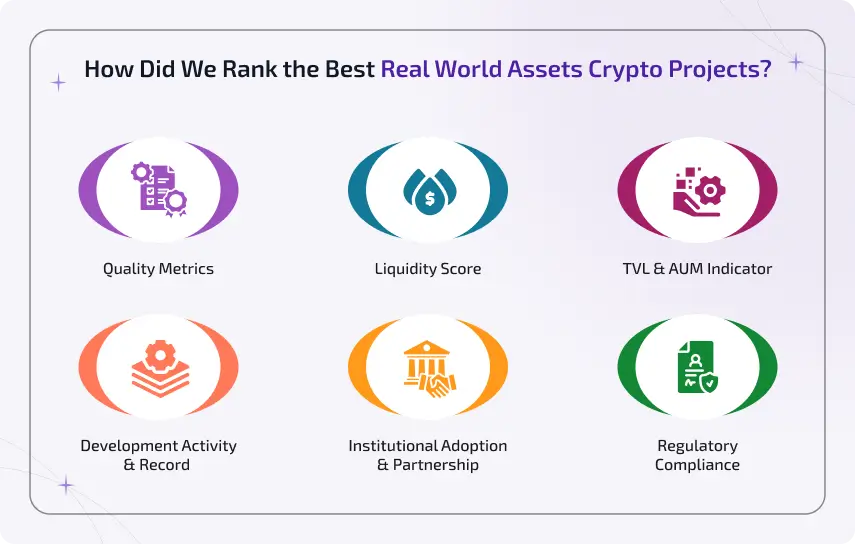
To identify the top-ranked real world assets tokenization crypto projects, we validated the core factors behind its mechanism and success. These criteria provide a balanced view of innovation, technical knowledge, and long-term sustainability in the transformation of the RWA landscape.
Quality Metrics
The key strength of an RWA project depends heavily on the reliability and quality of the underlying on-chain network, smart contract audits, and security features. This reduces the vulnerabilities involved, enhancing trust among investors.
Liquidity Score
Projects with robust liquidity and higher market capitalization indicate greater stability and user confidence as they reflect consistent market engagement. This further enables smooth trading with less price slippage in the market.
TVL & AUM Indicator
Total Value Locked (TVL) and Asset Under Management (AUM) are the core indicators demonstrating the level of user trust and adoption within RWA projects. It reflects the amount of capital committed by users and investors.
Development Activity & Record
A good-quality project depends on consistency, operating systems, and overall growth performance. These are the factors reflecting its long-term viability. Constant updates and a strong track record indicate a team’s commitment.
Institutional Adoption & Partnership
The institutional adoption and collaborations with TradFi, like banks and established players, such as BlackRock, contribute to the project’s tokenized assets. It reflects real capital flow, regulatory alignment, and user credibility.
Regulatory Compliance
RWA projects are validated based on their compliance with local and international governing regulations for properties and financial transactions. This ensures legal validity and protects investor interests and funds.
Why Real World Assets Crypto Projects Matter in 2026?
Investing in a high-value project or a private credit fund would have been impossible, as it requires a million-dollar investment before 2026. It has brought a massive shift from being a crypto experiment to a fundamental pillar of the finance space. Here is why RWA projects are defining the narrative of the crypto landscape at present:
Fosters a stablecoin-powered, globally tradable asset system, bridging the gap between traditional finance and DeFi.
Major platforms such as MakerDAO now use tokenized U.S treasury bonds as collateral, which provides a risk-free and stable yield floor for investors.
Real-world assets enable fractional ownership, allowing investors to access high-barrier assets or commercial loans with minimal capital value.
Large institutions like BlackRock have launched smart funds, positioning them as a core operational layer, reducing settlement time to near-instant execution.
Provides cross-border access, letting users invest in assets like U.S. funds without the need for Western brokerage limitations.
Key Types of Real World Assets Being Tokenized
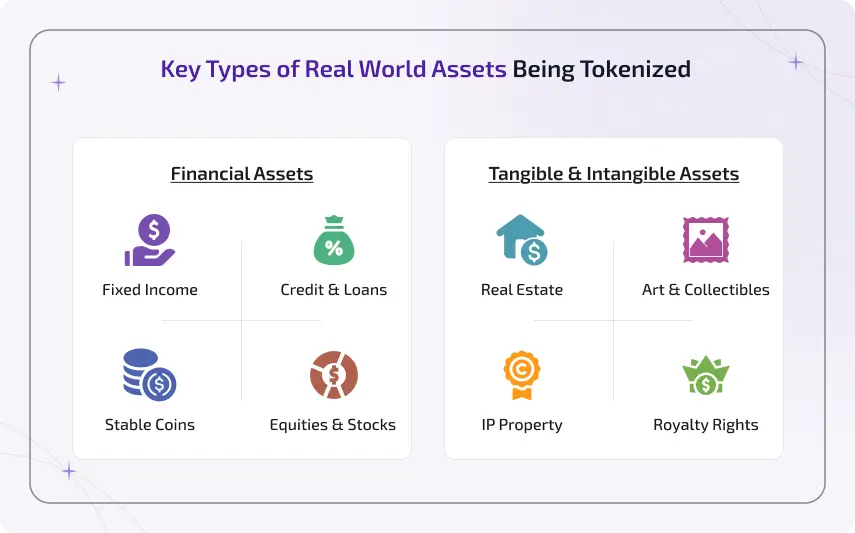
By bringing both financial and physical assets onto the blockchain network, tokenization is making them more liquid, divisible, and accessible for trading. From financial bonds to high-value assets, these holdings are now fractionalized and available among a broader audience, paving the way for a new era of ownership. Take a closer look at the major asset types mentioned below:
Financial Assets
Financial instruments are digital assets that are currently the market leaders in the ecosystem, enhancing liquidity rate and making trading flexible and seamless in highly competitive markets.
Fixed Income
Tokenized government bonds and treasury bills provide steady, predictable returns. It enables quick settlement and an improved transparency level on the blockchain.
Credit & Loans
Private credits and loans involve tokenizing debt instruments such as business loans and invoices, leading to smooth and efficient capital flow in the finance markets.
Stable Coins
Stablecoins are designed to maintain a stable value as they are directly tied to the fiat-backed value of an asset. This reduces price volatility and facilitates quick transactions on the blockchain system.
Equities & Stocks
A company’s shares can be digitally tokenized, allowing smart and flexible trading beyond standard restrictions, along with fractional ownership options for users.
Tangible & Intangible Assets
Tangible assets are highly valued physical assets, whereas intangible assets are non-monetary assets that hold economic value. These assets can be tokenized into digital form for easy trade execution.
Real Estate
Houses, office buildings, and commercial properties are tokenized into digital shares, allowing investors to own a fractional value of the properties. This enables high-value assets to be more accessible.
Art & Collectibles
Antique collections, luxury goods, and rare art/paintings are converted into blockchain-based tokens to enable fractional investments and a simplified trading process and execution.
IP Property
Intellectual properties such as ownership copyrights, registered patents, and brand marks are represented as virtual assets. This unlocks new revenue streams, legal licensing, and property transfers.
Royalty Rights
By converting royalty rights into tradable tokens, it allows investors to earn a share of future on-chain income streams from assets such as music, licenses, and film rights.
What to Look for When Evaluating RWA Crypto Projects?
Evaluating the finest RWA crypto projects real world assets requires a clear understanding of both financial fundamentals and on-chain innovation. The following criteria highlight the key factors that determine a project’s reliability, sustainability, and long-term value.
| Criteria | Why is it important? |
|---|---|
| Asset Backing | Establishes the stability and intrinsic value of the asset |
| Compliance Measures | Builds user credibility and enables institutional adoption |
| Yield Generation | Returns driven by real economic activity, not short-term hype |
| Liquidity & Market Access | Enhancing flexibility for investors with easy entry and exits |
| Institutional Adoption | Signals trust and the strong long-term potential of the project |
| Transparency & Reporting | Develops trust via clear audits, disclosures, and on-chain visibility |
| Tools & Technologies | Powers reliable, optimized and secure platform functions |
| Tokenomics | Drives market demand and defines the long-term of the ecosystem |
| Track Record & Performance | Indicates project consistency, stability and growth maturity |
| Risk Management | Protects against defaults via collateral, credit checks, or diversification |
The Future Outlook of RWA Tokenization in Crypto
The futuristic view of real world assets crypto projects looks promising as the technology continues to mature, unlocking greater liquidity, traceability, and global accessibility across traditional illiquid markets.
At the end of April, the distributed asset value is reported at $30.52 billion, with the determined asset value at $352.98 billion and over 735,000 token holders in the RWA tokenization market.
Unified Financial Framework: Industry players such as BlackRock envision a future in which every asset class operates on a common landscape, enabling 24/7 real-time settlement and eliminating delays.
Agentic AI: The IBM Institute of Business Value reports that 57% of executives see tokenization as the key enabler of AI to shift from basic automation to executing complex, autonomous financial transactions.
Emerging Technologies: Intelligent assets will use emerging technologies such as IoT sensors and VR digital twins to enable real-value instant settlement, eliminating the need for human intervention.
Fixed Income Returns: Government may increasingly move beyond traditional debt instruments by giving on-chain access to public utilities such as airports, bridges etc, This will allow users to directly fund and earn usage-based returns.
Regulatory Alignment: As RWA assets have globally expanded, regulatory bodies like the International Organization of Securities Commissions are expected to establish an integrated interface for a broader trading environment.
Conclusion
In the crypto industry, the rise of RWA tokenization leaves a decisive shift in how values are created, accessed, and exchanged across global entities.
The top RWA real world assets crypto projects 2026 in this space are not just modernizing assets—they are transforming liquidity, breaking down jurisdictional barriers, and bridging institutional-grade opportunities to a broader investor base.
For investors and traders, the opportunity lies in selecting the right projects that combine real-world usage built with strong compliance and technical expertise. As the ecosystem evolves, RWAs have positioned themselves as a foundational layer, shaping the convergence of TradFi and blockchain in the future.