How Much Does it Cost to Tokenize Your Asset? A Complete Guide
Listen to the Audio :
Turning a real world asset into a digital, tradable investment is no longer a futuristic concept—it's a strategic way that businesses are actively exploring now. But one question that actually hits you before stepping in is, how much does it cost to tokenize your asset? The answer just goes beyond a simple price tag, and it’s essential to understand the cost drivers in advance.
Asset tokenization is a layered process where each phase, from the type of asset you choose to the platform you build, directly shapes the overall investment. It’s a combination of technical, operational, and legal investments that define your total spending. For a detailed breakdown, refer to the sections below, get a basic understanding, and explore the complete cost structure to step into your tokenization journey.
What is Asset Tokenization?
The process of asset tokenization exists to transform all types of real-world assets, including physical objects and financial products, into digital tokens which operate on blockchain networks. The assets here may be art, real estate, commodities, intellectual property, or even stocks. These digital tokens are simple to trade, transfer, or divide into fractional shares with full or partial ownership rights.
Moving to its market size, asset tokenization has reached a value of $1474.72 billion in 2025 and is expected to see a massive growth to $7795.83 billion in 2030 with an annual growth rate (CAGR) of 40.1%. Unlike traditional ownership methods, tokenization uses blockchain technology, which increases asset liquidity and investor access and lowers the transaction cost by 20% with full transparency and security.
This creative approach of tokenization is now completely unlocking the value of any asset, right from banking and art to real estate and IP, with increased regulatory clarity, changing how we invest and trade in this decentralized digital economy.
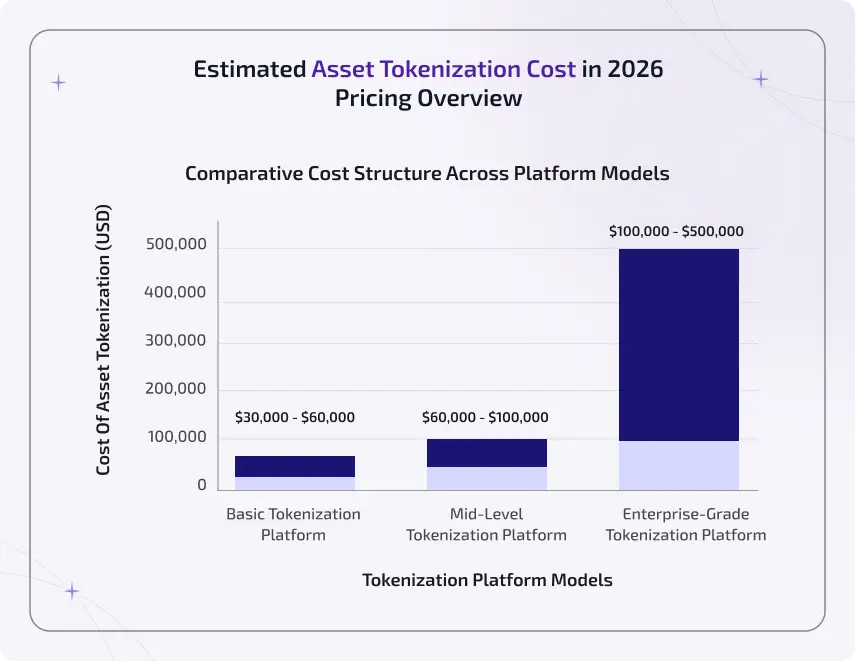
Estimated Asset Tokenization Cost in 2026 - Pricing Overview
(Comparative Cost Structure Across Platform Models)
Asset tokenization pricing in 2026 is not just limited to a fixed price. It depends on how advanced and compliant the project is. Tokenization has become a uniform pricing model which functions as an investment solution that extends from product design through to its final implementation.
The need for budget control begins at the startup phase because increased costs create difficulties for companies that want to develop their operations and reach global markets while maintaining compliance with regulations and marketing strategies.
Basic Tokenization Platform
Cost Range: $30,000 - $60,000
A basic platform is ideal for startups and businesses that are looking to tokenize simple asset types. They come with essential features and limited compliance integrations with a basic user interface. It comes with support for a single blockchain network, which stands as the preferred choice for beginners.
Mid-Level Tokenization Platform
Cost Range: $60,000 - $100,000
The solution delivers its optimal value through its combination of features which businesses can customize to build their own scalable platform that offers advanced capabilities. They come with multi-blockchain support, advanced features, and intuitive interfaces to attract a broader investor base with increased security.
Enterprise-Grade Tokenization Platform
Cost Range: $100,000 - $500,000
Having their main focus on large-scale operators, the enterprise-grade tokenization platforms feature advanced and modern requirements. Their comprehensive suite of solutions, complex risk management procedures, and high-level liquidity mechanisms make them scalable for the long term, handling high transaction volumes.
Key Component
Estimated Cost
Description
Initial Consultation & Legal Structuring
$2,000 - $10,000
Asset evaluation, ownership rights verification & legal framework structuring
Smart Contract Deployment
$5,000 - $25,000
Secure digital contracts are built to automate token issuance, transactions, etc.
Platform Development
$10,000 - $50,000
Developing custom or white-label platforms with a seamless user interface
Regulatory Compliance & Licensing
$3,000 - $15,000
Maintaining compliance with every legal framework & regulation
Token Creation & Deployment
$2,000 - $7,000
Tokens are generated & deployed onto the blockchain with the required configurations
Ongoing Maintenance & Security
$1,000 - $10,000
Regular monitoring, upgrades & protection against cyber threats
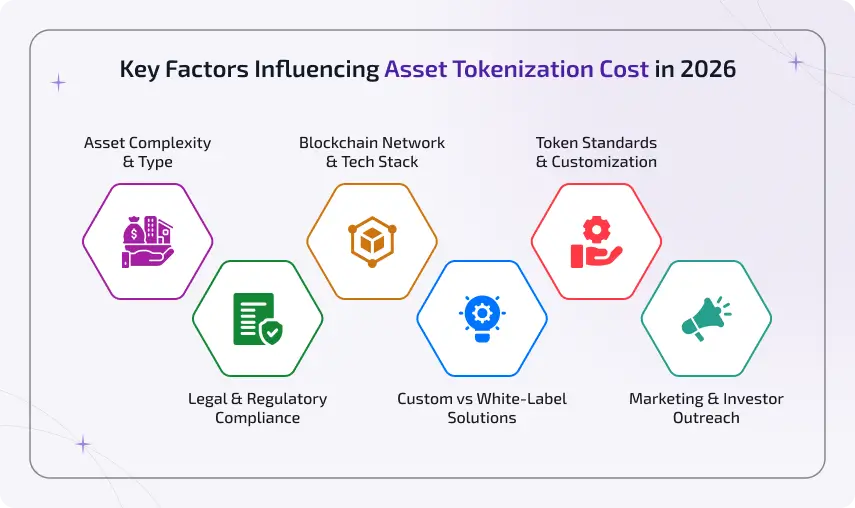
Key Factors Influencing Asset Tokenization Cost in 2026
So, you are looking for the cost to tokenize an asset? Before that, it’s important to get through the operational factors to build a secure and scalable tokenization model. The development expenses of an asset tokenization platform widely depends upon various factors, each playing a crucial role in determining the overall cost of development.
Asset Complexity and Type
The nature of the asset type plays a major role in determining the cost of tokenizing your asset. The more complex the asset, the higher the development cost will be. Simple assets like commodities or single ownership are much cheaper and easier to tokenize with less complexity.
The process of valuing complex assets that include luxury cars and real estate requires additional documentation because the ownership structure and advanced technological systems, serves as sophisticated oracles.
Legal and Regulatory Compliance
The more complex or unique an asset’s regulatory frameworks are, the more specialized development and cost will be. Depending on what type of asset you are tokenizing, the regulatory landscape plays a major cost driver. Legal documentation, licensing, approvals, and even audit coordination also contribute to this budget.
Jurisdictions in the U.S., the UAE, Singapore, or Switzerland also influence the legal retainer fees.
Blockchain Network & Tech Stack
Each blockchain network comes with different cost implications. The selection choice affects both initial and ongoing costs. Here, public blockchains involve transaction fees, whereas private or permissioned blockchains involve both infrastructure setup and maintenance fees.
Platforms like Polygon or Avalanche and other Layer-2 solutions such as Optimism or Arbitrum are preferred choices that offer lower transaction costs and faster processing.
Custom vs White-Label Solutions
Are you building platforms completely from scratch or adapting an existing one? Despite the build approach, the asset tokenizing pricing includes the interface, tokenization system, feature integration, and wallets. A white-label platform provides its preset features at a lower price, while a custom platform requires higher costs because it delivers complete operational freedom together with its advanced functionalities.
The selection of one platform over another requires you to base your decision on your specific business objectives.
Token Standards & Customization
The real world asset tokenization cost is primarily driven by the token standards and the customization level. The use of token standards can reduce the development time and smooth the platform functionality. Additional feature customization requires high development cost and testing, which raises the overall cost of the tokenization project.
So, balancing standardization with the necessary customization is a major key role in the asset tokenization development cost.
Marketing & Investor Outreach
Beyond the above factors, what makes a tokenization platform reach heights is branding and promoting through effective marketing strategies. Asset owners must attract and educate investors through campaigns and community engagement, which accounts for about 10-25% of the total tokenization project’s budget.
Strong outreach can achieve 3x higher investor engagement, marking an added advantage of tokenizing the asset.
Why Asset Owners are Choosing Tokenization
The growing acceptance of blockchain technology in worldwide global markets leads asset owners to pursue asset tokenization, which provides them with liquidity solutions while expanding their market reach and boosting operational performance. The increasing adoption of digital fractional ownership systems demonstrates a shift away from conventional asset ownership methods.
Below are the high-impact reasons why asset owners are choosing tokenization today.
1. Unlocking Liquidity With Full Ownership
Raise immediate funds from global investors
Convert a portion of ownership into digital tokens
Retain long-term control and future upside
For those owners who have properties with tokenization permits, you have an advantage, especially if they are rich in wealth, while cash is limited.
2. Expanding Investor Reach Beyond Traditional Boundaries
Lower entry barriers through fractional investment
Global investor participation
Access to retail investors' demand potential and capital inflow
3. Converting Illiquid Assets Into Tradable Markets
Many assets cannot be easily sold or transferred. Tokenization transforms them into liquid, market-ready instruments. Instead of waiting months for a buyer, owners gain,
Faster price discovery through market demand
Continuous buying and selling of fractional ownership
Reduced dependency on intermediaries or brokers
4. Increasing Asset Valuation Through Market Accessibility
When an asset becomes accessible and tradable,
Price discovery becomes more transparent
Demand increases due to lower entry barriers
Liquidity premiums often raise overall valuation
In many cases, tokenization makes assets more attractive than traditional ownership structures.
5. Creation of Structured, Programmable Revenue Models
Tokenization is not just ownership digitization—it enables built-in financial models. Owners can design,
This turns static assets into income-generating financial ecosystems.
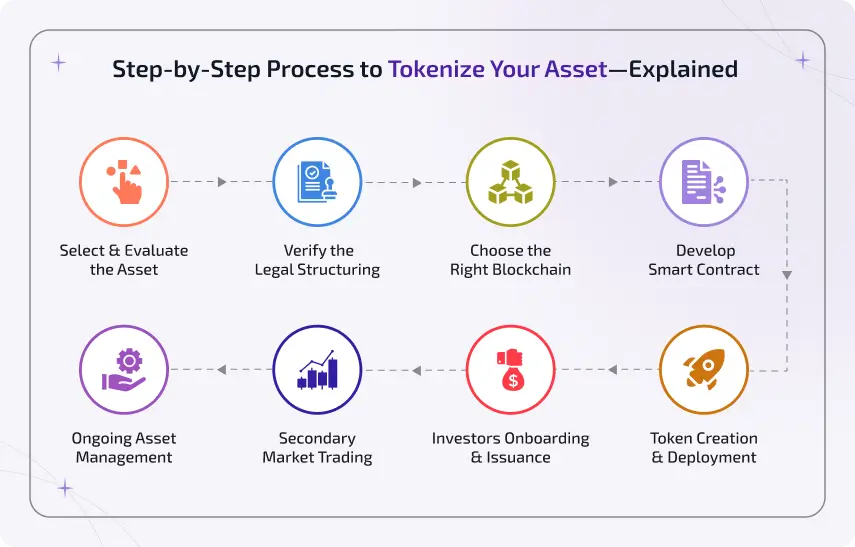
Step-by-Step Process to Tokenize Your Asset—Explained
Now you would have gotten a clear idea of the asset tokenization platform cost. Let’s begin to know the steps involved in the asset tokenization process, which covers multiple procedures of creating tokenomics for the chosen asset type, building smart contracts, and establishing the framework. Step into the process below for tokenizing your assets.
Step 1: Select & Evaluate the Asset
The asset selection process requires the identification of an asset, which should be tokenized through either art, real estate, commodity or intellectual property. Then, you need to determine the asset's market value and ownership details.
Step 2: Verify the Legal Structuring
Establish legal frameworks and entities such as SPVs to determine the asset’s legal compliance. This also clearly brings out the legal relationship between the token holder and the asset, clearly indicating that the asset is safe and transparent.
Step 3: Choose the Right Blockchain
Pick the blockchain platform that fits your business objectives and use cases. Consider the transaction cost, complexity, and regulatory needs and pick the wise one. Then, determine the token standard for your asset type.
Step 4: Develop Smart Contract
Design and develop programmable smart contracts to automate tokenization processes, ownership rights, token issuance, and transactions, and check token regulations with the appropriate legal regulations.
Step 5: Token Creation & Deployment
Craft digital tokens representing the asset’s ownership and then deploy them on a suitable blockchain network. Double-check whether it is accurately backed by the underlying asset without any interferences.
Step 6: Investors Onboarding & Issuance
Market the offering and onboard investors. Further, distribute the tokens to verified investors through a regulated STO or IDO platform. You can either make it a private or public launch, depending on your choice.
Step 7: Secondary Market Trading
Establish a secure mechanism and list the tokens on a secondary marketplace or exchange to begin trading. This increases market accessibility and liquidity of the asset among global investors.
Step 8: Ongoing Asset Management
Enable tokenized asset trading and manage transactions effectively. Use blockchain to manage ownership records, track performance, pay dividends, and ensure legal compliance with ongoing support and updates.
How to Reduce Asset Tokenization Cost: Practical Solutions
Now you would have come to know that tokenizing assets requires careful financial planning with proven strategies. To reduce your real estate tokenization pricing, one should follow certain optimization strategies without compromising on security and compliance.
Launch a basic minimal viable platform (MVP), which focuses on core modules such as market demand validation, investor test engagement, and more, by reducing the upfront development cost with minimal financial risk.
Instead of building the tokenization platform from scratch, opt for white-label platforms that come with ready-made solutions. The development cost and time decrease by 40%, which allows for uninterrupted deployment.
Select a layer-2 blockchain solution that reduces the cost of use and gas fees immensely, with unrestricted scaling. With no further compromise on the platform’s speed and security, Layer 2 will minimize the operational expenses.
Investing in scalable systems and architectures over modular systems reduces the cost of tokenizing real estate. It supports long-term growth and ensures the platform aligns with all requirements.
Partnering with the right blockchain provider ensures efficient execution by breaking down the tokenization cost. Their expertise helps you streamline the process with reliable solutions that do not exceed your budget constraints.
The process of early compliance planning establishes a better path for obtaining approvals while eliminating all associated risks. Regular audits should be selected instead of ad-hoc checks because they help organizations manage their compliance expenses and necessary changes.
Why Choose BlockchainX for Asset Tokenization Development
BlockchainX, a Leading RWA tokenization development company, approaches tokenization as more than just development. We combine deep blockchain expertise with compliant solutions to build future-ready ecosystems around your asset. With 8+ years of industry expertise and a proven track record, our team helps businesses transform real world assets into high-performing digital investment models.
End-to-End Tokenization Solutions: Get complete asset tokenization solutions from consultation to deployment, ensuring a seamless and efficient process.
Multi-Blockchain Expertise: Have proven experience across diverse industries and blockchain networks, ensuring a fit with the right technology for each project.
Custom & Scalable Development: We specialize in building tokenization platforms that are one-size-fits-all with complete flexibility and scalability.
Compliance-Driven Approach: Our developers help businesses meet the necessary legal requirements with smooth investor onboarding and operations.
Cost-Effective Services: Get a transparent and structured development approach with optimized cost, maintaining performance and quality.
Reach out to us to contact an expert and turn your assets into digital investments, scaling up with new investment opportunities.
The Future of Asset Tokenization: A New Era of Ownership
The tokenization revolution has arrived, and companies that adopt this new technology will become industry leaders. The worldwide asset tokenization market currently holds a valuation of $24 billion in 2025 and will grow to approximately $30 trillion by the year 2034.
The development of blockchain systems progresses from initial usage to full financial system adoption through the combined use of standard token protocols and artificial intelligence technologies. Traditional assets and other highly illiquid assets are gradually becoming more accessible, cost-effective, and tradable through simple digital tokens.
By 2030, all real world tokenization costs, which include art, real estate, commodities and gold tokenization cost will become less expensive and more reachable throughout commercial and residential spaces. The development of smart contracts will enable businesses to automate their operations, which will create investment opportunities for more people.
The digital economy uses asset tokenization as a fundamental technology that changes how people own, trade, and control assets.
As we wrap up our look at asset tokenization’s cost, it’s clear that tokenizing your assets is not just a tech play; it’s a financial strategy. Developing a real estate tokenization platform in 2026 involves careful planning across every stage while reducing long-term expenses. It just enhances accessibility, liquidity, and transparency in all asset markets.
Rather than just viewing the expense, it’s important to understand the asset model's cost structure and choose the right strategy to build a scalable model. So, confidently step into the future of digital assets and unlock new investment opportunities with advancements. To know more about the hidden costs of asset tokenization, start today with BlockchainX.
Get all the latest posts delivered straight to your inbox.
Get In Touch
Our expert team is professionally well-equipped with hands-on experience as a blockchain development company. Connect with us; at BlockchainX, we curate your desired sustainable solution!