10 Best Crypto PR Agencies to Grow Your Web3 Brand in 2026
Listen to the Audio :
The rise of global prediction markets, with a massive growth of $25.7 billion per month, created a significant impact on the evolution of decentralized prediction markets. At its core, the Polymarket clone script development stands as the backbone of the Polymarket clone smart contract architecture, enabling businesses to quickly launch feature-rich market platforms using pre-built blockchain infrastructure.
Understanding this architecture in 2026 plays a major role in building scalable and efficient market platforms with up to 90% lower transaction costs. Together, let’s explore how the Polymarket clone architecture works, its key components, and how it plays a crucial role in delivering users a rapid and trustless trading experience.
Step by Step Polymarket Clone Smart Contract Architecture: Technical Breakdown in 2026
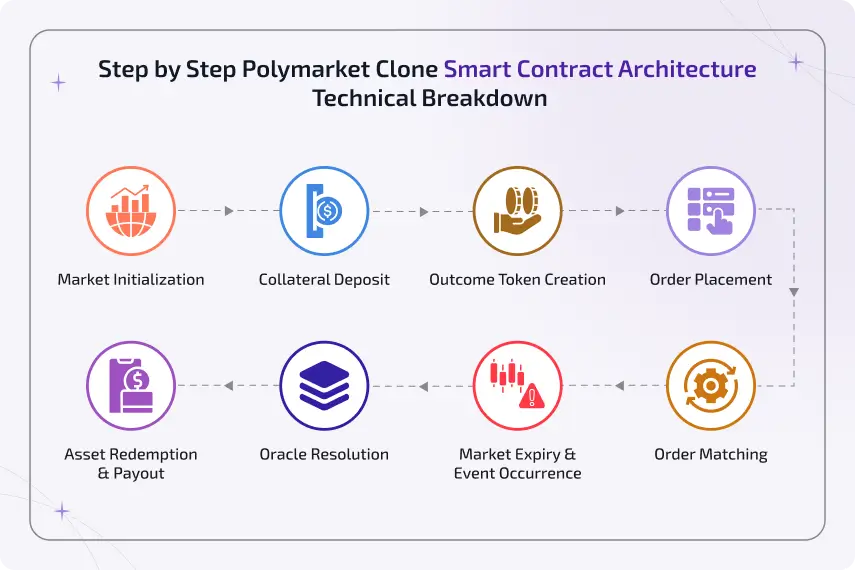
The smart contract architecture for Polymarket clone defines the overall structure and workflow of the system, outlining how different components interact to enable decentralized prediction markets. Here are the detailed steps that give a framework for flexible market creation and secure settling. Let’s break it down.
Step 1: Market Initialization (Creation Layer)
The process begins when an admin or user creates a new prediction market using the Market Factory Contract. The creator clearly defines the core parameters, such as questions (yes/no), outcomes (binary/multiple), expiry time, and the oracle source.
A new prediction market ID is generated, and the market parameters are stored securely on-chain. The contract verifies the market on-chain and makes it immutable and publicly verifiable.
Step 2: Collateral Deposit (Escrow Layer)
Users deposit funds, typically stablecoins, into the Collateral Contract to begin user participation. Every trading activity of users is backed by real value rather than speculative leverage.
Funds are transferred and locked securely on-chain using smart contracts. This guarantees a complete collateralized system, where every outcome token is backed 1:1.
Step 3: Outcome Token Creation (CTF Logic)
The CTF converts collateral into tradable outcome tokens. The system performs a split operation, where each outcome’s condition is registered and remains constant in the market.
The collateral, split into multiple outcome tokens, represents a possible result, allowing users to trade individual outcomes as a separate asset. Here, the minting process follows a predefined condition.
Step 4: Order Placement (User Interaction Layer)
Users interact with the trading contract to place a buy or sell order for specific outcome tokens. The order includes details such as quantity, price, and the direction that reflects the user’s prediction.
Orders are cryptographically signed by the user’s wallet and sent to an off-chain order book system. This improves speed and reduces the gas fee while maintaining full user ownership and control.
Step 5: Order Matching (Execution Layer)
The placed orders are matched using a Central Limit Order Book (CLOB) mechanism, where they are paired based on suitable prices and quantities, enabling users to trade directly with each other.
Trade execution happens either via AMM or order book. The matching engine pairs orders instantly, and they are sent to smart contracts safely. This off-chain execution significantly increases speed when compared to on-chain systems.
Step 6: Market Expiry & Event Occurrence (Lifecycle Control)
Once the limit is reached, the market stops accepting new trading orders. Here, the real-world event associated with the prediction market is about to be determined.
The smart contract functions are closed or disabled at this stage, temporarily stopping further interactions. The system waits for Oracle to finalize the real-world outcome.
Step 7: Oracle Resolution (Data Layer)
The Oracle takes complete responsibility for deciding the result of the actual event. The system delivers authenticated information to the smart contract, which verifies the correct results while maintaining protection against unauthorized changes.
An optimistic oracle model is used to determine the outcome within a dispute window. The final outcome is locked after validation, and this determines the winning tokens.
Step 8: Asset Redemption & Payout (Settlement Layer)
Once the outcome of an event has been decided, users redeem their tokens for cash payouts Each winning token represents a fixed value, which is worthless when it’s lost.
Smart contracts check the winning outcomes and burn the token to provide the corresponding collateral to users. This ends the prediction market process, ensuring a fair and trustless distribution of funds.
Build a next generation prediction market platform like Polymarket , Here is the detail Guide to Launch your own Polymarket clone script
What is Polymarket Clone and Why Does It Matters?
A Polymarket clone is a white-label, fully customized ready-made software solution that replicates the core architecture of the world’s largest decentralized prediction market.
The prediction market platform enables businesses to launch their operations through a streamlined and budget-friendly solution, which allows users to bet and trade Yes/No shares on actual events that include sports, politics, elections, cryptocurrency, and other events that are blockchain-based smart contracts.
The script provides businesses with a flexible solution because it allows users to design their own experience through customized requirements.
Leverages crowd intelligence for decentralized predictions with more accuracy
Stands as a proven model with minimal risk factors
Ensures trust and transparency by recording every transaction
Provides real-time market sentiment based on collective opinion
Turns global events into hedgeable financial instruments
Creates new revenue models in the evolving prediction economy
Comes with tailoring features to fit with specific brands
How Does Polymarket Clone Smart Contract Architecture Work?
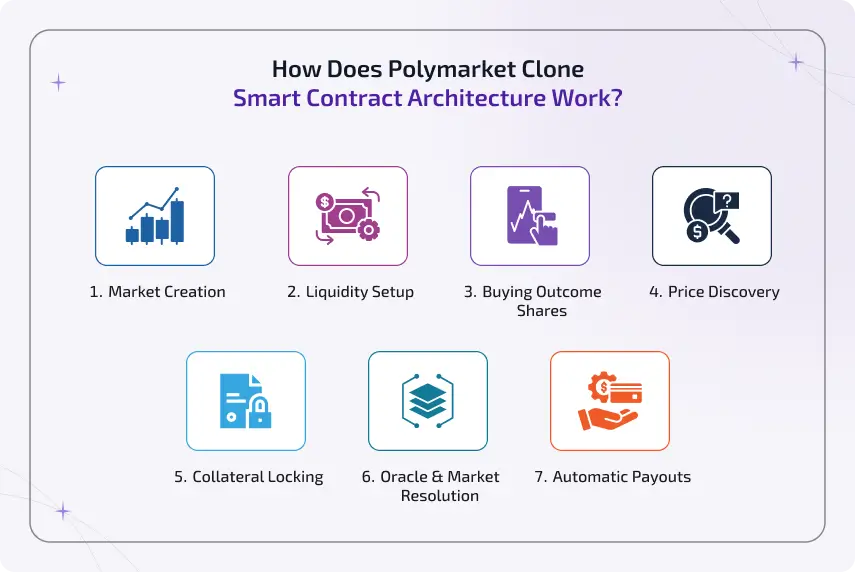
A Polymarket clone smart contract architecture is essentially a set of on-chain programs that replicate how prediction markets work in real-time. It handles pricing, trading, market creation, and payouts without any central intermediary. Here is a brief breakdown of its working.
Market Creation
Initially, admins or users create prediction market platforms around various events to attract users. This comes with secure conditions such as predefined outcomes, rules, and expiry times, which are stored immutably.
Liquidity Setup
Initial funds are added to the contract to enable smooth trading. An AMM mechanism ensures users can trade anytime without needing a counterparty.
Buying Outcome Shares
Users deposit funds to buy shares of a predicted outcome. Each share represents a potential payout if that outcome wins. Users then sell their shares before the market ends and lock in profits or losses.
Price Discovery
The smart contract adjusts prices using mathematical models like LMSR. This reflects the real-time probability of outcomes based on user activity. The more people buy one outcome, the higher its price goes, reflecting the market’s collective belief.
Collateral Locking
All user funds are locked securely within the contract. This ensures every position is fully backed with no risk of default. Once the event deadline is reached, trading stops and the market is locked for resolution.
Oracle & Market Resolution
After expiry, an oracle like Chainlink or UMA Protocol provides the final outcome. The contract verifies and updates the result on-chain. An external oracle system brings the real-world result (e.g., event outcome) onto the blockchain.
Automatic Payouts
Users holding winning shares can claim their rewards directly, with funds distributed from the treasury. The contract automatically distributes funds to winners, which can be redeemed for payouts.
Core Components of Polymarket Clone Smart Contract Architecture
Robust Polymarket clone script smart contracts often come with essential components, playing a distinct role in powering the entire system. Each module is responsible for a specific function that works together to run the prediction market smoothly and effectively. The following are the essential core modules of the Polymarket clone script.
| Component | Description |
|---|---|
| Market Factory Contract | Launches & manages prediction markets with defined parameters such as outcome rules, expiration, possibilities, etc. |
| Outcome Token Contract | Tokenizes each possible outcome (yes/no) to let users trade or sell possibilities as assets |
| Collateral/Escrow Contract | Acts as the financial backbone by securely holding and locking user funds |
| Oracle System | Collects & verifies real-world data to determine accurate outcomes of specific prediction event |
| Settlement Contract | Distributes payouts evenly to winning token holders after the market is resolved |
| Trading & Liquidity Mechanism | Manages the buying & selling of outcomes tokens using an off-chain order matching engine or an AMM |
| Conditional Token Framework | It splits the collateral into outcome-based tokens and merges them back during settlement |
Advanced Smart Contract Security for Polymarket Clone
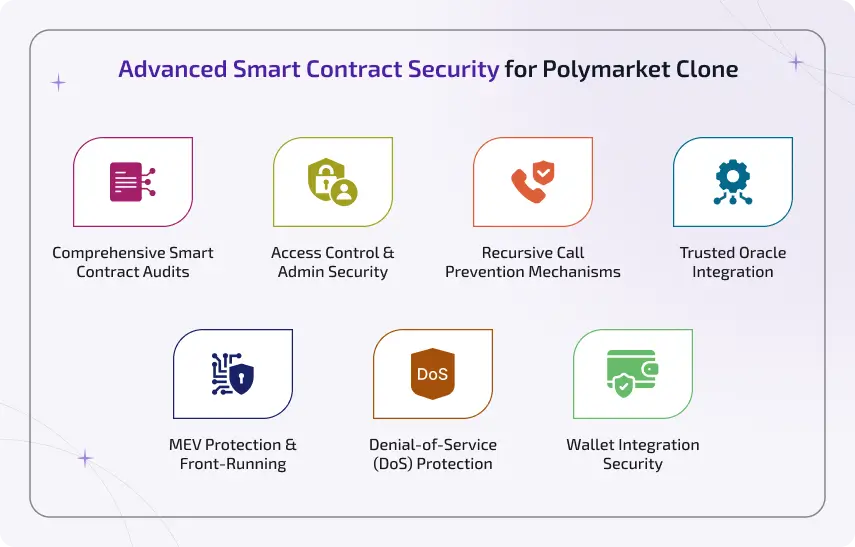
Smart contract security for Polymarket clone isn’t optional; it’s the main layer that safeguards user funds and prevents manipulation, ensuring fair market outcomes. Here are the focused, core security measures of a Polymarket clone implemented in 2026.
Comprehensive Smart Contract Audits: Audits find all system weaknesses through their code examination process and testing methods, which verify the secure and mistake-free operation of smart contract development.
Access Control & Admin Security: The combination of multi-signature with role-based access control systems establishes two security measures that stop unauthorized users from accessing funds and performing contract upgrades.
Recursive Call Prevention Mechanisms: Prevents recursive calls and malicious actions and ensures functions cannot be exploited during execution. This protects contracts from exploits and vulnerabilities.
Trusted Oracle Integration: Serving as the highest-risk component, decentralized oracles provide accurate data, preventing manipulation of event outcomes with fair and tamper-proof results.
MEV Protection & Front-Running: The off-chain matching creates minimal transaction visibility while simultaneously safeguarding users from front-running attacks and MEV threats.
Denial-of-Service (DoS) Protection: Bounded operations and optimized gas usage prevent disruptions, ensuring contracts remain operational under heavy network loads in one or another way.
Wallet Integration Security: Supports robust Web3 wallets such as WalletConnect and MetaMask to ensure user funds and data are protected and accessed only via authorized signatures.
Compliance Layer in Polymarket Clone Smart Contract Architecture
The compliance layer in the Polymarket clone smart contract architecture is responsible for aligning decentralized prediction markets with legal and regulatory requirements without compromising on blockchain’s core functionalities.
In essence, this layer acts as the regulatory safeguard, enabling the Polymarket clone to function transparently and securely within the legal boundaries. Here are the core components of the compliance layer.
| Compliance Layers of Polymarket Clone | Purpose |
|---|---|
| KYC/User Verification | Often uses proxy wallets, which ensure only verified users can access the platform with necessary identity checks and wallet addresses |
| Geo-Restriction | Prevents users from regulated and restricted jurisdictions from accessing the platform by blocking their participation |
| AML & Transaction Monitoring | This layer solely tracks users' activity to detect suspicious transactions and restricts blacklisted wallets |
| Market Compliance | This compliance layer checks and restricts the creation of legally prohibited prediction markets |
| Fund Flow & Limit Control | Essentially applies limits on every deposit, withdrawal, and trade size to meet the necessary regulatory requirements |
| Wallet Whitelisting/Blocklisting | Manages approved and restricted wallet addresses to control interaction within smart contracts |
| Governance & Audit | It ensures adherence to data protection laws and ensures transparent admin actions using multi-signature approvals, audit logs, and more |
Future of Polymarket Clone Smart Contract Architecture
The future of the Polymarket clone smart contract is shifting towards rapid, scalable, and more automated hybrid systems that combine off-chain efficiency with on-chain trust. By the end of 2026, these architectures will evolve, and it is expected that over 70% of decentralized trading will run on the Layer-2 scaling networks by reducing fees up to 90% with instant execution.
Hybrid models combining off-chain order matching with on-chain settlements will dominate with improved efficiency. Prediction market tokens will become more adaptable, being used in lending, collateralization, and yield strategies across DeFi ecosystems.
With the adoption of AI-driven automations and advanced oracle systems, prediction market development is turning into broader financial ecosystems. Now it’s time to adopt next-gen architecture and build scalable, future-ready prediction market platforms.
How to Choose the Best Company for Polymarket Clone Development? Why It Matters
The selection process to find an ideal development partner for Polymarket clone creation stands as the essential factor which determines the success of decentralized prediction market smart contract systems.
The search should focus on companies that possess a successful track record of work because they understand both technical aspects and user experience requirements.
The team needs to create trading platforms which will operate securely at high speeds while delivering better performance to all user categories. This must include the necessary safety tools and reliable data sources to ensure every trade is fair and operates smoothly in restricted regions.
Delivers reliable data for fair settlements
Provides enhanced platform security
Creates simple interfaces for easy betting
Maintains compliance with regional laws
Offers consistent support for technical issues
Conclusion
To build a secure and scalable prediction market platform requires more than just replicating features. The smart contract architecture of a properly built polymarket clone enables markets to be created transparently while executing trades automatically, settling outcomes precisely and protecting fund operations from unauthorized access.
Businesses need to use blockchain technology together with advanced liquidity systems and security frameworks because these elements will help them create a reliable system that serves international users. The right architecture also supports scalability and seamless user experiences across multiple devices and networks.
As decentralized prediction markets continue to gain traction, investing in a technically strong polymarket clone solution can position businesses for long-term growth and innovation in the evolving Web3 landscape.
Frequently Asked Questions
Which is the best blockchain network for a Polymarket clone smart contract architecture?
Polygon is considered the best blockchain for a Polymarket clone due to its low fees and fast transactions. Arbitrum and Ethereum are also popular choices for secure and efficient prediction market platforms.
What is the development timeline of Polymarket clone smart contracts?
Developing Polymarket clone smart contracts typically takes 3 to 8 weeks, depending on features, blockchain integration, security requirements, testing, and customization complexity.