Decentralized Prediction Markets A Complete Guide 2026
Listen to the Audio :
Ever heard of a betting platform that’s non-custodial, transparent, and completely trustless, with zero intermediaries involved? That’s the decentralized prediction markets development. Investors or traders predict a real-world event, trade their probabilities, and receive rewards based on the accurate outcomes of market price movements.
Rather than relying on expert polls as traditional systems do, these markets leverage the collective intelligence of the crowd to deliver real-time outcome resolutions without unfair decision-making. Also, as the markets run on blockchain technology, every transaction remains publicly verified. This positions them as a next-generation tool for both trading and informed predictions within the digital ecosystem.
Explore this blog to understand what is decentralized prediction markets, their working mechanism, features, and more.
What are Decentralized Prediction Markets?
Decentralized prediction markets are trading platforms that run on a blockchain network, allowing users to buy or sell shares based on the possible outcomes of future events such as stock markets, politics, sports, weather conditions, and more. The right predictions will be rewarded, and the remaining will lose their stake.
It is a blockchain-based platform that automatically generates the trade outcomes and payouts to the users without an intermediary. Unlike traditional betting systems, these markets offer cost-efficient fees, borderless access, and a robust censorship resistance within the ecosystem. This market relies only on community-driven outcomes, ensuring fair settlements and trustless trade execution.
Popular Decentralized Prediction Market Platforms
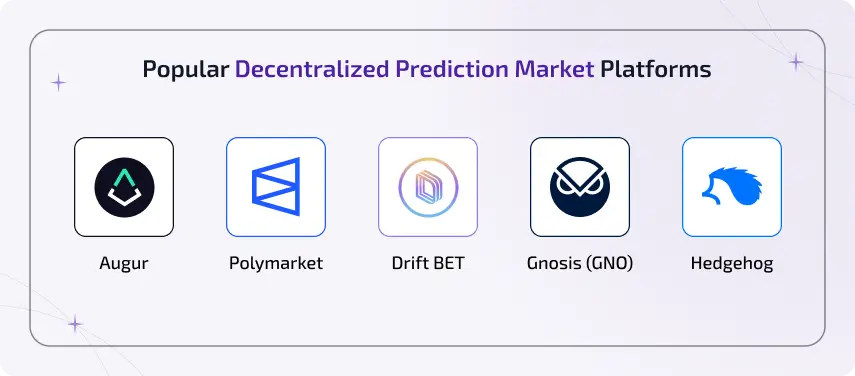
A wide range of platforms has emerged in the DEX prediction market space, each offering unique features, trading models, and a better user experience. From being pioneers to highly performing entrants, they collectively highlight the digital evolution of prediction markets in the Web3 ecosystem. Here are some of the top-rated and popular decentralized prediction markets to consider in 2026.
Augur Prediction Market:
Augur Markets is widely known as one of the first functional decentralized platforms, primarily operating on the Ethereum mainnet. It works with extensions like Augur Turbo built on Polygon for an instant and real-time trading experience. It features an inbuilt algorithmic forking mechanism that splits the entire network into multiple universes to resolve disputed outcomes.
This market has its own native tokens called Reputation (REP), which is distributed to the participants who report and validate the market outcomes, ensuring a fair trade settlement. Augur supports multiple market types, including binary (Yes/No), scalar, and multiple choice (categorical), enabling flexible trading.
Polymarket Prediction Market:
Polymarket, the world’s largest prediction market, is a peer-to-peer trading platform built on the Polygon network, offering fast and low-cost trading on real-life outcomes. They follow a binary market system (Yes/No), making it highly accessible for users to participate and speculate on the likelihood.
It is widely known for its high trading activity in the markets. Based on the anticipated reports of Polymarket 2026, the platform’s revenue generation will range from $800,000 to $1million on a daily basis due to the upgrade of its fee structure. Build platform like polymarket prediction.
Drift BET Prediction Markets:
Drift Protocol launched a fast-growing perpetual prediction market platform called BET (Bullish on Everything). It typically operates on the Solana network, offering traders cross-collateralized positions. Reports state that the BET platform has recorded over $3.5 million in order book liquidity within 24 hours of its launch, directly positioning itself as a competitor to Polymarket in the industry.
Drift supports over 30 different cryptocurrencies as collateral, providing users with enhanced trading flexibility. Additionally, the platform integrates Pyth network oracle data to maximize its user activity through its reward systems.
Gnosis (GNO) Prediction Markets:
Founded in 2015, Gnosis is observed as a pioneering project in decentralized prediction markets that functions on the Ethereum blockchain network. They developed a unique asset class named the Conditional Token Framework (CTF) for digitally tokenizing trade outcomes that offers modular and flexible forecasting systems.
They have introduced Gnosis 3.0, an initiative of 2026 aimed at transforming the network into an Ethereum Economic Zone (EEZ), developed to address liquidity fragmentation and improve interoperability across Ethereum roll-ups, enabling seamless asset flow. It also incorporates a Futarchy-based governance system, empowering more efficient DAO decisions and funding within the ecosystem.
Hedgehog Prediction Markets:
Hedgehog is one of the top decentralized prediction markets that comes with an intuitive structure, faster settlement, and a high-speed mechanism, operating on the Solana network. Unlike traditional order books, it uses on-chain metrics to automate the settlement process without any disputes.
Inspired by Uniswap, they were the first to establish a pooled liquidity model based on the AMM framework, aggregating liquidity into a single pool to provide consistent liquidity and instant trade execution. In Hedgehog, users participate in trades without losing their principal by staking their funds. So that, even if they lose, they can still withdraw the initial stake deposited. Build platform like hedgehog prediction.
Working of Decentralized Prediction Markets
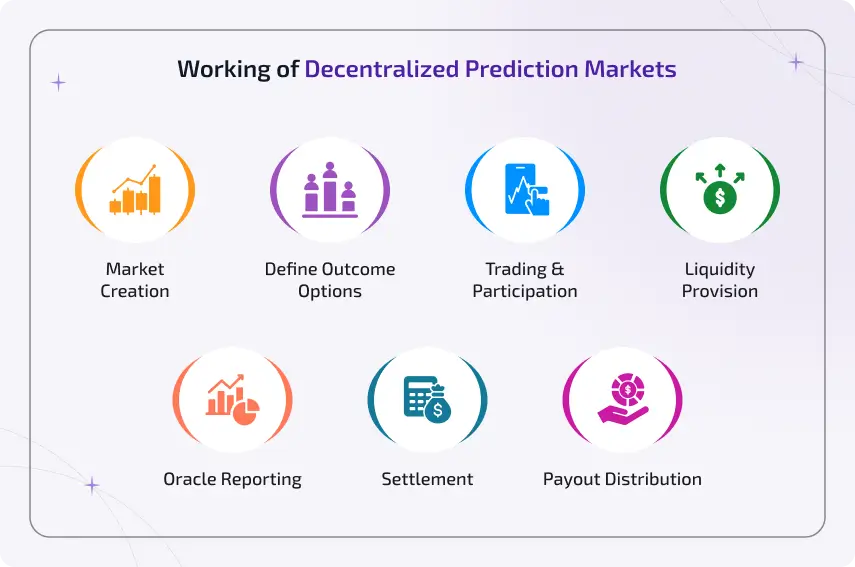
To understand how decentralized prediction markets work, it’s crucial to take a look at the structured format that runs behind the market system. From creating a market to final payout distribution, every working process is crucial and powered by a transparent blockchain, ensuring user safety, security, and seamless trade execution.
Market Creation:
Any user or platform can create a prediction market by defining a real-world event or a question for users to invest in the market. They set the bounded rules such as trade outcomes, deadlines, and payout criteria.
Define Outcome Options:
Each prediction market includes predefined outcome shares such as binary tokens (Yes/No), multiple choice, or other value ranges. Users are allowed to trade these tokens based on their prediction.
Trading & Participation:
Users take part in the market by buying or selling tokens based on their predictive analysis freely without any entry barriers. Prices shift dynamically according to the market demand, which reflects the probability of each outcome.
Liquidity Provision:
Automated market makers (AMMs), or liquidity providers, deposit funds into the pool, earning a small fee for every trade in return to prevent any price disruptions during trading in the decentralized prediction markets. This ensures users have a seamless trading experience.
Oracle Reporting:
Integrated oracles provide real-world, off-chain data required to determine the results of an event. They act as the connecting bridge between the two sources. The events could be politics, sports, stock markets, or more.
Settlement:
Once the event concludes, the outcomes are cross-checked and finalized. Results are recorded on a blockchain for better traceability and data accuracy. Winning shares are redeemed for a fixed value of $1, and losing shares are worthless ($0).
Payout Distribution:
Winners with correct predictions are rewarded with funds into their wallets through smart contracts, while liquidity providers receive their trading fee accordingly. This ensures a tamper-proof and fair payout settlement.
How is a Decentralized Prediction Market Platform Developed?
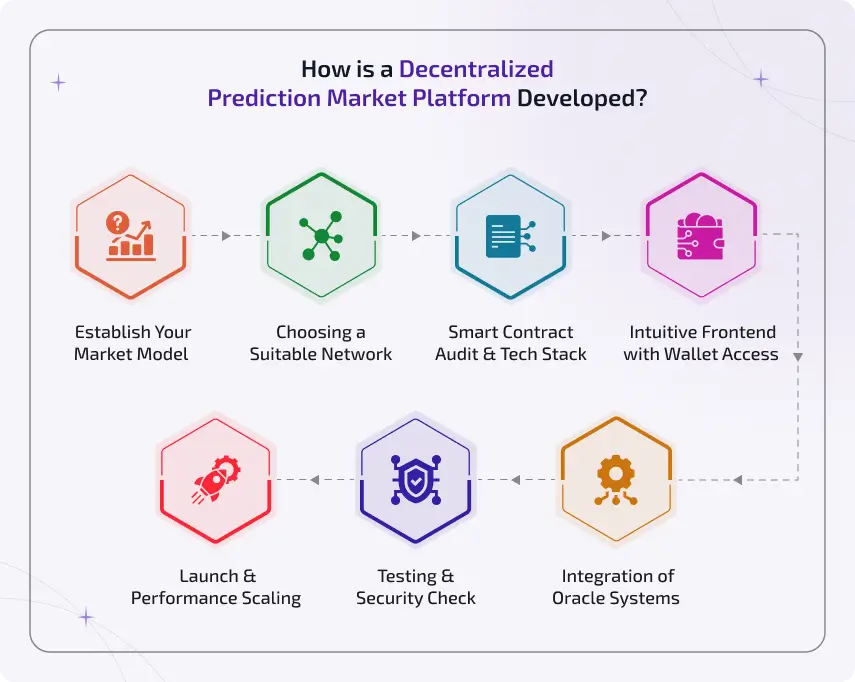
To build a decentralized prediction market with a well-organized approach, we must incorporate our technical knowledge with strategic planning, delivering the project with better functionality, transparency, and scalability across the ecosystem. Let’s take a closer look at the step-by-step breakdown of DEX prediction market platform development.
Step-1: Establish Your Market Model
Before developing your platform, clearly define your prediction model (whether binary, scalar, or multiple) and the supported use cases of the market. This attracts the right type of audience, as each case has a unique functioning quality.
Step-2: Choosing a Suitable Network
The choice of network will play a major role in impacting the overall trading performance, security, transaction speed, and gas fees. So, it is necessary to cross-check all these elements before selecting the suitable network for your project.
Step-3: Smart Contract Audit & Tech Stack
As contracts form the core of the system, they must be carefully developed to manage the market creation, trading execution, and automated payouts. A strong tech stack combined with thorough audits ensures efficient and reliable platform performance.
Step-4: Intuitive Frontend with Wallet Access
Design a simple and beginner-friendly interface that enables new as well as existing users to create, trade, and track their prediction markets easily. Integrate suitable wallets to further enhance the overall user experience and asset management within the ecosystem.
Step-5: Integration of Oracle Systems
Integrate reliable Oracle services to fetch accurate results from real-world events from verified external sources. It enables better and informed outcome resolution within the markets, enhancing credibility and fairness of the platform.
Step-6: Testing & Security Check
To ensure security layers, the platform is thoroughly tested before launch. It helps to find any rising issues and optimize the platform for providing a seamless user experience. Security checks also safeguard the funds and maintain system transparency.
Step-7: Launch & Performance Scaling
Once audited, deploy the platform for public access and gather user feedback and suggestions to optimize its core functions. Keep the prediction market engaged, active, and transparent to gain the maximum trading benefits from it.
Key Features of Decentralized Prediction Markets
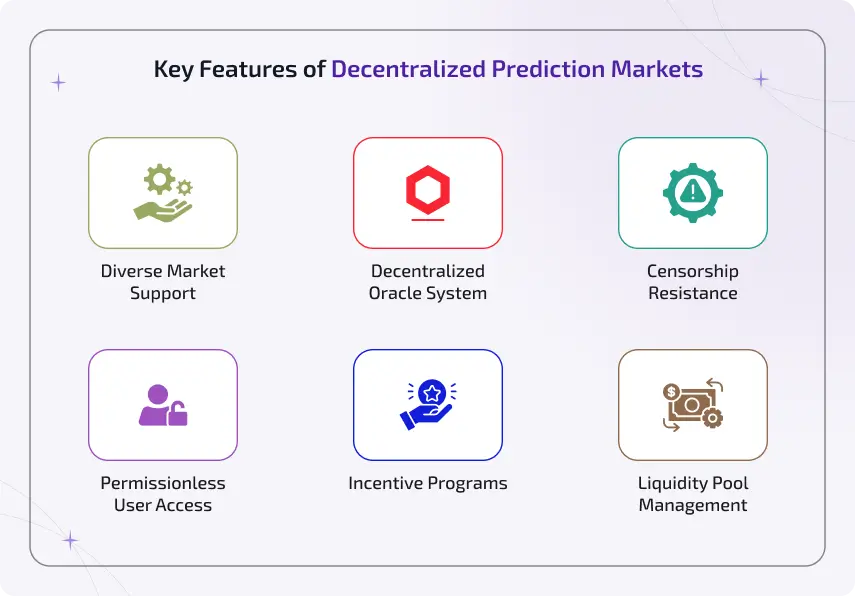
Decentralized prediction platforms are powered by significant features that act as the primary catalyst behind the platform’s operation. Let’s explore the key components that contribute to the overall enhancement of the digital markets.
Diverse Market Support:
Decentralized prediction markets support various types of markets, including binary, scalar, and multiple formats. This gives more opportunities and flexibility for users across different industries and use cases within the ecosystem.
Decentralized Oracle System:
To avoid any outcome disputes or unbiased results, the decentralized oracles, such as Chainlink, are integrated into the platform, bridging real-world event outcomes with smart contracts. This offers verifiable and tamper-proof outcome resolutions.
Censorship Resistance:
DEX prediction markets operate without the control of a centralized entity, making them resistant to any interference or shutdowns by government and institutional expertise. Traders are allowed to participate in any events freely without barriers.
Permissionless User Access:
Most of the prediction platforms are globally accessible to anyone with a crypto wallet and an internet connection. There are no barriers to entry or verifications. Users can directly trade with their peers without the need for a central authority to control their funds and settlements.
Incentive Programs:
By rewarding accurate prediction markets with financial rewards in return, the markets encourage user engagement. They earn profits based on the accuracy of the outcomes and positions in the market. This creates a motivated digital ecosystem for the participants.
Liquidity Pool Management:
Automated market makers (AMMs) management ensures users have enough liquidity without a direct counterparty. This replaces the traditional order books with liquidity pools where providers earn transaction fees for supplying the assets to the platform.
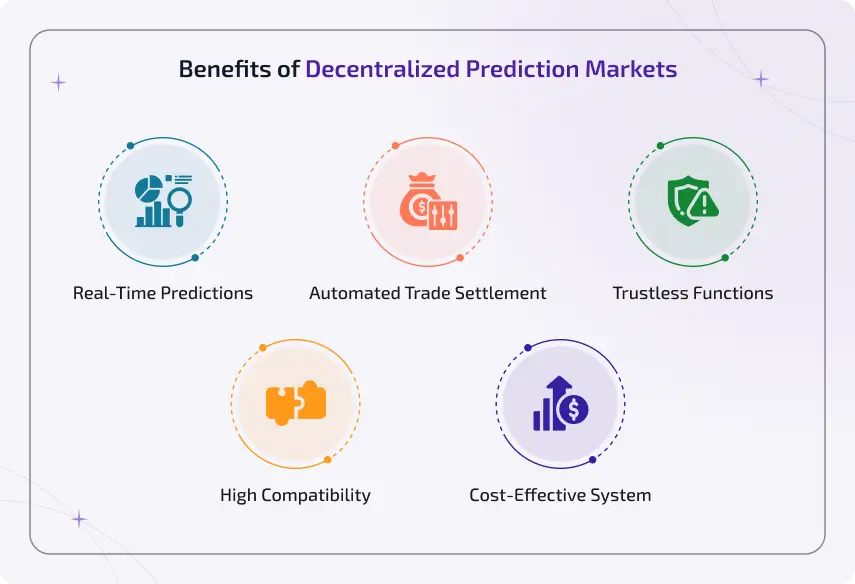
Benefits of Decentralized Prediction Markets
There are numerous benefits of decentralized prediction markets, providing a user-driven environment that distinguishes them from traditional systems. From reliable systems to cost-efficient marketing, these platforms are redefining how predictions are decided and monetized. Let’s break down the key elements that contribute to their overall growth.
Real-Time Predictions:
The collective intelligence of users leads to more reliable trading outcomes. The "wisdom of the crowd” improves the overall accuracy of the markets. Also, with financial incentives involved, users are encouraged to make well-informed decisions.
Automated Trade Settlement:
The integrated smart contract system distributes the payouts to the winners of the prediction markets once it is verified by the oracles. This settlement ensures instant, secure, and trustless distribution of funds directly to the user’s digital wallets.
Trustless Functions:
Smart contracts are integrated to automatically manage the transactions, trade execution, and market payouts with full transparency throughout the process. This ensures providing users with a secure and fair system working without relying on an entity.
High Compatibility:
Modern prediction platforms use multi-chain bridges and Layer 2 scaling to enable compatible trading across different blockchain networks like Solana, Ethereum, etc. It also features DeFi composability, allowing users to leverage prediction shares as collateral for stalking and yield farming.
Cost-Effective System:
As prediction market systems are decentralized, they eliminate the need for any intermediaries, substantially reducing the operational and transaction costs. This minimal cost advantage makes it more accessible and cost-efficient for a wide range of audiences.
The Future of Decentralized Prediction Markets (2026 & Beyond)
As there is a visible and major transformation in the digital space, the emerging trends are shaping the future of decentralized prediction markets. With broader adoption and recent advancements at its core, these platforms are expected to be a major pillar in the shift. Let’s explore the key developments and how they are going to define their growth in 2026 and beyond.
Started as an interactive platform experiment, the decentralized prediction markets are now turned into a significant and well-recognized financial market in the digital crypto industry.
The monthly transaction volume of decentralized prediction markets has crossed over 20 billion in January 2026, with more than 800,000 different wallet participants across the globe.
Beyond crypto, sectors like geopolitics, macroeconomics, and politics now play a major role in driving trading volume through real-time insights on prediction platforms.
Unlike early prediction markets, Myriad markets have decoupled the market engine from the frontend processor, enabling shared liquidity pools across multiple applications, solving the fragmentation issue in 2026.
Prediction markets generate more accurate forecasts than manual polls/panels. So, government and institutions may use the wisdom of the crowd as a complement to traditional betting tools for budgeting and planning.
The pricing dynamics may take a drastic turn as AI agents are becoming trading participants or liquidity providers, redefining the efficiency within the market ecosystem.
To enhance participation and user-driven growth, the markets are expected to introduce native tokens, allowing users to participate in decision-making and protocol upgrades.
Why Choose BlockchainX to Build a Decentralized Prediction Market Platform?
Being an industry-leading expert, BlockchainX continues to show excellence in delivering custom-built platforms for its clients. You can trust us to power your decentralized prediction with advanced trading engine development, robust smart contract integration, and a seamless on-chain framework.
Our platforms are precisely crafted for optimal performance with robust security and transparency, ensuring a truly cryptographically trusted environment for users and investors. Backed by our skilled prediction market specialists, we focus on crafting future-ready systems designed to lead and evolve with the market.
Deep Domain Expertise: With substantial hands-on experience across various prediction markets, DeFi systems, and DEX protocols, our company goes beyond surface-level development with minimum market slippage.
Value-Optimized Approach: At BlockchainX, we ensure delivery of feature-rich platforms with minimal charges for operational systems. Primarily, we prioritize smart-cost solutions without compromising on platform quality and efficiency.
Scalable Pre-Built Solutions: We offer highly performing white-label platforms for rapid deployment and smooth scalability. This helps reduce development time and complexity while supporting faster market entry and growth.
Relentless Assistance: Continuous maintenance and real-time monitoring support from our customer support team ensures your platform stays optimized and stable without disruptions.
Conclusion
In the digital economy, the growth and evolution of decentralized prediction markets have completely modernized the way people trade and anticipate future events. With trading volumes crossing millions of dollars day by day, the real-time accuracy, security, and trustless nature of these platforms have reached a large-scale audience, creating a significant impact.
It is the ideal time for new innovators or organization experts looking for opportunities to enter this high-growth prediction environment. Furthermore, deep integration with the DeFi ecosystem is set to transform these markets beyond simple speculation into a more reliable source of truth for future forecasting in the prediction markets.
FAQ
The DEX prediction markets are open to every global user interested in predicting real-world outcomes. They are widely adopted and can be accessed using a compatible crypto wallet, without any intermediary support.
Some of the common revenue models include charges for listing, trading, market creation, and for every on-chain user transaction. Also, some exchanges benefit from tokenomics fees and liquidity reward incentives.
Yes. Decentralized prediction platforms enable global participation without any entry barriers. They provide permissionless access to any individual with a cryptocurrency wallet and an internet connection within the blockchain ecosystem.
Get all the latest posts delivered straight to your inbox.
Get In Touch
Our expert team is professionally well-equipped with hands-on experience as a blockchain development company. Connect with us; at BlockchainX, we curate your desired sustainable solution!