Smart Contracts for International Payments: Why Wait 5 Days?
Listen to the Audio :
Smart contracts for international payments are quickly becoming a serious alternative to traditional banks - but even in 2026, international payments can still take up to 5 business days to arrive at their destination. You send money to a freelancer, a customer, or a supplier across the globe, and then you wait. And wait.
Meanwhile, your cash flow is stuck, and your supplier is chasing you. Opportunities are falling away because traditional banking systems still have to rely on complex, outdated processes that include multiple banks, time zones, and layers of human checks. But what if instead of taking days, your payment could be settled in seconds? What if money flowed automatically, transparently, and at a fraction of the cost, without relying on correspondent banks or weekend delays?
This isn’t science fiction anymore.
Smart contracts are gradually transforming cross-border payments, from a painful 3-5 day process to near-instant settlement.
This article will explain why international payments are still so delayed, how smart contract development address these issues, and the implications of this shift for companies, freelancers, and everyone who is sick of waiting for their money.
International Payments Are Still Slow. Here’s Why It Feels Like 1995?
We are in 2026. You can place orders from anywhere in the globe and get them within 48 hours. You can make instant video calls to anybody, anywhere.
However, what happens when you send money abroad? You wait. Here's why smart contracts fix international payments continue to move forward slowly:
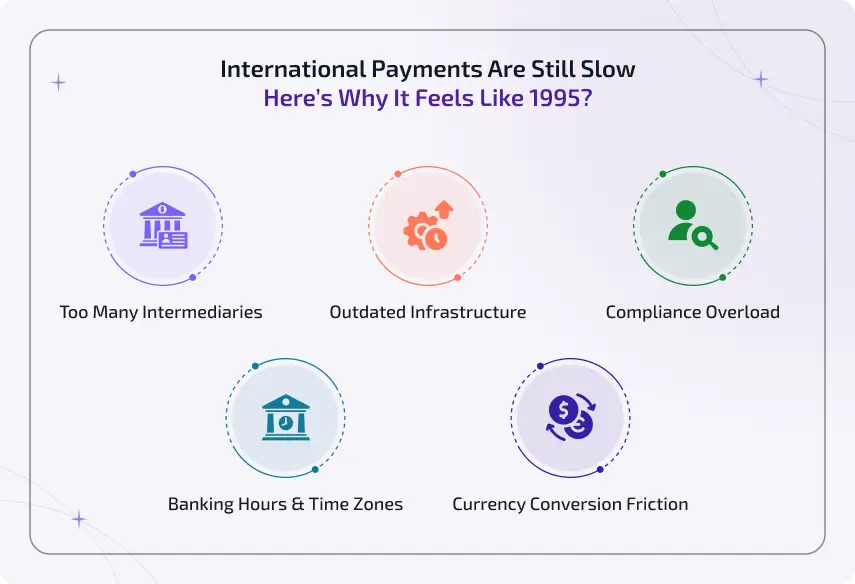
Too Many Intermediaries - A single transfer can go via three to seven banks: the recipient's bank, your bank, and many correspondent banks. They are connected via networks like SWIFT, but every extra layer adds costs, delays, and risk of mistakes.
Outdated Infrastructure - Built in the 1970s, SWIFT does not transfer money. Payment instructions are the only thing it sends. The real settlement takes place over time via slow, disconnected banking institutions.
Compliance Overload - AML, KYC, and sanctions checks take place on every transaction. These are crucial, yet they are often hard, manual, or overly careful. Even legitimate payments can be detected and delayed for days.
Banking Hours & Time Zones - Banks don't work 24/7. Due to vacations, weekends, and time zone changes, your payment may not be processed at all.
Currency Conversion Friction - You lose time and money when converting INR to USD, EUR, or SGD since there are multiple steps, hidden costs, and unclear exchange rates.
International payments still often take 3 to 5 business days, and occasionally more, for both individuals and companies.
It's not that banks don't want to move faster. However, the system they depend on was never intended for international real-time transactions.
Delayed supplier payments
Cash flow bottlenecks
Frustrated clients and freelancers
Missed business opportunities
Newer technologies such as blockchain platforms like Ethereum are gaining popularity exactly due to this inefficiency. They enable nearly instantaneous settlement, remove middlemen and automate execution.
And what is the focus of this shift? Smart Contracts.
What is a Smart Contract?
A smart contract is a self-executing computer software that automatically upholds an agreement’s terms. It doesn’t require banks, lawyers, or intermediaries because it is written in code and stored on a blockchain.
Think of it as a digital vending machine that instantly provides what you want such as releasing payment, transferring ownership, or confirming delivery, whenever you input the right coins(meeting specific needs)
Smart contracts remove manual approvals and delays in international payments. When certain criteria are met, funds are immediately released enhancing cross-border transactions speed, transparency and trust.
Why 5-Day International Payment Delays Are Costing Your Business More?
A 3 to 5 day delay in international payments may appear small at first but it poses deeper operational issues for businesses. Beyond only time, relationships, potential customers and financial flow are all impacted. These delays subtly impair efficiency, making it harder for companies to run efficiently in a fast-changing global market.
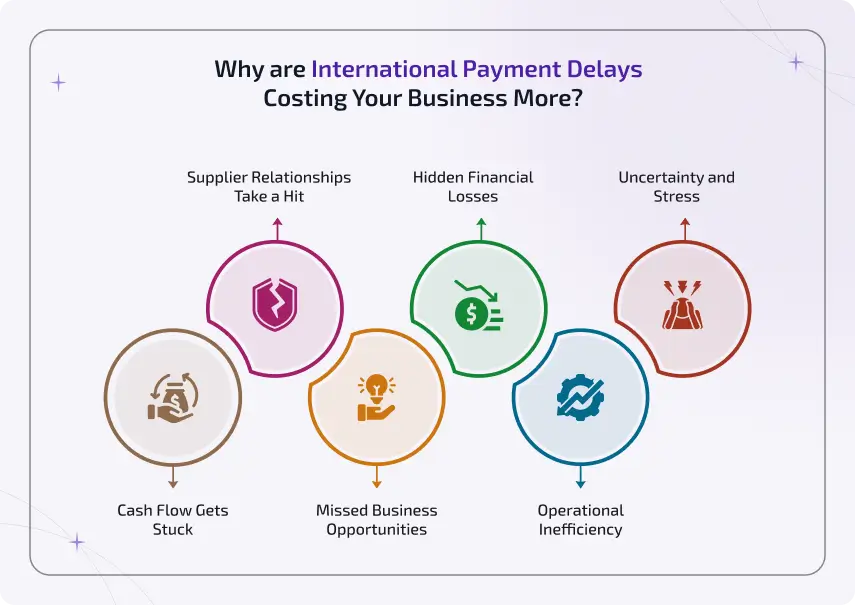
1. Cash Flow Gets Stuck
In transit - funds are inaccessible for immediate use. This makes it more difficult for a company to manage expenses, make investments in growth or handle urgent financial issues. Even short delays may lead to cash flow gaps, which make it difficult for companies to maintain stability and ensure smooth daily operations.
2. Supplier Relationships Take a Hit
Payment delays can negatively impact supplier and business trust. Late payments, regardless of cause, signify risk or inefficiency to the provider. Over time, such issues might lead to stricter payment terms, reduced flexibility, or hesitation to maintain the partnership, harming long-term business relationships and reliability.
3. Missed Business Opportunities
Global markets depend heavily on timing, and missed opportunities can arise from payment delays. Market circumstances may change, inventory may become unavailable, or competitors may move faster while processing payments. Even a short delay can prohibit firms from capitalizing on profitable and time-sensitive transactions.
4. Hidden Financial Losses
International transactions can entail costs that are not immediately apparent. Currency conversion issues, intermediary bank fees and unexpected deductions can all affect the total amount received. Businesses struggle to predict actual costs due to a lack of transparency in the process, which leads to lower profitability over time
5. Operational Inefficiency
Managing late payments requires constant follow-ups and coordination with banks and recipients. Teams spend vital time monitoring transactions, confirming data and fixing problems. In the end - his constant effort slows down company growth and limits operational efficiency across departments by reducing productivity and diverting attention from vital tasks.
6. Uncertainty and Stress
Businesses are unclear about their payment status since they lack visibility into it. Making educated choices or planning finances becomes difficult without clear updates. Questions about delays or missing payments can disrupt processes, impair efficiency and cause doubt in future transactions, lowering overall corporate trust and stability.
Smart Contracts for International Payments - Step-by-Step Guide
The manual, lengthy processes of traditional banking are being taken over by smart contracts, which are transforming international payments. Payments may settle in seconds or minutes, 24/7, with full transparency and reduced costs, as compared to waiting 3 to 5 days. Here's a step-by-step explanation of how smart contracts solve these delays :
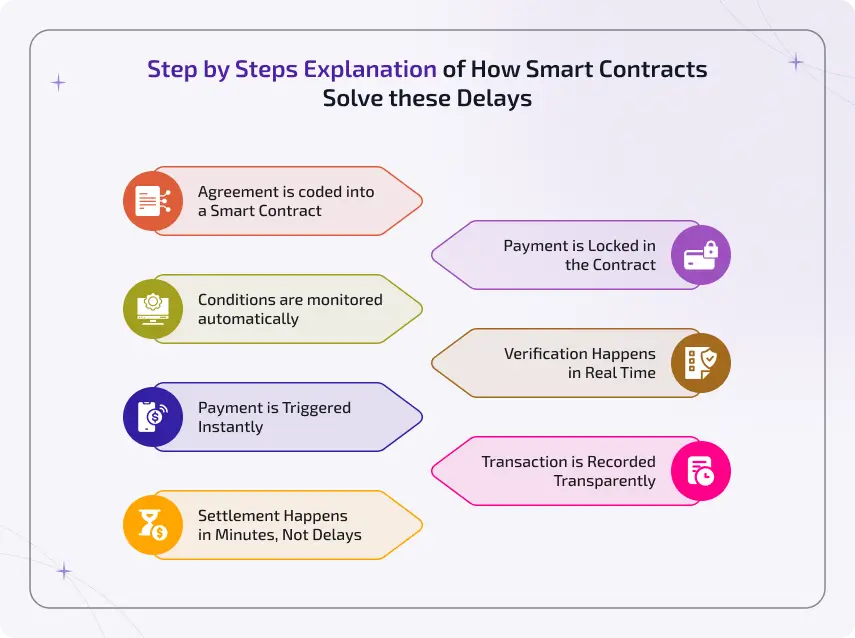
Step 1 - Agreement is coded into a Smart Contract
Payment terms such as amount, currency and requirements like delivery or milestone fulfilment, are agreed upon by both parties. These rules are integrated into a blockchain-based smart contract giving rise to a safe, immutable contract that runs automatically without banks or middlemen.
Step 2 - Payment is Locked in the Contract
Money is sent by the sender into the smart contract, where it is safely stored until needs are met. This ensures that the funds are reserved upfront, lowering payment risks, preventing disputes and avoiding delays caused by human approvals or bank processing processes
Step 3 - Conditions are monitored automatically
The smart contract tracks whether specific needs are met. It does this using programmed logic or linked data sources, without the need for manual follow-ups, emails, or third-party confirmations, which generally slow down traditional international payment processes
Step 4 - Verification Happens in Real Time
The blockchain uses consensus methods to instantly verify the transaction once the criteria are met. Since verification takes place in real time and ensures accuracy, speed, and trust without several middlemen, there is no need to wait for bank confirmations or clearing processes.
Step 5 - Payment is Triggered Instantly
The payment is automatically released to the recipient via the smart contract after successful verification. The process does not require any human interaction, approvals or delays allowing funds to be moved quickly across borders without relying on traditional banking infrastructure or time zones
Step 6 - Transaction is Recorded Transparently
Every transaction is fully visible to both parties since it is permanently recorded on the blockchain Unlike traditional systems where payment status tends to be unclear or delayed - this transparency removes confusion, builds trust and enables real time tracking
Step 7 - Settlement Happens in Minutes, Not Delays
Payments settle in minutes rather than days since the entire process is decentralized and automated. Smart contracts increase the speed, efficiency, and reliability of international payment systems by removing intermediaries, human inspections, and processing delays.
Smart Contracts vs. Traditional Payment Transfers
| Feature | Smart Contract Payments | Traditional Payment Transfers |
|---|---|---|
| Speed | Once the criteria are met, transactions settle in a matter of minutes or seconds | Due to several processing steps, it usually takes 3 to 5 business days |
| Intermediaries | Executed directly on a blockchain; no middlemen | Involves multiple payment networks and banks |
| Availability | Operates without holidays or deadlines 24/7 | Limited by public holidays, weekends and baking hours |
| Process Type | Completely self-executing and automated | Multiple verifications and manual approvals are necessary |
| Transparency | Blockchain-based real-time tracking with full visibility | Insufficient tracking; unclear or delayed status updates |
| Cost | Reduced costs due to the removal of intermediaries. | Increased costs, such as bank fees and hidden costs |
| Security | Secured by consensus techniques and blockchain encryption | Relies on centralized systems, which are more sensitive to delays or failures |
| Error Handling | Pre-established logic minimizes human mistakes | A higher risk of processing and human errors |
| Trust Model | Code-based execution in a trustless system | Trust depends on middlemen and banks. |
| Settlement Time | Near-instant settlement once requirements are met. | Clearing and reconciliation processes cause settlement delays. |
Leading Blockchain Networks for Cross-Border Payments
Multiple blockchain networks will allow fast and fairly priced international payments in 2026. Each offers unique benefits in adoption, cost, speed, and security. The main players are broken down as follows
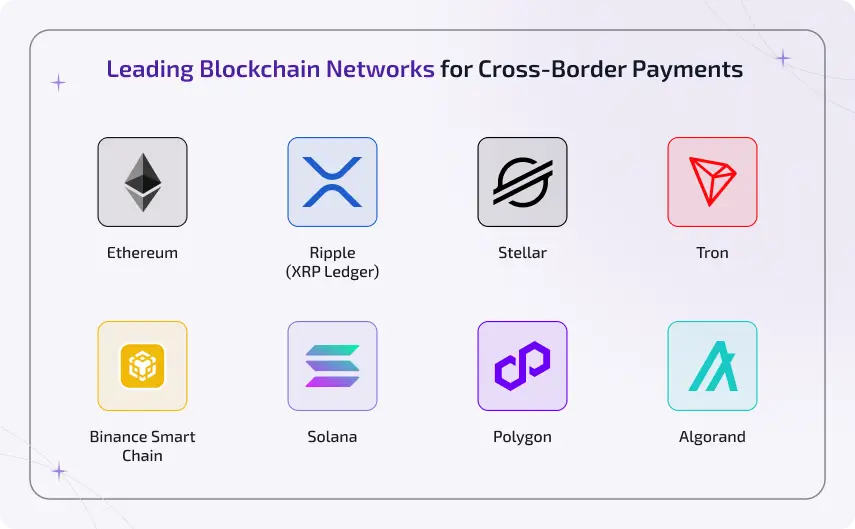
Ethereum - Ethereum, one of the most popular blockchain networks, enables smart contract payment automation. It has robust security and a huge development ecosystem. However it is less ideal for micropayments since transaction fees might be high amid network congestion.
Ripple (XRP Ledger) - Ripple which was designed specifically for global payments, makes cross-border transfers easy and cost-effective. It is a powerful alternative to traditional banking systems like SWIFT, as financial organizations often use it to complete transactions in seconds
Stellar - Stellar's main goal is to make international payments, especially remittances, cost-effectively. It allows easy currency conversion and fast transfers with low fees by connecting banks, payment systems, and people.
Tron - One of the most widely used networks for global transfers currently is Tron. It has extremely low costs (often less than $1) and fast confirmation times. Tron dominates USDT transfers because of its low cost and high accessibility, making it a top choice for freelancers, remittances, and small to medium-sized business payments.
Binance Smart Chain - Binance Smart Chain is widely used for decentralized finance (DeFi) applications notably blockchain cross border payment solutions. It is known for its fast processing times and low transaction fees.It also supports smart contracts.
Solana - Solana is perfect for real-time payment systems since it provides fast transactions and extremely low rates. Its scalability allows thousands of transactions per second effectively addressing use cases for global payments.
Polygon - Polygon enhances Ethereum by enabling faster and cheaper transactions.It is widely used for payment apps that require Ethereum's security without the high gas costs
Algorand - built to be fast, secure, and scalable. It is ideal for financial applications and cross-border payments since it allows for instant finality, which means transactions are confirmed immediately.
Latest Trends - What Banks & Fintechs Are Doing Right Now
The adoption of blockchain and smart contracts for international payments has reached a major milestone in the global banking industry. A few years ago, these small experiments had grown into large-scale pilots and live production systems. The long-standing 3–5 day settlement delays are being cut by both traditional banks and smart fintech firms.
Major Traditional Banks Are Actively Deploying Blockchain
With its Kinexys platform (formerly Onyx), JPMorgan Chase is at the forefront. The blockchain infrastructure has previously handled billions of dollars in tokenized transactions. It is used for treasury operations and cross border payments, allowing institutional clients to settle in nearly real-time.
Standard Chartered, HSBC, and Citi have all made large investments in blockchain-based payment corridors and tokenized bank deposits. These banks use distributed ledger technology to connect multiple currency zones while reducing reliance on slow correspondent bank networks.
Santander, Deutsche Bank, and BNP Paribas are currently running live pilots that mix smart contracts with traditional banking systems to automate complex international trade payments and escrow agreements.
SWIFT, the backbone of traditional international messaging, has launched its own blockchain-powered initiatives. Their new shared ledger technology seeks to provide banks with control over customer interactions and compliance while enabling instant payment capabilities.
Fintech Companies Are Pushing Innovation Faster
Fintechs tend to be more assertive and already offer businesses practical solutions:
Using the XRP Ledger and its own stablecoin, RUSD, Ripple helps banks and payment providers settle cross-border transactions in a matter of seconds as it keeps expanding its network.
The USDC issuer, Circle, has grown to be one of the key players. To make stablecoin payments for international companies, the company is partnering with key banks and fintech platforms, providing smooth on-ramps and off-ramps between traditional money and blockchain.
Visa and Mastercard have used stablecoin technology heavily. Both companies now support stablecoin settlements and are developing technologies that enable their card networks and business clients to send and receive money internationally at much faster rates due to acquisitions and internal development.
Stellar, Fireblocks, Chainlink, Siemens Financial Services and other prominent companies are building infrastructure to link blockchain rails with traditional finance
The Dominant Approach - Hybrid Models
Instead of fully replacing current systems, most institutions are following a mixed strategy:
Smart contracts and blockchain manage the fast settlement layer.
Stablecoins - USDC, USDT, and tokens issued by banks - act as an effective conduit for the transfer of value.
When necessary, traditional infrastructure still handles final fiat rails, KYC/AML, and severe compliance.
This combination enables banks to meet regulatory requirements while offering clients faster payments. Many are currently piloting or running live, 24/7 cross-border flows, specifically corridors, significantly reducing the usual wait time of 3 to 5 days.
Early adopters are already reaping measurable rewards such as faster settlement times (from days to minutes), far less costs, increased transparency and better liquidity management. Fintech platforms are making these new technologies accessible to freelancers and smaller firms, while large organisations use them for treasury operations and supplier payments
Smart Contract Payments - How to Start and Scale Quickly
In 2026, most people are unaware of how simple it is to begin using smart contract payments. You don't have to be an expert in cryptocurrency or a developer. Many freelancers and small enterprises have already used this technology to receive international payments in seconds rather than days
Here is a basic, step-by-step guide to get you started :
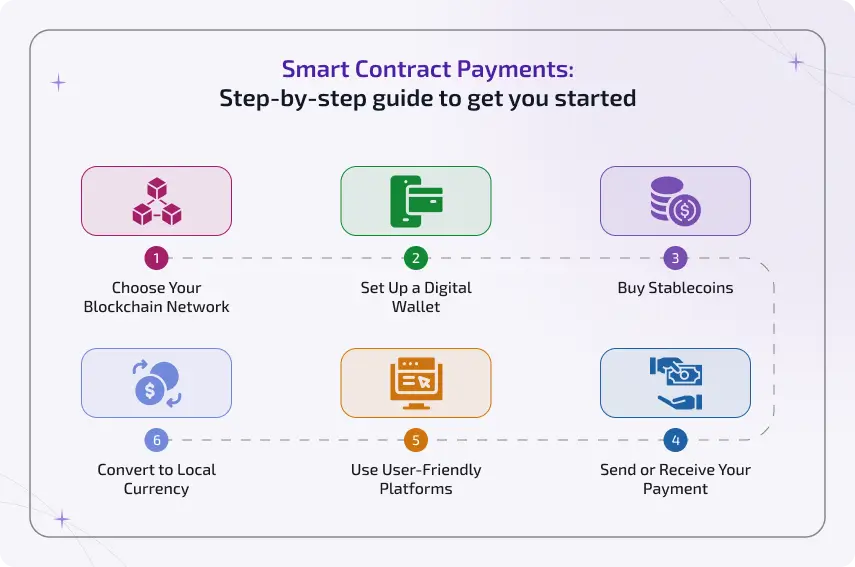
1. Choose Your Blockchain Network
Start with low cost and easy-to-use networks:
Tron (TRC20) - Most affordable and ideal for beginners
Solana - Truly fast and cheap
Base or Polygon - A good mix of security and speed
2. Set Up a Digital Wallet
Get a reliable wallet here:
MetaMask (compatible with Base, Polygon, and Ethereum)
Phantom (ideal for Solana)
Token Pocket or Trust Wallet (excellent for Tron)
Make a safe backup of your seed phrase and create a new wallet
3. Buy Stablecoins
Purchase in USDC or USDT, two stablecoins based on the US dollar:
Make use of centralized exchanges such as Kraken, Coinbase or Binance
Alternatively - use on-ramp services within wallets (MoonPay, Transak, Ramp) that enable direct bank transfer purchases.
4. Send or Receive Your Payment
Share your wallet address with the customer, or request theirs.
Send stablecoins straight to their wallet.
Use simple smart contract technologies or escrow systems that hold funds until needs are met for better security.
5. Use User-Friendly Platforms
Use these platforms if you prefer not to handle wallets manually:
Integrations with Ripple, Circle or Stripe Crypto
International systems like Payoneer (new cryptocurrency options), Mercury and Wise (with stablecoin features) or payment applications like Zebpay and WazirX
Decentralized methods for recurring payments such as Superfluid or Sablier
6. Convert to Local Currency
Sell your stablecoins for local currency when you receive them through:
Exchanges ( Coinbase, Binance )
Peer-to-peer networks
Fintech applications or local OTC desks that provide fast bank withdrawals
Our Expert Advice for Beginners
Always begin with small test amounts.
Confirm wallet addresses twice before sending
Never reveal your seed phrase and turn on 2FA.
For tax purposes, track every transaction.
For frequent payments, use networks with low costs.
Conclusion
The structure underlying international payments is the reason they fail, not the effort. As we've seen, delays affect relationships, growth, and cash flow in addition to being inconvenient
The change is already taking place. Businesses have switched away from slow, complex processes and toward speedier, automated solutions based on technologies
The implication is simple: speed, transparency and control are no longer options in global transactions. They are expected
Businesses that move first will not only save time in a market that rewards speed, but they will also gain an edge by being able to respond more quickly to customer demands and market changes
If your company still relies on delayed global payment methods, it's time to upgrade. Get in touch with BlockchainX to put effective, transparent, and instant cross-border payment solutions into place.