Centralized Prediction Markets A Complete Guide 2026
Listen to the Audio :
What if you could turn your predictions on real-life events into trading opportunities? Centralized prediction markets make this possible by offering a regulated and systematic ecosystem where users can participate in event-based outcomes with enhanced security and precision.
These platforms bridge the gap between casual prediction and professional prediction by using a central authority that manages the exchange and its operations. CPM markets are gradually transforming into accessible tools for both everyday users and institutional participants.
Exploring this blog, you can understand what centralized prediction markets are, along with their core features, working mechanisms, functionalities, and future trends heading into 2026.
What are Centralized Prediction Markets?
Centralized prediction platforms are operated by a central controlling authority, which manages the user account, custodial funds, matches trades, and determines outcome resolutions of an event. They allow users to trade based on their predictions of various events, such as sports, politics, macroeconomics, and more.
Similar to traditional betting systems, fiat currency such as USD is the primary medium in centralized prediction markets, providing users with a more adaptable trading environment. The transactions are faster and more regulated as these markets follow strict compliance due to jurisdictional restrictions.
Pros: Highly compliant, user-friendly navigation, and better liquidity provision
Cons: Third-party risks, geographical restrictions, and expensive
Popular Centralized Prediction Market Platforms
As there is a growing demand for event-based trading, popular centralized prediction markets are becoming key players within the digital ecosystem. They continue to attract users with a seamless training experience. Let's explore some of the leading platforms in the industry.
1. Kalshi Prediction Markets:
Kalshi Markets is recognized as the first legal and CFTC-regulated trading platform, using financial betting rather than placing illegal contracts. They have introduced a new asset class known as the "event contracts,” which enables traders to take positions on the possibility of an event. In October 2025, Kalshi joined hands with Pyth network, which streamlined its real-time, regulated prediction market data across 100+ blockchain networks.
Best For: Traders and businesses who seek a CFTC-regulated and transparent exchange.
Market Options: Primarily focuses on sports, while it also allows trading on politics, fed rate decisions, technology, finance, entertainment, weather, and science. Build platform like kalshi, get started now.
2. PredictIt Prediction Markets:
PredictIt is one of the notable nonprofit projects in centralized prediction markets built for educational purposes. It is operated by Victoria University of Wellington with the support of Aristotle Inc. The platform was granted a no-action letter from the CFTC regulator in 2014, featuring event contracts for political forecasting with the longest record in the political prediction ecosystem. According to recent reports, PredictIt's performance is highly more accurate than its competitors.
Best For: For educators and researchers interested in political forecasting with real-time exposure.
Market Options: Primarily political events, including policy decisions of the U.S. government and federal sectors.
3. Robinhood Predictions:
An ideal choice for users looking for a beginner-friendly interface would be Robinhood predictions in the ecosystem. It has partnered with Kalshi’s exchange, which offers a regulated backend trading infrastructure. One of the key advantages is that the platform is accessible to the existing Robinhood app users, who can fund trades instantly without a new account. In addition, they enable users with commission-free event trading.
Best For: Beginners and retail investors in stock markets looking for a simple and seamless interface experience.
Market Options: Economics, Finance, Sports & Athletic Events, Politics, Science, and Entertainment. build platform like robinhood
4. Fanduel Prediction Markets:
Fanduel Group launched a prediction platform for its users, named “FanDuel Predicts,” in late 2025, partnering with the CME Group. Notably, it is an official member of the NFA. The platform provides its users with a forecasting tool across finance, culture, commodities, and sports, allowing them to purchase binary contracts based on their predictions. It is a CFTC-regulated and peer-to-peer trading exchange that is available exclusively as a mobile application.
Best For: Mobile-centric users and sports betting traders looking for binary prediction event contracts.
Market Options: Mainly focusing on four contracts, such as commodity price, culture, sports, and financial indicators.
Note: In March 2026, MEXC launched its native prediction markets, positioning itself as a major centralized exchange that comes with zero trading fees and split-second settlement. This is expected to become a rival in the competitive landscape shared with top-tier exchanges such as Polymarket, Kalshi, etc.
How Do Centralized Prediction Markets Work?
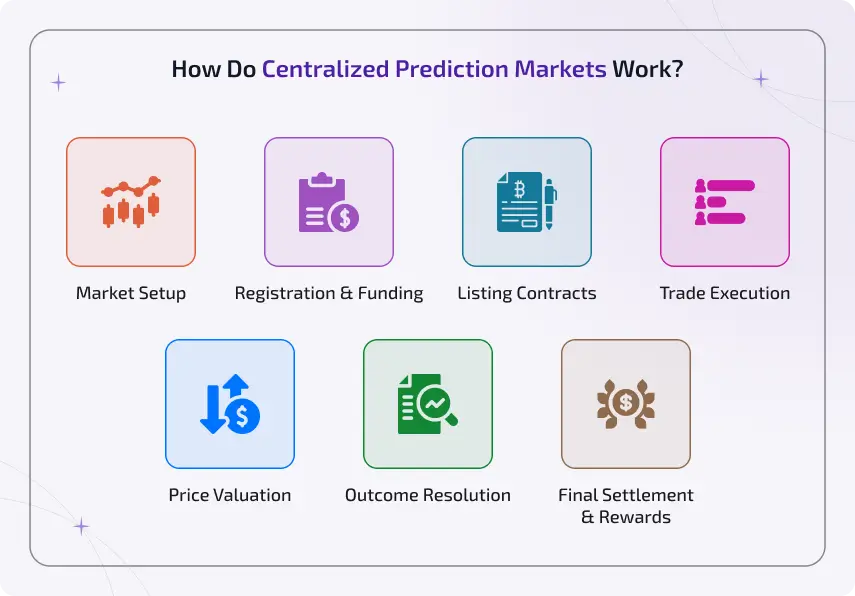
To explore how centralized prediction markets work, you need to get a clear picture of their regulated framework, which is managed by an authority. The following steps are fundamental for framing the internal working of the trading environment.
Market Setup:
The central management controlling the platform will set the rules, market events, outcomes, and resolution criteria in trading. The prediction market is created and internally approved by the company.
Registration & Funding:
Users register on the platform by completing the verification process, such as KYC/AML standards, and deposit their funds. The entity securely holds and manages the user balance for trading activities.
Listing Contracts:
The event-based contracts, such as binary or multiple choices, are listed on the platform with an initial price for public trading access. Prices reflect the likelihood of the trading outcomes in the market.
Trade Execution:
Individual users buy and sell their event contracts based on their own predictions as “Yes” or “No” shares. The prediction platform uses an order book and automated matching engines to execute trades efficiently.
Price Valuation:
The prices would fluctuate, changing the probability of the event outcomes based on the increase/decrease in the market demand and supply. These differences in price movements will guide users to make better trading decisions.
Outcome Resolution:
Once the event concludes, the entity verifies the outcomes through trusted external sources and finalizes the results according to the predefined trading rules and conditions within the platform.
Final Settlement & Rewards:
The platform settles winning contracts with a full value, while losing contracts become worthless. Profit amounts are credited to user accounts, where the system ensuress users have transparency and fairness in their work.
How to Build a Centralized Prediction Market Platform
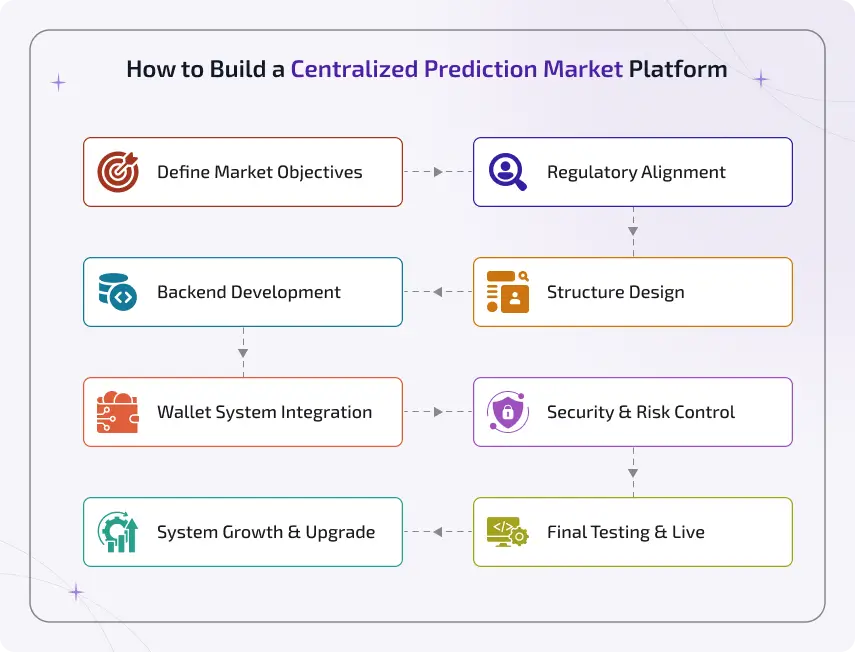
Building a robust platform requires a clear understanding of how to build a centralized prediction market platform with the right technology and regulatory structure. From market setup to deployment, each step plays an essential role in delivering a secure and high-performance trading experience for users and traders.
Step-1: Define Market Objectives
The primary step in the process is to clearly state the project’s purpose, target users, and suitable market types. Through this, we can establish the core features, compliance structure, and overall system requirements.
Step-2: Regulatory Alignment
The platform must be legally licensed and aligned with regulatory standards that include KYC/AML verification and other regional requirements. This forms the base layer of user trust in the exchange.
Step-3: Structure Design
Focus on creating an intuitive and user-centric interface; the usage of centralized prediction markets is simplified. Along with UI design, this stage defines contract outcomes, rules, and settlement criteria for establishing a better user experience.
Step-4: Backend Development
The trading engine using an order book, such as CLOB, must be integrated, as it is one of the core components in the backend development. This ensures smooth matching and trade execution, enhancing its overall trading performance.
Step-5: Wallet System Integration
Integrate secure and custodial wallets along with fiat access gateways so that users can deposit and withdraw funds seamlessly. Oracles are integrated alongside to ensure fair outcomes, as they are seen as a trust-boosting layer.
Step-6: Security & Risk Control
Strong security protocols must be incorporated to detect unnecessary threats and prevent scams and fake projects. In addition, risk management tools such as exposure controls and position limits help the platform to maintain market integrity and ensure user safety.
Step-7:Final Testing & Live
The developed initiative must be thoroughly checked to determine its performance level, security features, and scalability before deployment. Once verified, the platform is deployed for public trading access.
Step-8: System Growth & Upgrade
To provide a seamless trading UI/UX experience, the live platform must be closely observed and constantly upgraded based on user feedback and platform performance. Additionally, effective marketing techniques can be applied to boost liquidity and overall functioning of the project.
Key Features of Centralized Prediction Markets
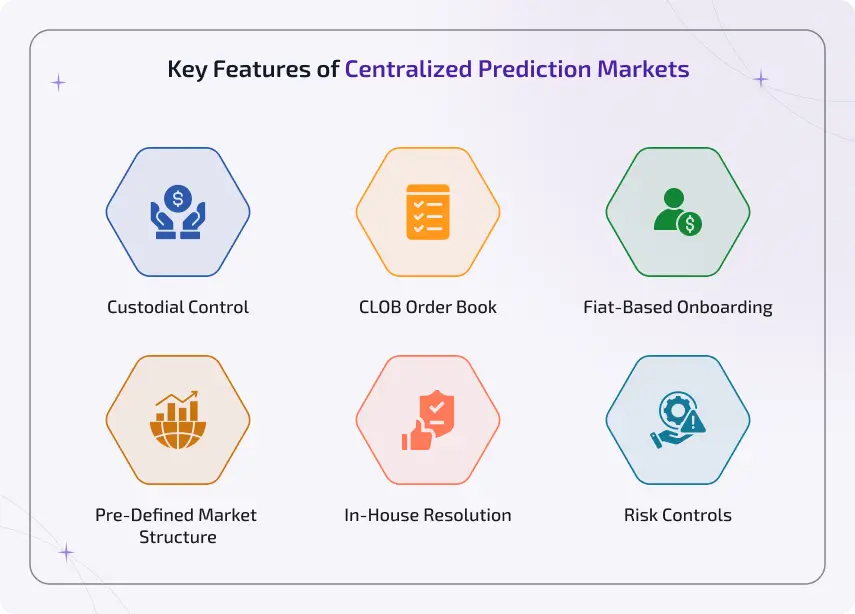
Integration of advanced features empowers centralized prediction exchanges with structured operations and high-performance trading. The components mentioned below stand as the driving force behind the platform’s credibility.
Custodial Control:
The platform itself is a custodian, where it holds and handles user funds internally. This structure ensures seamless market trade execution, fast settlements, and user account management.
CLOB Order Book:
Most of the centralized prediction markets primarily use the Central Limit Order Book (CLOB) to enable trading. It matches buy and sell orders based on price-time priority to ensure efficient trade execution.
Fiat-Based Onboarding:
Supports user onboarding through traditional currencies such as USD, giving access to fund accounts through banks. This enables them to directly use their accounts or credit cards for trading.
Pre-Defined Market Structure:
All the centralized markets are predefined with rules, trade outcomes, and event resolution criteria. This reduces different interpretations and provides a clear format to execute trades, ensuring market consistency.
In-House Resolution:
This type of prediction platform handles the outcome verification through internal authority itself using trusted external sources. It is known to be the “Truth Layer” for centralized markets, replacing the DEX oracles.
Risk Controls:
Risk management systems, such as exposure limits and position caps, are built-in features of centralized markets. It prevents markets from tampering or misuse, maintaining a fair and balanced user environment.
Benefits of Centralized Prediction Markets
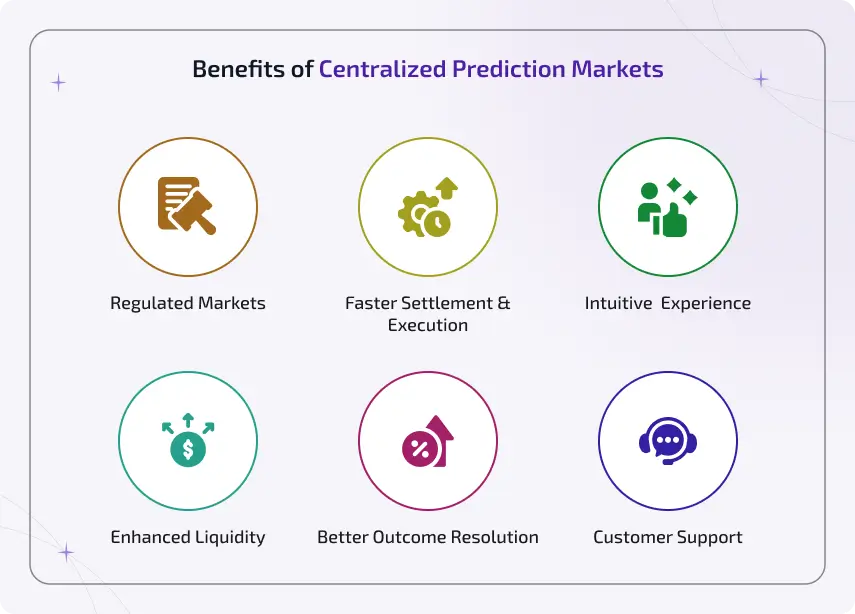
The benefits of centralized prediction markets lie within the system’s structured framework and efficient trading mechanism. These platforms provide enhanced reliability, better user experience, and streamlined functions, making them the preferred choice for many trading participants.
Risk Controls:
Operates within an established legal and compliant framework, adhering to the regulatory standards such as KYC/AML verifications. This ensures users have lawful system operations and a trading experience.
Enhanced Liquidity:
Centralized prediction markets attract a large-scale user base with platform-supported liquidity protocols. This facilitates active and smooth trade execution, maintaining stable liquidity within the platform.
Intuitive Experience:
Offers a simplified experience to users as the interface is familiar, reflecting the traditional applications. It features an easy onboarding process with funding methods such as bank transfers and credit/debit cards.
Faster Settlement & Execution:
As the platform itself handles trading matching, outcome verification, and payouts internally, it ensures quick execution and timely distribution of rewards. This, in turn, increases the accuracy and efficiency of the trading system.
Better Outcome Resolution:
Outcome resolution is generated after thorough verification using trusted and official data such as government reports. This reduces the complexity seen in decentralized systems and enhances the platform’s reliability and user trust.
Customer Support:
As the platform works under a CPM system, it ensures better accountability during tough circumstances. The support team of centralized markets assists users with payment issues or account recovery processes, enhancing user confidence in the platform.
Future Outlook of Centralized Prediction Markets (CPM): 2026 & Beyond
In 2026, centralized prediction markets are witnessing a massive shift—from being a niche experiment to becoming mainstream financial tools, driven by growing institutional dominance. According to recent reports, top-performing and CFTC-regulated platforms, such as Kalshi, have captured the majority of popularity, dominating nearly 91% of the U.S. prediction market share.
Initially started with political markets, the trend has now expanded into sports and entertainment, contributing to a major trading volume across many platforms. Leading retail CPM platforms, such as Robinhood, now provide event-based contracts alongside conventional stocks, giving access to investors to trade on fed-rate decisions, election outcomes, and price inflation with greater flexibility.
This fast-paced development reflects the evolving role of prediction markets in the industry, positioning them as trustworthy instruments for speculation and real-time decision-making in the future.
Why Choose BlockchainX to Build Your Centralized Prediction Market Platform?
BlockchainX, a one-stop prediction market development solution provider with 9+years of proven expertise and exposure in blockchain technology, is an excellent choice for building your centralized prediction market platform. We facilitate client-centric solutions for both emerging companies and high-scale enterprises, focusing on compliance, intuitive user experience, and efficient liquidity management to reduce price slippage in markets.
Our platforms are powered by an ultra-low latency trading engine that ensures users have instant order execution, verifiable market responsiveness, and a smooth trading experience. Backed by a talented crew of developers, we ensure 24-hour operational support along with seamless post-deployment assistance.
Join hands with us to turn your visions into a high-performing, market-ready CEX platform and lead in the evolving prediction market landscape.
Conclusion
This blog presents a clear picture of centralized prediction markets, their in-built features, user-benefits, working systems, and core functionalities. As the digital ecosystem continues to evolve, the centralized prediction platforms are steadily aligning with traditional financial systems while featuring more structured and beginner-friendly trading spaces for users.
These platforms have the ability to convert real-world events into digital tradable opportunities, opening new dimensions for user participation and strategic forecasting. It's not just about predicting events but also about enabling efficient, data-driven analysis. Moving forward, the CPM markets are set to play a major role in shaping how markets predict and act on future outcomes.
FAQ
1. How does a centralized prediction market make money?
The CEX platforms earn money through the revenue generated for each user trade and transaction within the ecosystem. In addition, some platforms may take commissions for market creation, listing, deposits, and withdrawals.
2. What technologies are used to build centralized prediction markets?
The centralized prediction markets are built by a blend of optimized cloud systems, strong backend frameworks, and frontend features. Advanced tools like real-time APIs, data analytics, and AI models are integrated to enhance the trading experience.
3. Is a centralized prediction market legal in my country?
The legal status of centralized prediction markets varies based on the financial and jurisdictional laws of each country. In India, they have a grey-zone existence, influenced by gambling laws and uncertain legal standards.
4. Why should I choose a white-label centralized prediction market solution?
A white-label CEX prediction market solution is much preferred, as it accelerates market entry with minimal development effort. It offers cost-efficient solutions with advanced tools and features, fostering a better end-to-end market process in the ecosystem.