Everything You Need to Know About Web3 in 2026
04 AUG, 2022The internet and its metamorphosis have never failed to capture public attention. A few years ago , no one could have predicted that virtual worlds would become a reality one day. The entire tech world is now buzzing about the arrival of web3, or web 3.0. How will the future of web3 converse with the future of the internet? Is Web 3.0 an important part of the Internet's future? All of these questions showcase the advantages of web 3.0 and its use cases. The following discussion will help you learn more about the future of Web3 development and its significance.
What is Web3?
Before you can learn more about web3's future, you must first understand the term itself. You should consider the fact that you do not own any of your data on TikTok, Facebook, or Instagram. The internet that most of us use today is highly centralised and under the control of major corporate entities.
On the other hand, web3 provides a new solution to these problems. Web 3.0, also known as web3, is an intriguing concept pertaining to the next generation of the internet, and it demonstrates users' ability to control and own their digital assets and other online content generated by users. The company has the authority to ban or block you based on your desires to control and be responsible for their digital assets and other online content. This reference shows how large corporations create and provide products and services using a centralized approach.
Assume we're talking about a social media platform like Facebook. Do you own any of the information on Facebook? No, Meta owns every asset on Facebook and has complete control over the content created by users.
The company has the right to ban or block you based on your needs. The online game Fortnite is another example of a centralized online platform. The game does not give you any control over your in-game identities or items. As a result, it is quite clear that users of Web 2.0 can not control or monetize the content they create.
Is Web3 The Future of the Internet?
Web3 is largely seen as the internets future due to its emphasis on transparency, user ownership and decentralization . It changes how we interact, share and transact online by eliminating centralized platforms such as those provided by big technology companies. Web3 allows users to safely connect with blockchain-powered applications, manage their data and receive rewards for their participation .
Even though Web3 is still in its beginnings , it has huge potential. It envisions a more fair, transparent and safe digital world where people gain power instead of corporations. Web3 is expected to have a major role in the future internet and impact how we interact with the digital world as technology advances and more people embrace blockchain, cryptocurrencies and decentralized apps (DApps) .
The Importance of Web 3.0
The most important piece of information you need to answer the question "How important is web3?" is how it determines the problem apparent with web3. When you consider the industries and solutions associated with Web2 right now, you can get a sense of the scope of the problem. For example, over 2.5 billion gamers around the world believe that they own the in-game assets, which is not the case.
Web3, on the other hand, enables the generation of content as well as the exercise of control, ownership, and monetization privileges. How? Blockchain and cryptocurrencies are driving developments in Web3 while also laying the foundations for NFTs.
Understanding how blockchain technology plays an important role in defining web3 can help you develop a solid overview of the future of web3. Users can interact with various online services using blockchain technology, which is guided by peer-to-peer networks.
Peer-to-peer networks are decentralised networks of computers as opposed to centralised servers of a particular entity. Users have complete ownership of their data in such environments and can engage in peer-to-peer, permissionless transactions.
As a result, blockchain can easily remove the need for intermediaries. If you have an internet connection and a cryptocurrency wallet such as Metamask, you can connect to the world of Web3.
As a result, users would have complete control over their digital identities, as well as the methods and timing of data sharing through various online applications. Users can use their private keys to ensure the security of their data and identity.
The plausible improvements provided by web3 over the existing web2 landscape expose important details about its work. At the moment, the world is gradually moving toward web3. The web3 would usher in significant changes and have various implications for data sharing and ownership, as well as control over digital identity.
How Web3 is Transforming the Internet
Web3 is transforming the way we use the internet by giving individual users greater power over it instead of big corporations. In contrast to Web2– where businesses control user data– Web3 uses blockchain technology to let users own and control their digital identities, assets and content. This makes the internet more transparent, safe & open.
Web3 allows users to interact directly through smart contracts, eliminating intermediaries which leads to faster and more reliable transactions. Additionally it includes token-based rewards which reward users for their contributions rather than allowing platforms to make profit from their data. DApps development offers greater security and privacy, are also taking the place of traditional apps.
Overall—Web3 is transforming the internet into a user-driven space that fosters open innovation across decentralized networks ensures data security and empowers communities.
Transformations Induced by Web3
Storage, browsers, social networks, finance, and operating systems have all seen Web3 solutions dominate the centre stage of transitions. The internet is gradually shifting toward web3 principles in order to introduce an internet of assets. How is this change taking place? Some of the notable examples of the transition to Web3 are the following:
Storage systems are shifting away from Google Cloud, AWS, and Microsoft Azure and toward IPFS.
New browsers like Brave provide a decentralised alternative to Google Chrome, the popular web browser.
The Web3 future would also highlight massive changes in finance, with people preferring crypto wallets like Metamask over conventional banking.
Many capabilities introduced in web3 operating systems such as EOS and Ethereum are lacking in centralized operating systems such as Windows, Android, and iOS.
The shift to the future of web3 would also highlight the rise of new decentralised social networks like Steemit rather than centralised alternatives like Facebook.
Another compelling example of the web3 transition is the growth of DAOs development as an alternative to traditional operating models for organisations such as LLCs. With transitions from centralised systems and processes to decentralised blockchain networks, it is clear that web3 is the future.
Key Features of Web3
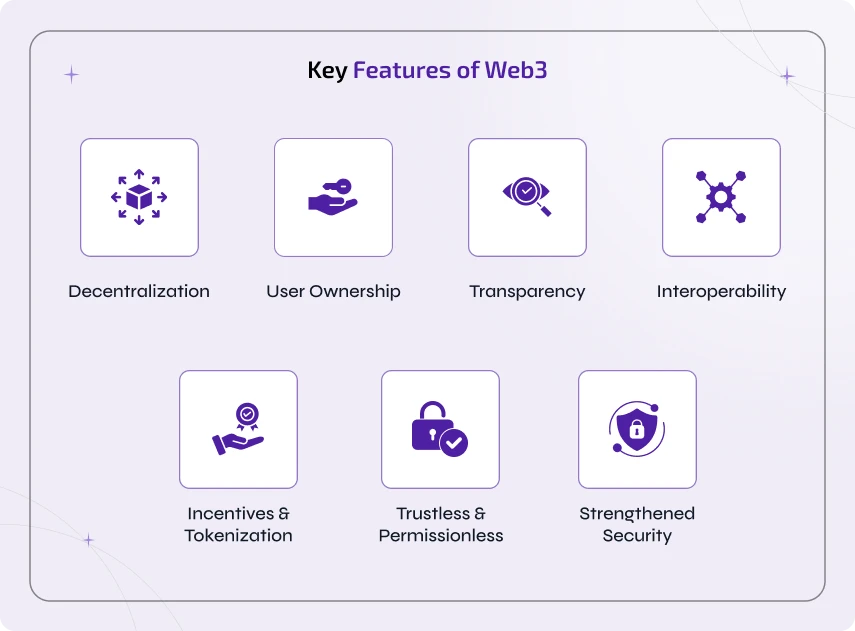
These are the main features of Web3 that, compared to the traditional internet, make it more decentralized, open & user controlled.
Decentralization
Web3 runs on blockchain networks in contrast to Web2 where data is stored on centralized servers. This makes the system transparent, safe and resistant to censorship as information is spread among multiple computers.
User Ownership
Users have complete control over their digital identity, assets and data via Web3. Your wallet or private keys allow you to directly control and manage everything, eliminating big IT platforms.
Transparency
Every action in Web3 is stored on a public blockchain making data and transactions verifiable for anyone. As a result, there is less chance of fraud and more trust.
Interoperability
Web3 apps can connect and collaborate across multiple blockchains with ease. This enables smooth asset and data transfers between systems.
Incentives & Tokenization
Tokens and cryptocurrencies are used by Web3 to reward users for participating in networks such as creating content, verifying transactions, or providing services.
Trustless & Permissionless
To access Web3 you don't need authorization or a central authority. Blockchain networks allow anyone to freely join, create and transact without middlemen.
Strengthened Security
Web3's blockchain immutability and cryptographic encryption provide robust protection against hackers, data leaks and manipulation.
Stepping Into the Future with Metaverse
The most plausible explanation for web3 is that it represents a set of standards for the new internet. Where do you see Web3 going in the future? Indeed, discussions about the future of Web3 frequently centre on the breadth of its applications.
The metaverse is the most notable example of proving the same points. The metaverse is defined by virtual worlds accessible via VR and AR devices that provide a shared and persistent environment.
It is a seamless virtual world that would operate in tandem with real-world activities. Although the concept of the metaverse is still evolving, it will provide many opportunities in the future. The metaverse would evolve into a massive virtual world with facilities for various tasks and activities such as learning, socializing, working, and entertainment.
The metaverse brings together the best of virtual experiences like social media and gaming, as well as virtual reality and augmented reality. The description of the metaverse contains answers to the question "How will Web3 change the world?" It would serve as a three-dimensional internet. Web3 content is presented in the form of three-dimensional objects, creating an innovative user experience.
Online gaming, for example, is possible by playing games in three-dimensional spaces, which allows users to interact with ease with avatars in-game. Users could interact virtually with web content and the internet while immersing themselves in virtual spaces.
Users could benefit from physically and visually immersive experiences if virtual reality is integrated. As of now, the metaverse's possible applications are focused on social media, education, work, and entertainment.
Will Metaverse Be the Future of Web 3.0?
The metaverse is a technology solution, and Web 3.0 refers to standards. Because of its practical value, metaverse development undoubtedly play an important role in the future of the web. Most importantly, no single entity has control over any user's data or assets. Many of the early-stage metaverse platforms are owned by various service providers.
The best example of the future of the metaverse is Facebook and its transition to Meta. The tech giant has assembled a 10,000-person team to work on its metaverse development project. Most importantly, the influx of capital into the community of $50 million USD and the creation of new jobs provide a solid boost to the metaverse's growth.
Companies such as Facebook would continue to be centralised owners of every interaction and experience in the metaverse. In such cases, data custody and digital identity safeguards become critical concerns. New players in the metaverse domain serve as an effective outline for the metaverse's future vision.
As a result, the web3 future with the metaverse will only bring about real change if it promotes decentralisation and emphasises user ownership. The various rules and guidelines for implementing decentralisation with web3 would develop user trust in decentralised control over user experiences and data identity.
The metaverse is a virtual space, and web3 enables a decentralised internet and can serve as one of the foundation elements for metaverse connectivity. Furthermore, the creator economy concept in metaverse would be an ideal way to supplement web3's vision of creating a financial ecosystem with decentralised solutions.
The transition to a decentralised web3 would also necessitate the integration of the virtual and physical worlds.Simultaneously, the future of web3 will revolve around interoperability, open-source verification, secure data storage, and exchange. It can only help to reassure users that they can use and interlink assets while seamlessly transferring them from one world to another.
Other Use Cases of Web 3.0
The most important applications of web3 are not limited to the metaverse. Many important use cases of web3 are emerging, such as web3 social media. The future of social apps on web3 would be more like normal social apps, with a focus on simplicity. In the future, Web3 dapp development may attract the attention of crypto enthusiasts as well as the younger generation of internet users.
With play-to-earn gaming, Web3 has a lot of potential in the future. The massive popularity of play-to-earn games like Axie Infinity has paved the way for web3 gaming platforms. In the future, decentralised storytelling could emerge as a significant use case for web3.
It focuses on resolving the issues associated with community involvement in storytelling. The emphasis on wallet-aware sites and data ownership is another key point in "How Will Web3 Change the World?" Blockchain development solutions like DAOs and zero-knowledge proofs empower a substantial boost to the future of web 3.0.
Download the PDF : Everything You Need to Know about Web3.pdf
To finish things off
web3, or Web 3.0, is the concept of the next generation of the Web in which most people will be connected on a decentralised network and have control over their own data. We learned about technologies that are expected to grow and evolve in the coming years in this blog.
Web 3.0 will introduce decentralization, metaverse, intelligent systems, semantic web, digital assets, and other new technologies. Time will tell which of these technologies will reign supreme on the Web in the coming years, but Web 3.0 is almost here and it's going to be big. One thing is certain. Security (data, web, and everything else) will be a major issue with all of this innovation and development.