9 Popular Cryptocurrency Exchange Development Trends in 2026
Listen to the Audio :
By 2026, crypto exchanges will shift from basic trading platforms to compliant financial infrastructure, moving away from quick deployment toward institutional operations for growth, with a focus on compliance, security, and resilience. Rising hack fines, strict custody regulations, and expanding stablecoin/AML frameworks are forcing businesses to redefine their exchange development strategies.
According to recent reports from various sources, the global crypto exchange market is projected to grow at a CAGR of 20.3% from a market of USD 85.75 billion in 2026 to the value of USD 314.00 billion by 2033, stressing rapid growth. Such dynamics have been reshaping cryptocurrency exchange development trends pushing up the need for compliant crypto exchange software development.
This blog explores the major cryptocurrency exchange development trends while discussing the whole essence required to create a cryptocurrency exchange platform that is secure, scalable, and future-ready.
9 Crypto Exchange Development Trends 2026
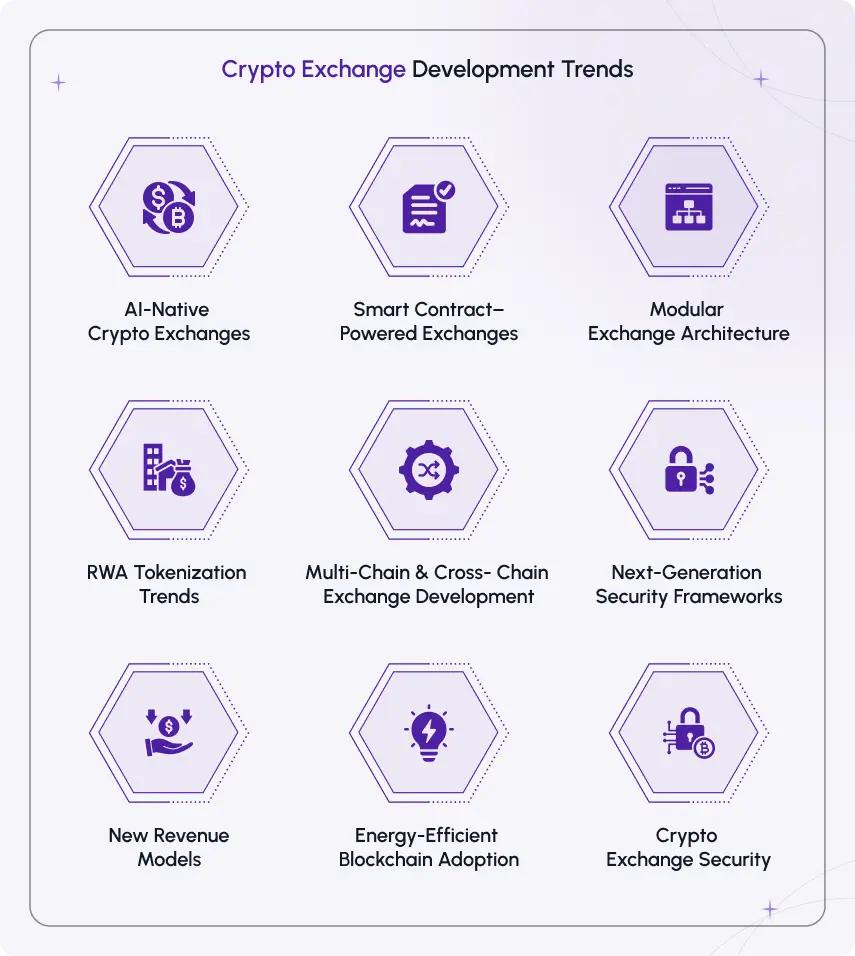
In 2026, the structure of crypto exchange development will be completely changed by regulation, AI, automation, and institutional adoption. A decade hence, exchanges are shifting alignment routes with regard to secure, compliant, and scalable financial institutions to grow on a long-term basis.
1. AI-Native Crypto Exchanges
In 2026, artificial intelligence will be embedded into the central architecture of a cryptocurrency exchange and not as an adjunct external tool. Marketplaces driven by an AI are concerned with fraud, anomalous behaviour, and trade performance with constant vigilance.
Fraud analytics in real time and behavioral anomaly detection
AI-powered anti-money laundering, Know Your Customer, transaction risk scoring
Predictive technology for liquidity risk management and optimization of order book
AI-based support for customers and automation solutions for operational intelligence
For regulatory compliance, AI crypto exchange might lower costs and appropriate a perpetual risk monitoring warranty.
2. Rise of Autonomous and Smart Contract–Powered Exchanges
Smart contracts are more and more automating their exchange operations compared to those traditional ones managed by centralized teams. While full decentralization remains difficult due to regulations, partial autonomy is necessarily required in next-generation cryptocurrency exchange development services.
Automated trade execution and settlement
Smart contract–based escrow, margin calls, and liquidations
Reduced operational risk through deterministic execution
Growing On-chain transparency and auditability
By 2026, compliant exchanges will achieve a balance between automation and regulatory oversight.
3. Modular Exchange Architecture
In exchange, a shift from rigid, monolithic systems are being experienced towards designing modular, composable, and easy-to-be-alloyed architectures to better steer the adverse effects of regulatory changes and market shifts.
Independent Modules for trading, custody, compliance, and reporting.
Implementing upgrades relating to the architecture without causing platform-wide downtime.
Customized Compliance for Specific Jurisdiction
Greater Scalability & Increased Maintainability
The modular architecture holds high esteem for exchanges spanning across multiple borders.
4. RWA Tokenization Trends
Crypto exchanges have pivoted drastically towards the gateway for tokenized RWAs bridging traditional finance governed over blockchain markets, beefing up for cryptocurrency exchange development services beyond mere digital asset trading.
Tokenization of Bonds, Real Estate, Private Credit, and Funds
Investor Eligibility and Jurisdiction-based Access Controls
On-chain settlement with off-chain legal enforcement
Integration with regulated custodians and asset registries
RWA tokenization is driving crypto exchanges one step closer to regulated public capital markets infrastructure.
5. Multi-Chain and Cross-Chain Exchange Development
It is not the case anymore in 2026 that exchanges are bound to exist in just one blockchain ecosystem. With improved modern-day demands, Interoperability is very important in modern crypto exchange development services.
Native support for multiple blockchains
Cross-chain swaps and unified liquidity access
Reduced dependency on single-chain performance
Improved user experience across ecosystems
A closer look will reveal a situation where the liquidity will certainly be distributed and systemic risk will be reduced.
6. Next-Generation Security Frameworks for Crypto Exchanges
Security is transforming from a reactive measure to a continuous regulation-driven framework that gets deeply woven into professional cryptocurrency exchange development services.
Zero-trust infrastructure and hardened APIs
Wallet segregation into multiple layers (hot, warm, cold)
Continuous inspection for threats and automated response
Mandatory compliant audit trails and forensic logging
In 2026, the cyber regulations spurring could lead to specific financial penalties rather than merely brand damage.
"Infrastructure is mature. 2026 is the 'Execution Year.' We’ve moved from building the plumbing to scaling the apps." – @Nekoztek on
7. New Revenue Models for Crypto Exchange Platforms
The trend of making money through trading fees is no longer a practical notion to keep on the exchange business. Exchanges must diversify their revenue streams in order to be resilient.
Custody-as-a-service and institutional accounts
Tokenization benefit from the blockchain platform and asset issuance fees
Compliance, reporting, and infrastructure services
API monetization and white-label exchange solutions
The diversification in revenue models helps exchanges to withstand the market volatility.
8. Sustainability and Energy-Efficient Blockchain Adoption
Reduced environmental awareness is gradually becoming regulatory, inviting interest in the ways how crypto exchange development services are put together.
Preference for using energy-efficient blockchains
Carbon footprint tracking and sustainability reporting
Optimize infrastructure to minimize computational debris
Alignment with the establishment of ESG
Partnership, investing, licensing and investor trust have become increasingly significant for sustainability.
9. Crypto Exchange Security in 2026
Security at the exchange will be a compulsory regulation requirement in 2026; forever it will no longer be a feature of competition, altering the expectations from crypto exchange development services providers.
Proof-of-reserves and solvency transparency
Regular external audits and penetration tests
Governance controls to key and access management systems
Incident readiness and regulatory response planning
An exchange that flunks security evaluations falls toward fines and license suspension or operational shutdown.
A regular path to the future lies in exchanges already committed to AI-native systems, modular architecture, enhanced security provisions, and compatible crypto exchanges SEC regulations in 2026. The adopted cryptocurrency exchange development trends are to be followed if divinely steadfast, compliant, and future-ready.
Reduce regulatory risk with BlockchainX’s crypto exchange development solutions aligned with AML, custody, and audit standards.
Evolution of Cryptocurrency Exchange Development Services
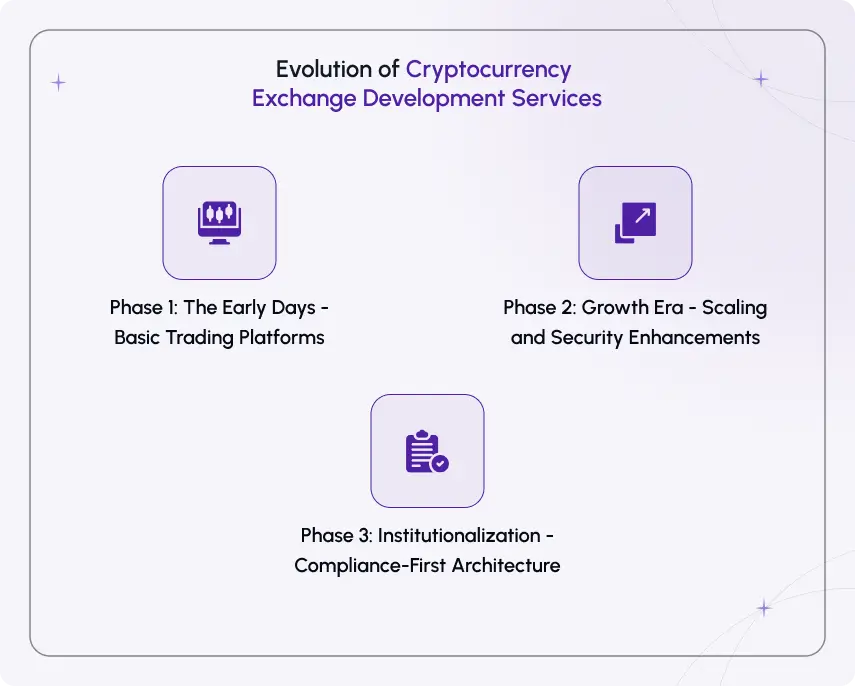
The evolution of cryptocurrency exchange software development services traces the progression from basic trading platforms to regulated financial systems.
Phase 1: The Early Days — Basic Trading Platforms
The very beginning of the crypto industry, cryptocurrency exchange development services involved tools for basic peer-to-peer and spot trading. This is when these exchanges looked more like born light and with limited focus on security or regulation.
Basic order matching and trading pairs
Centralized hot wallets
Minimal or optional KYC
No or very little regulation/government oversight
Hence, the initial phase was identified with the devising crypto exchange development trends for achieving the fastest possible order execution, with absolutely little attention paid to risk management or regulatory considerations.
Phase 2: Growth Era — Scaling and Security Enhancements
The sudden expansion of the crypto community results in increased daily trading volumes, which also creates significant security risks. The era was marked by substantial shifts in the practices of how the cryptocurrency exchange development services operated.
High-performance matching engines
Integration of cold wallets and segregation of funds
Enhanced control in terms of trading, KYC, and AML
Necessary technological updates and improved performance reliability for uptime
This pattern of implementation in the crypto exchange development trends was mainly backed by greater stability and confidence among the dedicated user base.
Phase 3: Institutionalization — Compliance-First Architecture
Today, cryptocurrency exchange development services are building more and more like regulated and enterprise-grade financial platforms as they try to operate like traditional financial institutions.
Building architecture focused on compliance
Institutional custody and proof-of-reserves
Assistance in regulatory compliance across multiple jurisdictions
Risk and transaction monitoring in real-time
Latest crypto exchange development trends increasingly stress the security, the consideration of regulatory issues, and sustainability.
Types of Cryptocurrency Exchanges You Can Build in 2026
With the ongoing development and advancement in the crypto industry, cryptocurrency exchange development services in 2026 should consider various applications and functionalities of exchange models. Various exchange models may fit different business, regulatory, operational, and ownership arrangements.
The choice of the type of exchange is not just a technical decision anymore; it is a critical business decision as it touches on regulatory compliance, scalability, and basically positioning in the market.
1. Centralized Exchanges (CEX)
The centralized exchanges are known to be the most widely used for the high liquidity and institutional trading. Despite the great popularity of CEXs, the current central exchanges are able to operate like well-regulated financial intermediaries.
Essentially, centralized exchanges run on a centralized order book and high-speed matching engine.
User funds are kept in custodial wallets managed by the exchanges.
Henceforth, it makes way for high liquidity and speed for trade execution-apt for institutional trading.
AML, KYC, and Travel Rule-related compliance should be prioritized to maintain CEX operations within legal zones.
High security in the sense of bank-grade custody and asset segregation protocols is paramount.
Proof-of-reserves and a regular potential audit must come together in order to prove transparency in any given transaction.
Exchanges must support some sort of compliance with different sets of regulations across multiple jurisdictions.
Best For: Businesses and enterprises that are aiming for institutional traders, regulated markets, and are stuck with the need for seamless fiat-to-crypto trading with high liquidity.
2. Decentralized Exchanges (DEX)
DEXs offer non-custodial smart contract-based trading, greatly benefiting transparency and user control.
Decentralized DEXs make use of smart contracts for trading, i.e., are non-custodial.
A transaction can be made on either blockchain or a hybrid system.
Users are capable of managing their wallets and private keys.
Liquidity is secured by smart contracts on a liquidity pool.
DEX platforms are increasingly utilizing smart contracts designed to meet regulatory requirements.
Layer-2 scaling and cross-chain interoperability become basic elements.
Compliance modules may have the long KYC front end procedures with geographically focused restrictions in regulatory-mandated regions.
User experience is improving so as to compare to centralized exchange standards.
Best For: Web3 Projects and native currency users already interested massively in managing their holdings, all the while having a full auditability of their transactions and enabling decentralized trade.
3. Peer-to-Peer (P2P) Exchanges
Under this P2P exchange, the trading of cryptocurrency takes place easily because of the direct buying and selling among users. They use escrow to feed trust among traders.
It offers direct trading between buyers and sellers agreed on the platform.
Escrow services are provided by the platform to provide protection for transactions.
The platform also allows multiple local and global payment methods to pay.
Manual intervention in dispute resolution is being reduced through automation.
Security of transactions is achieved through AI: fraud detection and mitigation.
KYC requirements and transaction monitoring become obligatory.
Local regulatory compliance is integrated into the platform workflow.
Best For: Platforms targeting emerging markets, remittance purposes, and users who rely on flexible payment methods, thereby ensuring direct/two-way trading with one another.
4. Hybrid Exchanges
Hybrid Exchanges are the glorious blend to garner the liquidity and performance of centralized systems while providing the ultimate transparency and control of decentralized systems.
Sorting through centralized matching engines with non-custodial settlements.
These platforms provide transparency without affecting trading speed.
Partial decentralization reduces the risk to counterparties.
Hybrid exchanges are designed to meet the requirements of evolving compliance.
DeFi end users as well as institutional end users are comprehensively supported.
The concept is part of a structure designed to prioritize security and decentralization.
Best For: Organizations who aim to comply with the regulatory requirements and allow customers to have better management of the owned assets.
In 2026, successful platforms will be built using advanced crypto exchange development solutions that promote a modular system environment. If you want to launch any type of exchange you must comply with contemporary legislative and regulatory stipulations, target users, and the scalability goals.
Regulations are tightening, and legacy exchange platforms are falling behind. Partner with BlockchainX to build a secure, scalable, and compliance-first crypto exchange.
Why Demand for Cryptocurrency Exchange Development Services is Growing in 2026
Cryptocurrency exchange development services will be in high demand in the event of an upward movement towards 2026. Simultaneously, with the evolution of regulation in digital currency exchange, these platforms could evolve into full-scale financial markets. This evolution relies not just on a market that overexpands but on structural regulation changes too, alongside security expectations and institutional adoption.
1. Regulatory Pressure Is Forcing Platform Upgrades
The AML, KYC, travel rule compliance, custody, and stablecoin regulations put forward by global government entities are becoming far stricter. Many legacy exchanges have not been architected to meet such changing requirements and so are now compelled to go after reliable cryptocurrency exchange development services built around compliance.
2. Rising Exchange Hacks and Regulatory Fines
Big hacks are being succeeded not only by warnings but also by direct financial penalties. Recently, South Korea verbally right-up put forward fines of up to 10% of the affected amount or revenue for exchanges, will be the monetary fine for dealing with security standards after a hack event.
This effectively led security, auditability, custody controls to march up the corporate hierarchy for an even greater demand for such crypto exchange development solutions that do embed risk management.
3. Institutional and Enterprise Adoption
Fintech, asset managers, and banks changing their minds to have a foot in the door, need solid platforms to support institutional security, reporting, and compliance. This shift is driving demand for custom cryptocurrency exchange development services instead of the off-the-shelf or clone-based exchange software.
4. Market Growth and New Asset Classes
The crypto exchange market is hitting high growth rates in CAGR and is looking expansions into new asset classes such as derivatives, RWAs, and tokenized assets, which is requiring highly scalable and modular exchange architecture.
5. Recent Global Regulatory Actions Are Accelerating Demand
In the past month, regulators from all over the world had come to disrupt the exchange design space with compliance mandates:
India has laid down greater KYC rules for crypto exchanges, including obligatory live selfie verification and geotagging, to be better prepared for the AML cause.
The EU and UK are now implementing new AML and crypto tax reporting rules under the Crypto Asset Reporting Framework (CARF) that would require stronger monitoring and reporting on transactions.
The regulators in Asia and Europe have begun tying licensing programs to security audits, custody segregation, and proof-of-reserves for these organizations.
These developments largely ramp up the substantial demand for cryptocurrency exchange development services with a sound emphasis on technology, security, and regulation.
Why Compliance-Ready Crypto Exchange Development Is a Competitive Advantage
In 2026, regulatory compliance is no longer an afterthought once the product is live—it is a core architectural requirement that can give a competitive edge for your services. With stricter global oversight regulations and control mechanisms being implemented for overall market integrity, restraints on the application of compliance procedures have left exchanges without significant disadvantages compared to their counterparts built from an existing compliance point of reference.
1. Faster Licensing and Market Entry
The compliance-ready crypto exchange platform enables users to navigate regulatory books with ease which results in faster approval processes and reduced conflicts with regulatory authorities.
Compliance functionalities for AML, KYC, and Travel Rule
User access and role restrictions across jurisdiction
Pre-configured audit logs and reports
Expedited regulatory reviews and license approvals
2. Reduced Risk of Fines, Suspensions, and Shutdowns
The higher level of regulatory concerns complicates issues with threats of fines and the need for great compliance efforts on a trading ecosystem.
An exhaustive blend of transactions monitoring and risk scoring
Safekeeping and token segregation
Proof-of-reserves and solvency transparency
Reduced non-compliance risk and fines severity
3. Stronger Institutional and Banking Trust
Financial players like banks, payment providers, and investors are considering those exchanges with very high compliance and operational transparency.
Rapid entrance to fiat exchange capabilities and banking partners
Financial custodial services and reporting
Ready-to-go set up for audits of due diligence
Better liquidation through institutional participation
4. Lower Long-Term Operational and Upgrade Costs
A compliance-first configuration decreases the cost of developing any future upgrade of all applicable regulations.
Retrofitting after the launch is less likely to occur.
Modules that meet compliance criteria are likely to enable straightforward and modular upgrades.
Minimizing downtime during the modification in regulation
Lower audit costs and associated remediation so a revision can be completed more quickly
5. Higher User Trust and Brand Credibility
Users like to trade on platforms where everything is accountable, transparent, and legally tolerable.
Simplifying disclosures regarding compliance and user protection
Security bolstering regarding the platform and safety of the funds
Reduced reputational risk in the face of market volatilities
Better brand positioning in competitive markets
6. Seamless Multi-Jurisdiction Scalability
Compliance-enabled architectural design sets the stage for global expansion despite not changing the core system completely.
Country or region wise configurable compliance rules
Faster market entry, with minimal re-engineering
Uniform risk controls across jurisdictions
Enabling compliance to serve as an instrument of growth, freeing multiple hurdles
Crypto exchange development services must build a cryptocurrency exchange platform that complies with global regulations. Nowadays compliance is no longer an imposition; it can actually be a strategic asset. Exchanges benefitted from compliant architectures for faster market entry, stronger institutional ties, lower regulatory risk, and the capability of sustainable growth.
By 2026, crypto exchange development that meets compliance standards is essential, as it offers a significant advantage in competing with emerging platforms by enhancing reputation and scalability.
Conclusion
Cryptocurrency exchanges in 2026 are transitioning strongly into a regulated, institutional-class infrastructure to support genuinely regulated finance. Rapid market growth, along with increasing regulatory oversight and more involvement of institutional stakeholders, are now hovering over how exchanges must be designed, secured, and operated.
Modern cryptocurrency exchange development services should take account of AI-native architectures, smart contract automation, modular systems, cross-chain interoperability, and the tokenization of real-world assets rather than merely the trading functionality by which the exchanges have historically been defined.
However, the deepening regulations worldwide, like those with harsher hacking penalties and the emergence of more stringent AML and custody requirements, mean that a capability for compliance-ready development is no longer optional but a competitive necessity.
Enterprises that invest in secure, scalable, and regulation-aligned exchange platforms will be even better placed to win market confidence, secure institutional partners, and expand into other jurisdictions. In the end, it is the exchange being set up today that will determine who becomes the key successor in the global digital asset economy.
Why BlockchainX for Cryptocurrency Exchange Development Services
At blockchain development firm, we develop secure, enterprise-grade cryptocurrency exchange platforms from scratch that can meet modern-day challenges in 2026 and further. The dynamics of the exchange have changed; the current exchange is not any more just a trading engine; it is a regulated financial system required to be compliant that must meet strict security, custodial, and compliance standards of different jurisdictions.
Our team is comprised of experts for rendering end-to-end cryptocurrency exchange development services, whether Centralized Exchange (CEX), Decentralized Exchange (DEX), Peer-to-Peer exchange (P2P), or any hybrid models in respect of modular, scalable architectures.
So, from day one, we pertain to AI-based risk management, institutional-level storage, proof-of-reserves, and multi-chain interoperability. So, we provide the tech, ready to be aligned with global regulations that are constantly changing, as to reduce regulatory risks to business, accelerate licensing, and build long-lasting trust with the users and institutions.
With BlockchainX, we don't build exchanges but are shaping the backbone of tomorrow's digital asset infrastructure engineered for growth, resilience, and regulatory confidence.