
How to Create Crypto Exchange Platform: 8 Quick Steps
Listen to the Audio :
Ever wondered how to create cryptocurrency exchange and turn it into a scalable trading platform built for real-world market demands?
Building a crypto exchange is not simply a development project. It is a regulated financial business requiring the right exchange mode, security protocol, liquidity mechanism, and a battle-tested development team. This is where partnering with an experienced cryptocurrency exchange development company becomes essential to ensure secure architecture, regulatory readiness, and faster deployment.
From defining the architectural model and choosing the ideal technology to platform launch and growth, every phase plays a crucial role in shaping the performance and trustworthiness of the project. Learn how to strategically transform your crypto exchange idea into a fully functional platform with this guide.
What is a Cryptocurrency Exchange Platform?
A cryptocurrency exchange is a digital marketplace where users can buy, sell, or trade cryptocurrencies such as Bitcoin and Ethereum. These platforms match buy and sell orders through an order book system or smart contracts, depending on the model you choose.
Across the ecosystem, there are 500+ active crypto exchanges globally, where users can trade their digital assets for conventional fiat currencies like the US dollar or the Euro, or any other cryptocurrencies. This collectively holds about $500 billion to $900 billion in crypto users' daily transaction volume, depending on market conditions.
Generally, cryptocurrency exchanges can be classified into various types, where centralized and decentralized exchanges are the major ones. Each type comes with unique features, holding various advantages to attract global investors in the rapidly growing digital finance.
8 Steps To Build a Cryptocurrency Exchange Platform
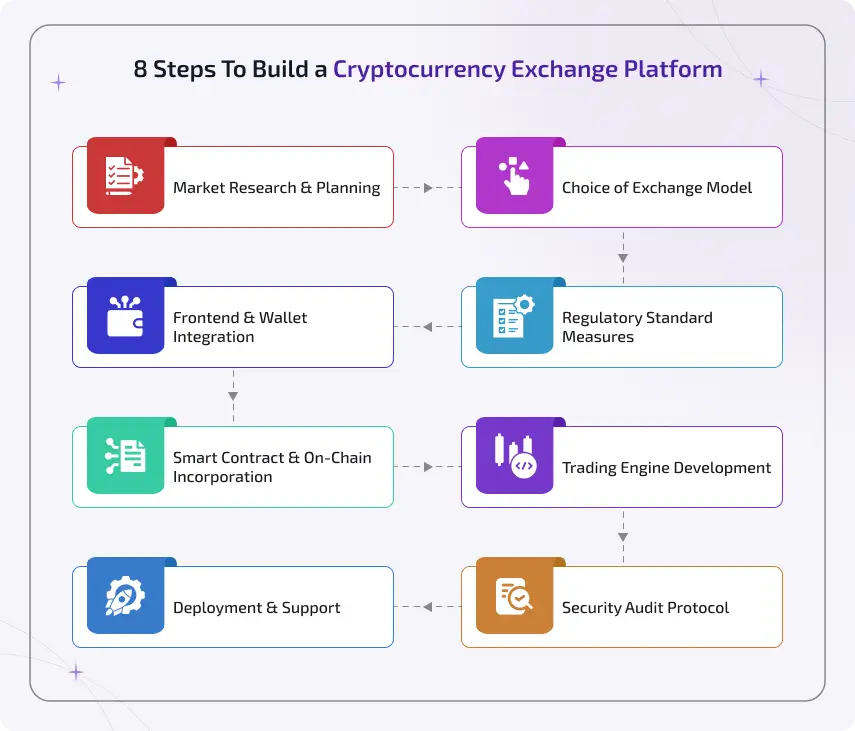
Building a cryptocurrency exchange is essential in today’s digital economy, as it enables users with secure asset trading, enhanced market accessibility, and supports the overall demand for both CEX and DEX ownership models in the Web3 space. Let's explore the crucial steps involved.
Step-1: Market Research & Planning
The initial step begins with the ideal planning of an exchange that is compliant-focused, efficient, and optimized. Also, we conduct thorough market research to understand the market trends and expectations for building a crypto platform.
Customer expectation & market variations
Core revenue income streams
Compatible technology stack
Jurisdictional regulations (Based on the targeted market)
Step-2: Choice of Exchange Model
Select a suitable crypto exchange model, as it is the primary driver behind the platform’s transaction speed, operational system, cost, and user interaction. Each model has distinct components supporting the overall platform functionality.
Step-3: Regulatory Standard Measures
Licensing the crypto exchange with the right regulatory standards is essential. There are stringent rules followed in different regions for exchange operations.
CEX - Requires strong KYC/AML authentication measures, transaction monitoring, and a compliance framework
DEX - Permissionless user accessibility. Focuses on smart contract audits and transparent operation
Step-4: Frontend & Wallet Integration
Create crypto exchange with a highly responsive UI/UX interface and seamless wallet system to deliver smooth trading access, asset management, and effective market execution across the platform.
CEX - Custodial wallet connection, sophisticated dashboards & real-time order management
DEX - Self-custodial wallet connections, basic token swaps & user-driven direct interactions
Step-5: Smart Contract & On-Chain Incorporation
Blockchain nodes and automated contract functionalities are integrated to facilitate traceable transactions, smart execution, and cross-chain trade interaction across the platform.
CEX - On-chain networks for secure deposits, withdrawals, and controlled asset management within a centralized entity
DEX - Smart contract protocol for trustless operations, liquidity handling, and decentralized trading automation
Step-6: Trading Engine Development
Build the core execution component that is significant for any type of exchange. It manages the buy and sell orders and matches trades efficiently. This ensures smooth and stable market performance across the exchange.
CEX - Uses central limit order books (CLOB) to match trades efficiently, execute, and manage the overall trading performance
DEX - Uses an automated market maker, a smart contract protocol to execute trades directly on-chain without any intermediaries
Step-7: Security Audit Protocol
Perform a comprehensive security audit to validate the involved vulnerabilities/bugs. This strengthens the system’s integrity and reinforces the overall security of the exchange before the deployment process.
CEX - Focus primarily on platform security features, penetration testing, wallet safety verification, and custodial asset risk monitoring
DEX - Includes mainly smart contract auditing, protocol validation, and ensuring on-chain transaction security and transparency level
Step-8: Deployment & Support
Once completely audited, the platform is deployed on a secure and highly scalable infrastructure for further access. The system is continuously monitored, optimized, and provided with back-to-back operational support.
CEX - Involves centralized server deployment processing, real-time monitoring, and post-launch support of wallet and trading services
DEX - Involves smart contract launch, node synchronization, and 24-hour monitoring and support through decentralized upgrades
Call to action — Build your crypto exchange with BlockchainX
Trusted Web3 Development Partner
Ready to Launch Your Cryptocurrency Exchange?
Partner with BlockchainX — a leading cryptocurrency exchange development company — to build a secure, scalable, and compliant trading platform. From CEX to DEX, we engineer end-to-end exchange solutions tailored to your vision.
Security-first architecture
CEX & DEX development
Regulatory compliance
24/7 post-launch support
Working Mechanism of a Cryptocurrency Exchange
A cryptocurrency exchange functions via a structured workflow of digital assets with speed, accuracy, and reliability. Designed with core infrastructure and robust security layers, it powers users to trade in a seamless environment across all supported assets. Let's take a look at the working functionality of cryptocurrency exchanges.
User Onboarding
Users need to open an official account on the exchange firm, providing mandatory identification details such as an email ID or wallet information. This provides user access to trade cryptocurrencies or valuable assets.
Identity Verification
Depending on the exchange type, users may need to comply with local jurisdictional requirements through the KYC identification process. The account gets verified with the submission of government-issued documents.
Deposit Funds
To begin trading, users fund their account using cryptocurrencies or fiat capital options using supported payment methods. Once funds are deposited, the wallet balance becomes available for trading digital assets.
Order Execution
Users can place a limit order or market order through the platform interface. A market order immediately executes a trade at the live market price, whereas a limit order is processed only at specified price levels.
Matching Engine
As a core trading component, the matching engine processes and matches the most compatible buy and sell orders in real-time. It ensures seamless and fast trade execution with minimal latency across the platform.
Trade Settlement
After the successful execution of the order, the platform will settle the transaction by transferring the valuable assets between the trading parties. The crypto wallet balance and the transaction details are updated, respectively.
Withdrawal Process
Once a trade concludes, users move the traded coins between their wallets. Users can cash out fiat to a bank account or move cryptocurrency to an external wallet at any time.
Types of Cryptocurrency Exchanges
A structured quick comparison of the major cryptocurrency exchange models, highlighting how each type operates across platforms and differs in control, efficiency, security systems, core functionality, and much more. Let's take a look at the comparison table.
Cost Breakdown Analysis for Building a Crypto Exchange Platform
Here is a comprehensive overview of the necessary investment required to build a crypto exchange. This table outlines the core sectors that influence overall crypto exchange development cost and scalability.
The choice between custom development and white-label crypto exchange development solution also impacts the cost. While choosing a white-label solution, which offers quicker setup but less customization, might cost anywhere from $30,000 to $100,000, a completely customized exchange can cost anywhere from $200,000 to $500,000. From $10,000 to $50,000 a month, running expenses cover security upgrades, maintenance, and customer service.
Key Advantages of a Cryptocurrency Exchange
Building a fully functional crypto exchange is driven by strong operational and business advantages that will assist your company with revenue potential and your overall market positioning of the niche project. Let’s explore the core advantages behind it.
Growing Market Demand
More and more people and businesses are realizing how important digital assets are driving the cryptocurrency market to grow at a speed that has never been seen before. This increase in demand gives new exchanges enormous opportunities to assist investors and dealers. To start a crypto exchange and providing services fit for the evolving needs of your clients eager to engage with cryptocurrencies will help you lead in this expanding industry.
Revenue Generation
Cryptocurrency exchanges can be very profitable businesses. You can usually make money in multiple ways, such as by charging fees to add new tokens or trade tokens & withdraw money. As the trading volume goes up, your exchange can make more money, which could make it a profitable business plan. By using the best social media marketing methods to get more traders, you can increase the amount of money you can make.
User Control & Decentralization
If you decide to build a decentralized exchange, you can give your users more power over their money and trades. DEXs appeal to users who value security and privacy since they let others trade among themselves free from middlemen. Apart from enhancing your users, this approach helps a fair financial ecosystem by following the fundamental principles of cryptocurrencies.
Innovation Prospects
A crypto exchange empowers your business with cutting-edge tools and services that will make your platform stand out among the competitors. In addition, providing an innovative user experience can increase your user count and encourage loyalty through advanced trading options, staking capabilities, and distinctive security measures. This resilience assists you in innovating regularly to meet your user expectations and adjust to changes in the market.
Global Market Access
Running a crypto exchange will provide access to world-wide marketplaces and a huge spectrum of people. Unlike conventional financial systems that could be limited by national boundaries, cryptocurrencies enable trade anywhere. Along with adding more potential users, this wider market access makes the platform more liquid, which is a technical advantage.
Community Engagement & Loyalty
To build crypto exchange, you might need to connect with a large community users who are interested in digital assets. People will communicate about your project and keep coming back to the platform if you connect via social media, forums, and educational tools. Loyal users of your platform are more likely to tell their peers about it, which helps with the platform expansion.
Financial Inclusion Contribution
There are places where normal banking services are hard to find or not available at all, but cryptocurrency exchanges can help people to get easy accessibility to their account. Giving flexible access to the worldwide market and financial capabilities they lacked before through digital product trading will empower the users more. This promotes financial inclusion, creating profitable and fair opportunities for everyone.
Why Do Companies Choose To Invest In Crypto Exchange Development?
Due to numerous strong benefits, organizations are increasingly adopting cryptocurrency exchange development. With recent statistical reports, the global cryptocurrency exchange market is predicted to reach $264,318.3 million by 2030, with the maximum user count rising at a CAGR of 28.4% from 2024 to 2030.
These exchanges will be the major contributors to profitable business opportunities for both fintech growth and tech advancement. Here are some of the core reasons listed below that insist that you invest and create a crypto exchange platform in 2026.
Companies prefer in-house platform development to embed customer KYC/AML workflows, transaction monitoring, and IP-first access controls tailored to evolving regulatory standards.
The rise of AI-agents and Web3 is allowing companies to build instantaneous, API-ready cryptocurrency exchanges designed to support autonomous on-chain trading, payments, and operations at machine scale.
As private credit, equities, and EFTs are rapidly shifting onto blockchain, businesses are booming with crypto exchange investments to support the next wave of tokenized asset trading.
Custom exchange architecture enables businesses to integrate multi-exchange API routing and a unified order-book matching engine, ensuring tighter spreads and seamless high-volume trading.
Key Features of a Cryptocurrency Exchange
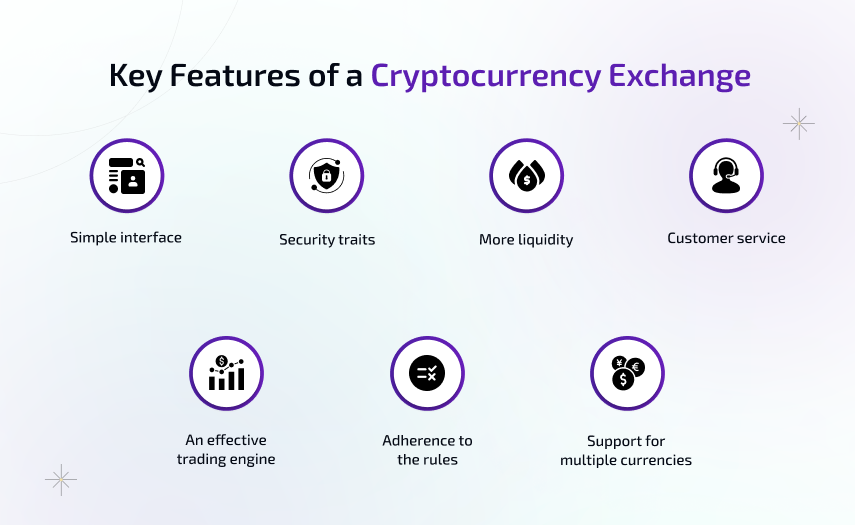
Every reliable crypto exchange must have a few essential features to ensure smooth operation and user safety. These features bring in more people by making crypto exchanges more unique. Any crypto exchange must have the following features.
1. Simple Interface
A Crypto market needs to have a simplified interface. It should not be difficult for users to navigate the platform and manage their accounts. A clear and well-designed interface makes trades and exchanges happen more frequently, which highlights the success of a project.
2. Security Traits
Security is the top priority for any cryptocurrency exchange. Security methods that protect users from cyberattacks include encryption, two-factor authentication, and cold storage for digital assets. A safe platform fosters trust by ensuring the adequate protection of consumers' investments and private data from potential dangers.
3. High Liquidity
It is simple for people to buy and sell crypto quickly and without major price changes due to liquidity. A market with a lot of liquidity paves way for seamless transactions by connecting buyers and sellers. When there is high liquidity, prices are better for trades & the market runs more effortlessly maintaining user retention.
4. Multiple Currency Support
On an effective platform, you should be able to trade more various cryptocurrencies. Supporting more than one crypto makes trading more popular and gives users more choices. Having various assets makes the platform more appealing to a wide range of investors. This increases its market reach and makes it more competitive.
5. Effective Trading Engine
The key to every exchange is the trading engine. It processes orders and transactions accurately and swiftly. An efficient engine ensures a smooth experience even during high traffic times, manages large trading volumes, and executes trades with minimal lag or errors. This is essential to keep your users satisfied and happy.
6. Legal Adherence
To create a crypto exchange, companies must follow rules of KYC (know your customer) and AML (Anti-money laundering) laws to be legitimate. Compliance helps to maintain user and authority’s trust level. A crypto exchange that is legally compliant has a higher chance of bringing in institutional investors, running smoothly across borders.
7. Customer Service
Effective customer service determines the prompt resolution of user problems. Having responsive employees on hand facilitates the speedy resolution of technical issues, transaction errors, or account concerns via live chat, email, or phone assistance. A robust support system ensures long-term platform loyalty by boosting user confidence and maintaining their satisfaction.
The Key Technologies Driving the Crypto Exchange Platform
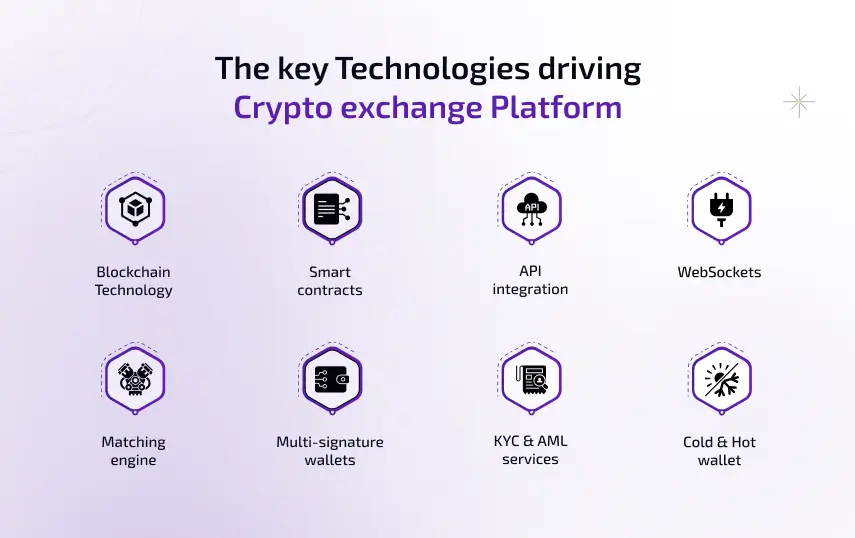
A strong combo of advanced technologies is needed to develop a crypto exchange platform that is safe, scalable, and intuitive for users to access. Below mentioned are the key technologies to be noted.
Blockchain Technology
Crypto exchanges operates based on blockchain technology, which ensures decentralized, public, and immutable transaction records. The network checks every transaction, enhancing its safety and reliability.
Smart Contracts
DEX platforms mostly use smart contracts, allowing automated user transaction without trusting an intermediary. They also let people carry out agreements for trading, staking, and yield farming in a cost-effective manner.
API Integration
To follow the rules, crypto exchanges connect to many different types of services through APIs. These include external trade tools, payment processors, liquidity providers, Know-your-customer (KYC), and Anti-money laundering systems (AML).
WebSockets
This technology plays a crucial role in enabling users and the exchange to monitor transactions in real-time without the need to restart the page, receive alerts when an order is executed, and monitor price changes.
Matching Engine
The matching engine is the heart of every cryptocurrency exchange matches buy and sell orders so that there is low latency and fast transaction flow even when there are a lot of trades going on at once. The platform demands it to be quick and effective.
Multi-Signature Wallets
As these wallets need more than one private key to accept transactions or withdrawals, they make things safer and make it less likely that someone will steal your money or tamper your account without permission.
KYC & AML Services
The exchange adheres to global law because it incorporates KYC (know your customer) and AML (anti-money laundering) regulations. These systems enhance security and prevent fraud by verifying the identities of users and monitoring any suspicious activity.
Cold & Hot Wallet Storage
Exchanges usually use both cold (offline) and hot (online) wallets to manage customer funds. While cold wallets keep most of your assets offline and safe from hackers, hot wallets let you handle transactions right away.
Monetization Strategies to Create Crypto Exchanges
Transaction Fees
Charges every trade with a percentage or a fixed fee.
Maker-Taker Fees
Provide greater fees for takers and lower rates for liquidity providers.
Withdrawal or Deposit Fees
Calculate costs for both fiat and crypto fund transfers.
Token Listing Fees
Charge projects for conducting initial coin offerings (ICOs) or token listings.
Margin Trading Fees
Place charges for liquidation fees and earn interest on borrowed money.
Staking & Lending fees
Get a paid commission from staking or lending fees.
Premium Membership
Use premium subscription models to provide innovative tools and reduced costs.
Advertising & Sponsored Listings
Earn money by placing sponsored tokens and running advertisements.om staking or lending fees.
Native Tokens
Provide fee reductions or token buybacks to boost exchange profitability.
API & White-Label Solutions
Charge fees for licensing white-label exchange software or access to premium APIs.
Why Choose BlockchainX for Cryptocurrency Exchange Development?
Due to its advanced technology, strong security features, and flexible solutions—BlockchainX is one of the preferred choices to create crypto exchanges in the industry. We guarantee our clients a smooth integration of robust security methods due to our extensive experience. The platform has simple interfaces and customer services that are available 24 hours a day and support numerous cryptocurrencies.
BlockchainX is a reliable partner for delivering secure and efficient cryptocurrency trading solutions due to its cutsomized features and strict adherence to regulational policies and integrating customized features. Here are the key reasons why you should choose our expertise.
Robust Security Protocol
Our system uses high-end security measures like encryption, multi-signature wallets, and two-factor identification for asset protection.
Scalability
The system's scalable design makes it simple to handle a large number of transactions and payments.
Fully Customizable
We can make choices that fit the needs of each exchange, like decentralized trading, margin trading, or spot trading.
Compliance Standards
It simplifies legal and compliance procedures and ensures their alignment with both national and international regulations.
Better Efficiency
To ensure low latency, the system is engineered with real-time data processing and high-throughput trade execution in mind.
24/7 Support Team
The technical service is available 24/7 to help with any queries or issues regarding the platform operations.
Liquidity Solutions
With liquidity solutions built into the system, traders can be assured that prices won't change much during trades.
White-Label Exchange
We provide completely white-label solution, so you can customize your own cryptocurrency exchange platform as per your requirements.
Conclusion
With crypto assets being adopted more and more, and with over 60% of the population already involved, exchanges become the main hub of the fintech industry. As said above, every little step counts, like choosing the core architecture first and then folding in the major pieces right after; it all stacks up to a smoother user experience, and that helps the ecosystem keep a kind of stable, sustainable momentum. So if you’re building a centralized crypto exchange, a decentralized exchange, or any other variation in the crypto sphere, it’s smart to team up with a dependable exchange development company, such as BlockchainX.
FREE CONSULTATION
Ready to Build Your Crypto Exchange?
Tell us your vision. Our team will put together a custom development roadmap, timeline and cost estimate - tailored specifically to your project.


