8 Easy Steps to Create Your Own Fiat-Backed Stablecoin
Listen to the Audio :
What if traditional money could move as easily as a digital asset? Fiat-backed stablecoins make it possible by combining the stability of fiat currencies with blockchain’s speed and programmability. What started as a crypto-trading tool has become something bigger: the global fiat-backed stablecoin supply has exceeded $273 billion by March 2026, growing 40 times bigger than in March 2020. But creating your own fiat-backed stablecoin in 2026 involves more than launching a token.
From remittances to B2B payments and treasury management, stablecoins are becoming harder to ignore, quietly reflecting how money is transferred. However, this blog breaks down clearly what it takes to build a fiat-backed stablecoin and why it matters now.
What is a Fiat-Backed Stablecoin?
It is a type of cryptocurrency or digital token that is designed to maintain a stable value of the traditional fiat currency in a 1:1 ratio. Here, the fiat currency may be the euro, the US dollar, or an Indian rupee whose value is being directly backed by reserves of real-world fiat currency and fiat-equivalent assets, such as bank deposits, cash, or short-term government securities.
They combine the efficiency of blockchain with high stability, offering a cost-effective, transparent, and rapid alternative to traditional remittances and serving as a gateway to traditional financial methods. The key characteristics of a fiat-backed stablecoin include
1:1 pegged ratio with the underlying currency
Designed to help holders redeem the token for fiat
Minimizes price volatility unlike Ethereum or Bitcoin
Audited regularly for high security and transparency
Understanding the Key Differences Between Major Stablecoins
Not every stablecoin is backed in the same way. Each model uses its own mechanisms and functions for maintaining stability. This comparison highlights the major differences between fiat-backed stablecoins and other popular models across various key factors.
| Core Components | Fiat-Backed | Crypto-Collateralized | Commodity-Backed | Algorithmic |
|---|---|---|---|---|
| Primary Backing | Fiat-reserved | Crypto assets | Commodities | Algorithms/mechanisms |
| Price Peg | Usually fiat currency | Usually fiat currency | Commodity or fiat value | Usually fiat currency |
| Stability Mechanism | Reserve and redemption | Collateral management | Commodity reserves/redemption | Supply and demand mechanisms |
| Collateralization | Typically reserve-backed | Usually overcollateralized | Asset-backed | No direct collateral |
| Volatility Exposure | Generally lower | Higher | Commodity-dependent | Potentially high |
| Centralization | Usually centralized | Varies | Usually centralized | Often more decentralized |
| Key Risk | Issuer/reserve risk | Collateral volatility | Custody/commodity risk | Mechanism or market failure |
| Common Uses | Payments, trading, settlement | DeFi, trading, collateral | Investment and value exposure | Experimental/DeFi applications |
| Examples | USDC, USDT | DAI and similar models | Gold-backed tokens | Various protocol-based models |
Must-Have Features for a Compliant Fiat-Backed Stablecoin
Discover the essential features that define how fiat-backed stablecoins stay stable and redeemable in a more transparent and practical way for digital financial applications. The right feature is important for maintaining the stablecoin’s value and user trust. Let’s get to know it.
Segregated Custody
Reserves are held with regulated banks or licensed custodians and kept legally separate from the issuer’s own operating funds. This protects holders even if the issuer becomes insolvent and makes the fiat-backed stablecoins trustworthy.
Redeemability
Eligible token holders can redeem their stablecoins for the underlying fiat currency either via authorized redemption partners or directly through the issuer without excessive delays. This mechanism is subject to the issuer’s redemption terms.
1:1 Reserve Backing
Every token is fully matched and supported by an equivalent unit of fiat currency or fiat-equivalent assets like cash or short-term treasuries. They are held in reserves close to the underlying currency, providing a strong foundation for users.
Regular Attestations
Independent accounting firms routinely verify whether the issuer holds sufficient eligible assets to support the circulating token supply, with improved transparency and strength. This report is published monthly or quarterly to maintain public trust.
Minting & Burning Mechanism
Tokens are seamlessly minted when eligible users provide reserve assets and burned when they are redeemed. This helps users control the circulating supply and maintain a constant alignment between tokens and the available reserves.
Controlled Token Supply
The token’s circulating supply is linked to the reserve and issuance process, which enables authorized entities to create or redeem tokens based on the available backing instead of unrestricted token issuance.
Multi-Chain Compatibility
The majority of fiat-backed stablecoins are issued across diverse blockchain networks to strengthen users' access across the same stablecoin ecosystem while selecting networks based on cost, speed, flexibility, and functionality.
8 Simple Steps to Create Your Own Fiat-Backed Stablecoin in 2026
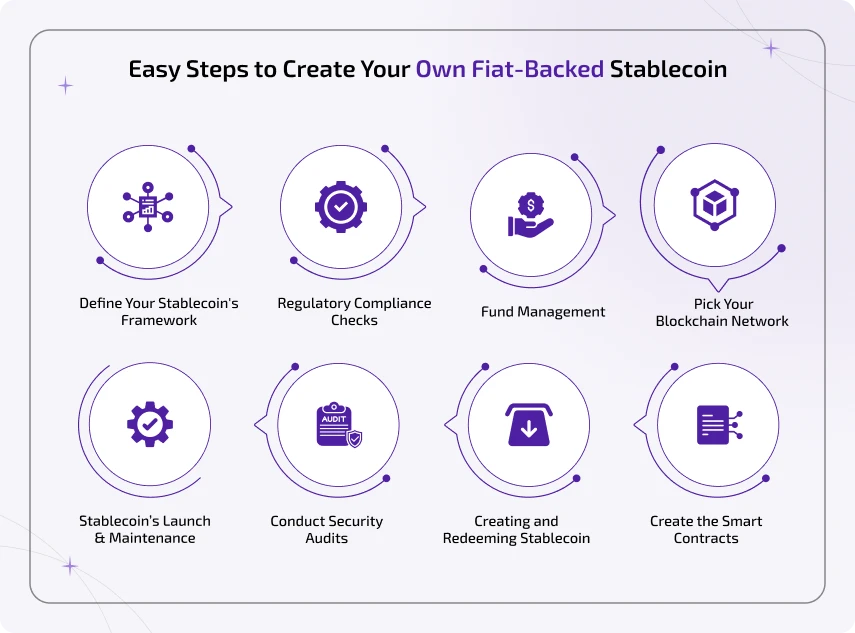
Explore the essential steps covering everything from defining your stablecoin model to integrating compliance. Here’s a look at the development journey for you to create a fiat-backed stablecoin in 2026.
Step 1: Define Your Stablecoin’s Legal Structure
Begin the development process by choosing a jurisdiction with clear stablecoin regulation. This determines licensing requirements, reserve rules, and redemption obligations. Then, decide which fiat currency your stablecoin is pegged to, whether it’s USD, EUR, etc.
Step 2: Obtain License & Regulatory Approval
Apply for a transmitter license or an e-money license based on your specific jurisdiction. Regulators typically use proof of reserve backing, AML/KYC compliance, and ongoing disclosure commitments to ensure transparency and to avoid future trespasses.
Step 3: Set Up Fiat Reserve Custody
Partner with a regulated bank or custodian to hold the 1:1 fiat reserve. Reserves are usually a mix of cash and short-term government securities, such as T-bills, repos, etc., to balance liquidity and safety. Once created, conduct audits and verify the necessary protocols to enhance trust among users.
Step 4: Choose Your Blockchain
Select the right blockchain network on which you want to issue your fiat coin. The blockchain may be Ethereum, Tron, Polygon, etc., or other Ethereum-equivalent token standards. Multi-chain issuance increases user reach but adds security complexity. So, choose platforms wisely, considering their price and security.
Step 5: Develop & Audit the Smart Contract
Build an audited smart token contract with mint/burn functions controlled by the issuer, along with features and blacklisting for compliance. Get the contract independently audited before mainnet deployment to support reliable transactions with reduced operational risk and cost-effectiveness.
Step 6: Establish Mint & Redemption
Build the operational reserve management so authorized partners or users can deposit fiat to mint tokens and redeem them back for fiat with a 1:1 ratio. This would properly check the KYC/AML at both ends while maintaining its trust and transparency.
Step 7: Set Up Reserve Attestation & Audits
Further, an independent accounting firm is engaged to publish regular attestations, confirming reserves and circulating supply. Full audits build stronger trust than attestations. Then, monitor the platform continuously to build confidence among users and strengthen the stablecoin’s value.
Step 8: Launch, List & Integrate
Finally, deploy the stablecoin on the mainnet to get listed on exchanges. Integrate with wallets and payment rails accordingly. Then, maintain continuous security audits with ongoing compliance and reserve management to enhance long-term sustainability and user confidence.
Global Fiat-Backed Stablecoin Key Regulations 2026
Stablecoins are going mainstream in 2026, with regulators focusing heavily on licensing. The following section clearly shows a country-wise breakdown of regulations for fiat-backed stablecoins, covering the major areas.
United States
GENIUS ACT (Guiding and Establishing National Innovation for U.S. Stablecoins Act)
Signed on July 18, 2025
It is the first-ever comprehensive federal framework for payment stablecoins with a dual-track system to maintain 1:1 reserves. Unauthorized treasury issuance is about to end in November 2026, after one and a half years of sanctions.
European Union
MiCA (Markets in Crypto-Assets Regulation)
Regulation (EU)
It provides an integrated EU licensing framework for crypto assets, including asset-referenced tokens and e-money tokens (EMTs). The single rulebook licensing for crypto-asset service providers and stablecoin issuers is implemented across all 27 member states.
Hong Kong
Stablecoins Ordinance
Effective from August 1, 2025
Issuing fiat-backed stablecoins has become a regulated activity with an HKMA license, marking it a major transition from framework development to active licensing. HSBC and Anchorpoint have already been licensed under the same rule, covering the major requirements.
United Kingdom
FSMA 2000 (Financial Services and Markets Act)
Signed in 2000
Fiat-backed payment stablecoins came into the UK’s regulated perimeter, where the Bank of England, FCA, and HM Treasury finalized detailed rules. The full service is about to become effective in October 2027, with FCA policy statements covering disclosures and issuance.
Singapore
MAS (Monetary Authority of Singapore) Stablecoin Regulatory Framework
Passed on September 2, 1970
Continues to easily distinguish regulated stablecoins backed by high-quality reserves from other cryptoassets, with rules on disclosures and reserve assets.
United Arab Emirates
PTSR (Payment Token Services Regulation)
Effective from July 2024
The CBUAE enables all stablecoin issuers to get central bank approval and maintain 100% reserve backing held securely in segregated accounts. USDU is the UAE’s first USD-backed stablecoin, backed by 1:1 dollar reserves.
What is the Development Cost of a Fiat-Backed Stablecoin in 2026?
Ready to create a stablecoin on your own? You need to have a basic understanding of its cost components. To provide the best estimate, you need to decide on the architecture as early as possible. Different models have different levels of engineering, and here’s what you need to know about them.
Basic-Level
$15,000 - $60,000- Simple token contract
- Minimal customization
- Single-blockchain deployment
- Supports mint/burn functions
- Covers basic wallet integration
Mid-Level
$60,000 - $150,000- Smart contract auditing
- Reserve custody setup
- Jurisdiction-specific licensing
- Blacklisting
- KYC/AML checks
- 1-3 month attestation process
- Reserve management
- Admin dashboard support
Enterprise
$150,000 - $300,000- Multi-chain deployment
- Independent audit trails
- Multi-jurisdictional licensing
- Tailored compliance structure
- Institutional-grade reserve management
- Exchange listings, SLA-backed uptime, and advanced controls
Have a stablecoin idea? Let’s make it real.
| Stablecoin Types | Development Cost | Complexity Level |
|---|---|---|
| Fiat-Backed | $80,000 - $250,000 | Low |
| Crypto-Collateralized | $150,000 - $400,000 | High |
| Commodity-Backed | $120,000 - $300,000 | Medium-High |
| Algorithmic | $200,000 - $500,000 | Very High |
What Are You Actually Paying For? The Main Cost Factors Explained
The Possible Ways Issuers Can Make Money From a Fiat-Backed Stablecoin
While development costs are straightforward, issuers must also consider the earnings that come post-launch. The five most important revenue streams where issuers generate funds are as follows.
Reserve Interest Income - Issuers earn income from eligible reserve assets such as securities, short-term government, and US Treasury bills with sufficient liquidity for redemptions.
Redemption Fees - Generate a small amount of revenue when users redeem stablecoins for fiat, helping cover operational costs, processing, and banking.
Payment & Settlement - Charge a small amount of fees with stablecoin-backed payment infrastructure and financial institutions, supporting rapid digital transactions.
Transaction Fees - A small share of fees is added from smart contract interactions and transaction fees on transfers. But this stands as a supplementary reserve yield for the majority of the issuers.
Enterprise Partnerships - Earn fees by integrating and having partnerships with popular payment providers, crypto exchanges, and financial institutions.
Note: For the majority of the fiat-backed stablecoin issuers, reserve interest income stands as the major revenue source, while others stand as the secondary option.
Business Benefits of Fiat-Backed Stablecoin
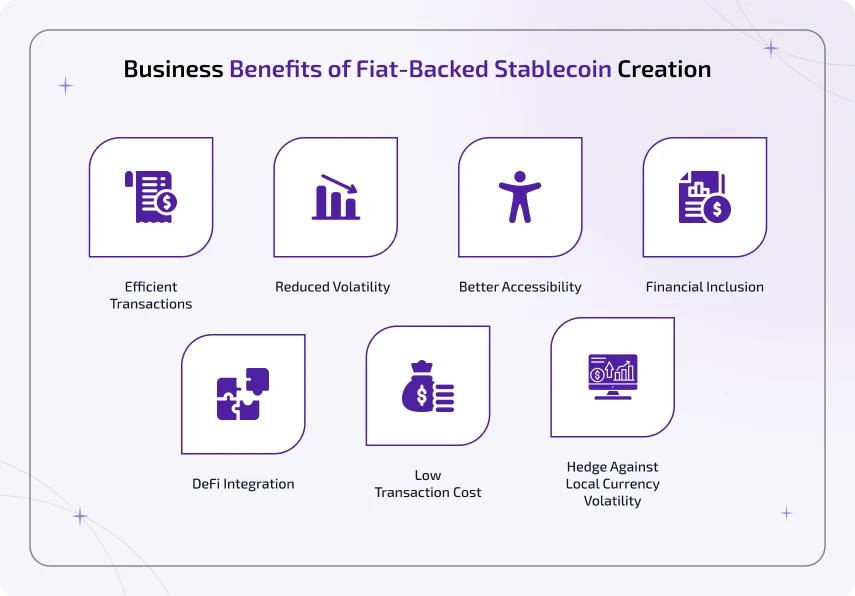
Fiat-backed stablecoins offer various benefits ranging from price stability to currency fluctuations. Let’s discover their benefits together to boost your proficiency in crypto finance.
Efficient Transactions
Unlike traditional banking systems, fiat-backed stablecoins remove middlemen and support instant transfers across borders. This enables businesses and individuals to make rapid payments and conduct instant financial operations.
Reduced Volatility
Stablecoins, in contrast with cryptocurrencies like Ethereum or Bitcoin, are tied to assets like fiat currencies with stable prices. Here, companies can smoothly conduct transactions and get rid of market price fluctuations without the fear of sudden loss.
Better Accessibility
Stablecoins support worldwide business transactions without relying on centralized banks, authorities, or digital wallets. This makes global users easily engage in digital payments and access previously restricted financial services.
Financial Inclusion
Supporting all types of users, stablecoins help both unbanked and underbanked users take part in the global financial system without access to traditional banking. Any user can easily use stablecoins for payments, savings, online commerce, remittances, and other activities.
Low Transaction Cost
Fiat-backed stablecoins remove middlemen and support rapid and affordable transactions, increasing customer satisfaction. This is one of the major advantages for businesses or individuals who frequently conduct borderless payments.
Hedge Against Local Currency Volatility
Fiat-backed stablecoins serve as one of the best ways to secure and store unstable currencies in a high-inflation area. This makes users preserve their purchasing power by handling stablecoins as a practical tool for financial planning and economic stability.
Industrial Use Cases of Fiat-Backed Stablecoins
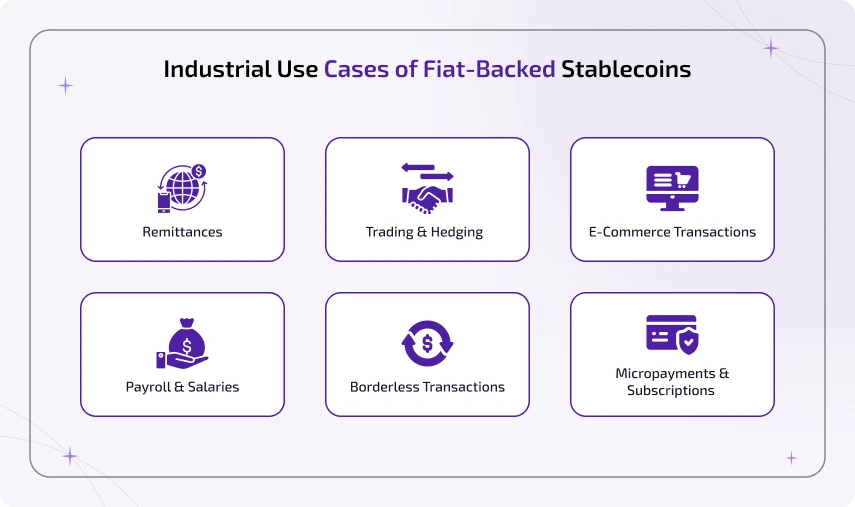
Fiat-backed stablecoins maintain stable value and simplify global transactions and payments, making them ideal in this crypto world. However, various users are increasingly using these stablecoins to enhance their accessibility, and the following section will give a precise description of which industries are benefiting from these coins.
Remittances
Fiat-backed stablecoins stand as a crucial component for undergoing seamless cross-border remittances. They enable businesses, individuals, and other migrant workers to easily go through fast and low-cost transactions without any middlemen. Eventually, this minimizes the dependency on high-cost money-transfer services or banks.
Trading & Hedging
Fiat-backed stablecoins are widely used in trading and hedging platforms due to market stability. Traders use these coins as a trusted tool to safeguard their assets from market fluctuations. This helps them to avoid sudden losses and quickly move their funds between exchanges.
E-Commerce Transactions
Businesses gain a lot from fiat-backed stablecoins by accessing instant settlements and borderless transactions for online shopping. This is in contrast to volatile cryptocurrencies, where global users secure their transactions without being affected by market fluctuations.
Micropayments & Subscriptions
If you want to make seamless micropayments and subscription-based transactions, stablecoins make it happen. Regardless of high transfer costs, any user can make instant payments without considering market fluctuations. They can seamlessly make micro-payments for various activities such as online digital content, gaming, etc.
Tokenized Asset Settlement
Serves as the settlement currency for tokenized real-world assets such as bonds, real estate, jewelry, and more. This is one of the fastest-growing categories of 2026, which streamlines instant settlement and transactions and reduces intermediaries, providing support for 24/7 across blockchain-based RWA marketplaces.
Real-World Examples of Fiat-Backed Stablecoins in the Market
Several fiat-backed stablecoins in the market are already supporting trading, payments, digital financial applications, and various other activities. Each comes with a different reserve structure and use case. Let’s see them.
USDC - The most popular U.S. dollar coin that is popular for its compliance and transparency. USDC is known as the second-largest stablecoin with a market value of $76 billion. This coin makes it popular among institutions.
USDT - The largest stablecoin, valued at roughly $184 billion. The USDT stablecoin is the most widely used fiat-backed stablecoin, which is circulated largely on exchanges.
EURC - It is the stablecoin that is redeemable for 1:1 euros. EURC operates under Circle's full-reserve model and is running specifically for euro-denominated payments and digital financial applications.
PYUSD - A PayPal U.S. dollar-backed stablecoin issued by Paxos Trust. It is designed to connect digital payments with blockchain infrastructure, which expanded from Ethereum to Solana in 2026 to support rapid micropayments.
RLUSD - RLUSD is Ripple’s USD-backed stablecoin that is used by banks and fintechs for instant cross-border transactions. It publishes monthly independent CPA attestations covering RLUSD circulation.
USDG - It is the stablecoin that is associated with the Global Dollar Network. It’s popular among the very few coins that are gaining market attention with a focused approach to dollar-based digital money.
Key Risks of Fiat-Backed Stablecoins and Their Mitigation Strategies
A strong reserve alone does not guarantee stability. Most of the fiat-backed stablecoins come with regulatory, financial, and operational risks that issuers should be aware of.
Custodial Risk
Risk: Reserves are held by a trusted bank, issuer, or third party. Any insolvency or mismanagement can cause the holder to lose their funds.
Mitigation: Use of regulated banking partners, segregated custody accounts, and reserve protection structures could eradicate the risks.
Centralization Risk
Risk: A centralized issuer or a third party that controls minting, burning, and transfer functions creates a single point of failure.
Mitigation: Executing transparent governance, multi-sig controls, and role-based access.
De-peg Risk
Risk: Extremely insufficient liquidity or reserve mismanagement can temporarily break the 1:1 peg in high demand.
Mitigation: Maintaining high liquidity and usage of low-risk reserve assets can easily reduce the risk factors.
Regulatory Risk
Risk: Sudden changes in restrictions, licensing requirements, and stablecoin laws can affect how it operates.
Mitigation: Following diversified jurisdictions and proactive compliance can reduce the dependency on one regulatory rule.
Smart Contract Vulnerabilities
Risk: The hidden exploits and bugs in the token contract can enable unauthorized minting, freezing, and transferring of funds improperly.
Mitigation: Performing independent security audits, extensive security testing, and ongoing vulnerability assessments with full-fledged.
Why Build Your Fiat-Backed Stablecoin With BlockchainX
Building a fiat-backed stablecoin is not just minting or burning smart contracts. It’s about building a system that can align with all audits and regulations. BlockchainX, a trusted blockchain development company, approaches the full technical lifecycle to create stablecoins, from token architecture to redemption workflows and post-launch upgrades.
With 9+ years of expertise, our 250+ blockchain projects have been completed with a compliance-first build process, integrated with role-based permissions, controlled issuance, custody integrations, and transparent reserve reporting. At BlockchainX, every fiat-backed stablecoin engagement starts with juridical mapping to make the token’s mint authority, reserve attestation, and freeze functions align with regulatory rules from day one.
We can post stablecoins in public and work across multiple chains. Layer 1 and Layer 2 networks help teams launch stablecoins with improved liquidity.
Ethereum - Many institutions use the Ethereum network for creating stablecoins like USDC and USDT. It can handle redemption paths and mint or burn rules. This makes it a fit for reserves that need oversight.
Solana - Solana works well when a stablecoin is built for tiny payments. It offers fast processing and quick settlement. With the SPL token standard, it can move funds in big payment flows.
Polygon - Used to design a stablecoin around Ethereum compatibility with low transaction costs. Supports transfers and high-volume payments with established Ethereum tooling.
BNB Chain - BNB Chain is a fast chain with low fees. It also works with the EVM. It connects to a large set of apps, so users can find more options. It also fits DeFi tools, handling payments and money moves.
Tron - Tron is often chosen when people want to move TRC-20 stablecoins with many transfers and small fees. In those cases, the cost of peer-to-peer sending needs to remain low.
Avalanche - Avalanche can be a good fit for stablecoin setups that are run by teams or companies. It works well when a group wants its own custom chain setup.
Conclusion
Fiat-backed stablecoins are no longer a crypto trend. It’s just becoming a crucial pillar of the global financial ecosystem. By maintaining better efficiency and security, these coins continue to control all the financial activities implemented in the digital space, provided by reduced volatility. Reliable redemption, strong reserve management, and transparent operations are essential for earning high user trust and maintaining the peg value.
As adoption continues to expand in 2026, businesses have the opportunity to build scalable stablecoin infrastructure around various real financial use cases. But only with the right technology and development partner can you effectively bridge traditional money and blockchain-powered finance.
From reserve architecture to smart contracts and regulatory alignment, our team builds coins end-to-end, aligning with your jurisdiction and use case.
FAQ
1. How is a fiat-backed stablecoin explained?
It is a cryptocurrency token that holds a steady value and is set with a 1:1 peg. That chosen currency can either be the U.S. dollar or the Euro.
2. Are fiat-backed stablecoins legal to build in 2026?
Yes, it is legal to build. The legality of the stablecoin solely depends on the coin’s structure, jurisdiction, and usage. Every issuer must follow proper licensing, AML/KYC controls, and redemption mechanisms before launching the coin.
3. How do fiat-backed stablecoins maintain their pegged value?
Typically through full reserve backing, controlled issuance, an open redemption mechanism. With a proper structure, issuers can redeem the tokens for the underlying fiat value, supported by the targeted price.
4. What is proof of reserves, and do I need it?
Proof of reserves is a verifiable report that provides transparency into assets matching your token supply. It is significantly required to meet modern transparency rules and issuer structure to earn user trust.
5. Which network is best for creating a stable fiat-backed stablecoin?
The blockchain choice depends on your coin’s use case, business requirements, regulatory components, and more. However, Solana comes with very low fees and high throughput for transactions, Ethereum offers enhanced liquidity, and BNB Chain balances both cost and high reach.