Kalshi vs Polymarket: Comparing Prediction Markets in 2026
Listen to the Audio :
In the rapidly evolving prediction market landscape of 2026, the legendary duopoly of Kalshi vs Polymarket is driving the future of event-based trading. Together, the two platforms command a significant share of the global forecasting market, each attracting distinct sectors of user base and liquidity sources.
Kalshi has surged to a reported $22 billion valuation by positioning itself as the ultimate, CFTC-regulated prediction market ecosystem for institutional and retail players in the United States. Polymarket holds a formidable $15 billion valuation, establishing itself as the undisputed home of a crypto-native prediction trading platform with massive liquidity control.
While both systems aim to answer the same question—what is most likely to happen next?—they differ in fundamental approaches in generating predictions. Polymarket focuses on decentralized, crypto-first innovation, whereas Kalshi prioritizes regulatory standards and TradFi services. This article compares Kalshi and Polymarket to help you choose the best platform.
Overview of Kalshi
Kalshi is a U.S based, fully regulated prediction market platform that allows users to trade real-world event outcomes in US dollars. Unlike many other prediction markets, Kalshi is under the oversight of the United States Commodity Futures Trading Commission (CFTC), which ensures legal clarity, robust consumer protection, and a familiar trading environment for users.
Built on a centralized prediction platform, Kalshi clone script prioritizes transparency and compliance, making it an ideal choice for both retail traders and institutional investors. Users can engage in markets that include anything from political events and economic data releases to weather forecasts and cultural events.
Kalshi delivers a traditional financial market experience to the growing world of prediction markets, with clear pricing, safe fiat transactions, and trusted liquidity.
A fully CFTC-regulated platform for prediction markets
Supports trade in US dollars (fiat)
Offers markets based on real-world events and outcomes
Compliance-focused, centralized exchange model
Clear pricing and settlement of contracts
Safe bank-based withdrawals and deposits
Reliable liquidity backed by trading institutions
Build your own prediction market platform with a scalable Kalshi clone script designed for real-time event trading.
What is Polymarket ?
Founded in 2020, Polymarket is a decentralized prediction market platform that lets users use crypto to trade on the outcomes of real-world events. The platform is based on the Polygon blockchain, which enables fast, cost effective, and scalable transactions, and it uses USDC stablecoin for trade.
Polymarket removes traditional middlemen and automates trade execution and settlement by using blockchain technology and smart contracts and also to build platform like polymarket check this out. This provides transparency, trustless operations, and real-time price discovery based on aggregate market sentiment. The platform is accessible globally, as anyone with a crypto wallet can participate from anywhere in the world.
Elections, economic indices, sports, technology, and global events are just a few of the various topics that Polymarket offers markets on. Due to this, it has emerged as a key player in the growth of decentralized prediction markets, attracting crypto-savvy users who like decentralized participation, openness, and low costs.
Decentralized prediction market platform
Trades using USDC stablecoin
Built on the Polygon blockchain
Smart contracts automate trades and settlements
Global access via crypto wallet
Fast transactions with low costs
Multiple marketplaces, such as sports, politics, and specialized events
Build a highly performing prediction market platform with our Polymarket clone script engineered for crypto-based trading.
Kalshi vs Polymarket Prediction Market: Platform Comparison
Leading prediction market platforms, Kalshi vs Polymarket features comparison, provide distinctive ways to trade fiat and cryptocurrency for real-world event outcomes. This is a thorough comparison:
| Feature | Kalshi | Polymarket |
|---|---|---|
| Platform Type | Centralized exchange-style platform | Blockchain-based decentralized system |
| Regulation | Completely regulated by the U.S CFTC | Decentralized with limited formal regulation |
| Currency | US dollars (fiat) | Stablecoin USDC (crypto) |
| Technology | Traditional trading interface | Blockchain-based smart contracts on Polygon |
| User Access | Best for U.S users who desire regulated trading | Global access for cryptocurrency wallet users |
| Fees | Standard trading and settlement costs | Gas costs may apply, but there are no trade fees |
| Market Variety | Weather, business events, politics and economics | Sports, politics, economics and specialized global subjects |
| Liquidity | Robust, supported by institutional participants | Market-specific variations; faster settlement via blockchain |
| Speed & Settlement | Standard settlement for exchanges | Automated and instant with smart contracts |
| Best For | Fiat-based, transparent, regulated trade | Low-cost, decentralized crypto prediction markets |
Kalshi vs Polymarket: Which Markets Do They Support?
What events customers can trade on and how insights arise depend on the kinds of markets that a prediction platform offers. While both Kalshi vs Polymarket prediction market comparison offer real-world event marketplaces, their flexibility and focus are different.
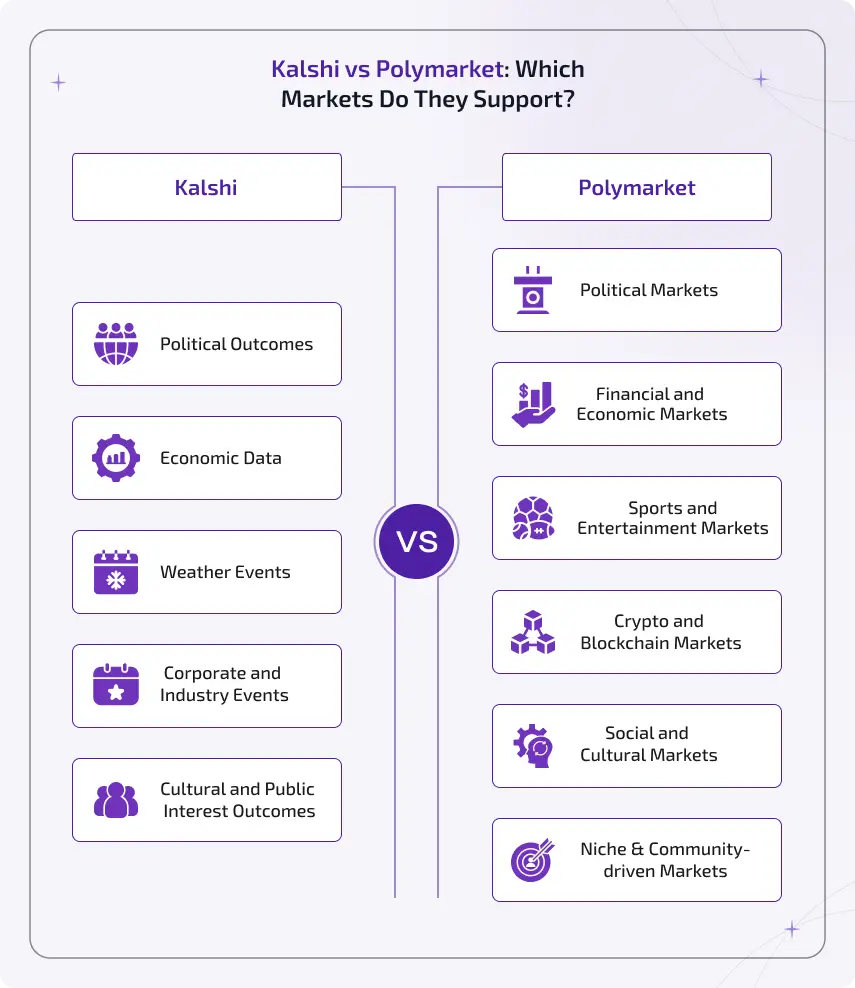
The market categories that each platform supports are compared in this section.
Kalshi
Kalshi focuses on a broad range of real-world event categories that let users trade on accurate, verifiable outcomes in multiple industries.
Political Outcomes:
Users can trade election results, governmental decisions and policy outcomes on Kalshi's political markets. These markets help users in predicting political direction while upholding transparency, precision, and regulatory compliance since they are based on outcomes that have been officially verified, such as vote counts or government announcements. Build political predictions platform.
Economic Data:
Kalshi's economic data marketplaces focus on important metrics, including GDP growth, employment statistics and inflation rates. Traders use publicly accessible and verified government information to provide insight into the state of the economy by speculating on whether released data will meet, far exceed, or fall short of expectations.
Weather Events:
Users can trade on measurable weather conditions including temperature, precipitation, storms, and extreme weather events, on weather markets. These markets help predict climate changes and manage weather-related risk since results are based on reliable meteorological data.
Corporate and Industry Events:
These markets include sector performance, company milestones, and regulatory approvals, among other business and industry-related results. Users can trade with trust in events that affect businesses and sectors because Kalshi's ensure all outcomes are precisely defined and verifiable.
Cultural and Public Interest Outcomes:
Public interest and cultural markets focus on popular social trends and events with predictable outcomes. These markets uphold Kalshi's high standards for transparency and verification while reflecting public opinion and community expectations.
Polymarket
Many decentralized prediction markets that let users trade on real-world events in a range of categories are supported by Polymarket, including
Political Markets:
Users of Polymarket's political markets can trade on government acts, election results, and geopolitical events. These markets show current popular opinion and events in global news. Prices fluctuate fast as new information emerges, allowing users to see how global public opinion develops to political events.
Financial and Economic Markets:
Macroeconomic patterns, including inflation rates, interest rates, and financial indicators, are the main focus of these markets. Users trade based on economic expectations, utilizing market prices to predict future financial situations rather than depending entirely on traditional or expert projections. Build Economic predictions platform.
Sports and Entertainment Markets:
Polymarket provides markets for sporting events and entertainment results, such as award shows, tournaments, and match outcomes. These markets are often active and engaging for traders because they attract large participation and often react quickly to news, accidents, or public reactions. Build Sports predictions platform.
Crypto and Blockchain Markets:
Users can speculate on Web3 trends, token pricing, protocol updates, and regulatory activities on crypto and blockchain markets. These markets, which are based on decentralized infrastructure, are particularly popular among crypto-native consumers looking for insights into rapidly evolving blockchain ecosystems. Build Crypto predictions platform.
Social and Cultural Markets:
These markets focus on public opinion, social trends, and culturally pertinent subjects. Users trade on outcomes impacted by collective action, media coverage, and social mood, offering an innovative way to track how public interest grows in new global issues.
Niche and Community-driven Markets:
Polymarket allows specialized markets based on innovative or experimental subjects. These community-driven markets let users make unforeseen predictions, providing flexibility and innovation that are rare on regulated systems.
How Do Prediction Markets Work?
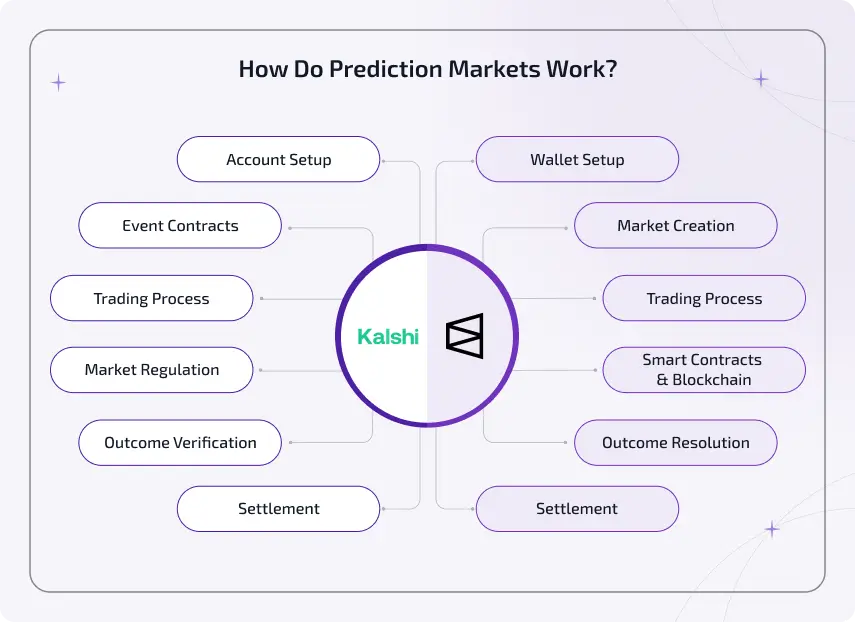
By allowing users to trade on event outcomes, prediction markets convert popular opinion into real-time projections. Kalshi and Polymarket are two platforms which drive this process using distinct models: Kalshi uses a regulated, fiat-based exchange, while Polymarket uses decentralized blockchain and smart contracts. This is how it works.
Kalshi
On the Kalshi platform, users register. Through bank transfers, money is deposited using US dollars.
Kalshi compiles contracts based on real-world events. Every contract denotes a precise, well-defined outcome.
Users buy or sell contracts based on their forecasts. Contract prices fluctuate according to probability and market demand.
A centralized, CFTC-regulated exchange is used for trades. Every market follows strict rules on compliance and transparency.
Event outcomes are verified using official and reputable data sources.
After the event, winning contracts are paid in cash.
Polymarket:
Users link the Polymarket platform to a crypto wallet. USDC stablecoin is used for trading.
Polymarket provides predicted markets based on real-world events. Every market has well-defined results.
Based on forecasts, users buy or sell outcome shares. Prices fluctuate in real time based on what consumers want .
On the Polygon blockchain, trades are executed via smart contracts. Smart contracts ensure automatic execution and transparency.
Using reliable data sources and oracles, event results are verified.
In USDC, winning positions are automatically settled on-chain.
Legal & Regulatory Framework: Kalshi vs Polymarket
Legal protocols and compliance oversight represent the core operational system that distinguishes between the Kalshi and Polymarket prediction platforms. Both exchanges function as powerhouses in prediction markets, allowing users to trade prediction contracts on future events, operating under different legal and operational models.
Kalshi: Government-Regulated Prediction Market
Kalshi is the first CFTC-regulated and one of the largest centralized prediction markets in the United States. It is structured to operate as a Designated contract maker (DCM). While other regulated operating platforms trade financial or agricultural derivatives, Kalshi pioneers in specifically dedicating itself to general happenings and prediction markets.
Operational Legal Standards of Kalshi
Mandatory identity authentication (KYC) for all users
Regulated check of the listed event contracts
Anti-money laundering transaction monitoring
Secure fiat-based deposits and withdrawals
Consumer protection & standardized financial reporting
Polymarket: Decentralized Web3 Architecture
Polymarket is a renowned and the largest global, decentralized platform deployed on blockchain networks, surpassing traditional financial systems. Instead of leveraging an order book, users connect their wallet credentials and trade using crypto assets. Unlike Kalshi, it is performing as a self-custodial system; however, the platform is legally restricted in some countries.
Operational Legal Standards of Polymarket
Permissionless wallet-first user onboarding
Global accessibility for legitimate users
Automated contract-based trade execution
Crypto wallet verification instead of bank accounts
Geo-fencing restrictions to limit access in highly regulated regions
Legal Differences Comparison Kalshi vs Polymarket
Here is a quick comparison of the regulatory differences between the two major players, Kalshi vs Polymarket, within the Web3 economy:
| Core Area | Kalshi | Polymarket |
|---|---|---|
| Type of Platform | Centralized prediction platform | Decentralized prediction exchange |
| Regulatory Status | CFTC-Federally regulated | Crypto-based DEX operations |
| Payment Method | Fiat-based currency (Stablecoins) | Cryptocurrency |
| User Verification | KYC/AML check (Mandatory) | Wallet-based access |
| Accessibility | Approved U.S user operations | Global accessibility in supported regions |
| Compliance Risk | Low | High (Due to evolving laws) |
| Transparency | Regulatory control | Enhanced transparency (On-chain) |
Kalshi vs Polymarket Prediction Platforms: Which One Is Better For You ?
Prediction markets have changed how traders and enthusiasts predict real-world events. Users on platforms such as Kalshi and Polymarket can speculate on elections, economic data, sports results, and niche cultural trends .
As prediction market development keeps growing, more companies and developers are investigating platforms such as these to build their own trading ecosystems with Polymarket or Kalshi clone scripts. However, your goals, trading style, and comfort level with fiat vs cryptocurrency assets ultimately choose which platform is best for you.
Choose Kalshi If You
Kalshi is a centralized prediction market and U.S.based that is regulated by the CFTC. Users who value safety, regulation, and institutional-grade markets may find it intriguing since it provides a traditional exchange experience and works in fiat (USD).
Under US law, Kalshi offers consumer protection and legal certainty.
Kalshi focuses on organized markets that are regulated by documented rulebooks, such as the CPI, Fed decisions, and election results.
Tighter spreads and a reliable trading experience are ensured by institutional participation.
Businesses looking to build a similar regulated platform can use a Kalshi clone script, which provides a compliant, fiat-based prediction market experience for customers seeking stability and legal protection.
Choose Polymarket If You
Polymarket is a decentralized blockchain-based market that uses smart contracts on the Polygon network and USDC stablecoin. Crypto-native traders prefer to choose Polymarket.
Users have complete control over their funds since trades are executed via a personal crypto wallet.
Polymarket lets anybody with a cryptocurrency wallet engage in prediction markets on topics ranging from politics to niche trends and memes.
Advanced users can use their investments in other decentralized protocols by integrating positions with DeFi tactics.
It is cost-effective for regular trade, as users simply have to pay gas fees.
Developers who want to replicate this model may utilize a Polymarket clone script to create a similar decentralized prediction platform with blockchain automation, smart contracts, and global user reach.
Using Both Platforms Strategically
Experienced traders frequently use Polymarket and Kalshi to optimize their approach and exposure:
Kalshi for high-stakes, regulated macro and election markets
Polymarket for fast, global or experimental events
Similarly, entrepreneurs looking to build prediction markets can use clone scripts to combine elements from both platforms into a new product. For example, they might provide both decentralized, crypto-native markets and fiat-based, regulated markets inside one ecosystem .
Kalshi vs Polymarket: Current Trends & Growth Outlook in 2026
The prediction market landscape has experienced a remarkable maturation phase in 2026, evolving from a niche project into a multi-billion-dollar mainstream digital asset class ruled by the two leading industry rivals, Kalshi and Polymarket.
Overview
⚖️ Regulation & Reach
Regulation & Global Reach
CFTC-Regulated U.S. Titan vs Offshore Web3 Giant
| Kalshi | Polymarket |
|---|---|
| Serves U.S. traders under strict CFTC regulations for native trading in the United States. | Runs offshore and Web3-based, capturing a global audience. Also building a compliant U.S. entry with a CFTC license. |
💰 Capital Efficiency
Perpetual Futures vs Stablecoin Liquidity
| Kalshi | Polymarket |
|---|---|
| Backed by multi-billion dollar market caps, Kalshi is unveiling perpetual futures to the institutional ecosystem. | Utilizes in-depth stablecoin liquidity to pioneer crypto-first margin trading. |
🏦 Institutional Drivers
Institutional Market Drivers
Macro Indicators vs Global Sentiment
| Kalshi | Polymarket |
|---|---|
| Anchors its volume by institutional-grade macroeconomic indicators and structured seasonal catalysts. | Thrives on massive liquidity from global news, pop culture, and cross-border market sentiment. |
💧 Liquidity & Fees
Enterprise Market Makers vs Near-Zero Fees
| Kalshi | Polymarket |
|---|---|
| Mimics legacy stock exchanges with enterprise-grade market makers and formula-driven fee systems. | Depends on global crypto traders for liquidity and operates with minimal or near-zero trading fees. |
BlockchainX Prediction Market Development with Kalshi & Polymarket Clone Script
BlockchainX actively helps advance prediction markets by offering ready-made and adaptable solutions to companies entering this fast-growing sector.
BlockchainX offers entrepreneurs complete control over features, design, and scalability while allowing them to build prediction market systems that replicate the features of industry leaders with its Polymarket and Kalshi clone scripts. These solutions enable faster go-to-market without compromising performance or security, by significantly reducing development time and costs.
For businesses looking for a controlled, fiat-based prediction market experience, the Kalshi clone script was built. It facilitates USD transactions, clear settlement processes, compliance-ready architecture, and structured event contracts.
In the meantime, the Polymarket clone script supports decentralized market models by utilizing smart contracts and blockchain technology to provide cryptocurrency-based trading, automated settlements, and global user access.
By providing both choices, Our blockchain development company helps to create prediction market systems that are reliable, flexible, and well-suited for an extensive range of audiences and regulatory environments.
Conclusion
Platforms like Kalshi and Polymarket show the potential of both regulated and decentralized models, and prediction markets are quickly gaining popularity as effective tools for predicting real-world events. BlockchainX's Polymarket and Kalshi clone scripts enable companies to safely access this dynamic market.
BlockchainX offers scalable, secure, and adaptable solutions, whether your goal is to create a decentralized, crypto-native prediction market or a fiat-based, compliance-ready platform.
Businesses can speed up their launch, lower development complexity, and build future-ready platforms suited to a wide range of user demands and global markets by utilizing BlockchainX's expertise in prediction market development.
FAQ.
1. Can “U.S Users” Use the Polymarket Prediction Platform In 2026?
Yes. As of 2026, the usage of Polymarket in the U.S. is official after securing a CFTC-regulated license, enabling U.S users to legally trade through a dedicated portal after completing the KYC verification. However, access is limited depending on state-level restrictions compared to other international users.
2. What Are The Important Security Features To Include Before Launch?
The fundamental security protocols to include before launching on a prediction market platform such as Kalshi or Polymarket are sophisticated smart code audits and strict regulatory review, like KYC/AML authentication, along with a fraud monitoring system and multi-sig wallet storage to prevent security breaches and abrupt legal shutdowns.
3. Which Is More Preferred: A Centralized or Decentralized Prediction Market Platform?
Choosing between a centralized and a decentralized prediction platform ultimately means checking the weightage of regulatory clarity and legal certainty against audience reach and participation. Centralized models like Kalshi offer strong compliance protocols and user credibility, but development costs are high, whereas decentralized markets like Polymarket use automated contracts for quick access to global liquidity but operate in a volatile legal landscape.