8 Steps to Build Perpetual DEX: An Exclusive Guide in 2026
Listen to the Audio :
Do you know whether it's possible to hold a trading position indefinitely without worrying about contract expiry? That’s the reason to build Perpetual DEX, enabling traders to gain a powerful edge in the decentralized financial landscape.
Unlike traditional futures, perp contracts remove expiry constraints, ensuring that the spot prices are aligned with the underlying market position.
From core smart contract architecture to liquidity mechanisms, every layer contributes to a smooth trading experience. This guide walks you through the practical roadmap in building a perpetual DEX development, from idea to execution. Explores how these market-ready platforms are structured and scaled for long-term growth and performance.
What Is a Perpetual DEX?
A perpetual decentralized exchange, also referred to as perp DEX, is a derivatives trading platform that enables users to speculate on price hikes/falls in the market using a contract without owning the actual asset. Perp DEX blends with DeFi, offering self-custodial, transparent, and leveraged trading to the traders.
Unlike the traditional futures market, users can trade perpetual futures contracts and hold positions (long or short) indefinitely, without an expiration date. As per a recent study, perp DEX has shown a trading volume increase from $81.7 billion to $739.4 billion during January 2026, and expects it to rise further in the upcoming months.
Core Functionalities:
∞
No predefined expiration date
🔐
Non-custodial framework
⚖️
Funding rate mechanism
📈
Leveraged trading system
Why Build a Perpetual DEX?
The increasing adoption of DeFi and derivatives trading has led to the massive growth of perps within the modern crypto space. Let’s get to know the key highlights that assist businesses in building a perpetual DEX in 2026.
Perp decentralized exchange is rising as a flagship product in the dominating crypto industry, accounting for major trading volume, offering massive market opportunities for investors, and generating significant income streams through various revenue models.
Users are opting for a secure and transparent trading environment that offers trustless, self-custodial, and seamless operations. Moreover, unlike traditional futures, Perp DEXs follow an expiry-free contract structure, enabling traders to hold positions with greater flexibility.
One of the major reasons to build perpetual DEX is its undisturbed 24-hour trading system, allowing global users to access sophisticated financial instruments smoothly. Every stage of the trading process is recorded publicly on the blockchain, further enhancing the credibility of the platform.
Free consultation
Launch Your Decentralized Exchange
From architecture to mainnet, we build high-performance, audit-ready DEX platforms tailored to your vision. Spot, perpetual or hybrid; your exchange, your rules.
Best Architectural Choices to Build a Perpetual DEX
Perpetual DEX development depends on three major architectural choices, which determine its security protocol, speed, core functionality, and UI/UX experience. Let's take a closer look at the key design models powering the modern perp futures platform.
01
Virtual AMM (vAMM)
Unlike standard AMMs, this structural model uses a virtual DeFi mechanism and mathematical formulas to ensure liquidity depth for trading perpetual futures without requiring real liquidity providers. They don’t hold real asset reserves and bootstrapping liquidity 24/7 for the traders.
SynFuturesPerpetual Protocol
02
Central Limit Order Book (CLOB)
CLOB is a perpetual DEX architecture that works like a traditional order book, matching a buyer and seller in real-time at a specific price. Trades depend only on the availability of the buy/sell order. It uses a high-performance on-chain network for settlement, which provides low latency and best price discovery for the traders.
HyperliquidLighter exchange
03
Hybrid Architecture
A hybrid model combines both the characteristic features of vAMM and CLOB systems to balance liquidity, transaction efficiency, speed, and trading experience. It is a blend of an automated liquidity mechanism with order-matching functionalities on the blockchain. The hybrid architecture offers a professional trading experience at a minimal cost.
AevoVertex Protocol
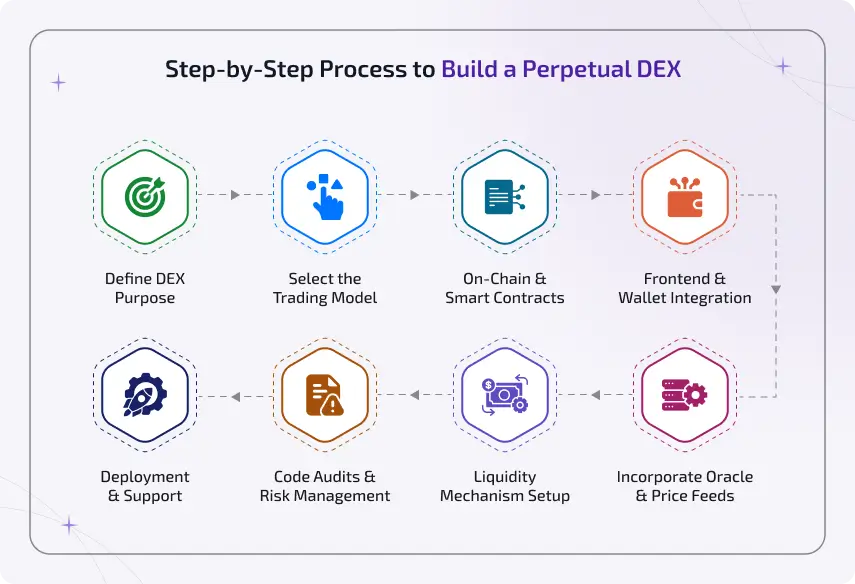
Step-by-Step Process to Build a Perpetual DEX
A successful perp development journey covers multiple stages, right from the on-chain selection and building the core protocol to launch crypto exchange. Explore how to build a perpetual DEX with the essential steps given below.
Step-1: Define DEX Purpose
The primary step in building a perpetual DEX is determining its trading purpose, target users, and major objectives. This acts as a foundational layer, as it builds the core function and purpose of the exchange.
Step-2: Select the Trading Model
It is crucial to pick a trading model that defines how your perp exchange executes your orders and settles trades. Choose between vAMM, CLOB order books, or the hybrid liquidity model based on functional requirements.
Step-3: On-Chain & Smart Contracts
Select a suitable blockchain network and develop core smart contracts based on its scalability, performance speed, and cost-efficiency. These are the operational factors that play a major role in the workflow protocol, forming the backbone of a perp DEX.
Step-4: Frontend & Wallet Integration
Staging an intuitive and well-equipped frontend framework with robust matching engines is essential for delivering a smooth trading experience. This step also includes secure wallet connectivity to enable better interaction between users and the exchange.
Step-5: Incorporate Oracle & Price Feeds
Configuring reliable data oracles and market price feeds to maintain the accuracy of asset pricing and secure perpetual trade settlement. This prevents price influence and ensures a stable trading operation across the exchange.
Step-6: Liquidity Mechanism Setup
Efficient liquidity bootstrapping through the integration of market-maker strategies, liquidity pools, and user incentive mechanisms helps to improve overall trading activity. This supports a healthy market depth.
Step-7: Code Audits & Risk Management
Performing exclusive security audits is necessary to identify and mitigate possible critical threats and vulnerabilities earlier. This makes sure the system is bug-free and strengthens the overall platform management.
Step-8: Deployment & Support
After going through a keen testing process, the perpetual DEX is launched for public access. With the help of performance metrics, the deployed platform is monitored regularly and optimized based on user feedback, enhancing its user trust and reliability.
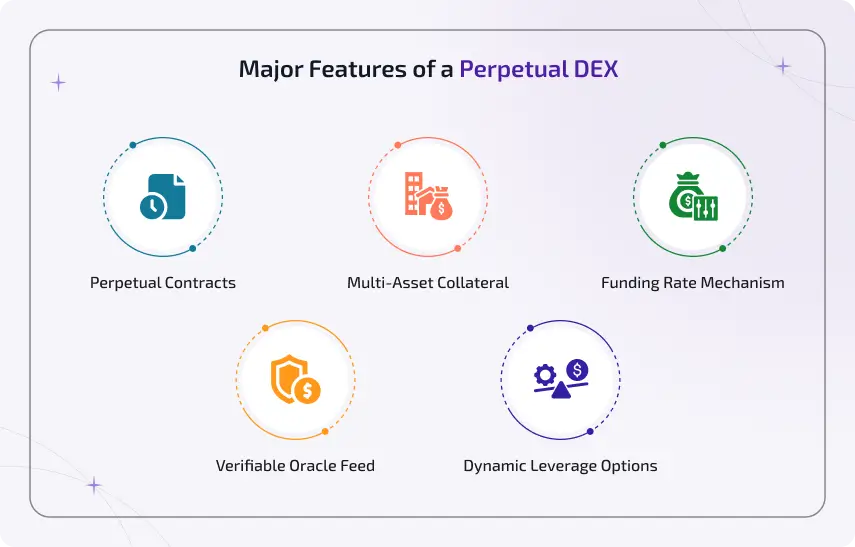
Major Features of a Perpetual DEX
Perp DEX ecosystems incorporate powerful features boosting trading efficiency, on-chain transparency, market conditions, and decentralized asset management. Explore the advanced functionalities mentioned below.
Perpetual Contracts
In contrast to standard financial futures, the traded perpetual contracts operate without a fixed expiration date. In this way, the crypto exchange development enables the traders to hold their positions for a desired time.
Multi-Asset Collateral
Perpetual decentralized exchanges support a wide range of digital assets that can be used as margin collateral to open trading positions in the market. This component creates a flexible environment for trading.
Funding Rate Mechanism
This mechanism is used to keep the perpetual price range closer to the underlying live price while balancing the market variations. It facilitates ongoing payments between traders to maintain the overall stability of the ecosystem.
Verifiable Oracle Feed
Real-time oracle system gathers live market price data from accurate external sources and delivers it to the Perp DEX platform. This ensures fair pricing, smooth trade execution, and manages overall market consistency.
Dynamic Leverage Options
A dynamic leverage system enables traders to control larger trading positions, using a small amount of margin collateral. Users can magnify their positions beyond the collateral, offering flexible leverage options for perp market trading.
Comparison table: Perpetual DEX vs CEX vs Spot DEX across 10 key features
Let's check out the quick comparison of Perpetual DEXs, CEX exchanges, and Spot DEXs that outlines the major distinctions, such as trading mechanism, operational aspects, and nature of custody.
Feature
∞ Perp DEX
🏛 CEX
↺ Spot DEX
👛Custody of Funds
✓Non-custodial funds
✗Platform-controlled funds
✓Non-custodial funds
📈Trading Type
✓Perpetual futures trading
✓Spot & Futures trading
◑Spot-only trading
⚡Leverage
✓Available
✓Available
✗Unavailable
📅Expiration Date
✓No expiry
✗Futures expiry
—Not applicable
🔍Transparency
✓On-chain & verifiable
✗Limited transparency
✓On-chain & verifiable
🪪KYC Check
✓Not required
✗Mandatory
✓Not required
💧Liquidity
✓Liquidity pools / vAMM
◑Centralized liquidity
✓Liquidity pools
💲Fee Structure
$ Low–Mid
$$ Mid–High
$ Low
🌐Accessibility
✓Permissionless
✗Regional restriction
✓Permissionless
⛓️Settlement
✓On-chain
✗Off-chain
✓On-chain
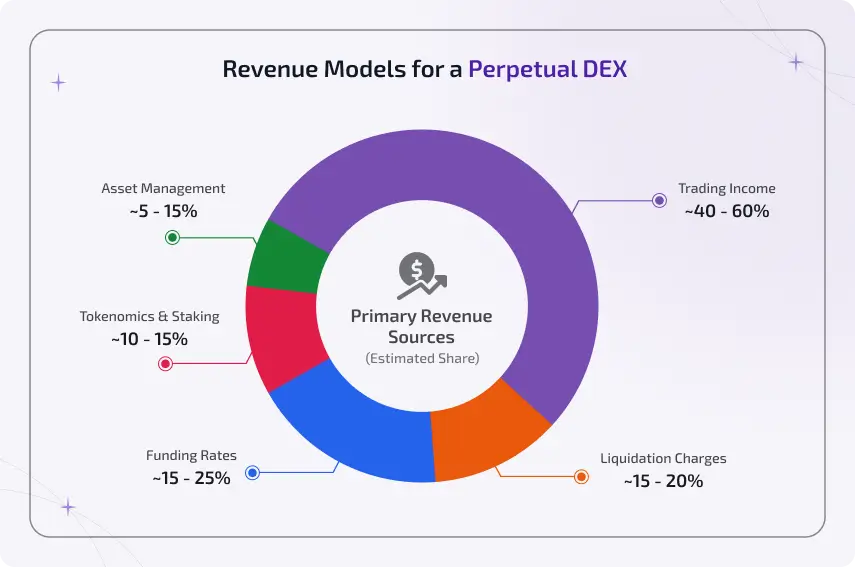
Revenue Models for a Perpetual DEX
Revenue planning is one of the basic requirements when launching a perpetual decentralized platform. The below list highlights the primary revenue sources that support the firm’s growth, operational system, and overall turnover.
Trading Income
Being the primary source, trading fees are the largest share generator of a perpetual decentralized platform. They charge fees whenever a trade is opened, closed, or a position is altered based on the type of market execution.
Estimated Revenue Share: 40 - 60%
Liquidation Charges
When there is a major drop in the trader’s margin, the positions are automatically closed by the liquidation protocol. A minimal penalty fee or charge is collected from the collateral to maintain the threshold balance.
Estimated Revenue Share: 15 - 20%
Funding Rates
Perpetual DEX smart contracts collect a small share of the funding rate settlement, enabling a consistent stream of recurring income. This system makes sure both contract prices are aligned with the live market price.
Estimated Revenue Share: 15 - 25%
Tokenomics & Staking
By encouraging users to lock native tokens for fee discounts and staking rewards, tokenomics mechanisms create additional revenue opportunities. This supports the platform’s sustained growth potential.
Estimated Revenue Share: 10 - 15%
Asset Management
Advanced perpetual decentralized protocols use collateral margins across the DeFi lending ecosystem to generate passive income. The exchange earns a performance-based share of the profits accumulated from it.
Estimated Revenue Share: 5 - 15%
Best Approaches for a Successful Perpetual DEX Launch
The grand success of a perpetual DEX depends on strong technical expertise, efficient planning, and execution. Explore the proven launch practices involved in building an effortless perpetual entity.
1. Pre-Launch Framework
A robust pre-launch framework helps establish the overall foundational layer required, as one bad debt can destroy the protocol’s overall growth at the beginning itself.
Need for a compatible trade execution model
Engage in rigorous formal security audits
Use a reliable oracle strategy with redundancy
2. Liquidity Bootstrapping
An efficient liquidity strategy plays a crucial role in maintaining seamless system operations and improving the overall market stability.
Join with institutional-grade market makers in the industry
Offer real-yield incentives for early liquidity participation
Support deep liquidity pools across various trading pairs
3. UI/UX Experience & Growth
An intuitive user experience combined with acquisition strategies is crucial to enhance brand adoption and market growth.
Offer a simplified and beginner-friendly trading environment
Ensure your PWA or interface for mobile is responsive and quick
4. Post-Launch Maintenance
Consistency in maintenance and performance optimization is significant to ensure operational stability of the perpetual DEX platform.
Conduct active threat discovery programs to manage risk/vulnerabilities
Ensure that the Perpetual DEX is built with a 24-hour monitoring model
Incorporate adaptive regulatory measures and geofencing protocols
Future Trends in Perpetual DEX Development
The next wave of perpetual decentralized exchanges has moved forward from being a general-purpose network to custom L1 on-chain networks processing 20,000 trade orders in milliseconds. This wave paved the way for hybrid crypto exchange development models, a unified liquidity framework, and ZK privacy layers. Let’s take a closer look at the expected developments in the future beyond 2026.
Privacy - A fully homomorphic encryption layer enables fully encrypted trading where orders are processed without exposing sensitive data.
Interface - From one-click trading to AI-driven agents that execute user-intent trading using Web3 account abstraction.
Infrastructure - Evolution from a centralized cloud system (AWS) to DePIN networks, where applications are decentralized and community-owned nodes.
Liquidity - Chain-specific pools are transformed into liquidity abstraction, where the assets are available in a unified global pool.
How to Choose a Perpetual DEX Development Partner?
Choosing an ideal partner to build perpetual DEX ecosystem requires more than just technical knowledge; it demands a team that understands decentralized trading mechanics, liquidity design, and on-chain risk management. Explore the key criteria for opting for a reliable perpetual DEX development partner.
1. Fundamental Technical Expertise
A recognized technical foundation is crucial for building a secure, stable, and optimized perpetual DEX ecosystem. The reliable development partner must possess expertise in smart contract engineering, liquidity systems, and on-chain integration.
In-house security expert team
Capable of building layer-1 with minimal latency trading
Ensures robust liquidity system setup
2. UI/UX & Interoperability
A compatible partner must deliver an intuitive interface with multi-ledger functionalities, allowing users to trade efficiently.
Beginner-friendly frontend design
In-built risk management tools
Cross-chain operational efficiency
3. Proven Record & Exposure
Assess the development partner’s credibility through live DEX launches, usage metrics, and client testimonials.
Real-time proven DEX projects
Client references and feedback
Trading volume and TVL analysis
4. Compliance Framework & Management
Make sure the firm includes regulatory-ready features such as KYC/AML, geo-blocking, and a liquidation engine for platform management.
Geo-restriction at the frontend level
Permissioned liquidity pools with full KYC audit
Prove compliance without exposing user data
5. Post-Launch Support
The team must ensure the long-term growth potential and stability of a perpetual dex platform after deployment. It plays a major role in the overall platform optimization.
24-hour responsive and technical support
Ongoing feature upgrade and protocol enhancement
Bug/vulnerabilities fix and issue resolution
Why Choose BlockchainX to Build Your Perpetual DEX?
If you are looking to build a secure, scalable, and highly optimized perpetual DEX, you are at the right destination. BlockchainX provides a comprehensive and real-time trading solution for users and investors. With 9+ years of expertise in this field, we focus on crafting a perpetual derivatives structure that comes with flexible leverage options and a trading model with verifiable oracle feeds.
Our team offers custom-built perpetual DEX systems at a budget-friendly price that are compatible with your business requirements and core purpose. We emphasize performance optimization, providing technical and security support to ensure long-term platform efficiency and growth. Here is why BlockchainX is an ideal choice:
One-stop trading solution
24-hour technical support
Skilled Perp DEX development team
Cost-efficient exchanges
In conclusion, building a promising perpetual DEX platform combines a strong foundation of architecture, a robust liquidation protocol, and more. With an optimal approach and trade execution strategy, perpetual exchange can achieve a lasting impact, growth, and adoption in the decentralized ecospace.
FAQ
Unlike a standard DEX that focuses on direct token swaps, a perpetual DEX platform is designed for advanced derivatives trading without requiring users to own the actual asset. It allows traders to speculate on price movements and trade perpetual futures contracts without an expiration date.
The approximate timeline to build Perpetual DEX varies based on the initiative’s core complexity, chosen network, and jurisdictional alignments. On an average scale, the development cycle may take around a few months to a year.
The necessity of obtaining a legal license for Perp DEX is not standardized. Legal requirements vary by operational jurisdictions. So it is best to consider local trading regulations related to derivatives exchange and user identity verification.
Yes. It is an ideal time to build and launch a perpetual decentralized exchange due to its witnessed growth and demand for decentralized derivatives, project adoption, and public interest in perpetual trading.
Get all the latest posts delivered straight to your inbox.
Get In Touch
Our expert team is professionally well-equipped with hands-on experience as a blockchain development company. Connect with us; at BlockchainX, we curate your desired sustainable solution!