9 Easy Steps to Build a Smart Contract Wallet in 2026
Listen to the Audio :
In the era of businesses moving from simple token transfers to complex financial operations, traditional crypto wallets often come with significant limitations. This is the place where you need to build a smart contract wallet that does operations that were previously impossible.
Instead of relying solely on a single private key, smart contract wallets define how well the transactions are authorized with greater flexibility and security.They shape the wallet experience for both developers and businesses in the Web3 space.
So, contract wallets are not just an option; they become a crucial component with wide solutions. Get into the blog below to know everything about smart contract wallets, how they work, the testing process, and their role in Web3 projects.
What is a Smart Contract Wallet?
Smart contract wallets are programmable wallets deployed as smart contracts, rather than being controlled by a single private key. With advanced functions, a smart contract wallet functions as a decentralized application (dApp) that can store, send, and manage digital assets while also executing predefined logic.
Unlike traditional wallets, this essential feature takes digital wallets to new heights. By integrating advanced features such as account abstraction and no-fee transactions, the cryptocurrency wallet development provides high flexibility with multiple blockchain support.
This wide flexibility to navigate through the Web3 landscape offers a recovery stage without any seed phrases and comes with a transfer limit, which traditional wallets often fail to offer. They interact with blockchain applications by having a major shift in control from externally owned accounts (EOAs) to programmable on-chain logic.
These smart contract wallets are ideal for both new users and experienced crypto enthusiasts.
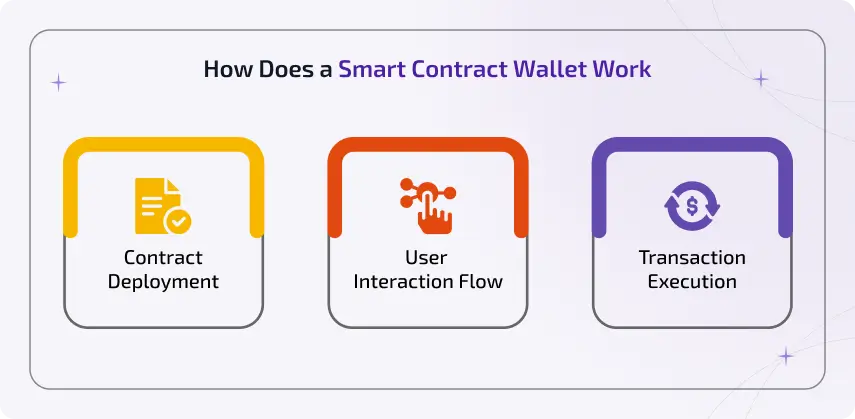
How Does a Smart Contract Wallet Work?
Smart contract wallets operate through a more fundamental way than traditional wallets. Here’s a simple overview of how they work.
Contract Deployment
At its core, the wallet stands as smart contract logic created on the blockchain, holding the wallet balance. Once the transaction begins, the contract checks the predefined conditions, such as signature verification, where, if the conditions are satisfied, the transaction proceeds; otherwise, it fails automatically.
User Interaction Flow
Users begin by interacting with the smart contract wallet through the wallet’s interface. They sign a request using their private key.
Then, it is sent to the smart contract to evaluate the request. After a few minutes of checking additional signatures, verifying limits, or triggering linked actions, the contract executes the transaction.
Transaction Execution
Finally, the smart contracts automatically verify the transactions, and here the cost of a single transaction varies based on the contract's complexity level. Once the predefined conditions are met, the contract will automatically perform the transaction and record it on the blockchain system effectively with high security.
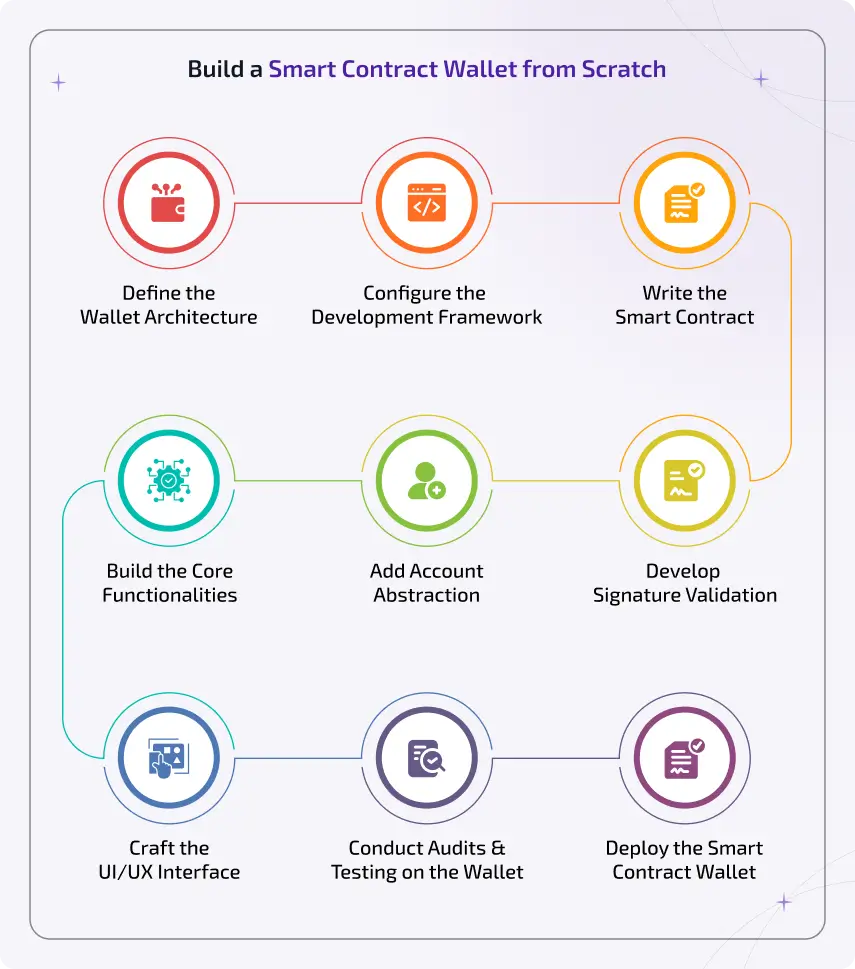
9 Simple Steps to Build a Smart Contract Wallet from Scratch in 2026
Once you have gone through the above criteria, you can proceed to launch your smart contract wallet, which is explained in detail in the section below. With advanced functionality and programmable transactions, smart contract wallets are designed to support complex use cases in everyday life. So, discover the steps below and create yours.
Step 1: Define the Wallet Architecture
Decide the core purpose of your smart contract wallet and explain its architecture in detail. Come up with the points, such as the integrated features, supported audience, and more. Clearly explain whether the platform is suitable for individual users, DeFi platforms, or DAOs. In addition to this, choose the blockchain platform on which your contract wallet should run.
Step 2: Configure the Development Framework
Creating your workspace is a crucial factor in the contract development process. Select the right technologies for better development. Consider Rust, Solidity, and Hardhat. Then, select a blockchain from the popular networks such as Ethereum, Solana, or Polygon based on your requirements and needs.
Step 3: Smart Contract Implementation
A smart contract is one of the crucial steps in wallet development. This is the place where a lot of activities are carried out automatically, such as fund management, transaction validation and execution, signature verification, and much more. Also, verify whether the smart contracts securely manage funds and interact with other decentralized applications.
Step 4: Develop Signature Validation
To make the wallet more reachable among users, integrate secure signature verification using popular cryptographic methods. This ensures the smart contracts will validate the transaction once the predefined conditions are met, instead of relying on a single private key. Here, the predefined conditions denote multiple approvals that take place before execution.
Step 5: Account Abstraction Essentials
Yet another important step in the wallet development process is the integration of account abstraction, which makes the contract more flexible and user-friendly among users. A crypto wallet with account abstraction removes the dependency on externally owned accounts and allows contracts to control transactions on their own.
Step 6: Build the Core Functionalities
Integrate essential and modern features, like token swaps to decide the performance of your smart contract wallet. This improves the overall user experience with a large user base and trust. Further, integrate advanced measures like biometric authentication to improve your wallet’s performance and to enhance the platform security.
Step 7: Design an Interactive Interface
An interface with crystal-clear structure is important to simplify complex interactions and transactions, making it handy for every type of user. So, create a user-friendly interface, and manage the digital assets securely. This step includes developing both the frontend and backend infrastructure with improved performance.
Step 8: Conduct Audits & Testing on the Wallet
Once the integrations are done, perform rigorous testing to ensure your contract wallet can function in any scenario without much difficulty. You can ensure it by conducting integration testing and unit testing to identify potential vulnerabilities and issues. This identifies the failed transactions or recovery flows within the wallet.
Step 9: Activate Your Smart Contract Wallet
Finally, launch the contract wallet on the selected blockchain platform. Here, the initial validation is done on the testnet and then carried out on the mainnet. Once deployed, continuously monitor the wallet and track its performance. Address the issues that you can roll out with and regularly update the wallet for better scalability and long-term growth.
Powerful Reasons Why Your Web3 Project Needs a Smart Contract Wallet
With the rise of modern Web3 projects, smart contract wallet integration is becoming a major part in 2026. This works beyond the limitations of traditional, key-based wallets, which come with account abstraction with improved security and flexibility. However, the following key reasons create a strong foundation for why your Web3 development projects need a smart contract wallet.
Superior User Onboarding
Smart contract wallets eliminate the biggest onboarding barrier in the Web3 ecosystem, which is private key management, unlike traditional wallets.
It enables users to access the wallets via biometrics, email, or social media accounts, making them more accessible to mainstream users.
With no gas fees, projects allow users to access and interact with the app directly without holding the native tokens.
Better User Experience
Traditional wallets often come with multiple approvals and puzzling prompts, which may interrupt the user flow.
This can be made easier with a smart contract wallet, which combines separate transactions into a single atomic transaction, saving enough time and gas charges.
Users can complete complex actions easily and can pay gas in any token, instead of relying on the native blockchain token.
Gasless and Frictionless Transactions
Expensive network fees continue to be a barrier in the Web3 landscape.
This is overcome by smart contracts using account abstraction, where users just pay with the tokens they already have, and it removes the barrier to entry, letting them directly interact with your dApp.
This process greatly reduces friction rates and increases conversion rates during the initial interactions.
Account Recovery Options
Traditional systems come with the possibility of losing your keys or funds, which is critical for users to retrieve them.
To fix this, smart contracts have introduced flexible recovery options such as multi-device approvals and social recovery to regain control of your accounts securely and build trust within the platform.
Smart contracts here play a major role in resolving one of the biggest challenges within the Web3 project.
Scalability for dApps
As Web3 projects grow rapidly, integrating wallets within your Web3 project minimizes the complexity level.
It supports complex use cases like DeFi platforms, NFTs, and DAOs more effectively to scale your project with constant support.
This integration makes it easier to scale and grow your project without redesigning the backend processes.
Essential Requirements to Consider When You Create a Smart Contract Wallet?
A well-planned approach helps you avoid major issues, ensures smooth development, and leads to an increased user base. Below are certain procedures to follow before a smart contract wallet development.
Clearly identify the specific use case and the essential requirements of your smart contract wallet.
Having expert knowledge of smart contract development, decentralized technology, and blockchain is a major factor.
A solid understanding of each blockchain's support, covering fees, and other support capabilities.
Prepare a detailed workflow, explaining your smart contract wallet’s functions in detail.
Make sure to choose proper technology stacks to set up a clear development workspace.
Establish a clear security model with powerful rules and regulatory compliance.
By examining these criteria, you can begin to create a smart contract wallet that comes with full potential.
How to Test Your Smart Contract Wallet: A Detailed Explanation
The smart contract wallet development process doesn’t end once it is deployed. It’s important to test the platform under certain scenarios to make it error-free, secure, and reliable for users. However, below is a concise procedure for the wallet’s testing phase.
Begin the testing process by developing a local blockchain environment like Hardhat and deploying your smart contract wallet on the test network.
Then, test the signature validation, deposits, withdrawals, and transactions of your wallet and ensure a smooth user control.
Double-check the owner permissions to ensure no third parties can perform transactions without proper permission.
Run integration tests to confirm whether the wallet’s functions are working properly in every real-world scenario.
Simulate recovery scenarios to confirm whether users can securely regain access and perform automated security analysis using Slither to detect bugs and errors.
Use the Hardhat Network or Tenderly Forks to simulate transactions, allowing for quick and private testing.
Then measure each function's gas consumption and check for vulnerabilities. Deploy the contract wallet to the public testnet and test real-world interactions.
Key Mistake to Look For When Developing a Smart Contract Wallet
Smart contract wallets differ significantly in their workflow, structure, and capabilities. Each comes in its own way, focusing on individual business needs. A small mistake in the development can ruin the entire process, which leads to serious issues. So, follow the common pitfalls in the section below that helps you build a crypto wallets with high security and efficiency.
Insufficient Testing
Lack of testing the wallet can lead to bugs and errors that go unnoticed. This can directly affect the wallet’s functionality. Developers must properly test the wallet under every scenario and use case, ensuring it works reliably.
Inadequate Access Control
Improper and weak permission handling can allow unauthorized or access-denied parties to perform certain actions. So, it’s important to integrate proper role-based access with multi-signature validation to control the wallet operations.
Ignoring Gas Optimization
Implementing inefficient smart contract codes makes transactions expensive. So, developers must optimize the logic and minimize the complications, leading to high user adoption and usability with cost-effectiveness.
Lack of Upgradability
Missing proper updates and not fixing the bugs and errors will lead to a major issue when you launch your smart contract wallet. Use proxy contracts and allow for necessary upgrades from the beginning to avoid such issues.
Overcomplicating the Contract Logic
One of the major problems every developer undergoes is overcomplicating the smart contract logic with too much stuff and advanced features. Try to keep the logic concise, greatly increasing scalability and security.
Conclusion
Smart contract wallets are rapidly becoming a major part, marking a significant change in how users interact with current blockchain technology trends. This strategic move of bridging the gap between everyday usage and crucial architecture aims for a projected Web3 approach, positioning to deliver seamless opportunities in this competitive landscape. It is also revealed that projects that leverage smart contract wallets are positioned to evolve with better demands.
If you are ready to build or upgrade your smart contract wallet in 2026, connect with our BlockchainX experts and discuss your requirements.
Frequently Asked Questions
An EOA, or Externally Owned Account, is a standard wallet that is controlled by a private key for secure authorization. Whereas a smart contract wallet is controlled on blockchains like Ethereum, using programmable logic. This paves the way far better than EOA in terms of better security and flexibility.
The cost to deploy a robust smart contract wallet ranges between $20 and $1000. This solely varies by blockchain network, gas fees, and the contract complexity.
Among the diverse networks, Polygon and Ethereum are widely popular for launching an effective smart contract wallet. Arbitrum is preferred for its cost-effectiveness. Besides this, the ideal blockchain for deploying your wallet entirely depends on your project's demands and goals.
Absolutely. Since smart contract wallets depend on deployed code, they are vulnerable to online hacks if they are not built securely. So, it's important to build wallets with strong security measures.
The removal of the limitations of traditional wallets and allowing transactions to be validated by smart contract logic, instead of private keys, is called as account abstraction. Here, the account abstraction concept is directly related to smart contract wallets, supporting features like social recovery, cross-chain signature approvals, and gasless transactions that are restricted within traditional wallets.
Get all the latest posts delivered straight to your inbox.
Get In Touch
Our expert team is professionally well-equipped with hands-on experience as a blockchain development company. Connect with us; at BlockchainX, we curate your desired sustainable solution!