
Web2 vs Web3: How Web3 Development Solutions Differ from Traditional Web Development
 By Yokesh Sankar
12 min read
Updated On
By Yokesh Sankar
12 min read
Updated On
What if your app didn’t need a login page, a payment processor, or a database you alone control? That’s the major shift behind Web2 vs Web3. This debate usually gets in full swing, questioning what makes you actually build on a blockchain instead of a traditional server stack and why startups and enterprises are rethinking how they build.
Web2 runs on centralized servers that manage everything for you, while Web3 runs on decentralized networks and builds around protocols where users, code, and consensus do the work. However, this guide clearly breaks down the key differences between Web2 vs Web3, how they matter to builders in 2026, and what makes sense when working with a Web3 development company.
Key Takeaways
Web2 is built for speed and owns your data. Web3 is built for transparency & ownership with hands-on control.
Web3 development means smart contracts, wallets, and nodes in the place of a central server and database.
Stablecoin supply hits around $308 billion, proving Web3 payments work in full swing.
A deployed smart contract is difficult to alter, so Web3 teams need to test and audit beforehand the launch.
Web2 breaches an average value of $4.99 million in 2026, but Web3 shifts the risk to contract security and key management.
What is Web2 vs Web3?
The internet has evolved and changed dramatically over these years. It has developed in three stages, each changing the users' ability to do online. Understanding this journey insinuates why Web3 is the future of the internet and why it matters in 2026.
Web1
In the early stages of the internet, websites were simple and were built with a basic HTML format. Businesses, publishers, and a group of individuals posted information, which can only be viewed by users.
There were no profiles, comments, user accounts, or personalization, and only little interaction was done, with just content to browse. Early company websites and online directories are the best examples.
1990s to early 2000s: Static HTML pages → Read only → Publisher-controlled → One-way content
Web2
Web2 turned the internet into a dynamic, two-way experience. Anyone can create, share, and connect with content on social media, e-commerce, video platforms, and cloud apps on both desktop and mobile.
This catch is made with a trade-off: a handful of big platforms own the servers, control the data, and set the rules, through which they earned money via ads and user data. The best examples are Amazon, YouTube, Instagram, Facebook, etc.
Mid-2000s to today: Social & cloud platforms → Read + Write → Big tech-controlled → Data-driven ads
Web3
Web3 incorporates a decentralized and highly user-centric internet that is as transformative as Web2. It is built on blockchain networks and smart contracts.
Here, users log in with a crypto wallet, hold identity and digital assets on their own, and transfer them through smart contracts without any third parties. Think of DeFi platforms, Ethereum-based apps, tokenized real-world assets, and NFTs.
2014 onward & emerging: Blockchain & smart contracts → Read + Write + Own → User-controlled → Peer-to-peer value
Web2 vs Web3 Differences 2026: Know Before You Build
Both Web2 and Web3 differ more than technology. This side-by-side view clearly breaks down the major differences that matter the most.
| Factors | Web2 | Web3 |
|---|---|---|
| Control | Owned & managed by platforms | Shared across users & networks |
| Architecture | Client-server model | Decentralized network of nodes |
| Data Ownership | The platform owns user data | Users own their data & assets |
| Data Storage | Centralized databases & cloud servers | Blockchain & decentralized storage |
| Identity & Login | Email, social login, password | Wallet signatures, passkey-based smart wallets |
| Payments | Banks, cards, payment gateways | Crypto, stablecoins, smart contracts |
| Backend Logic | Application servers run by the company (Java, Node.js, Python) | Smart contracts kept on a public blockchain |
| Security Model | Protect the perimeter | Code is public and holds funds directly |
| Transparency | Limited with closed systems | Transactions & contracts are publicly verifiable |
| Cost Model | The company pays for servers & cloud usage | Users pay every write cost a network (gas) fee |
| Governance Model | The company decides policies, features & fees | Rules set by token holders and DAOs |
| Development Lifecycle | Agile sprints, CI/CD, frequent releases | Security audits, testnets, formal verification & mainnet launch |
| Regulation | Data privacy (GDPR, CCPA) | Data privacy with crypto-asset rules (MiCA, etc.) |
Web2 vs Web3 Architecture: Layer by Layer
Both Web2 and Web3 look identical on screen, but it’s the layers that make them work differently underneath. However, here is how each layer changes by its structure.
The risk shifts from protecting a central perimeter to protecting keys and contract logics.
9 Key Web2 vs Web3 Differences in Development
Building a Web3 is not something of creating a new platform on Web2 development. The infrastructure, cost, security, data handling, settlement, and everything vary for both. Explore the 9 major technical differences between Web2 and Web3, which businesses and developers feel the most.
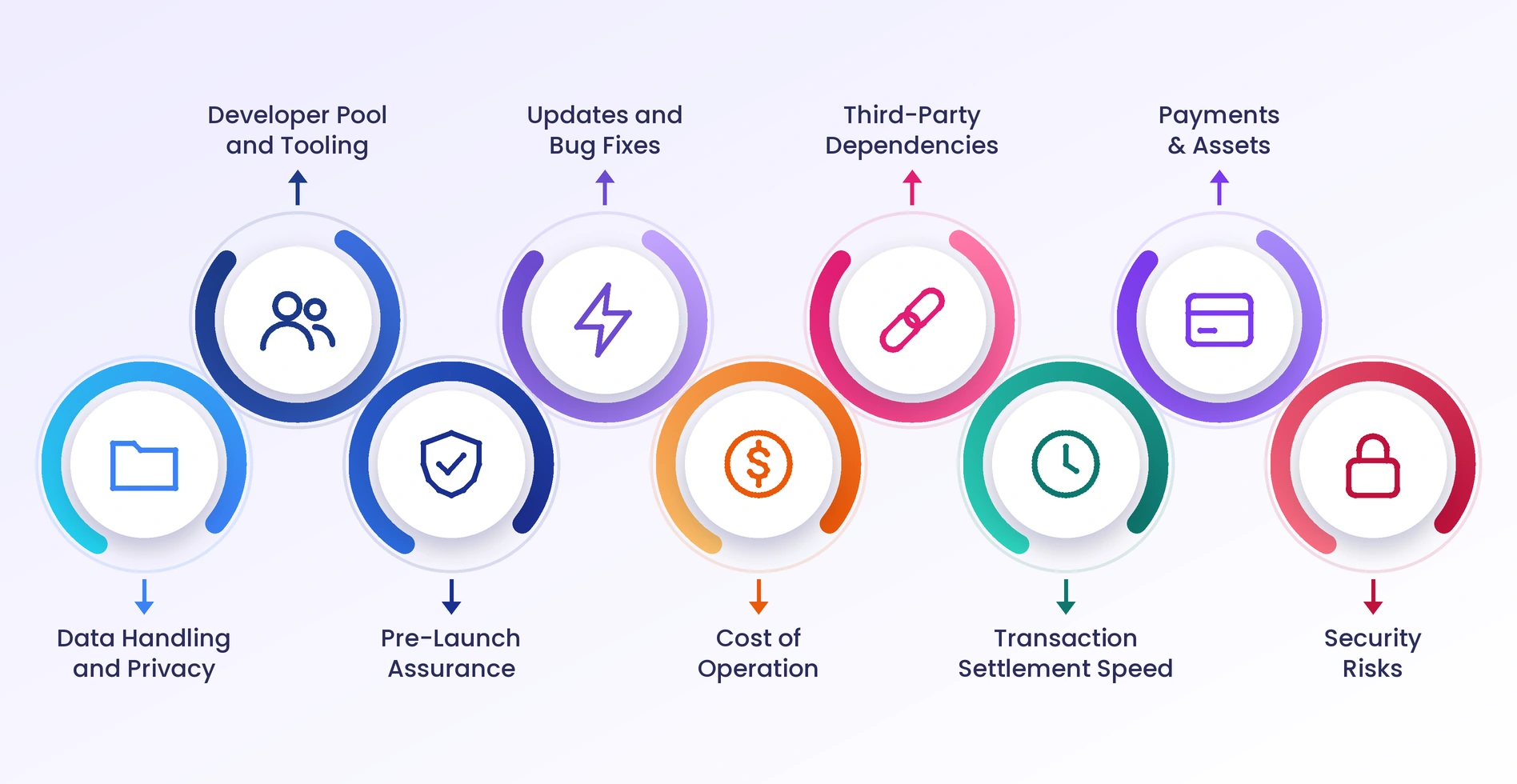
1. Data Handling and Privacy
In Web2, user records are typically stored in databases, which can be edited or deleted on request and even modified and corrected when required. This makes operations such as data fulfilling or erasing relatively straightforward.
On Web3, blockchain data is designed to remain persistent. The EDPB’s final blockchain guidelines adopted in July 2026 insisted on a clear placing of personal data in encrypted and hashed personal data on-chain.
2. Developer Pool and Tooling
The traditional web system has a massive developer base, which is supported by established libraries, frameworks, and development tools. With GitHub reports, it is viewed that more than 180 million developers are on its platform in 2025 Octoverse.
As of today, the Electric Capital recorded around 28,229 active crypto developers globally. Skilled smart contract engineers who are well-versed in blockchain infrastructure and protocol development are rare, which shapes the delivery timelines directly. Since these two figures measure different things, they are a sense of scale and not an exact ratio.
3. Pre-Launch Assurance
In Web2, teams rely on penetration tests, code reviews, and staged rollouts and quality assurance before reaching production. Security work continues after the launch to eradicate new bugs and vulnerabilities that emerge.
Web3 runs on critical smart contracts, which require deep pre-launch analysis. Audits for critical contracts can cost around $150,000, and formal verifications cross $200,000. Even audited contracts guarantee exploiting at roughly $285 million and $290 million, involving protocols such as KelpDAO and Drift.
4. Updates and Bug Fixes
Development teams in Web2 update application code and deploy a corrected version within hours. This rolls back a problematic release when necessary. Henceforth, bugs can be addressed after deployment without affecting the underlying data structure.
In Web3, a live smart contract is hard to change because deployed logic may be impossible or difficult to modify. For example, the 2026 Resolv involved a contract that lacked minting and relied on signature validation without restrictions. It is better to hire blockchain developers who fix the issues easily.
5. Cost of Operation
For Web2, the company pays for cloud usage, servers, databases, bandwidth, and other services. Users rarely pay separate infrastructure costs for every application action.
In Web3, users directly interact with blockchain infrastructure and encounter the network fees, which have dropped down sharply. Ethereum’s median transaction fee has gone from $3.79 in Q1 2024 to $0.012 in Q1 2026, which rollups roughly 95% of Ethereum activity. This made gas fees an important architectural decision.
6. Third-Party Dependencies
Inside Web2, applications depend on APIs, cloud platforms, SaaS providers, and software vendors. In IBM’s 2026 report, supply chain is positioned as the second most common attack, with an average of 258 days to identify it.
Decentralized applications depend on oracles for real-world data and bridges for cross-chain transfers. A drawback in any of the components can directly affect the application, with smart contracts remaining unchanged.
7. Transaction Settlement Speed
Transactions pass through various intermediaries before final settlement in Web2. For example. US equities settle on a T+1 cycle, so trades finalize one business day after the execution.
In Web3, a single atomic settlement lets both the asset and its payment change. The transactions either complete as defined or fail, minimizing the settlement gap. This model is particularly useful to onchain financial markets and tokenized securities.
8. Payments and Digital Assets
Payments in Web2 are added through banks, gateways, and financial platforms, while assets such as property, commodities, and securities are maintained in external systems, rather than within the application's architecture.
In Web3, tokens represent money, ownership, and other assets directly within the application logic. By August 2026, stablecoins had approximately reached around $308 billion, while tokenized real-world assets reached around $31 billion in July 2026.
9. Security Risks and Threats
In Web2, security incidents frequently point out centralized databases, authentication systems, and application servers where large volumes of information are concentrated. The global average cost of a data breach is found at $4.99 million, which took 247 days to identify it.
While in Web3, the attack surface moves towards smart contracts, private keys, oracles, and protocol infrastructure. Smart contract exploits were present in about 60% of incidents, out of which 17% are stolen, showing that Web3 security risks are distributed across several technical layers.
Not sure whether your build belongs on Web2 or Web3?
Talk to our team about the right architecture for your product.
Web2 vs Web3 Differences in 2026: What Has Actually Changed
The Web2 and Web3 comparison in 2026 looks very different, which was a few years back. Rules have changed, costs have dropped, and real assets are moving on-chain. Here are the major six shifts that matter the most
Regulation is now enforced: Regulations directly affect how Web3 products are designed and launched. The GENIUS Act was added to U.S. law in July 2026, and MiCA reached its full enforcement in July 2026.
Fees are no longer the main objective: layer 2 networks and Ethereum’s scaling upgrades have cut costs sharply, making low-value actions like minting, payments, and in-app transactions more practical.
Data rules got specific: The EDPB adopted its final blockchain guidelines in July 2026, guiding teams not to store clear text, encrypted, or hashed personal data on-chain.
Wallets get more friendly: Ethereum’s Pectra upgrade on 7 May 2025 made every regular wallet act like a smart contract account, which made passkey sign-in, social recovery, and sponsored gas more practical.
Security threats are shifting: Web2 breaches $4.99 million with one in four malicious breaches, while three-quarters of Web3’s $972 million in H1 2026 just came from infrastructure and stolen keys.
RWAs have evolved: The stablecoin market reached approximately $310.53 billion in September 2026, while tokenized RWAs were at $29.5 billion by mid-July 2026, which is around 173% higher than the previous year.
Where Web3 Still Wins and Why Hybrid Apps Are the Smart Choices
While the Web2 vs Web3 difference is highly noticeable, Web3 has closed many gaps, but Web2 is still serving as the better tool for several jobs.
Image, full-text search, AI workloads, and video processing, all runs best off-chain.
Provides real-time chats, live feeds, and instant notifications with fast updates, which servers handle more smoothly and cost-effectively than a blockchain does.
Bug patch and redeployment are done within hours, which is hard to change using smart contracts.
Centralized servers respond instantly with no signing and no wallet.
The editing or deleting process in records is routine in a database where storing personal data off-chain is highly recommended.
The Hybrid Rule:
Put on-chain what needs to be verified, and keep off-chain what users need to access quickly. In practice, check out the below.
Social Apps: Ownership and identity live on-chain, while posts and fees run on servers, as in decentralized social apps.
Asset Platforms: Legal documents stay in secure storage, while the token records who owns what, as in RWA platforms.
On-Chain: Users need to verify payments & settlement, asset ownership, token logic, and governance.
Off-Chain: Search, notifications, user profiles, media, and analytics, often with proofs on-chain.
Web2 vs Web3 Development: Cost and Timeline Compared
Cost and timeline are the two major factors that need to be considered before any build. Web3 isn’t much more expensive to build than a Web2 solution. Both overlap each other on their audits, security, planning, execution, and numbers by project stage. Here’s how to compare the cost and timeline of both Web2 and Web3.
| Project Size | Web2 | Web3 |
|---|---|---|
| MVP | $15,000 - $80,000 (2 to 4 months) |
$25,000 - $60,000 (2 to 4 months) |
| Marketplace (NFTs or tokenized assets) | $40,000 - $500,000+ (3 to 18 months) |
NFT: $40,000 - $150,000 (3 to 8 months) Tokenized assets: $80,000 - $500,000+ (6 to 12 months) |
| Financial Platform (DeFi) | $50,000 - $400,000 (4 to 14 months) |
$40,000 - $500,000+ (3 to 12 months) |
| Enterprise Integration | $75,000 - $1.5M+ (3 to 9 months or 12 to 18+ months for multi-system) |
$80,000 - $1M+ (2 to 14 months) |
Where the Additional Cost Comes From:
Security Audits: $5,000 - $50,000+, and $150,000+ for critical audit contracts
Longer Testing: The audit and fix cycle adds 4 to 8 weeks before the launch
Contract-Heavy Budgets: Contracts and audits take 30 to 40% of dApps' total cost
Ongoing Upkeep: 15 to 25% of the initial build cost
Should You Build on Web2, Web3, or Both?
Choosing between Web2 and Web3 doesn’t have to be a guess always, and the right choice is not about which technology is the latest one. It depends on what users need to verify, how fast it runs, and who needs to verify your data. Use the content below to match your product to the right architecture, and choose between Web2, Web3, and a hybrid model.
Build on Web2 (off-chain) if You Need:
A social feed, chat, media-heavy apps, or search that need high speed and scalability with constant updates.
If you need fast fixes and rollbacks and easy hiring with a lean budget.
A SaaS product or an internal tool where users need to own or independently verify anything.
Build on Web3 (on-chain) if You Need:
A tokenized-asset platform where ownership records can be owned, held, verified, or transferred.
A public, tamper-resistant audit trail, which is part of the product’s value.
Creating a stablecoin or payment product, where programmable settlement is the core feature.
Choose Both if You Are Building:
A marketplace to list, search, and get a stable user experience staying on Web2, while payments and ownership move on-chain.
A game where servers run the gameplay and items get live as tokens themselves, while players truly own them.
A membership or loyalty program, making the app familiar to users, while they can easily own and transfer them.
How BlockchainX Helps Teams Move from Web2 to Web3
BlockchainX helps businesses at every point on the path, supporting teams at every stage and building fully compliant on-chain products in full swing. Shifting to Web3 rarely means rebuilding everything from scratch and layering the trust and ownership. BlockchainX works with both and everything in between where you are. Our blockchain development company works over a decade with success, serving 250+ clients globally.
Design a Hybrid Architecture
We develop scalable and secure architecture, supporting both models, where your frontend, search, hosting, and user data can stay with smart contracts and wallets. While personal data stays off-chain.
Find What Stays On-Chain
Our team of dedicated developers thoroughly verifies and decides what users need, whether payments, ownership, or asset records, and which provides access quickly, and keeps the rest on Web2.
Build and Integrate
We make the process simple by linking the developed smart contracts and wallets into the existing systems, making the new layer work smoothly without replacing it.
Choose the Right Chain
BlockchainX breaks the one-network concept and works with multiple chains such as Solana, Polygon, Ethereum, Avalanche, and more, based on your speed, cost, and needs. This prioritizes the user's ideal choice and needs.
Test and Audit
We run independent audits before anything goes live, which cost around $5,000 - $50,000 and above. This makes security stronger from day one, which is before launch and not after it.
Ready to move your product on-chain?
Talk to our BlockchainX team about your development plan.
Conclusion
To conclude, Web2 and Web3 are two different technologies that face different problems. Alongside, they also have their own strengths, features, and model. The way they handle their control, ownership, transactions, and identity vary. Web2 still wins on its simple technology, speed, and ready-to-fix solutions, while Web3 wins over its transparency, ownership, and enhanced trust. Whichever model you choose, plan your audits and security from day one, since they are the biggest difference in the Web3 timeline and cost.
At BlockchainX, we do not replace the other; we use the smartest way, putting everything on-chain that users need to do. If you are ready to explore it, talk to our BlockchainX team about your development plan.
FAQ
Web2 is the most common internet most people use today, where online platforms like Amazon, Google, and Facebook run the apps and own their data without third parties. On the other side, Web3 is built on blockchain and smart contracts instead, where users hold their identity and assets through a wallet, enforced by public rules.
Yes, you can do so and don’t need a full rebuild. Most teams keep the hosting, frontend, user data, and search on Web2 and just move trust such as payments, ownership, and asset records onto a blockchain.
Not always the same and much more. Only at the MVP stage does the range overlap with Web2. The frontend of both is similar, but smart contracts can’t be easily matched, and they do so audits, testing, and design, which takes more time.
No. In the Web2 vs Web3 architecture, both coexist in different ways. The majority of successful products in 2026 are hybrid, which uses blockchain for payments, ownership, and verification, keeping their speed sensitive and private over traditional infrastructure.
Web3’s main advantages are transparency, ownership, and trustless coordination. Records on blockchain are publicly verifiable with no restrictions, and users can hold their own assets and identity through a wallet. Smart contracts automate various activities such as payments and settlements without middlemen. While Web2 still wins on its speed and data privacy, the majority of products combine both.
Our expert team is professionally well-equipped with hands-on experience as a blockchain development company. Connect with us; at BlockchainX, we curate your desired sustainable solution!


Follow us on


