Imagine having instant money transfers globally with no banks, no delays, and low fees. Does that sound futuristic? That is the power explained in this Stablecoin Infrastructure Guide for enterprises. Today's businesses are recognizing that the speed of global trade outpaces the abilities of traditional payment systems.
Stablecoins are revolutionary for cross-border transactions, payments, and settlements, as they combine the efficiency of blockchain technology with the stability of fiat money. However, creating a stablecoin requires more than just minting a digital token. A strong stablecoin infrastructure is essential for enterprises to function smoothly, their infrastructure must be reliable, secure, and scalable.
This is where partnering with an experienced stablecoin development company becomes crucial, as they provide the technical expertise needed to design, deploy, and maintain enterprise-grade stablecoin ecosystems. Every aspect is important, from connecting with current systems to maintaining reserves and ensuring compliance.
We outline the crucial elements needed to create a safe and scalable stablecoin platform in this guide to enterprise stablecoin infrastructure. This guide will help companies understand the operation of enterprise stablecoin infrastructure and how it facilitates effective digital financial operations in the blockchain-driven economy of today.
What is Stablecoin Infrastructure?
The term "stablecoin infrastructure" describes a complete set of tools, processes, and systems needed to effectively and safely develop, issue, manage, and maintain stablecoins. It consists of reserve management systems that sustain the value of the stablecoin, smart contracts that regulate token supply, and blockchain networks for transaction processing.
In addition, stablecoin infrastructure includes custody solutions, security measures, compliance tools, and API integrations that connect stablecoins to financial systems, wallets, and payment platforms. By ensuring that stablecoins continue to be reliable, transparent, and scalable, this infrastructure enables users and companies to conduct quick, low-cost digital transactions while keeping a constant value that is connected to physical assets like fiat currencies.
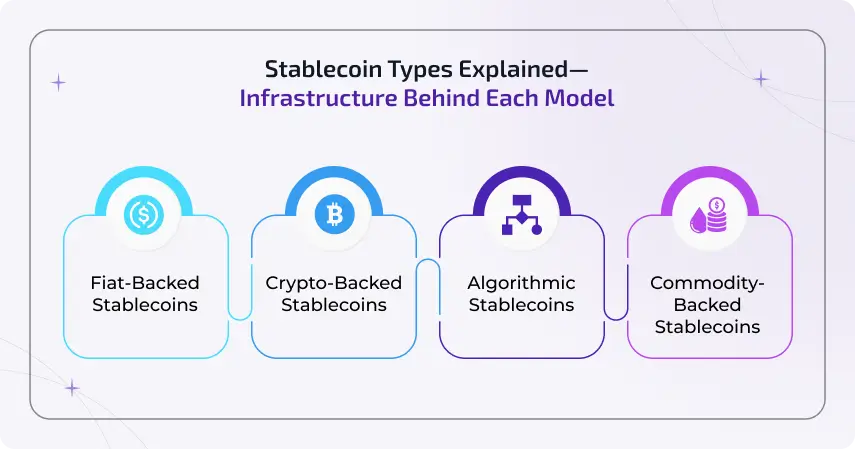
Stablecoin Types Explained— Infrastructure Behind Each Model
The goal of stablecoins is to keep their value constant, although they do so in different ways. For each type of stablecoin, specific infrastructure is needed to ensure security, stability, and seamless operation. Knowing these types allows businesses to select the most suitable stablecoin model based on their technical capabilities and business needs.
1. Fiat-Backed Stablecoins
Fiat-backed stablecoins are supported by traditional currencies like the US dollar, the euro, or other money issued by the government. A similar amount of fiat money stored in reserve accounts backs each stablecoin token. This stablecoin model is the most popular and widely used for businesses.
Fiat backed stablecoins require a robust financial infrastructure to ensure transparency and customer trust.
Examples
USDT (Tether) – Backed by USD reserves
USDC (USD Coin) – Fully backed by audited USD reserves
BUSD (Binance USD) – Fiat backed stablecoin
2. Crypto-Backed Stablecoins
Cryptocurrencies like Bitcoin or Ethereum support crypto-backed stablecoins. To protect against price volatility, stablecoins use over-collateralization. Smart contracts automatically control collateral and ensure the stablecoin's value.
Infrastructure Requirements
Smart contract-based collateral management
Systems for automated liquidation
Reserve tracking using blockchain technology
Secure crypto custody solutions
Oracle pricing integration
Risk monitoring devices
Crypto-backed stablecoins need advanced blockchain infrastructure to handle collateral and lower risks.
Examples
DAI - Backed by crypto assets like Ethereum
sUSD - Collateralized with crypto assets
LUSD - Backed by Ethereum collateral
3. Algorithmic Stablecoins
Algorithmic stablecoins use automated algorithms to manage token supply and maintain their value. To keep prices stable, the system modifies supply rather than holding reserves.
Infrastructure Requirements
Advanced smart contract frameworks
Mechanisms for supply adjustment
Market surveillance tools
Oracle service prices
Automated logic for trading
Ongoing system monitoring
Algorithmic stablecoins need advanced technical infrastructure and constant monitoring to provide stability.
Examples
FRAX - Partially algorithmic stablecoin
AMPL (Ampleforth) - Supply adjusting stablecoin
UST (TerraUSD) - Algorithmic stablecoin
4. Commodity-Backed Stablecoins
Commodity-backed stablecoins are backed by physical assets such as gold, silver, and other precious metals. In safe vaults, each token represents a specific quantity of the commodity.
Stablecoins backed by commodities need both physical asset management systems and digital infrastructure.
Examples
PAXG (Pax Gold) - Backed by physical gold
XAUT (Tether Gold) - Gold-backed stablecoin
DGX (Digix Gold Token) - Supported by gold reserves
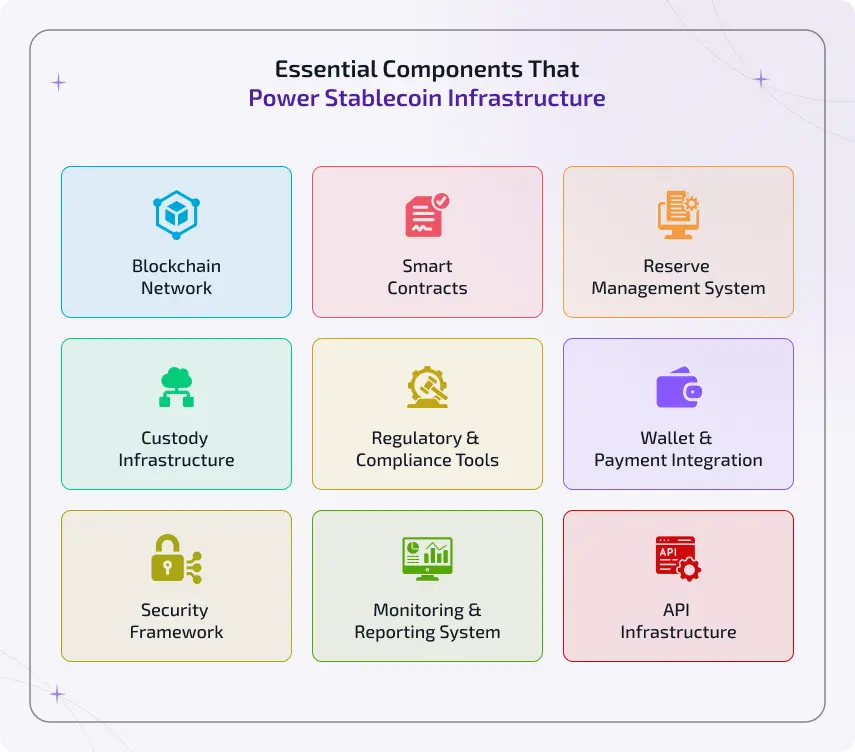
Essential Components That Power Stablecoin Infrastructure
This stablecoin infrastructure guide is built on a number of basic components that ensure stablecoins function effectively, safely, and consistently. Together, these basic components enable reserve management, transactions, issuance, and compliance of stablecoins. Understanding these helps companies build a scalable stablecoin ecosystem.
Blockchain Network
The stablecoin infrastructure is built upon the blockchain network. It securely and openly records every stablecoin transaction. A reliable blockchain offers fast transaction processing, low costs, and high safety standards. Additionally, users can send and receive stablecoins worldwide without middlemen due to the blockchain.
Smart Contracts
Stablecoin operations are managed via smart contracts. They automatically manage the minting, burning, transfers, and create crypto token processes. Smart contracts minimize human participation while maintaining accuracy. Stablecoin operations are made safe and effective by well-crafted smart contracts.
Reserve Management System
The value of stablecoins infrastructure is maintained via the reserve management system. It keeps track of the assets, such as fiat money or cryptocurrencies, that support the stablecoin. This system helps keep the right reserve ratio by keeping an eye on deposits and withdrawals. Transparent reserve management increases user trust.
Custody Infrastructure
Digital assets and stablecoin reserves are kept safe via custody infrastructure. It consists of asset storage options, private key management, and secure wallets. Strong custody systems lower the chance of theft or asset loss and stop illegal access.
Regulatory and Compliance Tools
Stablecoin infrastructure solutions can adhere to financial regulations with the use of compliance solutions. These tools include transaction screening, AML monitoring, and KYC verification. Regulatory compliance ensures operations are legal and helps prevent fraud and criminal activity.
Wallet & Payment Integration
Users may store and move stablecoins with ease due to wallet integration. Stablecoins are connected to payment networks and business systems through payment integration. This component enhances user experience and makes transactions easier.
Security Framework
An essential part of stablecoin infrastructure is security. The platform is protected from illegal access and cyberthreats by security mechanisms. Platform security stays through encryption, access restriction, and frequent security assessments.
Monitoring & Reporting System
Monitoring tools track stablecoin transactions and system performance. These tools help identify anomalous activity and technological problems. Reporting systems provide operational control and transparency by producing financial and compliance information.
API Infrastructure
Stablecoin infrastructure platform can communicate with other systems, including exchanges, financial platforms, and business applications, due to APIs. Automation and seamless integration with current business processes are made possible via API infrastructure.
Ultimate Guide to Stablecoin Infrastructure Provider Selection
Building a secure and trustworthy stablecoin platform requires selecting the best stablecoin infrastructure provider. A good provider should supply scalable solutions that facilitate long-term company growth, robust technology, and regulatory compliance. Careful provider analysis lowers risks for businesses and ensures stablecoin operations run smoothly.
Platform and Technology Capabilities
Examine the platform features and technological stack of the provider first. The infrastructure should allow for stablecoin issuance, token management, reserve tracking, and payment integration. Additionally– a reliable platform should have low downtime and superior performance.
Key things to look for
Supported networks of blockchains
Token management features
Transaction speed
Platform consistency
API accessibility
A solid technical base ensures effective stablecoin operations.
Security Standards
One of the most vital factors when assessing stablecoin infrastructure providers is security. To protect sensitive data and digital assets, the provider needs to have robust security solutions.
Look for
Smart contract audits
Encrypting data
Multiple signature wallet
Control systems for access
Regular security assessments
Cyberattacks and monetary losses are less likely when there is strong security.
Compliance & Regulatory Support
Stablecoin providers must adhere to financial regulations. To assist companies in operating lawfully, a quality infrastructure supplier should have integrated compliance solutions.
Stablecoin providers are subject to financial rules. A competent infrastructure provider should help firms operate legally by providing built-in compliance capabilities.
Confirm whether the provider provides
Tracking reserves systems
Reporting in real time
Audits support
Asset verification tool
Liquidity monitoring
Trust is increased via open reserve management.
Performance and Scalability
Platforms for enterprise stablecoin infrastructure must manage high transaction volumes. The infrastructure provider should provide scalable solutions that facilitate business growth.
Crucial elements consist of
High capacity for transactions
Cloud-based infrastructure
Balancing loads
Monitoring performance
Reliability systems
Scalable infrastructure ensures stability over the long term.
Integration Capabilities
The provider ought to make it simple to integrate with current business systems. APIs and SDKs make connecting stablecoins to wallets, financial platforms, and payment systems simpler.
Check out this
REST APIs
Wallet integration support
Compatibility with payment gateways
Integrating banking
Developer documentation
Effective integration cuts costs and development time.
Customization Options
Every business has its own needs. Stablecoin features and processes should be customizable by a flexible infrastructure provider.
When selecting a stablecoin infrastructure provider, experience counts. Reliable solutions are more likely to be delivered by providers who have shown experience.
Consider
Work experience
Client portfolio
Case studies
Consumer evaluations
Effective deployments
Providers with experience reduce project risks.
Stablecoin Infrastructure Security—What Every Business Must Know
Since stablecoins are becoming a growing part of global digital banking, security is a crucial component of building trusted stablecoin infrastructure. The scale at which stablecoin systems work now is shown by the stablecoin market's rapid growth, which has seen over 30 million active wallets worldwide and over $225 billion in supply.
Secure infrastructure is now necessary to protect business assets and financial activities, as stablecoin transactions surpass $33–35 trillion annually.
Smart Contract Protection
Smart contract protection is one of the most crucial security aspects of stablecoin architecture. To control token issuance, transfers, and supply modifications, stablecoins rely on smart contracts. Regular audits and security testing are crucial for enterprise platforms as smart contract vulnerabilities have traditionally resulted in large financial losses in the cryptocurrency sector.
Private Key & Wallet Security
Wallet security and private key security are other important factors. Access to operational funds and stablecoin reserves is restricted via private keys. One of the main reasons for crypto losses is poor key management. In fact, hacked wallets and security lapses cost billions of dollars annually, highlighting the value of safe key storage and access controls.
Reserve Security & Transparency
For stablecoin stability, reserve security and transparency are equally crucial. Stablecoin issuers have to protect reserve assets with ongoing oversight and safe custody measures. The stablecoin's value is maintained and trust remains intact by routine audits and reserve reporting.
Network & Infrastructure Security
Enterprises must also build strong network and infrastructure security to safeguard stablecoin systems from attacks and service outages. Secure cloud environments, access control mechanisms, and encryption all contribute to preventing illegal activity and maintaining system reliability.
Global Stablecoin Regulations and Compliance Explained
Stablecoin infrastructure works in a constantly changing global regulatory landscape in 2026. Like electronic money or payment systems, stablecoins—especially payment stablecoins—are increasingly seen as regulated financial instruments.
Stablecoins are able to move from experimental technology to mainstream financial infrastructure due to modern regulatory frameworks that prioritize safety for customers, financial stability, reserve transparency, and anti-money laundering regulations. Strong regulations allow stablecoins to be widely used for enterprise finance, remittances, and payments while reducing concerns such as reserve mismanagement, price volatility, and financial abuse.
United States - Guiding and Establishing National Innovation for U.S. Stablecoins (GENIUS) Act
The first federal regulatory framework for payment stablecoins was set up in the United States in July 2025 with the Guiding and Establishing National Innovation for U.S. Stablecoins (GENIUS) Act. Only approved institutions are permitted to create stablecoins under the system. Issuers must maintain a 1:1 backing with premium liquid assets like cash or US Treasury securities.
Stablecoin issuers are required to adhere to stringent financial risk management guidelines, maintain transparent reserve reporting and offer full redemption at face value. Agencies including the Federal Reserve, FDIC Office of the Comptroller of the Currency (OCC) and the U.S. Treasury share regulatory oversight. By 2027 full adoption is expected giving compliant stablecoin providers a clearer path.
European Union MiCA Regulation
The European Union enacted the Markets in Cryptoassets (MiCA) Regulation, which created a consistent regulatory framework for digital assets across EU member states. Stablecoins are divided into two primary categories by MiCA
Asset-Referenced Tokens (ARTs)—backed by numerous assets
E-Money Tokens (EMTs)—backed by a single fiat currency
Stablecoins issuers are required to secure regulatory approval, have fully backed reserves, separate customer funds, and produce clear documentation. MiCA also demands rigorous AML compliance, continuous oversight, and redemption rights. A passporting scheme allows licensed issuers to conduct business throughout the EU.
Global Regulatory Alignment
Stablecoin rules are becoming more uniform throughout key financial regions. Nowadays, the majority of jurisdictions need
Full reserve backing
Licensed stablecoins issuers
Redeemable rights guaranteed
Frequent reporting and audits
AML and adherence to sanctions
Transaction monitoring.
The United Kingdom, Singapore, Hong Kong, Japan, and the United Arab Emirates have all implemented such regulations. The environment for stablecoin infrastructure is made safer and more predictable by this globally convergence.
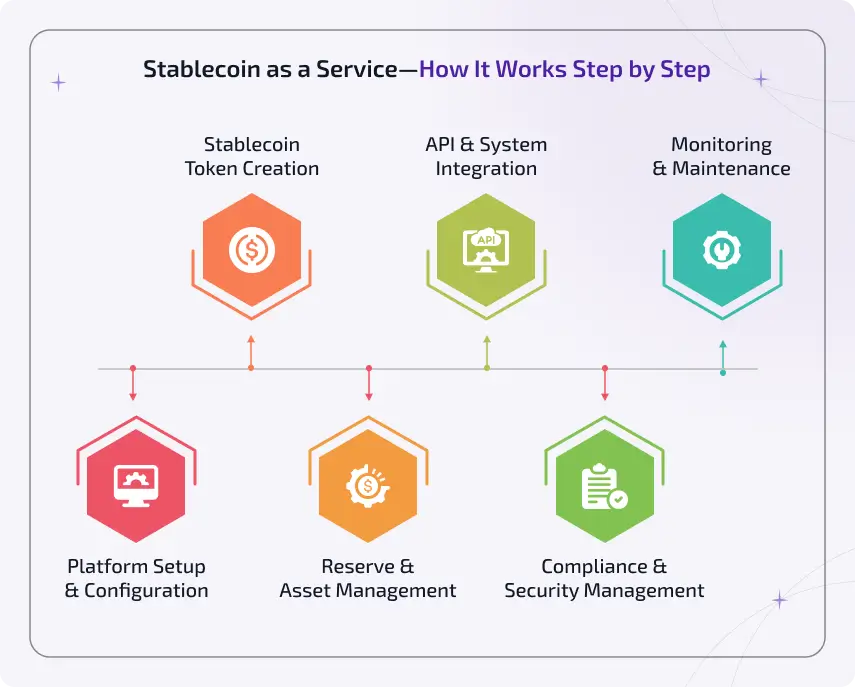
Stablecoin as a Service—How It Works Step by Step
A ready-to-use solution called Stablecoin as a Service (SaaS) enables companies to launch and monitor stablecoins without scratch with the infrastructure. Businesses can choose a service provider that provides a full stablecoin infrastructure platform rather than creating their own blockchain systems, reserve management tools, and compliance frameworks.
An organized process that involves stablecoin creation, integration, reserve management, and continuous monitoring is usually how Stablecoin as a Service works.
Platform Setup & Configuration
The first step in the process is to configure the stablecoin platform with business requirements. Businesses select the blockchain network, token features, and stablecoin model. The infrastructure, including transaction rules, token standards, and administrative controls, is set up by the service provider.
In this step, the stablecoin platform is made to meet business requirements and is prepared for deployment.
Stablecoin Token Creation
Secure smart contracts are used to create the stablecoin token after the platform is configured. The token is created and made available on the chosen blockchain network by the service provider. The token has features including the ability to burn, mint, and transfer.
Verification and testing of smart contracts guarantee the stablecoin's effective and safe operation.
Reserve & Asset Management
Stablecoin as a service providers use reserve management systems to track the assets that support the stablecoin. These systems keep an eye on withdrawals and deposits while upholding the necessary reserve ratio.
Transparent reserve tracking builds user trust and contributes to price stability.
API and System Integration
APIs are used to integrate the stablecoin platform with business uses. This enables companies to integrate stablecoins with financial applications, wallets, and payment systems.
API connection provides automated transactions and efficient financial processes.
Compliance & Security Management
Service providers incorporate compliance solutions like identity verification and transaction monitoring. Security systems utilize secure access restrictions and encryption to protect user data and digital assets.
This enables enterprises to operate securely while meeting regulatory standards.
Monitoring and Maintenance
The service provider keeps an eye on the stablecoin platform after deployment. Monitoring tools keep track of reserve balances, system performance, and transactions.
The platform is safe and scalable with regular upgrades and technical help.
Top Enterprise Use Cases for Cryptocurrency Payment Solutions
Cryptocurrency payment services are growing in prominence among enterprises who want faster, less costly, and efficient solutions to manage financial transactions. Cryptocurrency payments, in contrast to traditional payment methods, allow for nearly instantaneous transfers, reduced transaction costs, and global accessibility. Many companies are using cryptocurrency payment systems to increase operational efficiency and financial flexibility.
Some key business use cases for cryptocurrency payment systems are listed below
Cross Border Payments
When using traditional banking systems to make payments abroad, enterprises often run into delays and high fees. Businesses can move money across borders more swiftly and affordably with cryptocurrency payment services. With just a few minutes, transactions can be finished without the several financial middlemen.
Due to this, cryptocurrency payments are ideal for international companies who interact with global partners and clients.
Supplier & Vendor Payments
Cryptocurrency payment systems enable businesses to effectively pay vendors and suppliers. In many situations, cryptocurrency payments eliminate the need for currency exchanges and speed up processing times. Faster payments enable smoother business operations and enhance connections with providers.
This use case is especially useful for businesses with global supplier chains.
E-Commerce Payments
Global consumers can pay with cryptocurrencies to e-commerce companies. Customers can use digital assets to make direct payments without using traditional banking processes due to cryptocurrency payment services. This increases the number of clients and offers more ways to make payments. Crypto payments also have lower chargeback risks than typical card payments.
Payroll & Freelancer Payments
Enterprises pay freelancers and remote workers faster using cryptocurrency. Crypto payments enable companies to instantly deliver project or salary payments across the globe.
This is especially important for companies with distributed teams in multiple countries.
Treasury Management
Enterprises manage digital assets and increase liquidity by crypto payment services. Businesses can store and transfer digital currency to meet operational demands. Crypto-based treasury management enables enterprises to move funds swiftly between accounts and geographies. This enhances the financial efficiency of businesses.
Recurring Payments and Subscriptions
Cryptocurrency payment systems enable automated and recurring transactions. Enterprises that offer subscription-based services can take cryptocurrency payments on a regular basis. Automated payment systems increase payment consistency while reducing manual processes. Digital service businesses and SaaS platforms can benefit from this model.
Instant Settlements
Transactions using traditional payment methods could take several days. Cryptocurrency payments provide near-instant settlements, allowing businesses to receive funds fast. Faster settlements enhance financial planning and cash flow. Enterprises with large volumes will benefit from this.
Transparent Transactions
Blockchain technology transparently logs every cryptocurrency transaction. Enterprises are able to keep accurate financial records and monitor payments in real time. Transparent transactions make audits easier and increase accountability. Businesses can better manage their finances due to this tool.
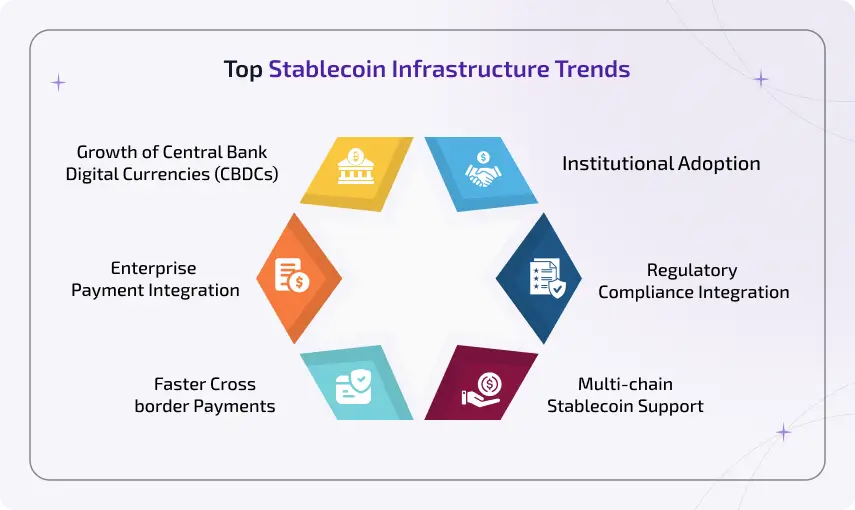
Top Stablecoin Infrastructure Trends Shaping 2026 and Beyond
This stablecoin infrastructure guide continues to grow as enterprises and financial institutions use blockchain-based payments. Stablecoins are becoming more safe, scalable, and widely recognized due to new laws and technologies. These developments will enhance digital financial systems and global payments.
Institutional Adoption
Banks and financial organizations are beginning to use stablecoin infrastructure to facilitate faster and cheaper transactions. Enterprises use stablecoins because they lower transaction fees and settlement times. For global payments and digital settlements, more organizations will include stablecoins into their financial systems in the future.
Regulatory Compliance Integration
Governments are enacting stablecoin rules to increase security and transparency. Future stablecoin infrastructure will come with integrated compliance features like transaction tracking and identity verification. This will boost user and investor trust while assisting firms in operating legally.
Multi-chain Stablecoin Support
Instead of supporting a single chain, future stablecoin infrastructure support many blockchain networks. Multi-chain support makes it simple for companies to move stablecoins between blockchains. This gives users more flexibility, lowers fees, and speeds up transactions.
Faster Cross-border Payments
The stablecoins infrastructure will keep enhancing international payments. Instead of days, enterprises will be able to move money across the globe in a matter of minutes. Faster cross-border payments will enhance global business operations and cut down on banking delays.
Enterprise Payment Integration
More businesses will incorporate stablecoin infrastructure into their payment systems. Companies will use stablecoins for online transactions, supplier payments, and payroll . Stablecoins will become a popular method of payment in global trade due to this trend.
Growth of Central Bank Digital Currencies (CBDCs)
Central banks are looking into digital currencies that operate similarly to stablecoins. In the future, these virtual currencies might coexist with stablecoins. CBDCs will enhance digital payment systems globally and have an impact on the growth of stablecoin infrastructure.
Enterprise Stablecoin Infrastructure Solutions by BlockchainX
With the help of BlockchainX, a leading stablecoin development company, offers innovative stablecoin infrastructure, companies may issue, manage, and run stablecoins with a scalable and safe design. Our infrastructure is appropriate for financial institutions, fintech platforms, and multinational corporations since it is built to handle large transaction volumes, smooth integrations, and reliable reserve management.
API-based connectors, reserve tracking modules, compliance-ready frameworks, and token issuance systems are all part of the BlockchainX stablecoin architecture. This enables companies to control stablecoin circulation across many blockchain networks while maintaining transparency and operational effectiveness.
Our system guarantees that the supply of stablecoins is always in line with reserve assets by supporting real-time minting and burning processes. To preserve asset-backed stability and transaction reliability, businesses might connect banking systems, payment gateways, and custodial services.
Enterprise-grade security features, such as role-based access control, encrypted transaction layers, and smart contract auditing support, are incorporated into the architecture of BlockchainX infrastructure. As a trusted token development company, BlockchainX also provides customized token creation, smart contract deployment, and multi-chain token management services to help enterprises launch secure and compliant stablecoins.
This keeps the network operating continuously while protecting digital assets. The platform can handle thousands of transactions with no delay as it is very scalable.
For large-scale financial applications, digital settlements, and cross-border payments, BlockchainX stablecoin infrastructure is perfect. BlockchainX stablecoin infrastructure solutions provide organizations with a future-ready infrastructure for easily launching stablecoins while ensuring stability, compliance security, and long-term operational reliability.
Conclusion
Are you prepared to launch stablecoin solutions or incorporate them into your enterprises? BlockchainX offers enterprise-grade stablecoin infrastructure that makes everything easier, from multi-network compatibility and compliance to wallet integration and stablecoin issuance. While maintaining operational control and transparency, our scalable and safe platform enables companies to implement stablecoin solutions faster.
BlockchainX offers the infrastructure and technologies required to launch fintech apps, digital settlement systems, and cross-border payment platforms swiftly and effectively. Businesses can handle stablecoin transactions in a timely manner due to our API-driven architecture, which facilitates smooth integration with current systems.
Businesses can trustly grow internationally, save transaction costs, and increase settlement speed using BlockchainX stablecoin infrastructure solutions. As a trusted Blockchain development company, BlockchainX delivers enterprise-grade stablecoin architecture, secure integrations, and compliance-ready frameworks that support long-term scalability.
With advanced API-driven infrastructure and multi-network compatibility, enterprises can launch, manage, and optimize stablecoin ecosystems efficiently while maintaining transparency, regulatory alignment, and operational reliability.
Get all the latest posts delivered straight to your inbox.
Get In Touch
Our expert team is professionally well-equipped with hands-on experience as a blockchain development company. Connect with us; at BlockchainX, we curate your desired sustainable solution!