Table of Contents
Listen to the Audio :
Regulation Flexible Countries for SPV Tokenization by Asset Type: 2026 Guide
What if you could convert real-world assets such as real estate, business shares, or commodities into digital tokens that everybody in the world could invest in? That's exactly what asset tokenization does. Businesses can allow fractional ownership by combining blockchain technology with legal frameworks such as Special Purpose Vehicles (SPVs).
However not all countries support SPV tokenization equally, and asset tokenization regulations vary across countries. Choosing the wrong country can lead to delays, compliance issues, or legal risks due to widely varying regulations. For this reason, choosing the right regulation flexible countries for SPV tokenization is one of the most significant decisions in any tokenization project.
Forward-thinking jurisdictions such as the United Arab Emirates, Singapore, and Switzerland are becoming global leaders by providing transparent frameworks, pro-innovation legislation, and robust support for SPV-based tokenization across a range of asset classes.
This blog will help you understand where and how to start a tokenization project that is compliant, scalable, and investor-ready by exploring the best countries with flexible rules across asset classes.
What is SPV Tokenization?
A Special Purpose Vehicle (SPV) is a legal entity created to hold a specific asset, such as commodities, real estate, or company shares. In asset tokenization, companies tokenize the ownership of the SPV that holds the asset rather than simply converting the asset into digital tokens.
This structure is popular in SPV tokenization because it simplifies ownership management and transfer and provides a clear legal framework. Investors gain indirect ownership of the underlying asset since each token is a share in the SPV.
Why Regulation Flexibility Matters?
The success of any tokenization project depends on choosing a regulatory-flexible country. It has a direct impact on:
Launch Speed - Faster setup and approvals
Legal Clarity - Clear rules for SPV ownership and tokenization
Investor Trust - Robust yet open regulatory structures
Cost-effectiveness - Reduced operating and compliance costs
Global Reach - Simpler access to foreign investors
Regulation-Flexible Countries Explained
The term "regulation-flexible countries" in asset tokenization refers to countries that provide transparent, supportive, and innovation-friendly regulations for blockchain and digital assets. Businesses can create SPV-based tokenization projects easily in specific countries without facing unnecessary legal complications or delays.
Unlike very restrictive regions, regulation in flexible countries for SPV tokenization provides a balanced approach. They ensure compliance with financial regulations while driving innovation in fields such as blockchain-based investments, asset tokenization, and security tokens.
Build Your SPV Tokenization Structure with Expert Support from a Top Real Estate Tokenization Service Provider
Essential Checklist— Find the Perfect Jurisdiction for Your SPV Tokenization Project
One of the most crucial elements in launching a successful SPV tokenization project is choosing the right jurisdiction. Using a defined checklist helps you avoid legal issues and ensures smooth project execution, as asset tokenization requirements vary by jurisdiction.
Regulatory Clarity
The most significant factor to consider when selecting a country for SPV tokenization is regulatory certainty. It is crucial to know whether your tokens are asset-backed, utility, or security tokens.
Countries such as Singapore and Switzerland have well-defined frameworks for asset tokenization rules, reducing legal uncertainty . It is simpler to set up your SPV, issue tokens, and run without unexpected compliance problems when you have clear regulations.
Ease of SPV Formation
A Special Purpose Vehicle (SPV) should be easy to set up, quick to establish, and affordable. While some countries permit entirely digital company registration, others require lengthy, complex paperwork and approvals.
For example, Estonia is well known for its fast and efficient digital business setup. A smooth SPV formation process helps you start your tokenization project sooner and focus on development and investor onboarding.
Compliance Requirements
Compliance regulations such as licensing, KYC (Know Your Customer) and AML (Anti Money Laundering) requirements vary by country. It is crucial to select a country with manageable and clear regulations.
Flexible jurisdictions such as the United Arab Emirates provide regulatory sandboxes that allow companies to test their tokenisation methods before adopting them widely. This reduces risk and ensures your project is compliant from the start.
Tax Structure
Taxes significantly affect the profitability of your tokenization project. You must assess capital gains tax, business tax rates, and token transaction policies. Some countries offer tax incentives that can significantly reduce operating costs.
For example, the Cayman Islands' tax-neutral climate makes it popular. An efficient tax structure increases overall returns and attracts investors.
Investor Protecting Laws
Strong investor protection regulations are necessary to build your project's validity and trustworthiness. Transparent legal regimes ensure the protection of investor rights, which is crucial in cross border tokenization.
Clear rules on disclosures, reporting, and investor protections are available in well-regulated markets such as the United Kingdom. Retail and institutional investors are more confident as a result
Support for Blockchain Innovation
Selecting a country that strongly supports fintech and blockchain innovation can help your project stand out from the competition. Governments that support digital assets frequently offer innovation hubs, funding for projects, and regulatory sandboxes.
Leading examples of robust ecosystems for blockchain firms are Singapore and the United Arab Emirates . Such support can accelerate adoption and growth.
Global Market Access
Lastly, consider how simple it will be to attract international investors to your project. Countries with robust financial infrastructure and global connections are better able to hire people from many regions.
Scaling your tokenisation platform requires easier cross-border transactions, improved liquidity, and increased investor engagement, all of which are enabled by a jurisdiction with strong market access.
Top 9 Regulation-Flexible Countries for Asset Tokenization
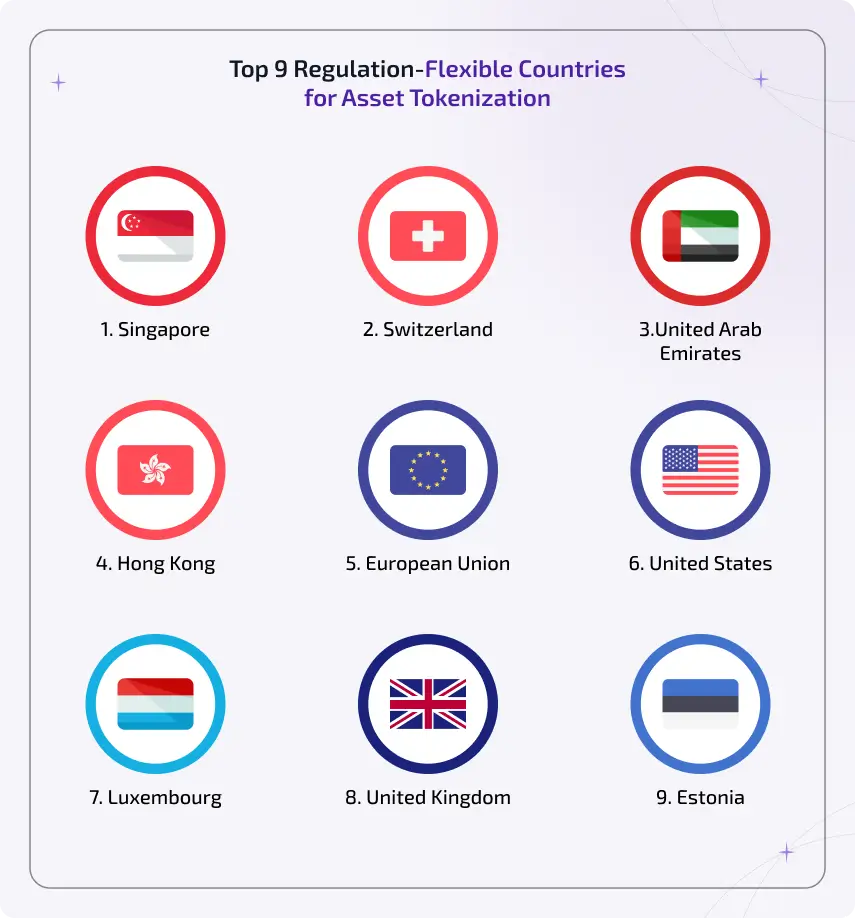
Regulation-flexible countries are those that design their laws to accommodate innovation—particularly technologies such as blockchain and asset tokenisation—while maintaining legal clarity, investor protection, and regulatory standards.
These countries offer a "smart regulatory balance" that enables companies to launch quickly, test innovative models (such as SPV-based tokenisation), and scale internationally without legal uncertainty, rather than being overly strict or completely unregulated.
1. Singapore—Structured Flexibility with Strong Compliance
Singapore has established itself as a global leader in digital asset regulation by combining rigorous compliance requirements with an innovative mindset .
The Monetary Authority of Singapore (MAS ) monitors tokenised securities under existing financial regulations, ensuring that digital assets are managed within a clear legal framework . Through progressive policy changes and regulated experimentation, Singapore allows for innovation rather than restricting it.
Notable Initiatives
Project Guardian - MAS-led project exploring the tokenization of assets in real financial use cases, such as funds and bonds.
Variable Capital Company (VCC) - A flexible fund structure that is frequently used for SPV-based tokenization initiatives.
Notable Market Activity
Major banks like DBS have launched tokenized bond and asset platforms.
Institutions are increasingly using tokenized funds and structured products.
Business Considerations
Although Singapore offers high legal clarity, licensing and AML laws must be strictly adhered to.
Institutional-grade initiatives are a better fit for it than experimental ones.
Best For
Private equity and tokenized funds
Compliant global offers and institutional investors
2. Switzerland—Legal Certainty for Tokenized Assets
For asset tokenisation, Switzerland is considered one of the most sophisticated and secure legal jurisdictions. Rather than treating blockchain technology as a separate sector, the country has adopted an active approach by integrating it into existing banking regulations. Businesses and investors entering the tokenization industry are less unsure due to this clarity .
Furthermore, regions such as Zug have become global blockchain hubs, attracting infrastructure providers, startups, and institutional investors. The Swiss regulatory strategy prioritizes innovation while maintaining financial stability and investor protection .
Notable Initiatives
The DLT Act Implementation - Gives digital ownership rights and tokenized securities a legal basis.
The Crypto Valley Ecosystem - Helps institutional players, businesses, and entrepreneurs.
Notable Market Activity
The SIX Digital Exchange (SDX) introduced digital asset infrastructure and tokenized bonds.
Tokenized share and structured product issuance is increasing.
Business Considerations
Although Switzerland has expensive operating and compliance costs, it offers robust legal protection.
Specific regulations reduce risk for long-term projects.
Best For
Equity and tokenized securities
High-value assets include money, property and art .
3. United Arab Emirates—Proactive Innovation in the Sandbox
The UAE is already one of the most innovative jurisdictions for asset tokenization due to a combination of evolving legislative clarity and government support . The UAE encourages blockchain adoption through pilot projects and regulatory sandboxes rather than restricting it .
The country excels at tokenizing real world assets, particularly in real estate and major investment projects. This approach focuses on bringing global companies while steadily enhancing legal enforcement and compliance frameworks.
Notable Initiatives
VARA Framework - A specialized regulatory agency for tokenized ecosystems and virtual assets
Real Estate Tokenization Pilot - The Dubai Land Department is exploring the tokenization of property titles using blockchain technology.
Digital Asset Zones - ADGM and DIFC allow tokenized securities and SPV structures
Notable Market Activity
Multibillion-dollar property tokenization strategies are gaining traction.
Global cryptocurrency exchanges and tokenization platforms are becoming a growing trend .
Business Considerations
The UAE provides significant flexibility and innovation help, particularly in sandbox environments.
Nonetheless, cross-border enforceability and regulatory uniformity are still developing .
Best For
Projects aimed at Middle Eastern investors
4. Hong Kong—Bridging Traditional Finance with Tokenization
Hong Kong is carefully integrating tokenization into its established financial system by applying current securities rules to digital assets. The Securities and Futures Commission (SFC) regulates tokenized securities with the Securities and Futures Ordinance, which ensures continuity with traditional finance .
The region has chosen a cautious yet progressive stance, encouraging innovation while providing solid investor protection . Additionally, Hong Kong is positioning itself as a gateway between mainland China and global markets, which makes it very appealing for cross-border financial flows.
Notable Initiatives
Tokenized Green Bonds - Blockchain-based bonds issued by the government
STO Sandbox Method - Controlled experimentation for tokenized securities
Fintech Approach - Focus on using blockchain technology in capital markets
Notable Market Activity
The Hong Kong government has issued multiple tokenized bonds.
Growing involvement of institutions in tokenized financial products
Business Considerations
Hong Kong offers robust access to Asia's capital markets.
Continuous monitoring is necessary since regulations are evolving .
Best For
Tokenized securities and bonds
Access to investors from North Asia and China
5. European Union—Harmonized Regulation with Growing Flexibility
The European Union is creating a uniform and structured framework for digital assets throughout its member states, with the goal of finding a balance between innovation and rigorous regulatory monitoring. The EU is growing more flexible by allowing the use of blockchain within regulated financial systems while historically seen as strict.
Member states such as Luxembourg, Germany, and France have already included tokenization into their legal frameworks. Companies can grow across multiple countries under a unified regulatory vision due to this harmonized approach, which reduces fragmentation.
Notable Initiatives
MiCA Regulation - Standardized framework for tokenization and cryptocurrency
DLT Pilot Program - Evaluating the infrastructure for trading tokenized securities
Cross-Border Access - A Unified Market for Digital Asset Companies
Notable Market Activity
Tokenized bonds and funds are being issued more often in EU markets.
Blockchain adoption by financial services institutions
Business Considerations
The EU provides vital legal protection, but it requires multi-layered compliance.
While flexibility differs by member state, regulatory clarity is improving .
Best For
Projects involving cross-border tokenization
Regulated and institutional financial products
6. United States—Innovation Under Strict Regulatory Oversight
The US offers a unique environment where tokenization innovation is strong but regulatory control is still strict and complicated. Tokenized securities are regulated by current securities regulations by authorities such as the Securities and Exchange Commission (SEC), which frequently apply traditional structures to digital assets.
This ensures robust investor protection and legal enforceability, but it also presents compliance issues. The advanced financial infrastructure and institutional interest in tokenized assets have made the U.S. market one of the biggest.
Notable Initiatives
Security Token Regulation - Compliant with existing securities legislation
Blockchain Pilots - Expanding financial market experiments
Institutional Adoption - Large companies exploring tokenized assets
Notable Market Activity
Tokenized Treasury goods and private securities are growing.
Growing institutional participation in blockchain technology
Business Considerations
The United States offers robust legal protection, but compliance regulations are complex and strict .
Regulatory uncertainty among states can affect project scalability.
Best For
Institutional-grade tokenization
Large-scale securities and financial marketplaces
7. Luxembourg—Institutional SPV & Fund Structuring Hub
Luxembourg is ideally suited for tokenized finance since it is a global leader in fund structuring and SPV-based investments. Blockchain can integrate into traditional financial systems due to its regulatory structure.
Notable Initiatives
RAIF and SOPARFI Structures - Widely used for SPVs and tokenised investment vehicles.
Blockchain Adoption in Funds - Tokenized fund units are increasingly being accepted.
Notable Market Activity
In Europe, asset managers are exploring the distribution of tokenized funds.
Blockchain integration in fund management and transfer agencies.
Business Considerations
For institutional investors, Luxembourg is quite reliable. There are formal compliance and administrative requirements.
Ideal for large scale, cross border initiatives.
Best For
Private equity and tokenized funds
Structuring institutional SPVs
8. United Kingdom—Sandbox Driven Financial Innovation
The UK is actively updating its regulatory framework to encourage digital assets while maintaining robust investor protection . Through its regulatory sandbox, the Financial Conduct Authority (FCA) is crucial .
Notable Initiatives
FCA Sandbox - Tokenization and blockchain solutions can be tested
Digital Securities Sandbox (DSS) - Facilitates tokenized financial products.
Notable Market Activity
Increasing use of fintech-driven asset platforms and tokenized bonds.
Institutional interest in digital securities is rising.
Business Considerations
Although full regulatory clarity is still developing, the UK offers flexibility through sandboxes.
Businesses must carefully consider the licensing requirements.
Best For
Tokenization of invoices and trade financing
Fintech-powered platforms for tokenizing assets
9. Estonia—Digital-First Tokenization Environment
Blockchain firms and tokenization projects find Estonia intriguing due to its strong digital infrastructure and optimized business processes.
Notable Projects
E Residency Program - Allows global entrepreneurs to start companies remotely.
Digital Governance Model - Enables smooth online compliance and reporting
Notable Market Activity
Growth of small-scale cryptocurrency service providers and tokenization platforms.
Blockchain adoption in finance services and business registries.
Business Considerations
Although it is simple to set up, Estonia is currently improving its regulations regarding cryptocurrency.
Ideal for tech-driven, early-stage projects.
Best For
MVP-stage tokenization and startups
Digital asset platforms with minimal complexity of operation
Comparison Table—Regulation Flexible Countries for SPV Tokenization
| Country/Region | Regulatory Approach | SPV Flexibility | Sandbox Availability | Key Strength | Best Asset Types |
|---|---|---|---|---|---|
| Singapore | Clear & adaptive under the Monetary Authority of Singapore | ⭐⭐⭐⭐⭐ | ✅ Yes | Strong compliance + global trust | Funds, Private equity |
| Switzerland | Legally recognized tokenized securities | ⭐⭐⭐⭐⭐ | ✅ Limited | Legal certainty & DLT Laws | Securities, Real Estate |
| United Arab Emirates | Innovation-driven (VARA, free zones) | ⭐⭐⭐⭐☆ | ✅ Yes | Fast-growing tokenization hub | Real Estate |
| Luxembourg | Institutional fund-focused | ⭐⭐⭐⭐⭐ | ❌ No | Strong SPV & fund ecosystem | Funds, Private Equity |
| Hong Kong | Traditional laws adapted to tokens | ⭐⭐⭐⭐☆ | ✅ Yes | Access to Asian capital | Bonds, Securities |
| European Union | Harmonized (MiCA framework) | ⭐⭐⭐⭐☆ | ✅ Yes | Cross-border scalability | Funds, Bonds |
| United States | Strict but well-defined (SEC) | ⭐⭐⭐☆☆ | ✅ Limited | Strong investor protection | Securities |
| Estonia | Digital-first, startup-friendly | ⭐⭐⭐⭐☆ | ❌ No | Easy setup & low cost | Startups, Small Assets |
Tokenization-Friendly Assets—Country-by-Country Analysis
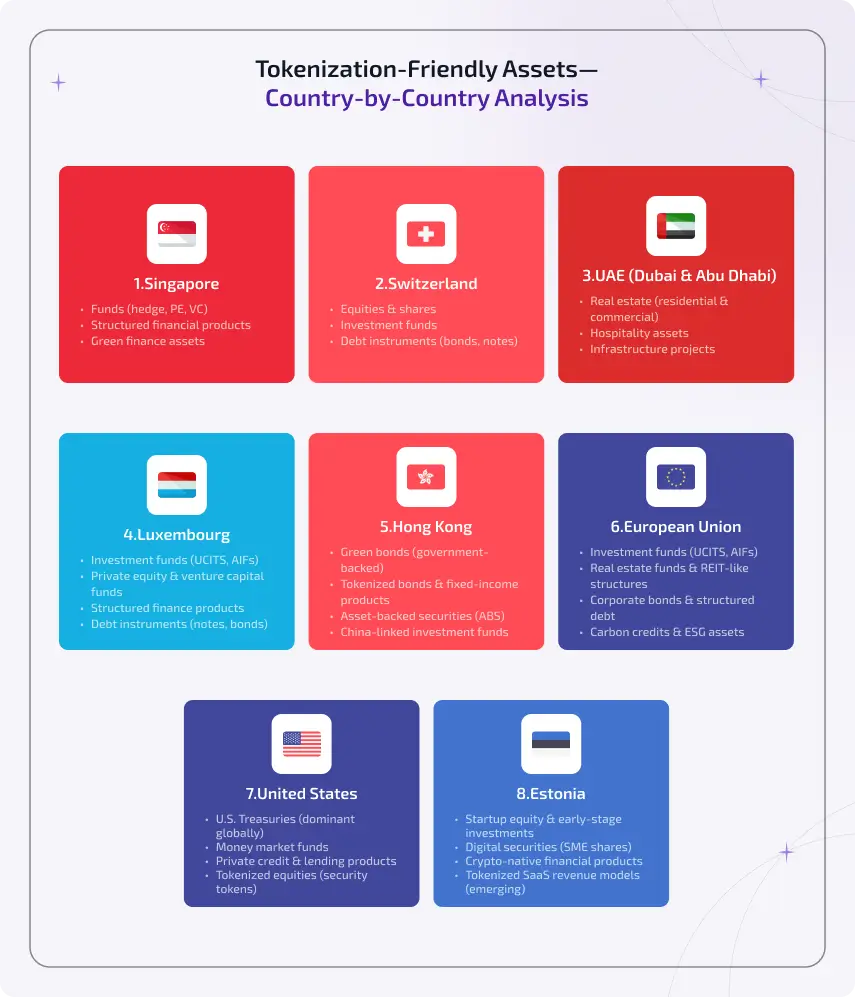
SPV tokenization by country is no longer experimental in 2026; robust legal frameworks and investor demand have led to the dominance of real estate, private credit, funds, and government assets. RWAs' on-chain value has risen above $24 billion globally, and they are growing rapidly year over year.
1. Singapore
Most tokenization-friendly assets
Funds (hedge, PE, VC)
Structured financial products
Green finance assets
Why
MAS sandbox + clear compliance rules
Institutional pilots (Project Guardian)
Strong fintech ecosystem
2. Switzerland
Most tokenization-friendly assets:
Equities & shares
Investment funds
Debt instruments (bonds, notes)
Why
Clear legal framework (DLT Act)
Recognized digital securities
Strong banking + crypto integration
3. UAE (Dubai & Abu Dhabi)
Most tokenization-friendly assets:
Real estate (residential & commercial)
Hospitality assets
Infrastructure projects
Why
Free zones like DIFC & ADGM
Active government-backed tokenization projects
Large-scale real estate deals (billions tokenized)
4. Luxembourg
Most tokenization-friendly assets:
Investment funds (UCITS, AIFs)
Private equity & venture capital funds
Structured finance products
Debt instruments (notes, bonds)
Why
One of the world’s largest fund domiciles
Flexible fund structures are ideal for tokenization
Strong legal recognition of digital securities
5. Hong Kong
Most tokenization-friendly assets:
Green bonds (government-backed)
Tokenized bonds & fixed-income products
Asset-backed securities (ABS)
China-linked investment funds
Why
Government-issued tokenized green bonds
Strong regulatory push for Web3 + finance
Gateway between China and global capital
6. European Union – Regulated Cross-Border Tokenization
Most tokenization-friendly assets:
Investment funds (UCITS, AIFs)
Real estate funds & REIT-like structures
Corporate bonds & structured debt
Carbon credits & ESG assets
Why
MiCA regulation creates clarity across member states
Countries like Germany & France support digital securities
Strong investor protection framework
7. United States
Most tokenization-friendly assets:
U.S. Treasuries (dominant globally)
Money market funds
Private credit & lending products
Tokenized equities (security tokens)
Why
Massive institutional participation
High demand for yield-bearing assets
Mature capital markets infrastructure
8. Estonia
Most tokenization-friendly assets:
Startup equity & early-stage investments
Digital securities (SME shares)
Crypto-native financial products
Tokenized SaaS revenue models (emerging)
Why
Fully digital government infrastructure (e-Residency)
Fast company formation & fintech innovation
Crypto-friendly regulatory approach (with EU alignment)
Step-by-Step Guide— How SPV Tokenization Works Globally
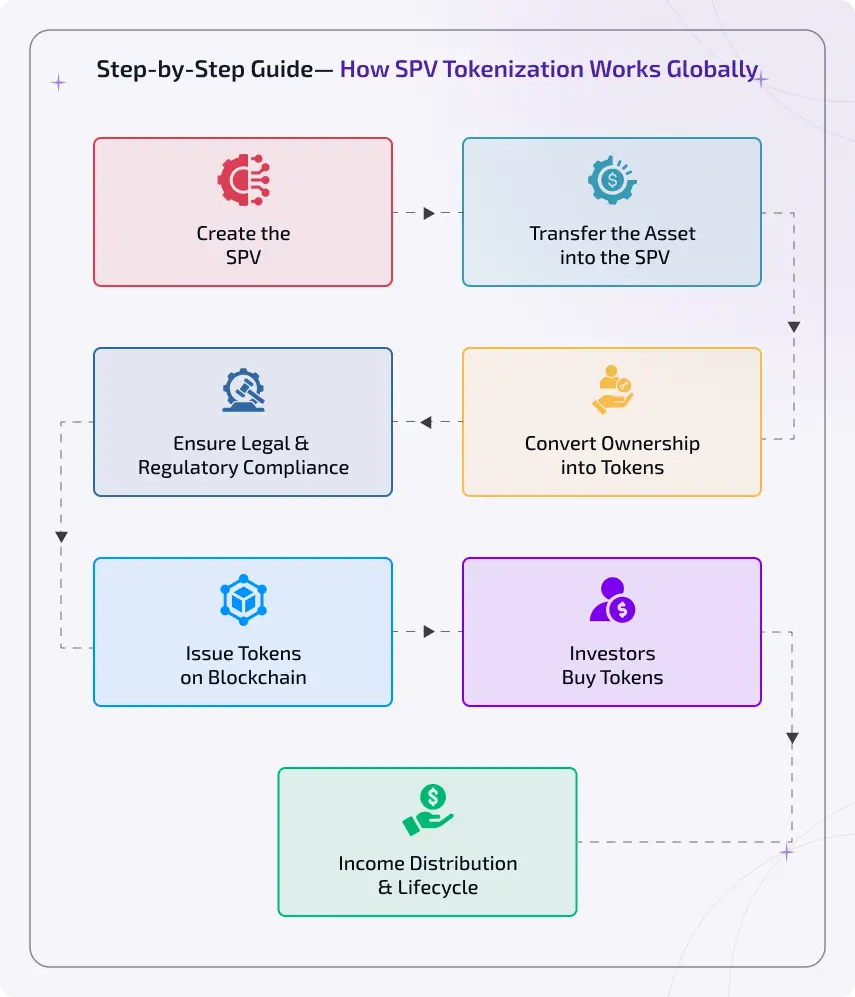
Each region adds its own regulatory layer to the globally uniform framework of SPV tokenization. The core idea is still the same
Step 1 - Create the SPV
To hold the asset, an SPV (Special Purpose Vehicle) is created as a unique legal body.
It might take various forms depending on the country.
Fund structure → Europe (like Luxembourg)
Corporate entity (LLC/company) → United States, Estonia
Issuer-based SPV → Hong Kong
Step 2 - Transfer the Asset into the SPV
Legally, the real-world asset moves into the SPV.
This can include
Real estate
Bonds or loans
Investment funds or private equity
Startup shares
Step 3 - Convert Ownership into Tokens
The SPV is now issuing blockchain based tokens that signify ownership.
Equity (shares or fund units)
Debt (bonds or notes)
Each token is legally connected to
Ownership rights
Income rights (rent, dividends, interest)
Governance rights (in some cases)
Step 4 - Ensure Legal & Regulatory Compliance
In this case, countries differ a bit, but the basic rules are the same .
Examples
United States → Securities exemptions (Reg D, Reg S)
European Union → MiCA + local regulations
Luxembourg → Fund structures (RAIF, SIF)
Hong Kong → Tokenized bond frameworks
Estonia → Digital-first compliance
Common requirements across all regions:
KYC (Know Your Customer)
AML (Anti Money Laundering)
Investor eligibility checks
Legal agreements linking tokens to SPV rights
Step 5 - Issue Tokens on Blockchain
A blockchain platform is used to create and deploy tokens.
They can be made available by:
Private placements
Regulated investment offerings
Investors keep them in digital wallets.
Smart contracts handle
Ownership records
Transfers
Compliance restrictions
Step 6 - Investors Buy Tokens
Investors use cryptocurrency or fiat money to purchase these tokens.
In return, they get:
Fractional ownership
Access to income streams
Exposure to high-value assets
Step 7 - Income Distribution & Lifecycle
The underlying asset provides income for the SPV
Rent → Real estate
Interest → Bonds or loans
Dividends → Equity
Token holders receive this income
Automatically via smart contracts
Or through traditional payout systems
Key Benefits of Selecting Regulation-Flexible Countries for Assets
In 2026, a tokenization project's success will depend more on its structure than its technology. Regulation-flexible jurisdictions shape the scalability, investor trust, and long-term sustainability of SPV-based asset tokenization by lowering obstacles.
Faster Structuring
Flexible jurisdictions allow SPVs to be formed fast, with reduced approval processes. Projects can go from concept to launch in weeks rather than months in countries like the United Arab Emirates and the Cayman Islands. This speed is important for tokenization , as early adoption and market timing have a direct impact on success .
Legal Clarity
For digital assets and SPVs, jurisdictions like Singapore and Switzerland offer explicit structures. This ensures that tokenized assets adhere to current financial regulations and are legally enforceable. Projects achieve long-term stability and avoid potential legal issues .
Global Investor Access
Flexible jurisdictions are intended to attract foreign investments. Global participants can more easily be onboarded into tokenized services due to financial hubs like Singapore and Luxembourg. This improves fundraising opportunities and increases liquidity.
SPV Efficiency
Countries like the Cayman Islands are experts in tax-neutral and bankruptcy-remote SPV models. As a result, asset packaging, management, and tokenization are all improved. Cleaner ownership patterns and investor-friendly frameworks are the outcome.
Innovation Sandboxes
Regulatory sandboxes are available in places like Dubai and Abu Dhabi, where companies can test tokenization schemes under close supervision. This lowers risk while enabling a short cycle and innovation .
Institutional Credibility
Operating in reputable countries like the United States or Switzerland shows compliance and trust to investors and partners. This is necessary to create major investments and institutional capital.
Cross-Border Scalability
Tokenization projects can expand across several countries without rebuilding legal frameworks due to frameworks in areas like the European Union. This supports multi-market operations and long-term growth.
SPV Tokenization 2026: BlockchainX’s Complete Solution
BlockchainX's SPV tokenization is a future-ready solution that transforms real assets into digital securities that are consistent with regulations. It offers unique ownership, risk separation, and robust legal protection for assets such as finances, real estate, and private equity by creating a specific Special Purpose Vehicle (SPV).
BlockchainX provides an end-to-end ecosystem that includes token issuance, smart contracts, legal structuring, and SPV building. This streamlines difficult tasks and ensures global regulatory compliance. A legally backed share is represented by each token, leading to trust in investors.
Assets become more liquid and available to global investors with fractional ownership. All things considered, BlockchainX makes asset tokenization safe, scalable, and effective, helping companies unlock value and maintain their competitive edge in the fast-paced digital economy.
Conclusion
We have addressed every important facet of SPV tokenization in this guide, including its basic idea, legal framework, benefits, process, and applications. This thorough explanation aims to provide you with a clear knowledge of SPV-based tokenization's operation and the reasons behind its growing popularity as a model for asset digitization.
SPV tokenization can help you increase investment prospects worldwide, guarantee compliance, and unlock liquidity through using the right strategy and technology. You can confidently go forward with secure and scalable asset tokenization in the changing digital ecosystem with the help of BlockchainX.