Table of Contents

Emerging Real Estate Tokenization Trends 2026
Listen to the Audio :
With the emergence of new technologies, real estate tokenization trends have boomed around the globe, enabling every individual to invest, buy and hold a share of the real-world assets or properties. This global market is poised to redefine property investment by converting ownership rights into blockchain-based digital tokens.
Entering as a moment that will shape the future, the global market for tokenized real estate will reach up to $3 trillion by 2030. Experts also predict that the real estate tokenization field will keep growing through 2026. For instance, this evolution goes far beyond a technological advancement, representing a fundamental shift and investment across the world.
Driven by increased market adoption, the emerging trends highlighted in this blog represent how this sector is making its shift towards a compliant, scalable, and accessible investment ecosystem.
What is Real Estate Tokenization?
Real estate tokenization is the process of using blockchain technology to convert any property or asset value into a digital token, allowing for fractional investment. The tokenized assets here represent a partial or full ownership of a particular real estate property, making it easily accessible for every type of investor.
This enables global investors to easily buy, sell, and trade property shares cost-effectively, despite their location. Through tokenization, the real estate properties, such as hotels, lands, residential & commercial buildings, and other properties, are legally structured and linked to blockchain-based tokens, which give ownership rights and revenue-generating streams based on the project's structure.
This approach lowers the barriers to entry and makes it more flexible and accessible to high-net-worth assets.
Join the Future of Real Estate Investments - Get Expert Advice
Why Real Estate Tokenization is Gaining Momentum?
As the traditional tokenization is modernized by real estate tokenization, it gains momentum in this modern era, aligning with the broader digital transformation of finance. This makes property investment more accessible and efficient. The conventional real estate transactions are often slow and are limited by geographical and regulatory barriers.
This can be replaced by blockchain-based digital tokens, which fractionalizes the high-value shares, simplify ownership, enable more flexibility, and modernizes asset management, attracting a wider investor base towards them. The major reason behind tokenization's growth and the users' accelerated interest in tokenized real estate is due to the evolution of blockchain technology. It enhances trust among users by providing an immutable record of ownership and uses automated smart contracts to reduce the reliance on third parties at minimal cost.
This technological advancement made tokenization a practical solution rather than a conceptual innovation. Overall, this increasing demand for blockchain and Web3 has made tokenization gain momentum among startups, institutions, enterprises, and businesses. Together, they make real estate tokenization a compelling solution in this digital asset ecosystem.
Top Trends of Real Estate Tokenization to Watch in 2026
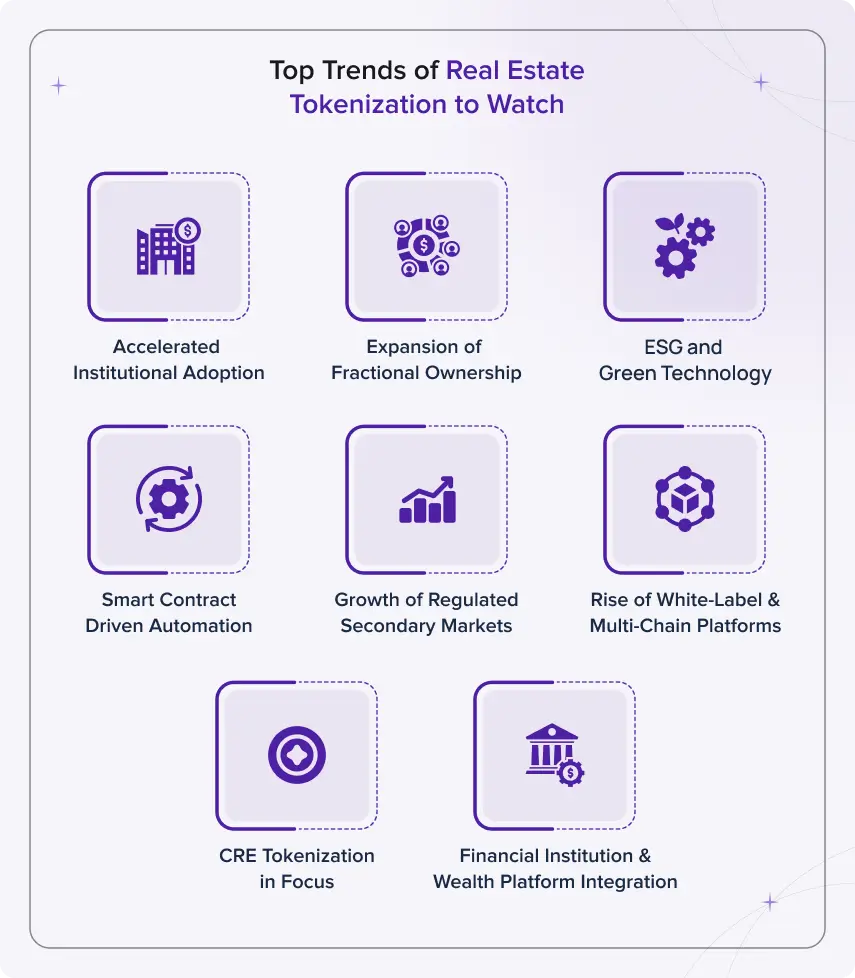
With the evolution of cutting-edge technologies, a major shift is being made in real estate investment for individuals and businesses. A large number of investors are actively ready to invest in tokenized properties with its institutional-grade infrastructure.
Based on the latest industry analyses, platform developments, and market forecasts, we have listed the current look at real estate tokenization services heading into and through 2026. Explore them and learn how real estate is becoming a more scalable, accessible, and trustworthy platform for mainstream investors in 2026.
1. Accelerated Institutional Adoption
As institutions become mainstream in tokenization, technology is revolutionizing real estate by allowing a larger number of financial players, including asset managers, banks, REITs, and private equity firms, to increasingly engage with tokenized real estate.
This enables them to secure investments from all over the world. This trend of institutional adoption scaling up has improved the demand for institutional-grade security and compliance in the market.
Why It Matters?
It brings credibility, market stability, and large capital inflows.
With the acceleration of tokenization from an experimental concept to a mainstream investment, this shift increases market maturity & confidence.
Large financial players like institutions that are seeking yield and diversification can drive liquidity, scalability, and legitimacy in 2026.
2. Expansion of Fractional Ownership
One of the significant trends in 2026 is the growth of fractional ownership through real estate tokenization. It breaks down the traditional barriers by dividing high-value premium real estate assets into fractional digital tokens, enabling young investors who are participating for the first time and global players who seek budget-friendly access to high-value real estate with high value. This leads to simplified onboarding and automated dividend payouts for global investors.
Why It Matters?
Millions of new retail and global investors can enter the real estate markets with small capital thresholds.
By broadening the investor base, tokenization improves diversification opportunities, supporting global participation regardless of location.
It modifies property investment and opens the markets widely to retail and international investors and individuals.
3. ESG and Green Technology
ESG conformity standards have become a primary focus for real estate platforms, and this will now make real estate tokenization a priority for investor decision-making in 2026. With the decrease in carbon footprints, asset managers and developers are embracing real estate tokenization with green technology solutions.
Why It Matters?
ESG reports can be verified and audited using blockchain’s transparency, which increases investors' confidence.
Large-scale or commercial real estate innovation projects that come with ESG ratings have higher resale value, attracting more investors towards them.
The demand for custom real estate software development is growing among investors who look to invest in the ESG-compliant development process.
4. Smart Contract-Driven Automation
At present, tokenized real estate transactions are relying on smart contracts more than ever before, and 2026 is becoming a standard year for the management of tokenized assets.
It automates various critical processes like the rental income distribution, ownership transfers, and compliance checks, making the platform rely on self-executing logic instead of manual processes. This automation makes real estate a passive income asset class.
Why It Matters?
The technology behind this automated process eliminates third parties, minimizes manual errors, and secures every online transaction.
The contract-driven platforms support high transparency, fast end-to-end transactions, and support trustless execution when compared to traditional systems.
Tokenized offerings become more efficient and investor-friendly, attracting a wide range of users.
5. Growth of Regulated Secondary Markets
Since liquidity stands as a challenge in real estate, tokenization will lead to the rise of regulated exchanges and secondary marketplaces, allowing investors to buy and sell tokens legally in the market.
Platforms are integrated with compliant peer-to-peer marketplaces and ATSs, considering their jurisdiction. This makes investors quickly get their money for the sold token, instead of waiting for a long time. Eventually, it gains traction and makes real estate more flexible and investor-friendly.
Why It Matters?
Compliance with security regulations and KYC/AML protocols builds strong confidence with reduced risks.
It serves as a transparent price market for 24/7, enabling investors not to wait for months or years.
Growth of regulated secondary markets resolves the long-term standing illiquidity issue of traditional property investments.
6. Rise of White-Label & Multi-Chain Platforms
Rather than building it from scratch, companies often look for white-label solutions which help them easily launch tokenization platforms with built-in templates, dashboards, and compliance.
Also, the multi-chain approach makes the tokenized assets exist on more than one blockchain network, improving the overall scalability with broader investor access. This will reduce the tech cost and launch time, making it popular among global investors.
Why It Matters?
This approach enables asset managers and property developers to launch offerings quickly and get global service across networks.
The reduced development time and platform dependency accelerate startups, enterprises, and businesses to adopt this technology.
The standardized and customizable tokenization infrastructure drives market expansion and innovation to its core.
7. CRE Tokenization in Focus
Like residential tokenization, commercial real estate (CRE) is dominated by large funds and is gaining traction in 2026. It allows investors to access retail, industrial, logistics centres, and office portfolios through tokens to yield capital returns and rental income.
However, this requires access to advanced features like long-term yield forecasting, lease management, and more, enabling investors to unlock billions in previously illiquid capital.
Why It Matters?
CRE typically offers higher returns and attracts deeper institutional capital due to its scalability potential.
It unlocks massive liquidity and reshapes how institutional and global investors access high-yield assets effortlessly.
CRE tokenization is the largest and most valued part of the property market with its asset diversification.
8. Financial Institution & Wealth Platform Integration
In 2026, real estate tokenization is increasingly integrating with the mainstream finance's growth and facilitates integration of APIs with banks and FinTech companies. This integration enables investors to access fractional property assets directly through platforms and allows them to be a part of a diversified investment portfolio. It enables real-time account funding and rapid withdrawals, ensuring smooth and seamless token purchases.
Why It Matters?
With built-in custody solutions and compliant frameworks, this approach helps investors connect traditional finance with blockchain-based real estate investments, supporting wider user adoption.
Custodial banks opt for secure digital asset vaults, especially for institutional investor usage.
It supports seamless and simple asset diversification without complex onboarding or any technical barrier to entry.
Key Benefits of Real Estate Tokenization To Consider in 2026

Real estate tokenization offers significant benefits to both investors and property holders and redefines how they own, trade, and sell assets within a blockchain-powered ecosystem. However, this model offers several advantages and makes the platform more transparent and accessible.
1. Increased Liquidity
Compared to conventional property transactions, tokenization makes real estate an easy-to-access platform, allowing investors to seamlessly buy and sell fractional shares with less capital investment.
2. Low Barrier Entry
By leveraging fractional ownership, tokenization allows investors to participate and access high-value asset properties with a small investment without any intermediaries. This broadens the market to a larger investor base.
3. Embedded Incentive Models
Tokenization enables property owners to reward long-term investors with loyalty benefits, priority access to future projects, and bonus yields with long-term asset performance, strengthening investor engagement.
4. Real-Time Asset Programmability
With tokenized real estate, assets become programmable financial instruments by automatically adjusting returns, distributions, and governance rules. This real-time programmability ensures faster and more efficient real estate investments.
5. Portfolio Diversification
Investors can seamlessly distribute their capital across multiple tokenized properties, asset classes, and geographic markets without any barriers. This allows them to get exposure with reduced risks and access mixed real estate portfolios.
6. Improved Asset Visibility & Valuation
Blockchain-based tokenization records cash flows, user ownership, and performance, enhancing asset visibility with improved pricing accuracy. This enables investors to gain clearer insights with improved credibility and market trust.
7. Automated Income Distribution
The use of smart contracts in real estate tokenization automates various processes like rental income distribution, profit shares, and dividends. This eliminates delays and ensures timely payouts without manual intervention.
8. Efficient Capital Rising
Asset owners and real estate developers can raise capital efficiently by issuing the tokens directly to investors. This streamlined approach reduces intermediaries and operates with reduced cost, providing access to global capital pools.
9. Regulatory Environment
Tokenization with its regulatory transparency and well-structured frameworks, allows regulators to effectively monitor property investments. This strengthens investor protection and supports sustainable market growth.
BlockchainX’s Role in Building Scalable Real Estate Tokenization Platforms
BlockchainX plays a crucial role in enabling businesses to build secure, scalable, compliant, and feature-rich real estate tokenization platforms integrated with modern blockchain solutions and tools. From asset onboarding to legal structuring and secondary market trading, we ensure to streamline your tokenization journey with simple planning and advanced platform architecture.
With the ability to scale across markets and asset classes, our solutions help businesses and investors to easily deploy a reliable tokenization platform that is built for growth and global adoption. However, our professionals use high-performing blockchain networks and multi-chain frameworks to ensure a seamless transaction process and use smart contracts to automate asset transfers, ownership distribution, and much more.
Additionally, we ensure a safe and transparent record of ownership using advanced technologies, which enables fractionalization of real estate assets into smaller units to increase asset participation. The company also focuses on creating intuitive dashboards and platforms embedded with regulatory-ready systems to help businesses easily develop real estate tokenization platforms that can remain long-term in the evolving digital ecosystem.
Download the PDF : Real Estate Tokenization Trends.pdf
Conclusion
Tokenization is a promising technology that can change how an asset can be traded and owned. As we fast-forward into 2026, the property tokenization trend is a new financial reality which can play a huge role in the global property market and the investment sector. Looking ahead, we have sorted and listed the top 8 trends of real estate tokenization which makes investing in assets much easier for everyone.
By combining regulated infrastructure with blockchain technology, tokenized real estate is becoming more scalable and accessible with the right rules, making the platform more efficient for mainstream investors in 2026. If you are looking to create compliant and feature-rich tokenized platforms, do contact our BlockchainX team for more insights.