The Expert Guide on How to Launch Crypto Token?
Listen to the Audio :
Are you considering developing your cryptocurrency or figuring out how to launch crypto token? For this—you must have an effective strategy for governance, fundraising and creating decentralized applications. However, where do you even begin? We will delve into the process of launching a cryptocurrency token, covering everything from selecting a blockchain platform to crafting smart contracts and ensuring regulatory compliance.
In this blog, Whether you are a blockchain enthusiast or an entrepreneur, we will equip you with the necessary resources to effectively create crypto tokens and launch tokens.
Crypto Token Overview
A crypto token creates and manages a digital asset on a blockchain network known as a crypto token. Generally a decentralized ecosystem uses it to signify ownership, value or the ability to access specific features. On the other hand—existing blockchain platforms such as Ethereum (ERC20) and Binance smart chain (BEP20) serve as the foundation of cryptocurrencies like Bitcoin or Ethereum.
Cryptocurrency tokens are used for various purposes, including
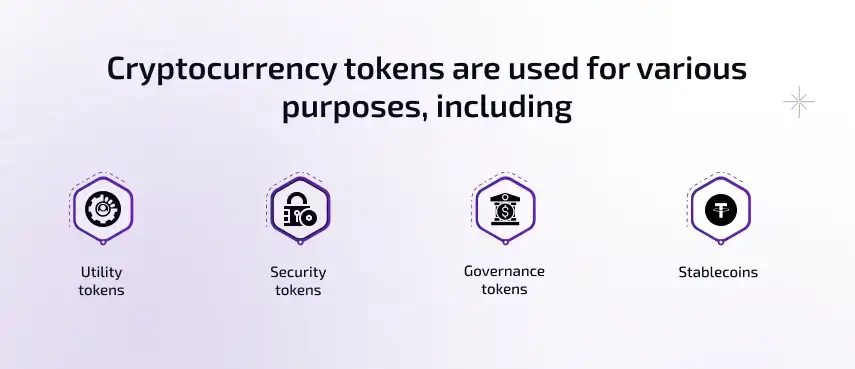
Utility tokens
Grant users access to goods or services in a blockchain based network (e.g. by allowing
tokens to pay for services in decentralized applications)
Security tokens
These tokens signify the company or asset ownership which is similar to shares in
traditional finance.
Governance tokens
Give owners the right to vote on decentralized platforms or protocols.
Stablecoins
It is linked to fiat currency or other real world assets to keep their value steady (e.g.
USDT or DAI)
Cryptocurrency tokens are created through smart contracts which can be used, exchanged or
transferred within the decentralized apps (dApps) without the need for middlemen.
How to Create and Launch Crypto Tokens
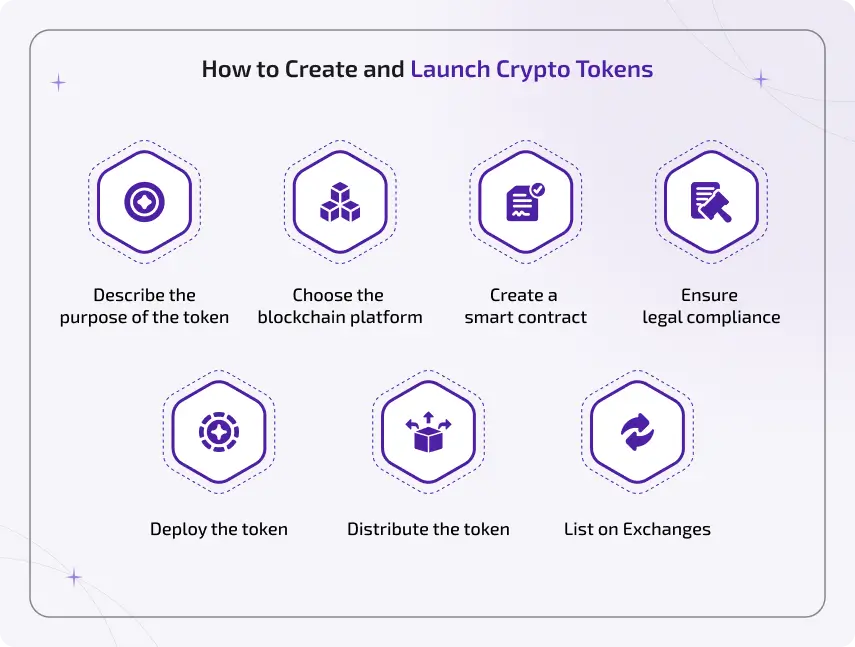
To ensure success and understand how to launch your own crypto token, you require several crucial measures. Here is a concise step to understand
1. Describe the purpose of the token
Determine the initial goal of your cryptocurrency token. Will it function as a
security token, a governance token or a utility token for decentralized applications
(dApps)? A detailed understanding of its purpose is necessary for the subsequent actions.
2. Choose the blockchain platform
Choose the blockchain that will work best for your project. The famous and well
known options include Ethereum (ERC20), TRON (TRC20) and Binance smart chain (BEP20). Each
has specific benefits like transaction fees and scalability. Here is the list of best blockchain to create crypto token check it out.
3. Create a smart contract
Your crypto tokens are the backbone of your smart contract. This code specifies
how your token will function in terms of creation, transfer and total supply. You can write
the code yourself or hire a developer if you are skilled.
4. Ensure legal compliance
There can be legal and regulatory obligations depending on your location such as
KYC (know your customer) and AML (anti-money laundering) standards. Talk with legal
professionals to ensure your token conforms with all applicable laws.
5. Deploy the token
Launch token on the selected blockchain is the next step when your smart contract is complete. Your token is generated and ready for distribution for use.
6. Distribute the token
Select the token distribution strategy you want to use, after deployment. You
can use them on your platform, airdrop them and release them through an Initial Coin
Offerings (IC0). At this point, marketing is essential to create an interest and adoption in
it.
7. List on Exchanges
It is possible to list your token on centralized or decentralized exchanges and
enable users to exchange, sell or trade it. Partnering with the apt exchanges can increase
your token's visibility and liquidity.
You may successfully launch a crypto token and begin developing your blockchain project by following these steps on how to launch a token effectively.
Cryptocurrencies: Where Do They Stand Now?
Since the launch of Bitcoin in 2009, cryptocurrencies have experienced significant growth
transitioning from a specialized interest in the global finance industry. Today—hundreds of
digital assets work at the intersection of regulation, finance and technology. The use cases
for major cryptocurrencies such as Bitcoin, Ethereum and other recent additions like Solana
and Binance coin have grown to include from Non-fungible tokens (NFTs) to Decentralized
finance (DeFi) and beyond.
Interest from institutions has increased as governments and businesses investigate the
possibilities of blockchain technology. Nonetheless, the market continues to be extremely
volatile and countries continue to face regulatory obstacles as they attempt to manage
digital currencies without impeding innovation. These days, cryptocurrencies serve as a
gateway to a new digital economy and an alternative means of money.
Popular Crypto
Tokens
The popular crypto tokens have appeared on several blockchain systems each with unique
features and functions. Below are the prominent tokens.
Tether(USDT)
A popular stablecoin for trading and a reliable store of value in the cryptocurrency
industry, Tether is based on a stablecoin.
Chainlink(LINK)
This decentralized Oracle network links smart
contract development on several blockchains to real world data allowing for the
development of more advanced decentralized applications (dApps)
Uniswap(UNI)
One of the biggest DEXs in the cryptocurrency world—UNI is the governance token of the
uniswap decentralized exchange (DEXs) and it enables holders to take part in the platform’s
decision-making.
USD Coin(USDC)
Linked to the US dollar, USDC provides price stability and serves as a platform for
payments, trading and decentralized finance (DeFi) applications.
Aave (AAVE)
Aave is a decentralized lending system that is open source and allows users to borrow and
lend various cryptocurrencies.
SushiSwap (SUSHI)
SUSHI powers the Sushiswap decentralized exchange providing incentives and governance
opportunities to users who contribute to the platform’s expansion by providing liquidity.
Wrapped Bitcoin
WBTC is a tokenized form of Bitcoin that makes BTC tradeable within the Ethereum ecosystem
and provides Bitcoin’s liquidity to decentralized exchanges built on Ethereum.
Polygon(MATIC)
The native token of the polygon network which offers Layer2 solutions to enhance Ethereum’s
scalability is MATIC. The Polygon network uses it for governance, staking and paying
transaction fees.
Solana
Due to its quick and affordable transaction speed, DApps and NFTs favour the Solana
blockchain which uses SOL as its native token to pay for transactions and staking.
Use cases of
Creating Crypto Token
Here are detailed explanations of the potential use cases for cryptocurrency tokens, along with key insights on successfully.
Fundraising
To generate funds for a new startup or any new project—you can issue tokens which is
possible. Investors purchase these tokens with the expectation that they will eventually
increase in value or provide access to a service. With this approach– projects can interact
with their community directly and avoid more conventional funding channels like venture
capital.
Digital identity
Cryptocurrency tokens can stand in for digital identities or credentials allowing people to
control their information. Users can safely share their login credentials with reputable
organizations by storing them on a blockchain.
Tokenizing real estate
One way to represent fractional ownership of real estate or other tangible assets is via
tokens. Consequently—investors can purchase a fraction of an asset instead of the full
amount which makes their investing in high value markets simpler. Since tokenization stores
ownership and transaction history on a blockchain— it also facilitates transactions,
increases liquidity and boosts transparency.
Supply chain management
Tokens can improve system transparency by tracking products at every stage of the supply
chain. Stakeholders can use tokens to represent particular products and follow a product's
journey from manufacturing to distribution. This can help combat counterfeiting, ensure
product authenticity and support companies in adhering to legal requirements for ethical
sourcing and sustainability.
Virtual goods and gaming
Video games allow players to use tokens as in game currencies to purchase upgrades, skin and
other items. In addition, they can stand in for ownership of special digital assets that
players can purchase, sell and exchange outside of the gaming environment like non-fungible
tokens (NFTs). Thus, in game achievements support good value and generate a secondary
market.
Loyalty programs and rewards
To provide rewards engaged to loyal customers businesses can create tokens. One can obtain
tokens by making purchases, referring others and participating in community activities.
Consumers can exchange these tokens for special offers, discounted goods or services and
encourage repeat business and brand loyalty.
Rules of the
Crypto Token Launch
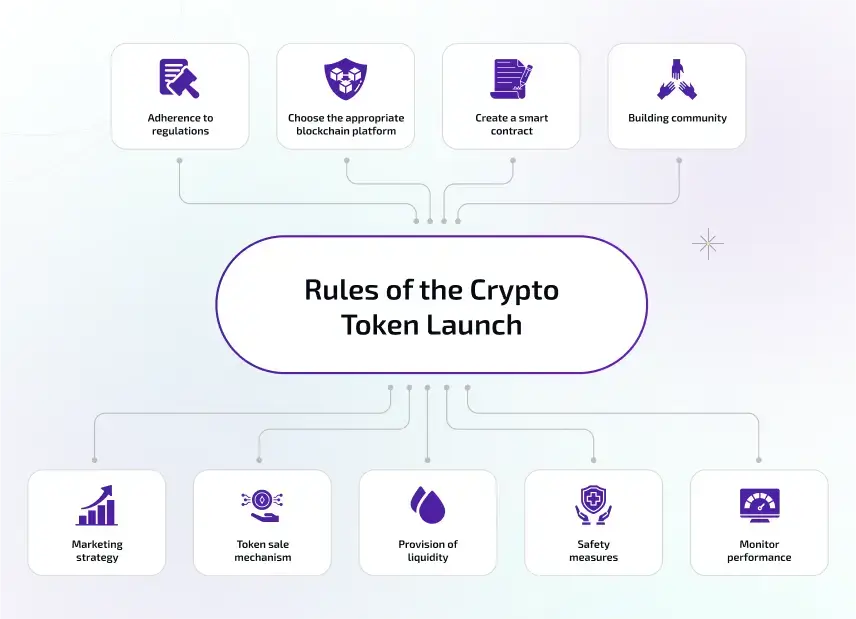
To ensure compliance, security and market success–the launch of cryptocurrency tokens
entails many essential processes and best practices. The following are key regulations and
recommendations to consider when launching a cryptocurrency token.
1. Adherence to regulations
Following all the appropriate laws which are essential for running your business. Securities rules, know your customer (KYC) requirements and anti-money laundering (AML) laws may fall under this category.
To negotiate complicated restrictions, think about getting counsel.
2. Choose the appropriate blockchain platform
Depending on the project you want to complete, choose a blockchain platform like Ethereum, Binance Smart Chain or another that supports ERC20 or BEP20 standards.
3. Create a smart contract
For the token, create a safe and thoroughly checked smart contract. Make sure that it complies with the selected token standard and is secure.
To guarantee security and dependability & carry out extensive testing and take into account independent audits.
4. Building community
Always begin to build a group around your token before the launch of your token. Utilize forums, social media and other various platforms to engage with potential investors and users.
Be transparent and honest about your project's objectives, status and updates.
5. Marketing strategy
Develop a comprehensive marketing plan to increase interest in and knowledge about the token. Press releases, collaborations, influencer marketing and internet campaigns are a few examples of this.
Express your token's advantages and special qualities understandably.
6. Token sale mechanism
Choose the type of token sale (ICO, IEO, IDO etc..) and the financing method (set price, auction etc..)
Provide specific information about the token sale including the start and end dates, the price and the accepted currencies.
7. Provision of liquidity
Make arrangements to list your digital currency on exchanges and decentralized exchanges (DEX) to ensure liquidity. To make trading easier, think about creating liquidity pools.
8. Safety measures
To stop fraud and hacking–put strong security measures in place for wallets, exchanges and user data.
Inform the public about safe and effective safety measures.
9. Monitor performance
Closely monitor the community opinions, market developments and token performance after the launch.
Be ready to modify and enhance the project in response to user requirements and market dynamics.
Common Mistakes to Avoid When Launching a Crypto Token
It can be hard to launch a token, but you can avoid losses, ensure compliance, and attain long-term project success by being aware of typical pitfalls .
Skipping Regulatory and Legal Compliance Inspections
Before launching your crypto token globally, always check the regulations. Failure to do so could result in fines or project termination .
Starting a Token Without a Clear Use or Goal
Make sure your token adds value or solves a real problem, as tokens without defined uses or benefits fail to attract users.
Unfair Token Distribution and Poor Tokenomics
For long-term growth, create fair supply, distribution, and incentive structures. Ineffective token allocation or inflation might hinder adoption.
Ignoring Security Audits and Smart Contract Testing
Before launching, do extensive testing and audits because unverified smart contracts could be exploited, risking user funds .
Poor Community-Building and Marketing Plans
Without awareness, even a great token fails; focus on social media, community involvement and strategic marketing.
Insufficient transparency with Users and Investors
Maintaining transparent communication, updates, and roadmap visibility is essential for long-term success; hiding project specifics undermines trust .
Underestimating Exchange Listing Requirements and Liquidity
Trading suffers from low liquidity or a lack of exchange access; prepare token listings and liquidity provisions in advance .
Ignoring the Long-Term Roadmap and Governance
Projects lose focus without a plan or governance; set future benchmarks, decision-making processes, & governance rules early on.
Why choose BlockchainX to Launch your Crypto token
Our expertise is required in the creation of smart contracts, regulatory compliance and community involvement for the launch of a cryptocurrency token. BlockchainX offers end to end solutions customized to your project’s requirements, simplifying the intricate procedure.
Our team of professionals ensures safe development, effective launch and compliance with all applicable laws for your token. Additionally—BlokchainX offers strong marketing assistance to ensure your token acquires the traction it needs in the tough cryptocurrency market. BlockchainX is a reliable partner to assist in bringing your token to life and has demonstrated success.
BlockchainX is an expert in creating safe and effective smart contracts which lowers the risks involved in token launches. We allow you to choose the best blockchain platform for your token from a variety of options including Ethereum, Binance smart chain and Polygon. Due to its full spectrum strategy—BlockchainX is the ideal partner to launch your own crypto token.
Key reasons to choose BlockchainX
Comprehensive token creation and launch services.
Secure and skilled smart contract development.
Regulatory compliance and legal guidance.
Multi blockchain support.
Continuous post-launch assistance.
Cost-effective pricing.
Conclusion
We have covered all you need to know as a business owner by going over the crucial processes required in creating a token on any blockchain. We have addressed every aspect from the technical challenges of token minting to the strategic rationales that bolster your investment. Our development services can help you every step of the way if you are interested in going further and launching your crypto token. Talk with our experts about how we can help you achieve your goal. Reach out to us right away!


