Crypto exchange market trends are evolving fast as digital assets are increasingly used in global financial systems. So, what if crypto exchanges became the future of global finance rather than just trading platforms?
This revolution has already begun as seen by the latest crypto exchange market trends for 2026. Crypto exchanges have moved from simple buy-and-sell platforms into advanced digital ecosystems. The industry is evolving at a remarkable rate, from tokenized assets and smooth global transactions to AI-driven trading tools and decentralized finance (DeFi) integration.
Governments are passing clearer laws, institutions are making huge investments, and millions of new users are joining the market. All of this is bringing in a new age for crypto exchanges--one that is smarter, faster and safer than before.
What major trends are driving this transformation ? And how will they impact crypto trading in the future?
In this blog, we explain the latest crypto exchange trends for 2026 simply, so you can remain ahead of the game.
Crypto Exchange Market Overview
The crypto exchange market is where consumers buy, sell, and trade cryptocurrencies such as Bitcoin, Ethereum and other digital assets. It functions similarly to a stock market except users trade crypto rather than stocks.
The platforms that enable this are crypto exchanges. They facilitate transactions by connecting buyers and sellers. Nowadays, buying and selling cryptocurrencies is not the only reason for cryptocurrency exchanges. They now provide multiple services, including DeFi access, staking, spot trading, and derivatives trading.
In fact, more than 60% of consumers favour platforms that offer several services in one place, indicating the growth of all-in-one operations.
The market is still rather erratic and competitive, however. Exchanges need to focus on:
Robust security measures
Smooth user experience
Regulatory compliance
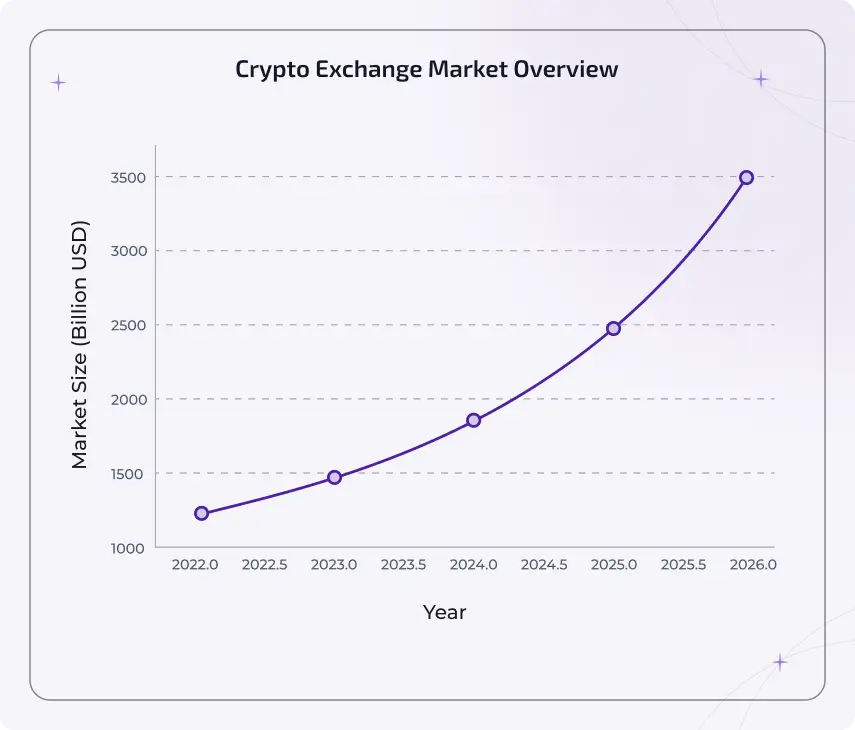
The chart below illustrates the crypto exchange markets consistent growth emphasizing rising adoption and market expansion between 2022 and 2026.
2026 marks a turning point for crypto exchanges. The market is transitioning from high Volume speculation to institutional-grade infrastructure, utility driven features, and deeper integration with traditional finance.
Exchanges are developing into all-inclusive financial super-apps that include spot/derivatives trading, staking, lending, tokenized assets and even payments. They are no longer just trading venues.
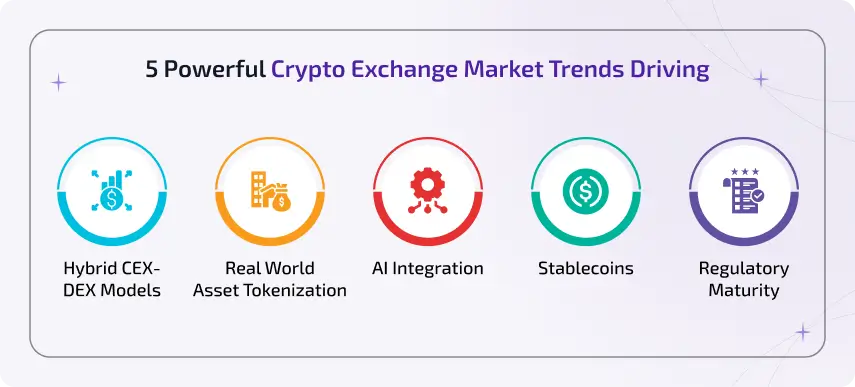
The following are the key developments shaping the crypto exchange market this year:
Hybrid CEX-DEX Models & Shifting Market Share
Approximately $80 trillion in combined spot and perpetual futures were traded on centralized exchanges (CEXs) in 2025, and this trend is expected to continue into 2026.
Because of their deep liquidity, fiat on-ramps and institutional services—platforms like Binance, Bybit, OKX and Coinbase are still at the top.
Nonetheless— decentralized exchanges (DEXs) are making major strides. Since early 2024, DEX spot market share has nearly doubled.
In early 2026, it was between 13.6 and 14%. Innovations from platforms like Hyperliquid and enhanced Layer-2 scalability, which offer reduced costs and faster execution, have caused perpetual DEX volumes to rise even faster (up to 8x in some measures).
Trend Takeaway - A hybrid future is emerging. While DEXs are superior in self-custody, censorship resistance, and fast innovation (particularly in memecoins and on-chain perps), CEXs are superior in scale, compliance, and institutional flows. Many exchanges are using hybrid designs to combine the best features of both worlds.
Explosive Growth in the Real World Asset (RWA) Tokenization
The tokenization of real-world assets, such as stocks, private loans, treasuries, and more, is moving from pilot projects to mainstream exchange infrastructure. Tokenized treasuries and credit instruments are being widely used as yield-bearing collateral, and RWA's overall value has increased significantly (to tens of billions).
Exchanges are strongly integrating RWA tokenization development, letting users trade tokenized equities, funds, and real estate alongside crypto assets. This trend increases liquidity, makes trading possible 24/7, and attracts traditional investors looking for fractional ownership.
Trend Takeaway - As regulatory clarity increases and more institutions tokenize assets, RWAs are transforming exchanges into links between TradFi and DeFi. This trend is expected to continue rising.
AI Integration Transforming User Experience and Operations
Major crypto exchange market trends are starting to use artificial intelligence as a key element. Expect wide adoption of:
AI-driven portfolio optimizers and trading assistance
Advanced fraud detection and risk management tools
Decentralized AI chatbots for customer service
Automated information aggregation and predictive analytics
AI is also allowing autonomous agents to manage trades, handle collateral and interact across protocols with minimum human intervention.
Trend Takeaway - Platforms that thoroughly integrate AI will stand out by providing customized, efficient and secure experiences reducing friction for both retail and institutional customers while enhancing operational resilience.
Stablecoins as the Backbone of Trading and Payments
As the main on/off-ramp, settlement layer and funding mechanism for derivatives, stablecoin supply is continuing to grow fast (with pathways beyond $500 billion and beyond). Stablecoin features, such as smooth conversions, yield opportunities (where compliant), and integration into international payments, are being improved by exchanges.
Trend Takeaway - Stablecoins have evolved from basic pegged assets into the "internet's dollar," enabling real-time transfers on exchange platforms and spot trading.
Regulatory Maturity and Institutional-Grade Compliance
2026 offers clearer global frameworks:
Full compliance with the EU's MiCA law, creating a uniform passport for crypto service providers with strict rules for operations, stablecoins, and custody.
Alongside CFTC/SEC clarity on digital commodities, there has been progress on U.S. stablecoin regulations (the GENIUS Act) and on market structure laws
Rising compliance criteria for AML, KYC, and the Travel Rule.
Even though this raises operating costs, it reduces uncertainty and enables greater institutional participation through tokenised goods, corporate treasuries, and exchange-traded funds (ETFs).
Trend Takeaway - Regulatory development benefits well-capitalized, compliant exchanges and drives mainstream approval, but also poses a challenge to smaller, less-regulated platforms.
Market Analysis of Crypto Exchanges
A closer look at the crypto exchange market trends and analysis reveals a clear trend toward long-term sustainability and institutional maturity. The industry is no longer driven only by trade volume, but is growing into a structured financial system supported by regulations, liquidity, and integration with traditional finance.
Economic Scale and Market Size & Economic Scale
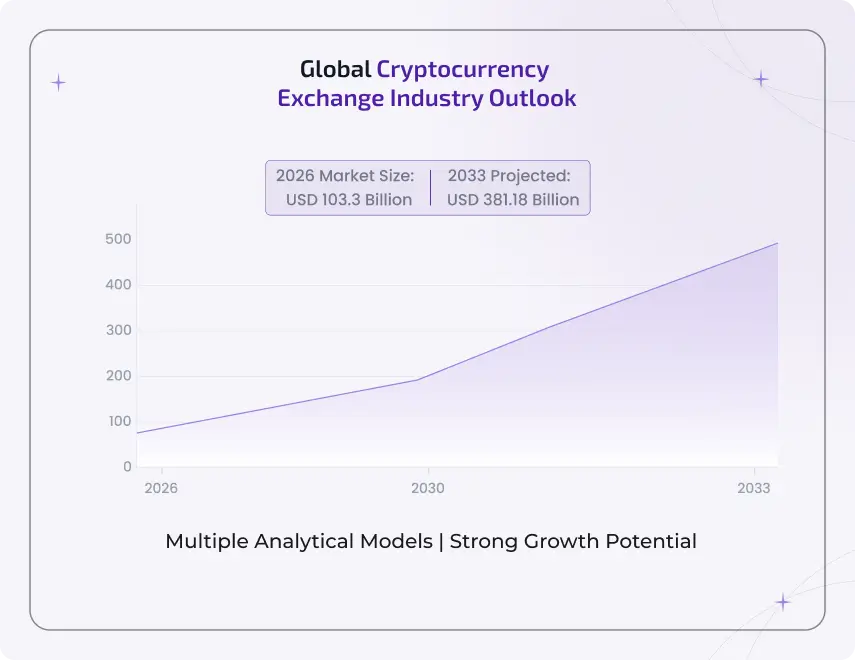
The global cryptocurrency exchange industry is expected to reach USD 85– 103 billion in 2026 based on several analytical models.
According to a thorough analysis—the market is valued at USD 103. 3 billion in 2026 and is expected to grow at a CAGR of 20.5 % to USD 381. 18 billion by 2033. Other predictions expect USD 68- 85 billion in 2026 with long term growth reaching USD 170 - 300 billion by 2030 - 2033.
This highlights the robust and constant expansion of the crypto exchange industry.
The trajectory of the crypto exchange market future growth is illustrated in the above chart, which highlights its transition into a mature financial ecosystem with steady growth, a robust CAGR, and rising institutional engagement.
Key Growth Factors
The market for crypto exchanges is expanding quickly due to several significant factors:
Institutional Adoption
Spot ETFs and digital asset treasury strategies have increased engagement.
Stablecoin Growth
With the potential to reach USD 500 billion to 1 trillion, the market capitalization is projected to exceed USD 300–320 billion in 2026.
Tokenization of Real-World Asset (RWA)
Tokenized US Treasuries are getting close to USD 10 billion, while on-chain assets are increasing between USD 12 and USD 36 billion.
Role of Derivatives in Market Growth
In the cryptocurrency ecosystem, derivatives trading remains dominant.
Approximately 70-75% of the overall trade volume
Perpetual futures contracts are the primary mover.
For new investors, spot trading is still a crucial entry point.
This structure depicts a mature market where new user adoption is supported while advanced trade goods drive activity.
Crypto Exchange Market by Region—Segmentation & Key Insights
Dividing the crypto exchange market by exchange model, trading type, asset focus and region is required to fully understand it. Segmentation shows a mature market in 2026, where regional dynamics and hybrid methods are changing competition but centralized platforms continue to lead.
1. Segmentation by Exchange Model
The three primary types of the industry are growing hybrid platforms, decentralized exchanges (DEX), and centralized exchanges (CEX).
Centralized Exchange - In 2026, CEXs are projected to maintain a dominant 88.4% market share. Deep liquidity, seamless fiat on-ramps, institutional-grade services, and user-friendly interfaces remain their key strengths.
As a result, businesses increasingly rely on a centralized crypto exchange development company to build scalable and regulation-compliant platforms that can handle high trading volumes and global users.
Decentralized Exchange - DEXs are expanding rapidly, with spot market share nearly doubling since 2024, reaching around 13.6–14% by early 2026. Additionally, DEX-based perpetual futures have surged significantly, accounting for approximately 10.2% of the derivatives market.
The growth is driven by demand for self-custody, transparency, and censorship resistance, making decentralized exchange development a key focus for startups aiming to innovate in DeFi.
Hybrid Exchange - A new class of exchanges called hybrid exchanges combines the security and transparency of DEXs with the speed and liquidity of CEXs. These solutions are gaining traction as users seek a balance between control and performance.
As a result, hybrid crypto exchange development is emerging as a strategic choice for businesses looking to reduce counterparty risk while maintaining operational efficiency.
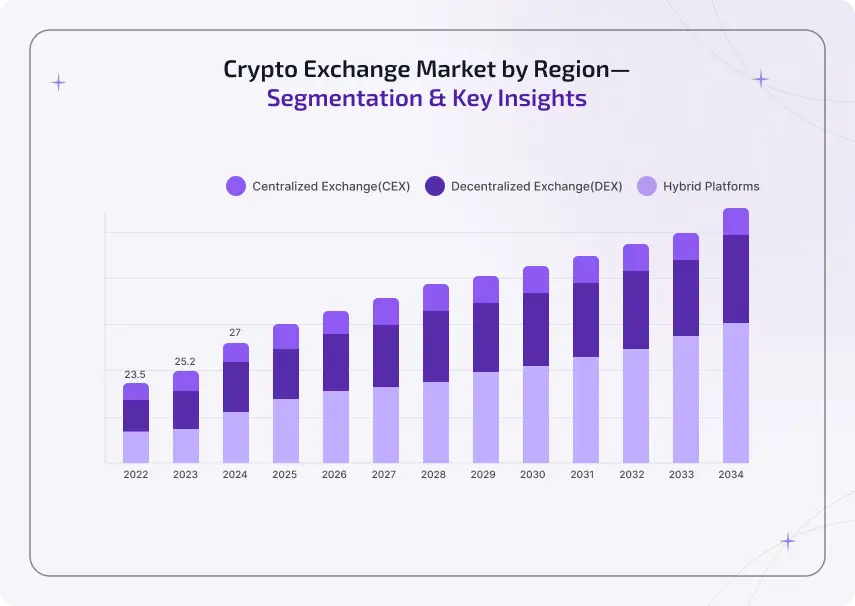
The rise of crypto trading platforms per exchange model from 2022 to 2034 is depicted in this graph, which emphasizes the power of centralized exchanges while decentralized and hybrid platforms continue to increase their market share.
2. Segmentation by Trading Type
Spot Trading
Spot trading is still the main way users enter into the market and is expected to keep a 63.6% market share. Retail investors and new participants in the cryptocurrency market utilize it extensively.
Derivatives Trading
Perpetual futures especially make up the majority of trading activity, typically accounting for 70–75% of total volume. For risk management, hedging, and leverage, institutional and advanced traders—choose this category.
3. Regional Insights
North America — Largest Market (37.2% Share)
North America dominates the crypto exchange market, owing to significant institutional engagement and regulatory certainty. The presence of spot Bitcoin and Ethereum ETFs, and prominent platforms like Coinbase and Kraken, reinforces the region's dominance. It is renowned for its integration with traditional finance and institutional grade trading.
Asia-Pacific — Fastest-Growing Region (23.8% Share)
The fastest-growing region is Asia-Pacific, where South Korea, Japan, Singapore, India, and other countries are leading adoption. This region's high retail engagement, financial innovation, and mobile first clients make it a significant contributor to the volume of global trade.
Europe
Europe is experiencing consistent growth, helped by legal frameworks like MiCA. Countries like France, Germany, and the UK are at the forefront of institutional adoption and compliance-driven crypto services.
Emerging Markets (LATAM, Middle East & Africa)
Although their present market share is still lower, regions in Latin America, the Middle East, and Africa show growing popularity of remittances, inflation hedging, and mobile accessibility.
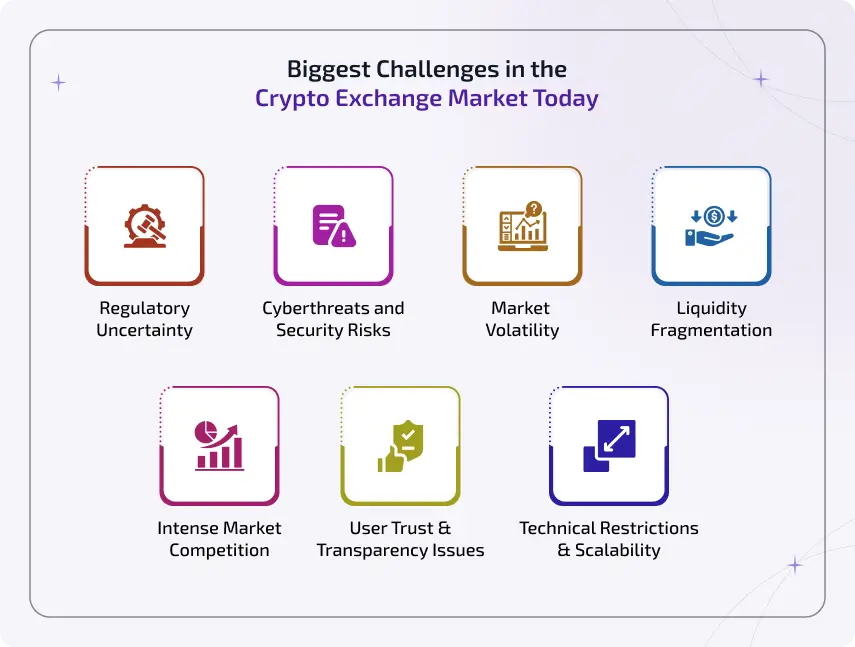
Biggest Challenges in the Crypto Exchange Market Today
Understanding crypto market trends in 2026 faces several major challenges despite its rapid growth and innovation. Exchanges must constantly adapt and improve since these issues affect user trust, platform stability, and long-term sustainability.
1. Regulatory Uncertainty
Crypto laws differ widely between countries and are constantly evolving. While certain regions have well defined frameworks, others are still ambiguous or constraining.
This leads to challenges like:
Compliance issues with global trade
Risk of abrupt policy changes
Limited access in some markets
2. Cyberthreats and Security Risks
Crypto exchanges are frequently targeted by hackers, phishing, and cyberattacks due to the huge amount of digital assets they store.
Important issues include:
Fund losses and exchange hacking
Breach of data
Vulnerabilities in smart contracts (for DEX platforms)
3. Market Volatility
The crypto market is extremely chaotic, with prices changing quickly in response to macroeconomic variables, investor mood, and global events.
This results in:
Higher trading risks
Abrupt liquidation of leveraged positions
New investors' uncertainty
4. Liquidity Fragmentation
Liquidity is frequently spread across numerous exchanges and platforms, especially with the advent of DEXs and hybrid models.
This may lead to:
Variations in prices between platforms
Slippage in huge trades
Ineffective market pricing
5. Intense Market Competition
The number of crypto exchanges is growing rapidly, making platform competition fierce.
To remain competitive, exchanges need to focus on:
Reduced costs
Improved user experience
Advanced features
Powerful branding
6. User Trust & Transparency Issues
Many users remain concerned about the transparency of centralized exchanges, particularly after past incidents involving fund theft.
Among challenges are:
Lack of operational transparency
Asset custody concerns
The need for proof-of-reserves systems
7. Technical Restrictions and Scalability
Exchanges must manage high transaction volumes without delays or outages as user demand rises.
Typical problems:
Congestion in the network
Slow processing of transactions
Platform failures when volatility is high
Use Cases/Real-World Applications
Buying and selling digital asset exchange is no longer the only use for crypto exchange market trends and analysis. In 2026—they will have a major effect on real-world financial activities and provide a range of use cases for people, companies, and organisations.
Cryptocurrency Trading & Investment
Users purchase, sell and trade digital assets like Bitcoin and Ethereum through crypto exchanges. They provide investment opportunities, portfolio diversity, and real-time market access to both novice and seasoned traders.
Cross-Border Payments
Crypto exchange market trends offer fast, affordable, and middleman-free international payments. They are ideal for business deals, remittances, and reducing traditional banking delays as users can transfer funds globally in a matter of minutes.
Access to Decentralized Finance (DeFi)
DeFi services, including lending, borrowing and yield farming, are accessible through crypto exchanges. Users access financial tools, get rewards, and participate in decentralized ecosystems without relying on traditional financial institutions.
Staking & Passive Income
Exchanges allow users to lock their crypto to get rewards through staking services. This allows investors to sustain long-term asset holdings, promote blockchain networks, and earn passive income.
Tokenized Asset Trading
Tokenized real world assets, including equities, commodities, and real estate, can be traded on crypto exchanges. This enables higher liquidity, fractional ownership, and global access to traditional investment options.
Digital Assets and NFT Trading
NFT marketplace development, which allow users to buy, sell, and trade digital assets like music, art, and gaming items, support many exchanges, increasing opportunities in the rising digital economy.
Risk Management and Hedging
Crypto exchanges provide derivatives like futures and options allowing traders to hedge against market volatility. These innovations provide advanced trading techniques, risk management, and investment protection.
Enterprise-grade, secure cryptocurrency exchanges are in high demand due to institutional investments.
DeFi integration improves platform function and creates new income sources.
Tokenized assets provide access to traditional markets valued at trillions of dollars.
AI-driven solutions increase user engagement and trade accuracy.
With millions of new consumers, emerging markets provide unexplored growth.
Strong security and compliance build long term user retention and trust.
Hybrid exchange development solutions offer the ideal balance of transparency, control, and speed.
Future Outlook of Crypto Exchanges (2026-2035)
We are on the cusp of an innovative decade in the cryptocurrency exchange market. From 2026 onward, exchanges will transition from primarily trading platforms to basic infrastructure for a tokenized global economy. Predictions show strong, steady growth, but are limited by macroeconomic, security, and regulatory constraints.
Analyst forecasts for the cryptocurrency exchange platform industry vary in scope and approach, reflecting varying definitions (spot/derivatives versus larger ecosystem). Common estimations consist of:
Baseline for 2026 - Between USD 55 and USD 103 billion; one comprehensive analysis places the figure at about USD 68.85 billion.
By 2030 - With CAGRs of 14.4% to 26.1%, it will reach USD 142–174 billion (or more in aggressive scenarios, up to USD 260–347 billion).
By 2035 - Estimates vary from USD 160 to USD 380+ billion, with a conservative CAGR of roughly 13.12%, or about USD 167 billion.
Conclusion
Analyzing the ever changing crypto exchange industry makes it clear that long-term success depends on keeping up with new trends and technical developments. By embracing innovation, regulatory maturity, and tighter connectivity with the global financial system, the sector is rapidly moving beyond traditional trading functions.
Businesses need to use the right strategies and technology as this growth proceeds to stay competitive. Partnering with expert solution providers like BlockchainX simplifies this process. BlockchainX helps companies create safe, scalable, and feature-rich platforms by providing end-to-end cryptocurrency exchange development services that are suited to modern market demands.
BlockchainX offers everything from centralized and decentralized exchange development to robust trading tools, strict security integration, and high-performance architecture to help you create a future-ready crypto exchange.
Whether you're a startup or a company, now is the time to develop a safe, innovative, and effective crypto exchange platform to stay ahead in this fast- changing digital economy.
Get all the latest posts delivered straight to your inbox.
Get In Touch
Our expert team is professionally well-equipped with hands-on experience as a blockchain development company. Connect with us; at BlockchainX, we curate your desired sustainable solution!