Crypto Exchange Development Cost Guide by BlockchainX
Listen to the Audio :
The crypto industry is expected to boom in 2026 with centralized crypto exchanges (CEXs) at the forefront. One of the most successful business models in the blockchain sector, crypto exchange apps like Binance and Coinbase which create billions of dollars in daily trading activity. This fast growth has brought up a major question among startups and busineses: Can I build my own crypto exchange, and how much will crypto exchange development cost?
The truth is that creating a centralized crypto exchange is more than just starting a trading platform. It entails advanced technology, robust security measures, regulatory compliance, liquidity management, and a smooth user interface. This is where cryptocurrency exchange software development services play a crucial role, helping businesses design, develop, and deploy secure and scalable trading platforms. The cost can vary from a small initial budget to a multi-million dollar cost, depending on your goals.
The entire cost of create a centralized crypto exchange will be broken out in this blog, including development, licensing, and ongoing operating costs. This article will help you understand what to expect and how to budget efficiently whether you are planning a small MVP or a large trading platform.
Is 2026 the Right Time to Build a Crypto Exchange? Find Out
Centralized exchanges (CEXs) continue to rule the market, and 2026 offers a huge potential for businesses to enter the crypto space. Leading platforms such as Binance and Coinbase have shown that a well designed exchange can earn steady revenue & attract millions of users and grow globally.
Massive Growth in Crypto Adoption
Cryptocurrency is no longer a specialized market.With growing global use, more institutional and retail investors are entering the market. Both beginners and professionals like centralized exchanges as they provide a simple and secure way of trading digital assets.
High Revenue Potential
Trading fees, withdrawal fees, listing fees and margin trading are just a few of the ways that CEX platforms generate revenue. Even a small percentage fee can eventually offer large profits when trading volumes are high
User-friendly Interface
In contrast to decentralized platforms, centralised exchanges offer customer service, faster transactions and user friendly interfaces. This ease of use attracts a wider audience particularly new users who are new to the cryptocurrency market
Better Liquidity & Faster Transactions
Centralized exchanges provide high liquidity and speedy trade execution by managing order books internally. Compared to many decentralized platforms, this makes trading smoother.
Stronger Security Control
CEX operators can implement advanced security features like multi-signature authentication, cold wallets and real time monitoring. This level of control helps protect user funds and build platform trust.
Regulatory Clarity is Improving
In 2026— many countries are introducing clearer crypto regulations. Although compliance adds costs, it also makes the environment more stable so that businesses may grow and operate with trust.
Easy Integration of Advanced Features
Features like margin trading, staking, futures trading, and fiat on-ramps are easy to integrate into centralized exchanges, which helps you remain competitive and attract various types of traders.
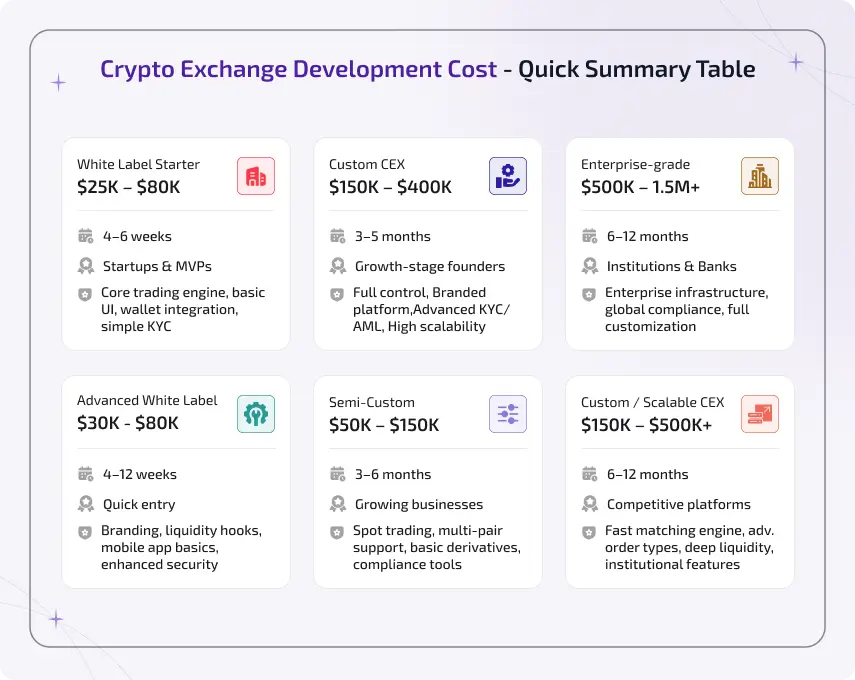
Crypto Exchange Development Cost—Quick Summary Table
What Affects Crypto Exchange Development Cost? Key Factors
Building a centralized crypto exchange costs can be more based on several important factors. Understanding them will allow you to more accurately plan your budget and prevent unexpected costs
Development Approach (Custom Vs White-Label)
The choice between a white label crypto exchange development solution and a custom built exchange has a significant impact on cost. While custom development offers complete control, scalability and branding—but at a higher cost—white label platforms are affordable and faster to start.
Features & Complexity
The more advanced features you add—the higher the development cost. Spot trading and wallets are examples of basic exchanges. Crypto margin trading exchange, futures, staking, copy trading, and analytics tools are examples of advanced platforms.
Security Infrastructure
For centralized exchanges— security is paramount Although it raises development costs including features like encryption, DDoS protection, cold wallets, multi signature access and two factor authentication (2FA) —it is crucial for protecting user funds
Regulatory Compliance (KYC/AML)
Each country has different compliance regulations, which can have significant effects on costs. Development and operating costs are increased when KYC (Know Your Customer) and AML (Anti Money Laundering) systems are integrated with legal licensing.
Liquidity & Market Depth
For trading to be smooth, an exchange must have a high level of liquidity. Integrating liquidity providers or market making solutions may increase your budget but it is essential for attracting and retaining users.
UI/UX Design
A user friendly interface improves retention and engagement. Skilled designers are needed to create user-friendly dashboards, trading charts and mobile applications which affects the total cost.
Scalability & Technology Stack
The technology used (programming languages, frameworks and cloud infrastructure) has an impact on both performance and cost. If you intend to manage large trade volumes in the future, a scalable architecture is crucial.
Third party Integration
The overall cost increases when payment gateways, financial systems, APIs, and analytics tools are integrated. These integrations are required to allow deposits, withdrawals, and advanced trading tools.
Location & Development Team
Hiring an in-house team or outsourcing to a crypto exchange development company can have a significant impact on cost. Location, skill level and team size all affect costs.
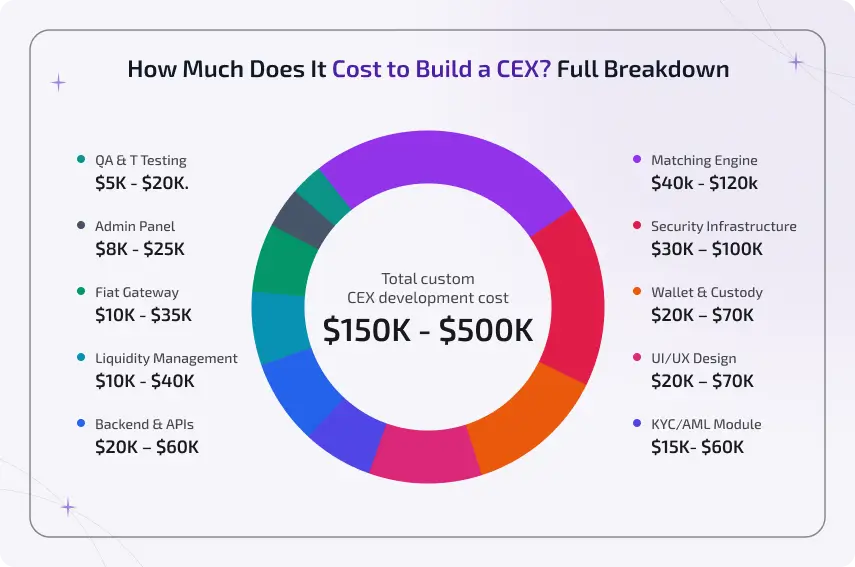
How Much Does It Cost to Build a CEX? Full Breakdown
Total custom CEX development cost - $150,000 - $500,000.
Important Notes
These figures show custom development (not white-label) from scratch
The ranges are very wide since costs rely heavily on:
Sophistication level (simple spot trading vs advanced derivatives/margin trading)
Technology stack (high-performance C++/Rust for matching engine on Node.js)
Location of the development team
Regulatory needs in target markets
These unique numbers would normally cost 40-70% more than white-label or script-based CEX.
White Label vs Custom Crypto Exchange: Which Costs Less?
One of the first choices you'll have when launching a cryptocurrency exchange is whether to use a white label solution or create a custom exchange from scratch. The two can differ significantly in cost but which option is best for you will depend on your goals.
White label
Starter/MVP
$25K - $80K
upfront cost $20k - $50k/year ongoing
Timeline
4 - 6 weeks
Customization
Limited
Scalability
Moderate
Compliance
Basic KYC/AML
Pros
Lower upfront cost
faster deployment
minimal technical effort
pre-tested features
Cons
limited customization
Less feature control
Scalability limits
Provider dependency
Custom Exchange
Full build
$150K - $400K
upfront cost $80k - $200k/year ongoing
Timeline
3 - 5 weeks
Customization
Full
Scalability
High
Compliance
Advanced KYC/AML
Pros
Full customization
High scalability
Strong branding
Advanced features
Cons
Higher dev cost
longer time to market
Needs skill scalability
In The End—Which Is Less Costly?
White-Label Exchange - White-label crypto exchange costs are obviously lower. Long-term, however, they can limit your growth.
Custom Crypto Exchange - Custom crypto exchange software is more costly at first, but they provide a higher return on investment if you want to grow, add advanced services, and build a strong brand.
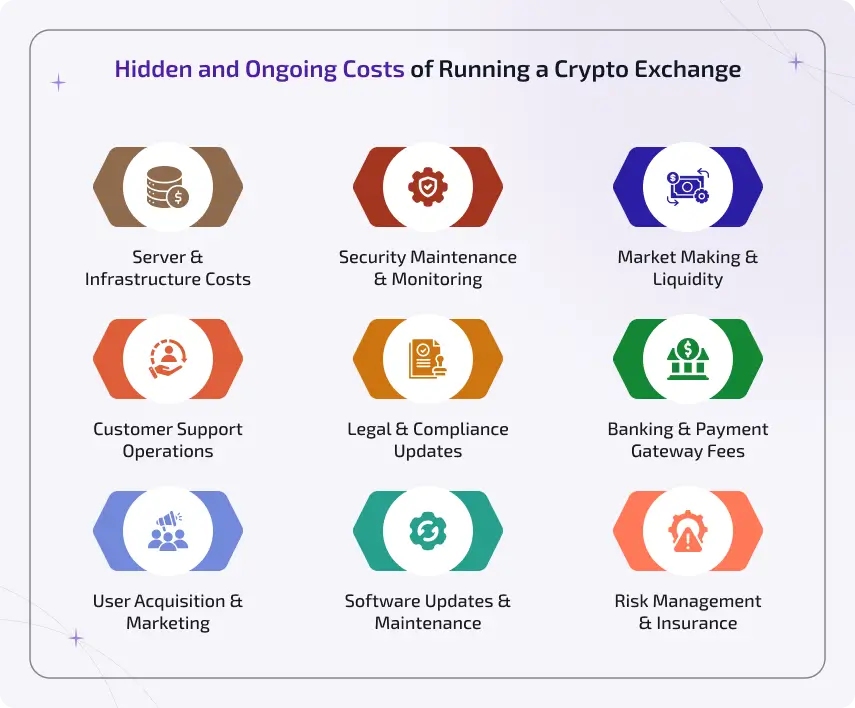
Hidden and Ongoing Costs of Running a Crypto Exchange
Building a crypto exchange is just the first step. The true costs are incurred after launch. Many businesses ignore the ongoing, hidden costs of maintaining the platform's security, compliance, and competitiveness
Server & Infrastructure Costs
It takes cloud hosting, high performance servers, and uptime monitoring to run a crypto exchange. Infrastructure costs rise to fit higher trade volumes and real-time transactions as your user base grows.
Estimated - $5,000 to $50,000 /month.
Security Maintenance & Monitoring
Security cannot be set up once To stop hacks and breaches, regular audits, penetration testing, updates and continuous monitoring are crucial
Estimated - $3,000 to $15,000 /month.
Market Making & Liquidity
You need sufficient liquidity to make sure trading runs smoothly.This often involves working with market makers or liquidity providers which have ongoing costs
Estimated - $10,000 to $100,000/month.
Customer Support Operations
Customer service must be available 24/7 to handle user problem transactions and disputes Hiring and managing a support team increases operational expenses
Estimated - $10,000 to $50,000/month.
Legal and Compliance Updates
Crypto regulations are constantly evolving. Staying up with regional legislation requires ongoing legal consulting, compliance updates and reporting
Estimated - $5,000 to $30,000/month.
Banking and Payment Gateway Fees
Every deposit, withdrawal and fiat transaction incurs processing costs. As your platform grows—these charges can add up substantially.
Estimated - Based on the volume of transactions, variable.
User Acquisition & Marketing
You will need ongoing marketing to grow your exchange including influencer campaigns, paid advertisements, SEO and referral schemes.
Estimated - $ 10000 to $ 100,000+/ month.
Software Updates & Maintenance
To address bugs—enhance speed and provide new features, regular updates are necessary This covers system updates and developer costs.
Estimated - $5,000 to $25,000.
Risk Management and Insurance
Some exchanges make insurance investments to protect user funds and foster trust. Although optional—it increases security and cost
Estimated - Depends on coverage
Reduce Crypto Exchange Development Cost— Smart Strategies (2026)
To build a crypto exchange platform 2026 doesn't have to take up your entire budget. The smartest companies don't just spend less;they spend smartly at the right stages. Timing, priority and leveraging current ecosystems rather than starting from scratch are essential elements of cost efficiency .
Think ‘’Phased Growth, ‘’Not ‘’Big Bang Launch’’
Successful exchanges start with a lean version of their platform instead of launching with all the advanced features. They collect user feedback, focus on basic trading functions, and then gradually expand. This method eliminates high upfront costs and ensures that you only invest in features that users actually require.
Balance Build vs Buy Decisions
Not everything has to be built in house. While core components like the trading engine and security should be robust, third party providers can integrate areas like KYC verification, payment gateways, and liquidity. This keeps quality and compliance while reducing development time.
Focus Budget on What Truly Matters
Early on, high performing exchanges put security, speed, and reliability ahead of visual design. Spending a lot on design animations or barely used features might look spectacular, but it does not cause long-term success. Investing on a basis initially and then improving the experience subsequently is what smart budgeting means.
Choose the Right Operating Environment
Your jurisdictional and infrastructure choices can have a major impact on costs. Some regions have more crypto-friendly laws and lower compliance costs. In a similar vein, cloud providers that provide flexible pricing help you in avoiding paying for capacity that isn't used in the early stages of growth.
Build Once, Scale Smart
While a scalable design may initially cost a little more, it avoids expensive rebuilds in the future. If you build your system with growth in mind from the start, you won't have to make major changes to technology as your user base grows
Efficiency Over Cheap Talent
Hiring inexperienced developers to save costs often causes delays, challenges and security issues. A proficient team minimizes long term costs, builds faster and makes fewer mistakes. Quality development is a protection in the cryptocurrency space, not a cost.
Prevent Problems Before They Grow
Early testing and ongoing monitoring save substantial money over time. Fixing a mistake during development is far cheaper than fixing a security issue after launch. One of the most commonly ignored cost saving strategies is proactive quality assurance.
How Long Does It Take to Build a Centralized Crypto Exchange ?
The development methodology, feature complexity, and regulatory requirements all affect how long it takes to build a centralized cryptocurrency exchange (CEX). I have a question about how much does it costs to build a crypto exchange from scratch? It might take anything from 1 month to 12+ months on average.
White-Label Exchange (Fastest)
Timeline: 2 -6 weeks
White-label solutions have low development time as they are pre-built platforms. You mostly focus on deployment, minimal modification, and branding.
Custom Mid-Level Exchange
Timeline: 3 - 6 months
Building essential elements like the matching engine, wallet integration, UI/UX, and APIs is a must for a custom exchange. This timeline also covers deployment and basic testing.
Enterprise-Grade Exchange
Timeline: 6 - 12+ months
Advanced features like multi-layer security, derivatives, margin trading, and high-frequency trading are all part of enterprise systems. Extensive testing and compliance also lengthen the process.
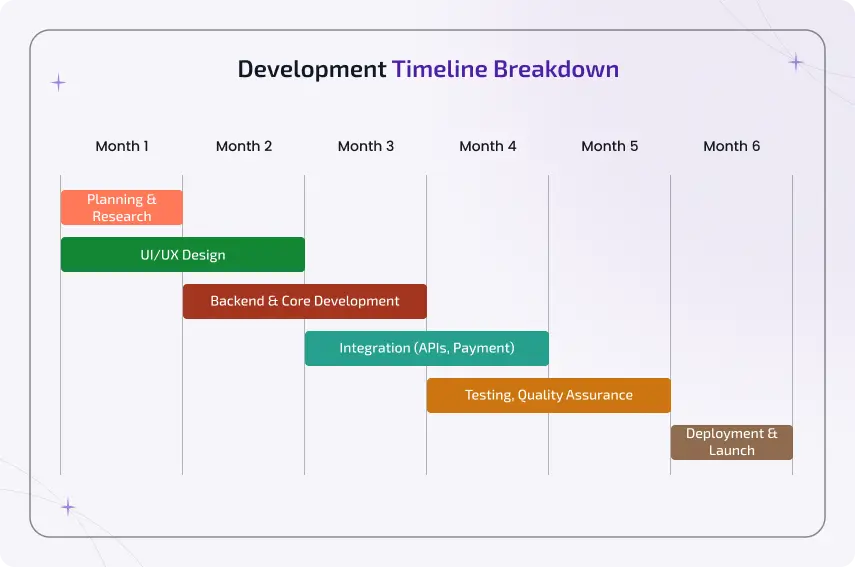
Development Timeline Breakdown
BlockchainX Advantage
While the industry average is 6 months - We deliver in as little as 3 months
The timeline above reflects a standard phased process where each stage runs sequentially. At BlockchainX, our dedicated exchange teams run planning, design and core development in parallel - cutting delivery time in half without compromising on security, compliance or quality
Why Choose BlockchainX for Centralized Crypto Exchange Development ?
Building a trustworthy and safe centralized cryptocurrency exchange development (CEX) is a difficult task that requires in depth technical knowledge, strong security protocols and a solid grasp of legal requirements. For companies and entrepreneurs wishing to create high performance centralized trading systems. BlockchainX a blockchain development company stands out as a reliable partner
BlockchainX is a preferred option for the creation of centralized cryptocurrency exchanges for the following main reasons:
Proven Expertise in Crypto Exchange Development
End-to-End Development Services
High Security Standards
Advanced Features & Scalability
Faster Time to Market
Experienced Team & Client Centric Approach
Cost Effective & Customized Solutions
As we've seen the total cost might differ widely based on your goals, feature set, security needs, and whether you go with a fully customized or white label solution. Beyond development, recurring costs such as infrastructure, compliance, liquidity and support are critical to long term success.
The secret is to begin with a well defined plan. If youre new to the market, starting with an MVP or white label solution will help you validate your idea fast and minimize risk. You can stay competitive as your platform expands by adding advanced features and a robust infrastructure.
In the end, creating a safe, trustworthy and user-friendly platform that traders trust is more important for a successful crypto exchange than merely sticking to a budget.
At BlockchainX, we specialise in providing custom centralized crypto exchange solutions, from fast-track white-label platforms to fully custom-built exchanges.
Contact our team for a free consultation and get a custom development roadmap, timeline, and cost estimate for your project.
FREE CONSULTATION
Ready to Build Your Crypto Exchange?
Tell us your vision. Our team will put together a custom development roadmap, timeline and cost estimate - tailored specifically to your project.
Get all the latest posts delivered straight to your inbox.
Get In Touch
Our expert team is professionally well-equipped with hands-on experience as a blockchain development company. Connect with us; at BlockchainX, we curate your desired sustainable solution!