10 Easy Steps to Build Your Own Uniswap v4 Clone Script
Listen to the Audio :
Building a reliable and robust decentralized exchange is no longer a complex task. With the introduction of Uniswap v4, the DEX development process has become significantly easier through innovations such as singleton architecture and hook-based logic. This comprehensive guide will break down the 10 easy steps to build your own Uniswap v4 clone script with custom integrations without developing the protocol from scratch.
Understand the basic concepts, the core architecture, and deploy the platform according to a specific use case. Later, optimize the platform with the latest DeFi models and reduce its technical complexity. To implement all these processes successfully, go through the entire blog, learn the simple steps to build your own platform and talk to our experts to bring it into reality.
What is a Uniswap v4 Clone Script?
Uniswap v4 Clone Script is a pre-built decentralized exchange (DEX) framework inspired by Uniswap v4, designed to help startups, businesses, and enterprises launch their own DEX trading platform on a preferred blockchain network without starting from scratch. The script includes Uniswap v4’s modern protocol design, including gas-optimized singleton contracts, hook-based customization, and flexible liquidity strategies.
By using a Uniswap v4 clone script, users can accelerate development, reduce risk, and deploy a secure, feature-rich decentralized exchange across EVM-compatible networks. This approach allows projects to enter the DeFi market cost-effectively and rapidly, making it suitable for every type of user.
It comes with advanced DEX solutions and integrates enhancements like atomic swaps, AMM integration, and token swap functionalities. If you wish to build your own decentralized Uniswap v4 clone script, then get into the section below to learn its development process in detail.
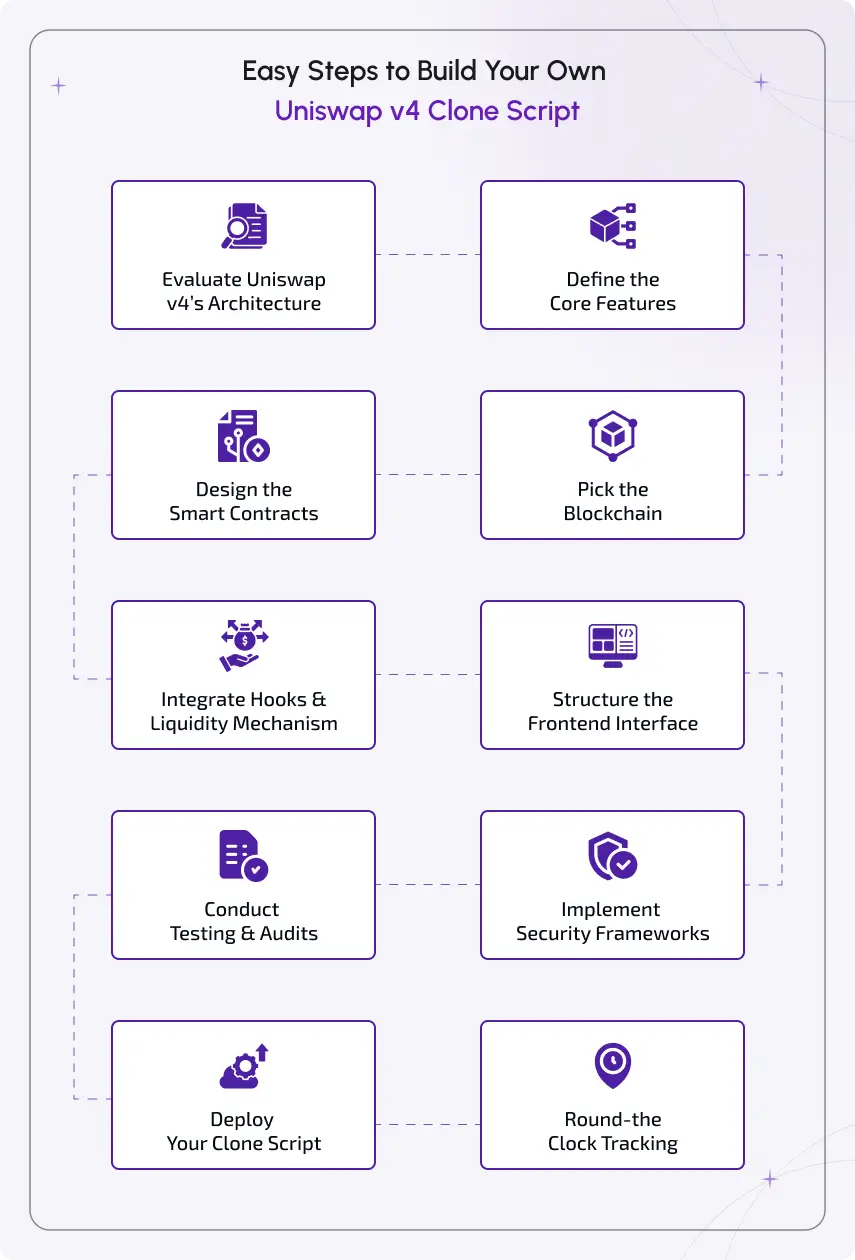
10 Easy Steps to Build Your Own Uniswap v4 Clone Script
More than just a basic setup, creating a Uniswap v4 clone script involves a structured development process, which undergoes careful planning and implementation. If you are here to develop your own decentralized exchange (DEX) platform that enables instant swapping of cryptocurrencies without intermediaries, explore the step-by-step process detailed below and launch a powerful DeFi trading platform.
Step 1: Evaluate Uniswap v4’s Architecture
Begin your development process by understanding the basic design and core concepts of Uniswap v4. This includes the hooks framework and the singleton contract model for the flash accounting system, and much more. Having a deep understanding at the early stages will help you create a futuristic clone script, with custom trading logics and upgrades.
Step 2: Define the Core Features
As a second step, you need to explain the core features that you wish to implement within your Uniswap v4 script. Then, focus on the fee structures, supported models, governance model, and the compliance needs that you wish to have on your script. You must also define the custom hooks that are required for your business.
Step 3: Pick the Blockchain
Developing a reliable clone script requires selecting the right blockchain network. The popular choices for Uniswap v4 include Ethereum, Optimism, Arbitrum, etc. Evaluate these, consider their fee structure, development time, speed, and then select a suitable network that increases user adoption and optimize the software’s performance.
Step 4: Design the Smart Contracts
It’s important to create Solidity-based smart contracts, which enable the clone script to duplicate the exact liquidity management, hook integrations, and swap execution of what the original DEX platform represents. Once created, ensure that these contracts comply with the EVM standards and the singleton architecture to create efficient decentralized trading operations.
Step 5: Integrate Hooks & Liquidity Mechanism
In the Uniswap v4 clone script development process, implementing concentrated liquidity mechanisms and custom hooks is a crucial step to make customized behaviours within the exchange clone script. A proper implementation can improve your capital by reducing slippage and ensuring fair reward distribution, similar to Uniswap v4’s advanced AMM model.
Step 6: Structure the Frontend Interface
Design a responsive and intuitive user interface using frameworks like Next.js or React, where users can handle various tasks like liquidity management, token swaps, and instantly view the pool analytics. Further, enable the wallet connections to provide a smooth and flawless experience for every DeFi user.
Step 7: Implement Security Frameworks
Now, it’s time to build the platform with strong security protocols to make it free from risks. So, incorporate the major security mechanisms, such as transaction validation and slippage protection, into your clone script. Then, double-check whether your Uniswap v4 clone meets industry-related security standards.
Step 8: Conduct Testing & Audits
You need to make rigorous testing and smart contract audits on your clone script to identify the hidden vulnerabilities. Therefore, conduct thorough integration tests, unit tests, and other required testnet deployments to validate the script's behavior. You can also cross-check your Uniswap v4 script with any third-party auditors.
Step 9: Deploy Your Clone Script
Once the developed platform is integrated with security protocols and is error-free from bugs, ensure its functionality, security, and optimize its performance to finalize it. Then, connect it to the frontend and deploy it on the mainnet to make it available for global users. At this stage, actively promote your platform in the market to gain popularity.
Step 10: Round-the-Clock Tracking
The final step is to track and optimize the clone script platform. So, monitor the platform in real-time and provide support assistance. In addition to this, update the script’s features, software, and governance mechanisms according to the market trends to make the script stay competitive in this ecosystem.
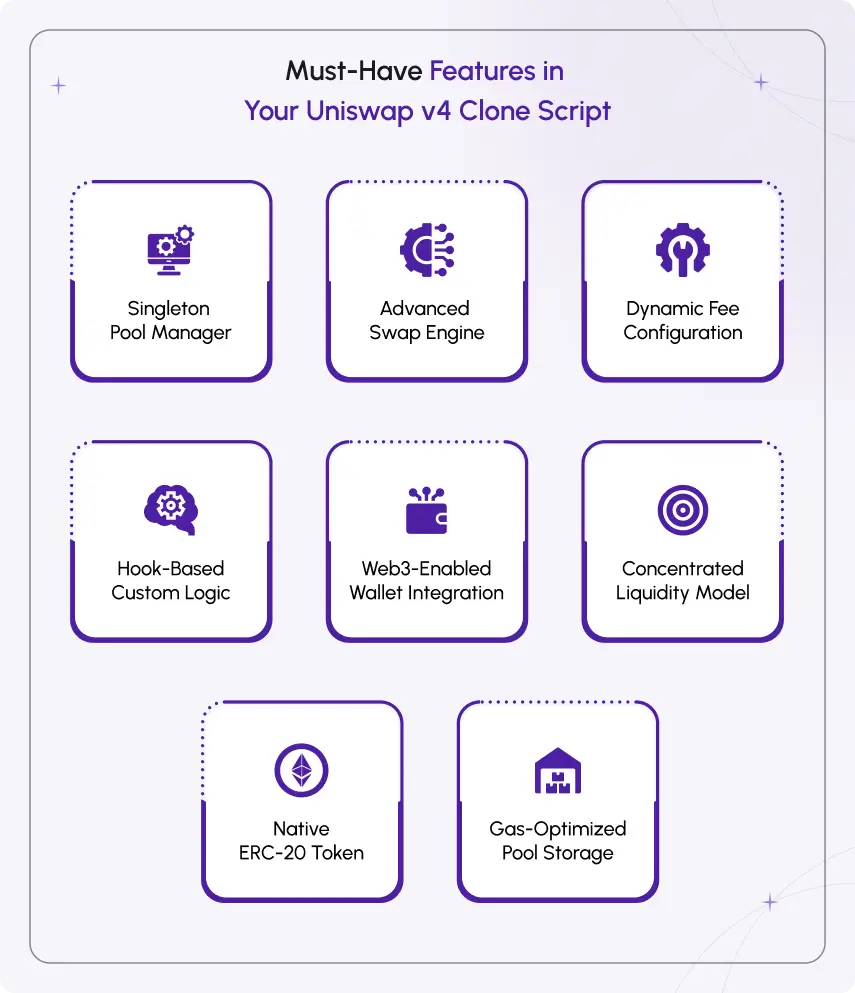
Must-Have Features in Your Uniswap v4 Clone Script
Our Uniswap v4 clone script is designed to help you launch your own branded DEX effectively, integrated with the top-notch features. Go through them and check whether they give complete customization to match your business needs.
Singleton Pool Manager
A Uniswap v4 clone uses single-core smart contract, managing all liquidity pools and swaps. This simplifies liquidity management across multiple trading pairs and enables efficient interaction. However, a Uniswap v4 can replace multiple pool contracts with one centralized manager, supporting unified logic execution.
Advanced Swap Engine
The swap engine in Uniswap v4 supports fast, low-slippage token swaps with optimized routing and precise pricing. It also handles single-hop and multi-hop token swaps and maintains consistent decentralized trading operations with minimal slippage. Here, the routing logic executes swaps through the singleton pool manager.
Dynamic Fee Configuration
Enables users to explain and adjust swap fees based on market conditions, liquidity depth, volatility, and trading strategies. This feature optimizes returns for liquidity providers and improves capital efficiency, while making the Uniswap v4 clone script adaptable to different market conditions.
Hook-Based Custom Logic
Supports customizable hook contracts, which allow users to execute custom logics before and after the swap. Here, hooks enhance dynamic fee control, MEV protection, KYC-enforcement, and automated strategies without modifying the core protocol contracts.
Web3-Enabled Wallet Integration
Users can get seamless connectivity with popular Web3 wallets like MetaMask and many more. This feature enables them to trade and manage multiple assets directly from the decentralized interfaces with real-time interaction, ensuring a smooth trading experience.
Concentrated Liquidity Model
Liquidity providers define and allocate assets within the selected price ranges. This increases the capital efficiency of a Uniswap v4 clone script with increased trading depth and enhances the overall reward distribution. The protocol used in this liquidity model calculates fees and swaps based on active segments.
Native ERC-20 Token
The clone script comes with support for all native ERC-20 tokens, enabling permissionless pool creation and trading for any supported token pair. It can be used for governance voting, allowing token holders to participate in protocol upgrades, fee structure decisions, and future roadmap proposals.
Gas-Optimized Pool Storage
Uses efficient storage structures to minimize gas costs, ensuring swaps and liquidity updates, making transactions more affordable and scalable on-chain. Pool data, liquidity states, and fee calculations are optimized for minimal on-chain storage and reduced execution overhead, aligned with Uniswap v4's design approach.
Uniswap v3 vs Uniswap v4: The Major Differences
The comparison table below outlines the major differences between Uniswap v3 and Uniswap v4, which allows any individual to evaluate and choose the best version for building their DEX platforms.
Parameters
Uniswap v3
Uniswap v4
Core Architecture
Uses multiple pool contracts
Uses only a singleton contract
Hooks Support
Doesn't support hooks
Comes with a native hook system, supporting custom logic
Customization Model
It comes with limited customization through fixed protocols and parameters
It supports extensive customization using hook contracts
Fee Configuration
The fee structure is predefined and static
The fee structure is dynamically controlled through hooks
Gas Model
It requires high gas usage due to multiple contract interactions
The gas usage is optimized through centralized state management
Permission Controls
The pools in Uniswap v3 are permissionless by default
The pools in Uniswap v4 are permissioned or permissionless using hook logic
Oracle Integration
Built-in TWAP oracle is attached to each pool
Oracle logic can be replaced or tailored via hooks
Liquidity Management
Supports position-based management with concentrated liquidity
Supports hook-controlled liquidity
Testing
Pool-level testing is required for Uniswap v3
Singleton-level testing with hook simulation is required for Uniswap v4
Protocol Complexity Level
Comes with a fixed or stable execution path
Comes with a dynamic execution path controlled by hooks
Why This Comparison Matters for Your Project?
Despite being a startup, business, or enterprise, anyone who plans to launch the next-gen DeFi or DEX platform must clearly understand the differences between a Uniswap v3 and v4. This can be perfectly achieved with the above comparison that distinctly illustrates and defines how your clone script is structured with the right architecture.
Choosing between a v3 or v4 clone script directly impacts the development complexity level, architecture decisions, and the customization scope of your DEX. If a user needs a project with standard token swaps and basic liquidity pools, then Uniswap v3 will be the right choice.
On the other hand, v4 with its hook-based execution model will be suitable where users opt for a custom fee structure, latest access rules, and tailored compliance layers. Overall, the comparison provides clarity on your product vision, whether to build a simple AMM, a regulated decentralized exchange, or a clone script with customized trading protocol.
Selecting the wrong version can limit your flexibility and the driving growth. So, choose the right one and ensure your DEX clone script is built for future expansion with high scalability.
Future of DEX Development with Uniswap v4 Clone Script
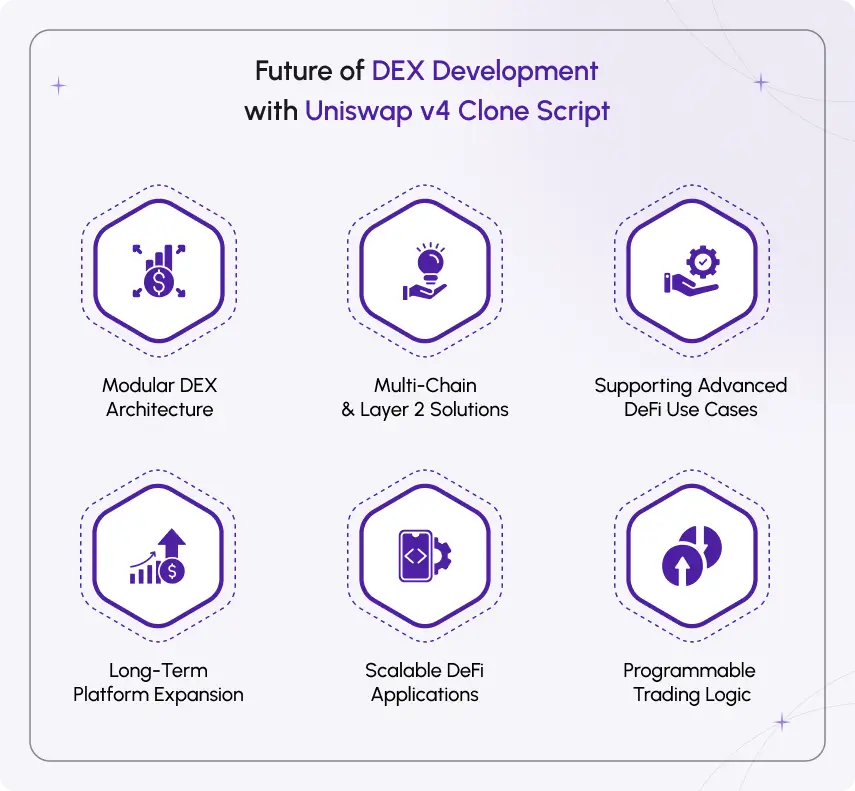
The future of decentralized exchange development is rapidly moving towards a major shift with its modular, customizable, scalable, and cost-efficient architectures. And here, the Uniswap v4 clone scripts perfectly align with this transformation. The introduction of the singleton pool manager and book-based customization enables developers to build Uniswap v4 clone with core protocol contracts tailored to specific use cases.
Modular DEX Architecturem - The shift towards advanced DEX architecture evolves without changing core contracts, making future upgrades more manageable.
Multi-Chain & Layer 2 Solutions - The Uniswap v4 clone script will be suitable for multiple EVM-compatible blockchain networks, attracting borderless users' from worldwide.
Supporting Advanced DeFi Use Cases - Supports future integrations such as custom oracles, permissioned pools, and protocol-specific liquidity strategies with various compliance logic.
Long-Term Platform Expansion - With hooks and advanced new features, the upcoming interferences can be reduced, supporting long-term platform evolution.
Scalable DeFi Applications - The reduced on-chain operations make the Uniswap v4 clone scripts suitable for high-volume trading environments with a gas-efficient design.
Programmable Trading Logic - Hooks enable developers to customize liquidity logic, swaps, and rules. This enables the DEX platforms to quickly adapt to the market trends & new DeFi models.
Why Choose BlockchainX for Uniswap v4 Clone Script Development
Partnering with BlockchainX for developing a decentralized exchange like Uniswap v4 clone script is a reliable choice for businesses that aim to build a well-structured and future-ready DeFi platform. With 8+ years of experience and standing as a renowned white-label clone script provider, our experts have proficiency in implementing the core features like flash accounting, singleton pool manager, and hook-based customization based on users' choices.
With a focus on customization, end-to-end support, audit-ready smart contracts, and post-deployment maintenance, BlockchainX lets you create a DEX like Uniswap v4 and turns your vision into reality. We prioritize security from initiation to deployment and ensure to provide top-notch risk management for your market-ready launchable software solution.
With no more delay, choose us to confidently develop your own Uniswap v4 clone software with a future-ready, robust solution.
Conclusion
Startups and businesses that are heading to build Uniswap v4 clone script are advised to get through a structured step-by-step process to make it more reliable. However, this can be fairly achieved by following our 10 easy steps, which mainly focus on scalability, flexibility, and a security-first approach.
Apart from this, we guarantee that our professionals provide advanced fee models, customized trading logics, liquidity conditions, and a clone script that has gone through proper testing and optimization. Utilize the above blog wisely, integrate the necessary features and build a decentralized exchange that aligns with modern DeFi standards and technological advancements.
Get all the latest posts delivered straight to your inbox.
Get In Touch
Our expert team is professionally well-equipped with hands-on experience as a blockchain development company. Connect with us; at BlockchainX, we curate your desired sustainable solution!