A Complete Roadmap to Build an RWA Tokenization Platform Like Centrifuge
Listen to the Audio :
Introduction:
Have you ever wondered what pushes you to build an RWA tokenization platform
like Centrifuge? It is no longer just a niche project, it is a major development of
next-generation financial infrastructure within the DeFi ecosystem. This sector is
rapidly moving beyond experimental pilots toward mainstream adoption, with major
financial markets unlocking billions in value through the tokenization of assets such as
private credit and real estate treasuries.
Centrifuge has set a benchmark in the fast-paced digital world by
demonstrating the potential of blockchain-based asset financing and institutional
engagement. Developing a similar RWA protocol requires a strong foundation across
tokenomics, asset management, jurisdictional laws, tech insights, and a scalable
framework.
This guide gives you a detailed overview of core features, licensing
requirements, functional workflow, and development considerations needed to build a
robust RWA platform in the evolving digital industry.
What Is a Centrifuge?
Centrifuge is a leading, enterprise-grade platform in the decentralized
finance (DeFi) sector, bringing RWA assets on blockchain. It bridges the gap between
TradFi and the blockchain industry through tokenization of tangible and financial assets
backed by real-world value. The platform operates on the Centrifuge chain, an EVM-native
layer 1 network protocol designed specifically for RWA tokenization and financing. It
also interacts with other major networks to enhance in-depth liquidity and
accessibility.
The types of RWA assets that the Centrifuge ecosystem can tokenize include:
Invoices and trade receivables
This is a cost-efficient approach that enables businesses and traders to
access traditionally illiquid assets easily in an efficient, transparent, and
decentralized investment framework.
Core Architecture of a Centrifuge Like Platform
A well-structured backend core architecture is the primary catalyst behind a
robust, fully functional asset tokenization platform like Centrifuge. It forms the base
mechanism that powers the entire process, from asset onboarding to liquidity management
and governance. The following infrastructure layers form the backbone of the platform:
Asset Origination Layer
Acts as the first entry point gateway for real-world assets into the
tokenization ecosystem. It manages asset onboarding, ownership verification, and document
validation according to jurisdictional compliance protocol. This ensures only eligible
assets are brought on the blockchain, reducing potential risks involved.
Smart Automation Layer
Smart contracts are the heart of the platform, powering the management of
tokenized assets on the blockchain. It handles token issuance, transactions, fund
transfers, and payouts, and executes systematic protocols without third-party
intervention.
Multichain Interoperability
Instead of being limited to a single blockchain network, the multichain RWA
protocol architecture layer enables tokenized assets to interact with various networks
and access wider markets. It enhances liquidity access, network compatibility, and
investor participation.
Liquidity Pool Layer
The liquidity pool layer aggregates investor capital into asset-backed
liquidity pools to facilitate funding and liquidity provision within the market
ecosystem. As the pools generate returns from real-world assets, returns are distributed
back to investors accordingly, ensuring a consistent flow of capital for investors and
asset owners.
Governance Layer
This layer allows token holders to influence the protocol decisions that
guide the platform's overall growth and evolution. It manages system upgrades, workflow
regulations, and strategic decisions via a community-first voting and governance
system.
Step-by-Step Guide to Develop a Centrifuge Like Platform
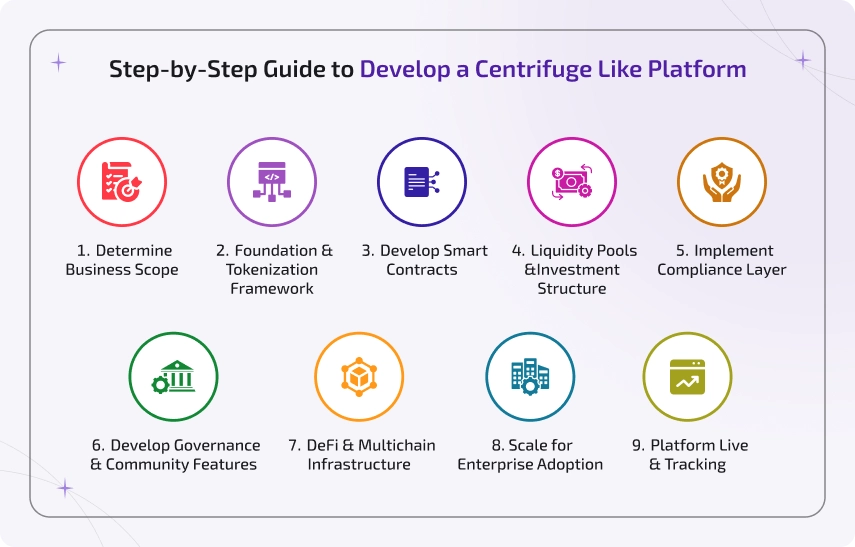
Centrifuge clone development requires a structured approach with multiple
stages, from tokenization architecture to ecosystem management control. Each step plays a
major role in the overall efficiency of the platform. The following steps cover the key
development roadmap for crafting an enterprise-ready exchange.
Step 1: Determine Business Scope
Start by clearly defining the platform's goal, primary users, and the types
of real-world assets that can be digitalized. This phase accomplishes the core
propositional value and market focus of the system before moving into technical
integrations and overall development.
Key Considerations:
Type of valuable asset classes (e.g., private credits, real estate)
Key real-world applications
Market demand & business opportunities
Step 2: Foundation & Tokenization Framework
Build the underlying core infrastructure of the platform required to
tokenize, manage, and execute system operations. The choice of key technical
integrations, such as blockchain and tech stack, plays a crucial role in the overall
workflow, security, and efficiency.
Major Components:
Ethereum, Polygon (Blockchain network)
Node.js, Python (Backend protocol)
Metamask, WalletConnect (Wallet integration)
AWS, Google Cloud (Cloud protocol)
ERC-1400, ERC-20 (Token standards)
Step 3: Develop Smart Contracts
Enable RWA tokenization smart contract development to simplify asset
tokenization and ensure seamless ownership management. This phase automates asset
issuance, transfers, and overall asset control on the blockchain.
Step 4: Liquidity Pools & Investment Structure
Develop liquidity asset pools and investment frameworks for funding and
investor participation in digitized assets. It establishes how fund capital is pooled,
valued, and issued across the platform.
Core Development Sectors:
Senior tranches (low risk, stable returns)
Junior tranches (high-risk, high-yield opportunities)
NAV calculation engine (tracks asset & pool data)
Interest and yield payouts
Investment subscriptions & redemptions
Step 5: Implement Compliance Layer
Incorporate a robust compliance framework to ensure regulated and secure
asset tokenization while maintaining transparency across platform operations. This step
includes investor onboarding, user authentication, and regulatory workflows to enable
trusted participation.
Step 6: Develop Governance & Community Features
Implement governance and community-driven features that allow stakeholders
to participate in platform decisions, propose upgrade changes, and contribute to the
ecosystem's overall futuristic growth.
Core Features:
DAO governance - enables decentralized decision-making via community
voting
Voting mechanism - offers a transparent voting protocol for ecosystem
updates
Community interaction - engages active participation from investors and
platform users
Proposal system - allows token holders to suggest and review protocol
updates
Step 7: DeFi & Multichain Infrastructure
Integrate cross-chain capability along with DeFi to bridge verifiable assets
with broader Web3 markets. This ensures in-depth liquidity flow, flexible token
movements, and high efficiency across other on-chain networks.
Step 8: Scale for Enterprise Adoption
Optimize the platform to handle growing institutional users, business
demand, and high-volume transactions. This step enhances performance, scalability, and
reliability for widespread enterprise-level adoption.
Step 9: Platform Live & Tracking
Launch the market-ready platform into the production environment with
continuous tracking of operational flow, performance, and user interaction. This step
primarily focuses on ongoing optimization, enhancements, and scaling based on real-time
application and user feedback.
FREE DEMO
Unlock the complete potential of real-world asset tokenization by taking the first step with BlockchainX. Let's transform your valuable assets into scalable, compliant, and high-performance Web3 solutions for sustainable growth.
Essential Features of a Centrifuge Like RWA Platform
Modern RWA tokenization platform development must incorporate a comprehensive
feature framework that supports compliance, investor engagement, and asset management.
Explore the core capabilities that power a fully functional tokenized asset platform,
given below:
Asset Tokenization Engine
Transforms real-world tangible and financially valuable assets, such as real
estate and treasury bills, into digital tradeable tokens, enabling users with fractional
ownership, liquidity control, and better trading opportunities.
Multi-Tranches Lending Pools
Supports a senior and junior tranches structure that manages investors with
different risk-return policies. This division allows users to choose investment profiles
based on their preferences.
Senior tranches - low and stable returns, low risk level
Junior tranches - high yield, high risk level
Quick-Launch Deployment
Launch tokenized asset liquidity pools and investment structures instantly
using automated deployment workflows designed for efficiency and scalability. This
reduces setup time and complexity of overall platform operations.
Multi-Chain Compatibility
This feature allows seamless digital asset transactions and compatibility
across various networks without any restrictions. It offers flexible market
accessibility, efficiency, and more business opportunities.
Yield Distribution Mechanism
The investment reward mechanism automates the calculation and distribution of
incentives, interest, or revenue shares to token holders. This reduces manual processing,
enabling more accurate and timely payouts.
Voting & Governance Protocol
Stakeholders are allowed to be a part of the main platform decisions, such as
ecosystem updates, protocol changes, and strategic development planning. This ensures a
traceable governance system, empowering overall accountability.
Best Tech Stack for Building a Centrifuge-Like Platform
A well-structured technology stack forms the foundational layer to build an
RWA tokenization platform like Centrifuge. It ensures scalability, robust security, and a
seamless operational workflow of the exchange model. Check out the recommended key tech
stack mentioned below.
Cost Estimation for Building a Centrifuge-Like RWA Platform
Several significant features influence the cost to build a tokenization
platform like Centrifuge, such as development complexity, required integrations, and
ecosystem capabilities. The following table provides a clear overview of the estimated
development cost.
FREE QUOTE
Are you ready to develop a platform like Centrifuge, but are not sure about the project investment? Our RWA tokenization development company delivers a clear roadmap, cost insights & strategic guidance for building a highly adaptive platform solution.
Legal Framework to Build a Major Platform Like Centrifuge
Regulatory protocol has become a critical aspect of the RWA tokenization platform
due to the increasing significance of strict jurisdictional laws for investor
trust and credibility over the ecosystem. Adhering to regional regulations ensures asset
issuance and sustainable ecosystem value. Explore the key regulatory protocols shaping
tokenization across core operating regions.
1. United States
Securities and Exchange Commission (SEC)
Commodity Futures Trading Commission (CFTC)
Financial Crimes Enforcement Network (FinCEN)
How is it followed? Asset platforms verify tokens under the
Howey authentication to distinguish securities status and use SEC-approved exemptions
such as Reg. D and Reg. S. Alongside, for token issuance, KYC/AML and compliance checks
are also conducted.
2. European Union
Markets in Financial Instruments Directive II (MiFID II)
Markets in Crypto-Assets Regulation (MiCA)
How is it followed? These platforms use MiCA for
asset-backed issuance, industry specialists, and transparency requirements. Digitized
assets qualified as security instruments must follow MiFID II legal regulation covering
authentication, protection standards, and ecosystem regulations.
3. United Kingdom
Financial Services and Markets Act (FSMA)
FCA Cryptoasset Regulations
How is it followed? Tokens are classified under FSMA, comply
with FCA authorization, and ensure compliant marketing of token offerings. Along with
this, KYC controls are implemented for token utility under UK laws.
4. UAE
Virtual Asset Regulatory Authority (VARA)
Abu Dhabi Global Market Regulatory (ADGM)
How is it followed? RWA systems working in the UAE must
mandatorily obtain relevant virtual asset approvals, aligning with legal operational laws
such as VARA or ADGM, based on jurisdictional regions for token issuance, custodial
services, and asset transactions.
5. Singapore
Monetary Authority of Singapore (MAS)
Securities and Futures Act (SFA)
How is it followed? Tokenization exchanges must follow SFA
legal protocol if digital tokens represent financial instruments or assets backed with
real value. It must also align with license obligations, disclosure standards, and user
protection measures under the oversight of the MAS system.
6. Switzerland
Swiss Financial Market Supervisory Authority (FINMA)
How is it followed? Tokenization platforms follow the FINMA
DLT framework, where the DLT Act provides legal recognition for digitized securities,
allowing compliant token issuance, trading, and ownership transfer of virtual assets.
Why Now Is the Right Time to Build a Centrifuge-Like Platform
RWA platforms like Centrifuge have become one of the flagship projects in the
Web3 ecosystem as the demand for bridging TradFi with blockchain, with assets backed by
real-world value, grows. The convergence of institutional-grade DeFi solutions,
transparent on-chain applications, and infrastructure maturity has brought tokenization
beyond niche experimentation.
According to recent statistical reports, the tokenized RWA market has
witnessed significant expansion, with its total market capitalization value surging by
256.7% in just 15 months, rising from $5.42 in early 2025 to $19.32 billion by
March 31, 2026. As more organizations turn to asset-backed tokenization and
blockchain-powered models, the RWA market is expected to grow further and reach new
milestones in the upcoming years.
Take a closer look at the major drivers influencing today's ecosystem across
various industries:
Institutional global adoption of tokenized assets with real value
Support for cross-chain asset liquidity across major blockchains
Secure tokenization with built-in KYC, AML & legal requirements
Unlocking DeFi utility and trading of tokenized real-world assets
Why BlockchainX Is the Right Choice for Building a Centrifuge-Like Platform
RWA tokenization platform development demands more than smart contract
architecture; it takes regulatory precision, proven strategies, and absolute credibility
over the platform. BlockchainX stands as a trustworthy partner for building an
institutional-grade ecosystem like Centrifuge, ensuring tokenized assets are legally
licensed, secure, and optimized for global markets.
With over 9+ years of proven expertise, we make sure to deliver comprehensive
solutions covering market planning, backend framework, deployment, and ongoing
maintenance. Our technical team ensures extensive support and timely delivery, helping
clients build RWA lending platform solutions while maintaining our commitment to quality
and excellence.
Professional RWA architects
Back-to-back development support
Battle-tested security protocol
Pre-built dual-tranche frameworks
Round-the-clock technical assistance
Programmable on-chain compliance
FREE CONSULTATION
Partner with BlockchainX to create a fully scalable, compliant & market-ready RWA platform like Centrifuge.
Conclusion
In conclusion, we can understand how RWA tokenization solutions are transforming the way traditional assets are tokenized, accessed, and managed on-chain. With the surging interest in tangible assets with real-world value, business organizations now have the investment opportunity to build an RWA tokenization platform like Centrifuge that supports enterprise market adoption, regulatory progress, and efficient asset digitization. By partnering with an ideal blockchain specialist, you can establish an efficient, compliant-focused, and compatible architecture designed for the next wave of the finance ecosystem, unlocking new business opportunities within the industry sector.


