Best Blockchains for Tokenization in 2026 | BlockchainX
Listen to the Audio :
Tokenization is becoming a growing important aspect of the digital world, helping businesses in converting real-world assets such as property, art or company stock into digital tokens on a blockchain. This makes assets simpler to trade, transfer and manage. However , selecting the best blockchains for tokenization is the most crucial stage in creating a successful tokenization platform.
Everything depends on the blockchain you choose including security, transaction speed, pricing, scalability and overall user experience. Before choosing a blockchain, it's critical to understand its benefits since each one has different strengths. We'll go over why blockchain selection is important in this blog and how to choose the best one for your tokenization platform.
Understanding Tokenization and Its Technical Needs
The process of converting real-world assets like real estate, artwork, gold, invoices or company stock into digital tokens on a blockchain is known as tokenization. These tokens , which stand for ownership, are simple to store, transfer and trade online.
Tokenization is gaining popularity because it increases transparency, reduces costs and allows for fractional ownership, which allows more people to invest in high-value assets. However , it's crucial to understand the underlying technical needs to create a smooth and reliable tokenization platform.
Tokenization is more than creating a digital token; it also includes selecting the right blockchain ensuring high security, utilising smart contracts, managing wallets and providing compliance and identity verification . A solid technical foundation helps to ensure that tokens are secure, tamper proof, easy to trade and adhere to legal standards.
The background technology of a tokenization platform determines its success. The better the technical setup– the more reliable and effective the platform becomes .
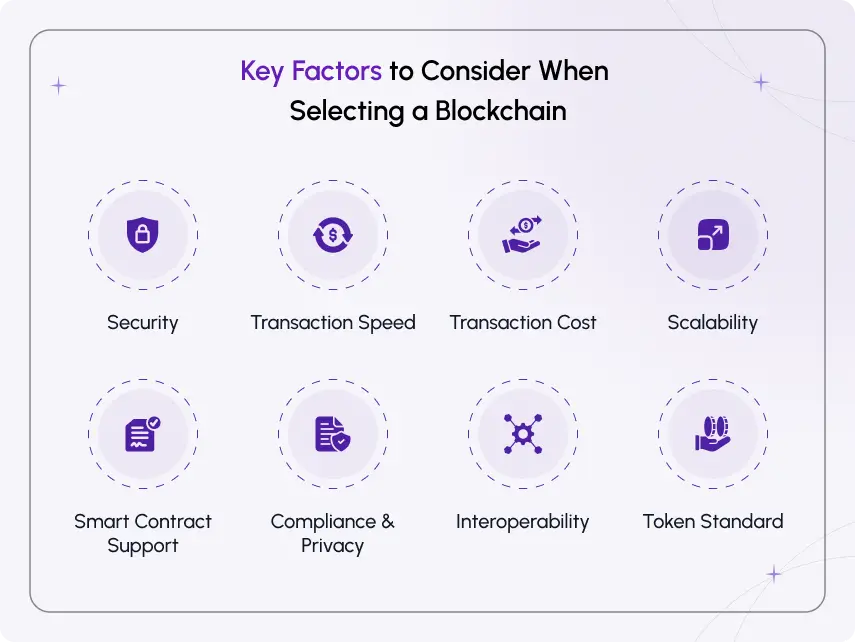
Key Factors to Consider When Selecting a Blockchain
One of the most crucial phases in creating a tokenization platform is choosing the right blockchain for tokenization . Every blockchain has different levels of flexibility, speed, cost and security. You must understand the critical elements that directly impact your platforms performance to make the optimal decision.
Security
When choosing a blockchain for tokenization, security is the most crucial factor. Tokens are real assets; thus , the network needs to protect them from fraud and hacking. Strong encryption, trustworthy validators and reliable consensus procedures are used by a secure blockchain to ensure that every transaction is safe and resistant to fraud.
Transaction Speed
A good tokenization platform must handle transactions fast. Delays are caused by slow networks, which also reduce user satisfaction. Choosing the best blockchains for tokenization with a high transaction speed ensures faster transfers, smoother trade and improved performance all around.
Transaction Cost
Each blockchain transaction has a cost. Your platform becomes costly to use due to high costs, especially for frequent transactions. Choosing a blockchain with low and steady transaction costs makes operations more affordable for users and businesses, resulting in increased platform adoption and long-term profitability.
Scalability
How well a blockchain manages growth is determined by its scalability. The network needs to keep running properly as more users sign up and transactions rise. A scalable blockchain avoids costly fees, congestion and slowdowns. Your tokenization platform can grow without having performance problems if you select a scalable network.
Smart Contract Support
Important tasks like token creation, ownership transfers & compliance standards are automated by smart contracts. Selecting a blockchain with robust smart contract support helps and increase the reliability of development. EVM-compatible blockchains are well-liked because they provide developers with easy integration, extensive ecosystems and adaptable tools.
Compliance & Privacy
Tokenization platforms that deal with real assets are required to protect user data and adhere to legal rules. Blockchains with identity layers, permissioned settings or compliance features help in following legal regulations. Privacy-focused networks allow for transparent and reliable asset management while ensuring the security of sensitive data.
Interoperability
Tokens can move across various blockchains via interoperability. This feature allows new network, exchange and user connections for your platform. Strong interoperability in a blockchain ensures adaptability, improved asset accessibility and long term compatibility with developing Web3 systems, allowing your platform to grow.
Token Standard
Token standards specify how tokens work within a blockchain. They guarantee the compatibility of wallets, exchanges and apps. Token creation is made simpler and more reliable by popular standards like ERC20, ERC721 and ERC1155. Selecting a blockchain with robust standards enhances platform use and integration.
10 Best Blockchains for Tokenization Platforms in 2026
Find the most trusted blockchains that will propel next-generation asset tokenization in 2026. These technologies ranging from Ethereum to Hyperledger , are defining the future of real-world assets by allowing for safe, transparent and effective on-chain ownership and trading.
Ethereum
Ethereum often comes off as the most trusted blockchain platform for tokenization in general. It offers a highly secure infrastructure for digital asset creation. Its advanced smart contracts, strong protocols, and broad market compatibility make it ideal for businesses to easily manage and trade tokenized digital assets.
Pros
Comes with wide support for ERC token standards
Strong institutional-grade support across global markets
Robust smart contract capabilities with massive adoption
Cons
Scalability constraints on Layer-1 transactions
High gas fees during network congestion
Offers slow transaction throughput compared to new chains
Polygon
Polygon is one of the top blockchains for tokenization, which is a Layer-2 scaling network built for the Ethereum network. Businesses longing to build asset-backed tokens and investment platforms rapidly with reduced operational cost can go with the Polygon blockchain ecosystem.
Pros
High scalability with reduced transaction cost for
Powerful network performance for heavy asset processing
Provides strong support for scalable RWA & NFT tokenization
Cons
Bridging assets across chains increases complexity
Relies partially on Ethereum for the ecosystem’s security
Enhanced network centralization concerns
Binance Smart Chain
Built using EVM-compatible technology, BSC has a reputation for its quick processing times with low operational fees. This network is suitable for retail-focused digital assets, investment platforms, and fundraising ecosystems with easy smart contract deployment for a larger user base.
Pros
Larger user base with an active blockchain ecosystem
Offers high-speed transactions with minimal gas fees
Rapid deployment of EVM-compatible smart contracts
Cons
Limited institutional trust for every heavy compliance
Regulatory uncertainty with Binance-related operations
High centralization compared to Layer-1 networks
Avalanche
A scalable Layer-1 blockchain, Avalanche, strengthens tokenization ecosystems with customizable subnet architecture. It enables enterprises to build a compliant-rich digital asset network for real estate, institutional investments, and more with high security in a globally regulated environment.
Pros
Energy-efficient consensus mechanisms with high scalability
Rapid transactions with high throughput
Provides tailored custom subnets for enterprise platforms
Cons
Smaller ecosystem compared to Ethereum
Liquidity fragmentation across multiple subnets
Requires deep technical expertise for subnet deployment
Stellar
Looking for a simplified blockchain for tokenization to handle international payments? Stellar is the preferable one. This network is used to transfer tokenized assets effectively across global payment ecosystems with integrated asset creation features and built-in asset issuance tools.
Pros
Optimized for efficient asset transfers and settlements
Perfect for stablecoins and remittance solutions
Extremely low transaction fee with fast settlements
Cons
Comes with limited smart contract flexibility
Lower enterprise innovation with complex logic
Equipped with a smaller DeFi ecosystem
Tezos
Tezos is an energy-efficient, safe blockchain network with built-in upgrading features, particularly to fit tokenization projects that prioritizes compliance. It is a widely adopted network with flexible governance, long-term stability, and eco-friendly blockchain operations.
Pros
Lightweight proof-of-stake consensus mechanism
Focuses strongly on the compliance of asset tokenization
Self-upgradable with blockchain governance
Cons
Limited global adoption compared to other networks
Smaller ecosystem growth and development community
Minimal trading liquidity and DeFi integrations
Algorand
Algorand seems like a solid option for tokenization platforms that are sort of built around high scalability , speed, and long-term sustainability , so in practice it works well. It also aids enterprises in digitizing real world assets, you know, with instant finality and very low transaction fees, which feels pretty helpful.
Pros
Eco-friendly infrastructure for digital asset issuance
High transaction speed with low operational cost
Economical blockchain operations for enterprises
Cons
Relatively smaller ecosystem when compared to others
Limited interoperability support with wider blockchain ecosystems
Fewer market adoption in the NFT and DeFi areas
Polkadot
Polkadot is a multi-chain network that enhances tokenization with interoperable parachains. Businesses use this Polkadot to safely transfer their tokenized assets across diverse networks with high flexibility. Its parachain architecture supports custom platforms with seamless functionality.
Pros
Provides scalable architecture for enterprise deployments
Diverse asset support across various blockchains
The parachain model in Polkadot supports custom platforms
Cons
Complex ecosystem with increased development difficulty
Slower ecosystem maturity in enterprise markets
Higher operational cost for parachain development
Solana
Solana is a high-performance blockchain designed for ultra-fast transactions and scalable tokenization operations. It works for large-scale tokenized real estate applications globally and facilitates real-time asset trading with fractional ownership ecosystems.
Pros
Extremely rapid transaction processing speed
Low transaction cost for large-scale tokenization
Rapid ecosystem expansion in DeFi and tokenization
With permissioned tokenization infrastructure, the Hyperledger Fabric network plays a major role in regulated consortiums and institutional asset management. It is widely used for private tokenization ecosystems and regulated financial infrastructures with robust privacy.
Pros
Flexible design for tailored tokenization frameworks
Comes with strong role-based access management
It is a permissioned architecture ideal for enterprise tokenization
Cons
Lack of native decentralization support
Limited exposure to public DeFi ecosystems
Complex setup for deployment for maintenance
Comparing the Top Blockchains for Tokenization
Here is a concise comparison of the leading blockchains to assist you in selecting the ideal network for creating effective tokenization platforms.
Blockchain
Transaction Speed
Cost
Smart Contract Support
Token Standards
Best For
Ethereum
Moderate
High
Very Strong
ERC 20, ERC 721, ERC 1155
Safe, enterprise grade tokenization
Polygon
Fast
Low
Strong (EVM)
ERC-Based
Low cost, scalable platforms
BNB Chain
Fast
Low
Strong (EVM)
BEP 20, BEP 721
Cost efficient tokenization
Avalanche
Very fast
Low
Strong (EVM)
ERC based
High performance, custom networks
Stellar
Very Fast
Very Low
Limited
Native Assets
Payments & financial assets
Tezos
Fast
Low
Strong
FA1.2, FA 2
Compliance-focused tokenization
Algorand
Very fast
Low
Strong
ASA
Financial grade tokenization
Polkadot
Fast
Low
Strong
Parachain-based
Cross chain tokenization
Common Mistakes to Avoid When Choosing a Top Blockchain for Tokenization
Selecting a blockchain for RWA tokenization based only on its popularity without considering if it is right for your business use case
Ignoring transaction fees, which might increase in cost as platform usage increases
Ignoring transaction volume and future user scalability needs
Avoiding the need for real-world assets to comply with regulations
Choosing a blockchain that lacks robust support for smart contracts
Neglecting token standards and exchange and wallet compatibility
Not making plans for other blockchains' interoperability
Underestimating the power of the validator network and security threats
Selecting a blockchain with poor community support or developer tools
Lack of long-term upkeep, upgrades and ecosystem expansion planning
Public vs. Private vs. Hybrid Blockchains for Tokenization
Feature
Public Blockchain
Private Blockchain
Hybrid Blockchain
Access Type
Available to anyone
Only approved users have access to it
A mix of private and public access
Transparency
Completely transparent
Limited transparency
Restricted transparency
Security
High since it's decentralised
High with regulated validators
High with adaptable security layers
Transaction Speed
From moderate to fast
Fast
Quick and efficient
Transaction Cost
Can be high
Low
Low to moderate
Scalability
Moderate
High
High
Compliance Support
Limited
Powerful
Robust and adaptable
Privacy Level
Low
High
From medium to high
Best Use Cases
Public RWAs, DeFi and NFTs
Governments, businesses and banks
Enterprise DeFi and regulated RWAs
Smart Contracts
Completely supported
Supported
Completely supported
Examples
Solana and Ethereum
Corda and Hyperledger Fabric
Avalanche and Quorum Subnets
Future of Tokenization Blockchains
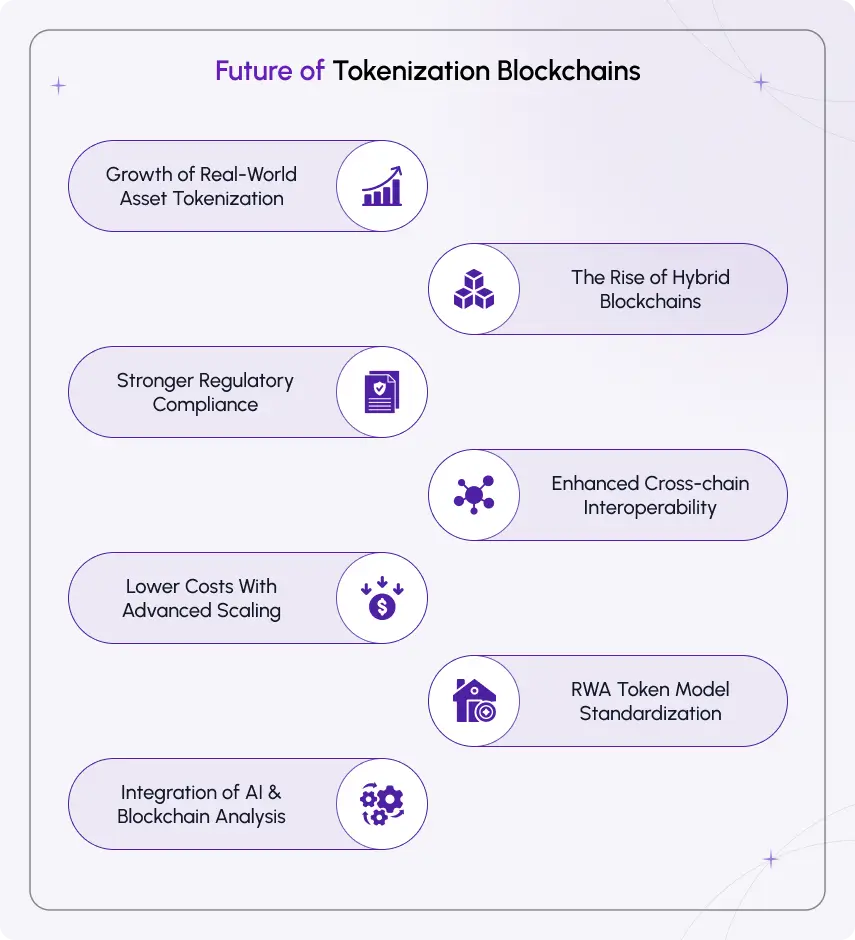
Tokenization blockchains will develop rapidly between 2025 and 2030, allowing for safe, legal and scalable digital ownership of tangible assets. New technology, laws and enterprise adoption will all have an impact on how assets are created, traded in and managed on blockchain.
Growth of Real-World Asset Tokenization
Blockchains will tokenize more real-world assets including bonds, real estate, commodities and invoicing. This growth will increase liquidity, make fractional ownership possible and give global investors easy, safe and transparent access to assets without traditional middlemen.
The Rise of Hybrid Blockchains
Hybrid blockchains will grow more popular as they integrate public transparency and private control. Hybrid blockchains are suited for enterprise and regulated tokenization platforms since this model enables companies to keep sensitive data while meeting regulatory requirements.
Stronger Regulatory Compliance
Future blockchains will have compliance features like identity verification, KYC and permission-based access built into the system. These solutions will help tokenization platforms in adhering to global laws, building institutional trust and conducting business lawfully in various industries and regions.
Enhanced Cross-chain Interoperability
Tokenized assets will be able to move smoothly across several blockchains because of improved interoperability. This will increase market access, avoid platform lock-in and allow smooth and safe asset management and trading across several networks.
Lower Costs With Advanced Scaling
Enhanced consensus methods for Layer-2 networks will lower transaction costs and boost speed. Tokenization platforms will be more accessible, handle large transaction volumes and promote broader user and business adoption as a result of lower costs.
RWA Token Model Standardization
Token standards tailored to real-world assets will arise. Tokenised assets will be legally safer, easier to manage and accessible across platforms and wallets due to these standards, which will enable ownership rights, compliance regulations and transfer limits.
Integration of AI & Blockchain Analysis
Blockchain and AI will be combined to enhance asset performance tracking, risk analysis and fraud detection. This combination will raise platform security, improve decision-making and increase tokenised asset managements overall efficacy.
How BlockchainX Helps You Choose the Right Blockchain for Your RWA Project?
Selecting the best blockchain for a real-world asset (RWA) tokenization project is an important business choice, not merely a technical one. Your choice of blockchain has an impact on long-term success, scalability, compliance, trust with investors and asset governance. Before you commit, BlockchainX helps you weigh all relevant factors.
Nature of the Asset
BlockchainX starts by choosing which asset—real estate, bonds, funds or commodities—you wish to tokenize. Liquidity, compliance and life cycle needs vary among assets. We map the behaviour of your asset to the blockchain that best fits its use case and structure.
Who is Your Target Audience?
Every audience has different expectations, whether your platform is for government agencies, institutions or individual investors. BlockchainX helps in matching your user base with a blockchain that offers the ideal ratio of speed, control, transparency and trust.
Evaluating the Assets Lifespan
While some tokenized assets are short-term, others last for decades. BlockchainX evaluates long-term viability, ecosystem maturity and blockchain stability to make sure your assets are safe and accessible for a very long time.
Balancing Privacy & Transparency
Different levels of data visibility are needed for different projects. BlockchainX helps you in selecting public, private or hybrid blockchains with investor trust, regulatory restrictions and data protection standards in your target regions.
Evaluating Node Availability & Infrastructure
Real-world infrastructure determines performance. BlockchainX assesses network latency, node availability and regional support to make sure the blockchain of your choice can function reliably in your region or industry.
Planning Upgrade & Exit Strategy Plans
Technology is always changing. Without interfering with users or asset integrity—BlockchainX ensures that your blockchain allows seamless smart contract upgrades, governance modifications and even migration if necessary.
Building a Custom RWA Tokenization System
You can go beyond traditional solutions with BlockchainX. We choose blockchains that offer independence, flexibility and modularity so you may create a unique RWA tokenization platform that fits your business model without restricting future innovation.
Conclusion
The tokenization of real-world assets is changing how value is transferred and kept, as we have seen thus far, making blockchain selection more crucial than ever. Whether you are tokenizing government securities, private equity or real estate— the performance and reliability of your platform are directly impacted by the blockchain foundation you select.
BlockchainX is a seasoned RWA tokenization platform development company that has successfully guided companies in turning complex tokenization ideas into real-world solutions. Based on important criteria like security, decentralization, speed & ecosystem maturity , we thoroughly assess blockchains.
We also help with incorporating emerging trends such as AI, interoperability and eco-friendly consensus practices to ensure platforms remain future-ready. Businesses allow sustainable growth, future-proof their RWA tokenization platforms and safely enter global markets by giving priority to these essential components.
Become a market leader in your sector by working with BlockchainX as your blockchain development partner. Our team of experts is ready to help you on your path with purpose-built solutions and in-depth domain knowledge from technical advice to full-stack development.
FAQs
Polygon makes tokenization cheap for startups and businesses with its low transaction fees, lightning-fast processing, and scalability.
Ethereum remains the top blockchain for security token issuance due to its mature standards, robust developer community, regulatory support tools, audited smart contracts, and extensive institutional usage across global digital asset platforms.
Ethereum and Polygon are frequently chosen for real estate tokenization because of their high security, scalability choices, development tools, compliance support, and integration with regulated custody, identification, and trading systems.
Large-scale tokenization with fast transaction finality, cheap costs, and high throughput is supported globally by Solana.
Through the provision of permissioned access, compliance controls, data privacy, identity management, and interaction with enterprise governance frameworks for secure digital asset issuance, private blockchains such as Hyperledger Fabric facilitate regulated tokenization.
Get all the latest posts delivered straight to your inbox.
Get In Touch
Our expert team is professionally well-equipped with hands-on experience as a blockchain development company. Connect with us; at BlockchainX, we curate your desired sustainable solution!