Blockchain for Business: Elevate Security & Scale Smarter
Listen to the Audio :
Blockchain is no longer a technology trend; it is becoming the core driver
behind tomorrow’s business economy. At present, businesses are built on trust, security, and
Web3 innovation, unleashing fresh opportunities beyond standard methods. By fostering
verified data exchange, streamlined workflow automation, and programmable asset ownership,
blockchain is reshaping how organizations manage digital systems and primary
functionalities.
Across leading industry domains, enterprises are adopting blockchain technology
to address real-world challenges and build more efficient systems, often with the support of
blockchain development services.
Dive into this extensive guide to understand the significance of blockchain in business, its
role in a decentralized future, and its contribution to sustainable growth.
What is Blockchain Technology
Blockchain technology is a sophisticated data management system that records
every transaction or critical data in an immutable ledger with high transparency and
operational security. Unlike traditional models, blockchain is capable of automation by
predefined rules and distributes data across multiple computer node systems for
authentication. This eliminates the need for a central authority, enhancing credibility
between the parties.
During every transaction, the data will be stored in blocks, and each one will
be interconnected with the previous block using cryptographic methodologies. Once the data
is added to the protocol, it becomes permanent and tamper-proof, making it extremely
challenging for malicious cyber attackers. Here are the main elements of on-chain
technology:
Decentralized
ledger
High
traceability
Robust security
Immutability
Automated
contracts
Types of Blockchain for Businesses
Business enterprises can adopt various blockchain models depending on their
project requirements, data management framework, and control preferences. Understanding
these blockchain types helps organizations determine the ideal infrastructure behind strong,
efficient, and business-first Web3
development solutions.
Public Blockchain
This type of blockchain network is simply open and permissionless, allowing the
public to participate, verify transactions, and contribute to the ecosystem without the
approval of any controlling third party.
Use cases
Digital asset ecosystem
Decentralized applications
Public token platforms
Private Blockchain
Private networks are permissioned blockchain systems controlled by a central authority. Only approved participants can access and validate data. It is most suitable for blockchain and small business entities.
Use cases
Internal data management
Secure transactions
Enterprise record keeping
Consortium Blockchain
A consortium network is considered to be the best business blockchain, managed by a group of organizations rather than a single authority. Multiple trusted parties share control over the blockchain.
Use cases
Supply chain management
Banking sector
Healthcare data sharing
Hybrid Blockchain
A hybrid network bridges the characteristics of public and private blockchains, allowing enterprises to maintain significant data while making specific information publicly verifiable. It is suitable for enterprises requiring both secure operations and external accessibility.
Use cases
Asset tokenization
Real estate platforms
Identity management
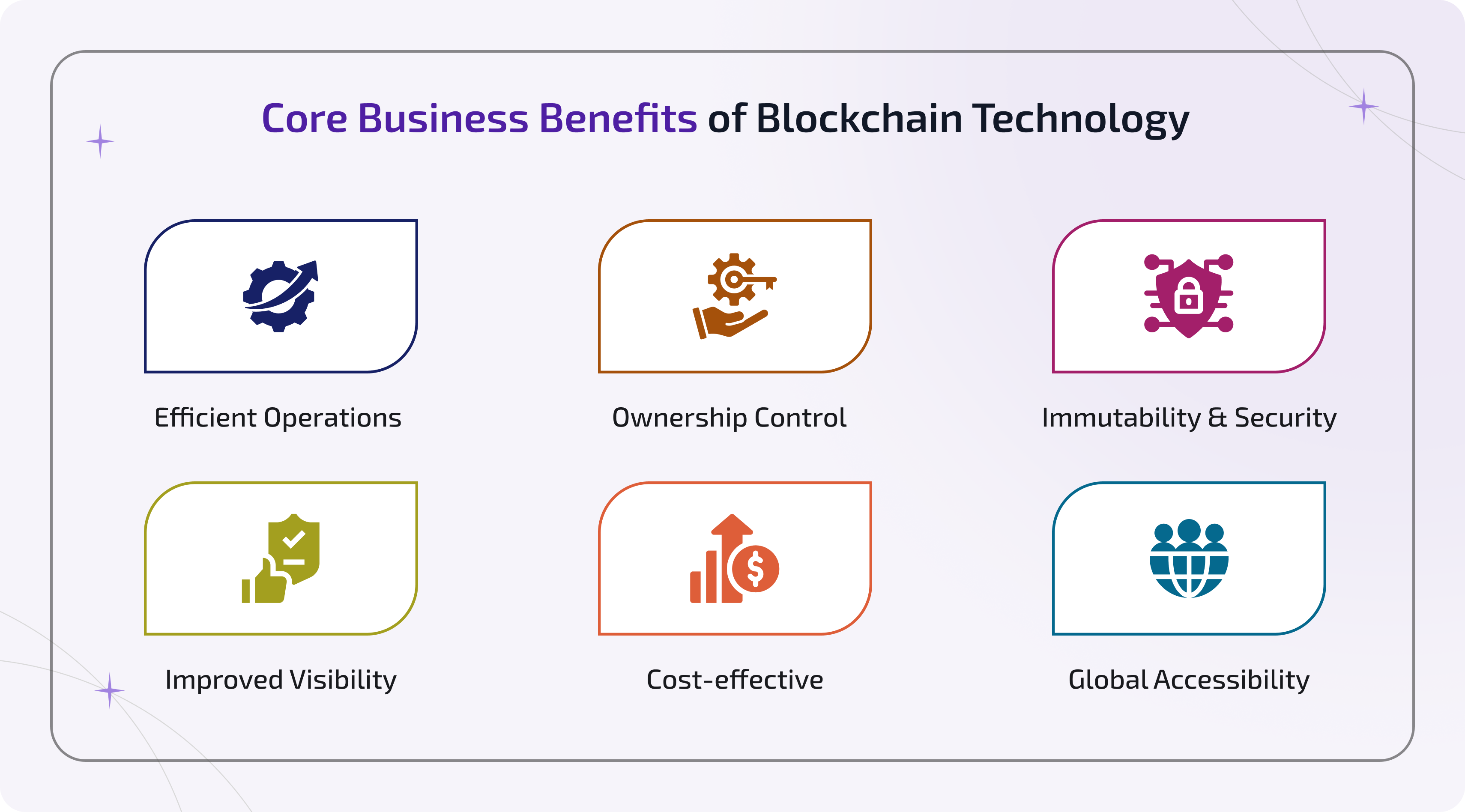
Core Business Benefits of Blockchain Technology
With the adoption of blockchain technology in business, organizations are receiving much greater security, transparency, and efficient digital operations. The technology allows reliable data exchange and process automation while improving the overall functionality. Explore the following benefits and understand how blockchain drives Web3 transformation.
Efficient Operations
Blockchain technology develops a unified protocol for secure asset exchange, automated system operations, and quick approvals. Businesses reduce manual intervention and foster more efficient workflows with verifiable data.
Ownership Control
Enables organizations to maintain verifiable ownership records through immutable tracking and management. It improves asset controls and ensures trusted ownership verifications and transactions.
Immutability & Security
The information stored on-chain is tightly secured through cryptographic hashing methodologies and distributed across numerous nodes, ensuring data security. Once verified, data cannot be modified or tampered with, reducing unauthorized access and potential risks.
Improved Visibility
Provides a shared and verifiable record of transactions, allowing authorized participants to access accurate information in real-time. This enhances user trust, accountability, and market visibility across business operations and various blockchain networks.
Cost-effective
Enables businesses to cut down unnecessary costs by minimizing the reliability on intermediaries and automating time-consuming processes. It improves transaction efficiency, reduces errors, helping enterprises achieve more value with strong operational resources.
Global Accessibility
Removes jurisdictional barriers by allowing users to access global markets via a decentralized network, empowering fast, secure, and cross-border transactions. It supports borderless collaboration and ecosystem transactions.
Why Are Business Enterprises Adopting Blockchain Systems?
The crypto landscape is experiencing a huge shift from conventional systems to decentralized and sturdy infrastructure that uses blockchain operations. It has established a tamper-proof ledger where every transaction record or essential data can be verified by multiple stakeholders without third-party authorization. From a business perspective, these capabilities are especially beneficial for prominent industries where trust and data integrity are crucial for optimized functionality within the ecosystem.
According to reports, the on-chain market is predicted to rise from USD 108.3 billion in 2026 to USD 9.055.5 billion by 2033, driven by a CAGR of 88.2%. The intelligent capabilities minimize manual errors, increase speed, and cut down unnecessary expenses. Ultimately, this efficiency, combined with considerable budget savings, allows organizations to use blockchain for business with a compelling competitive edge.
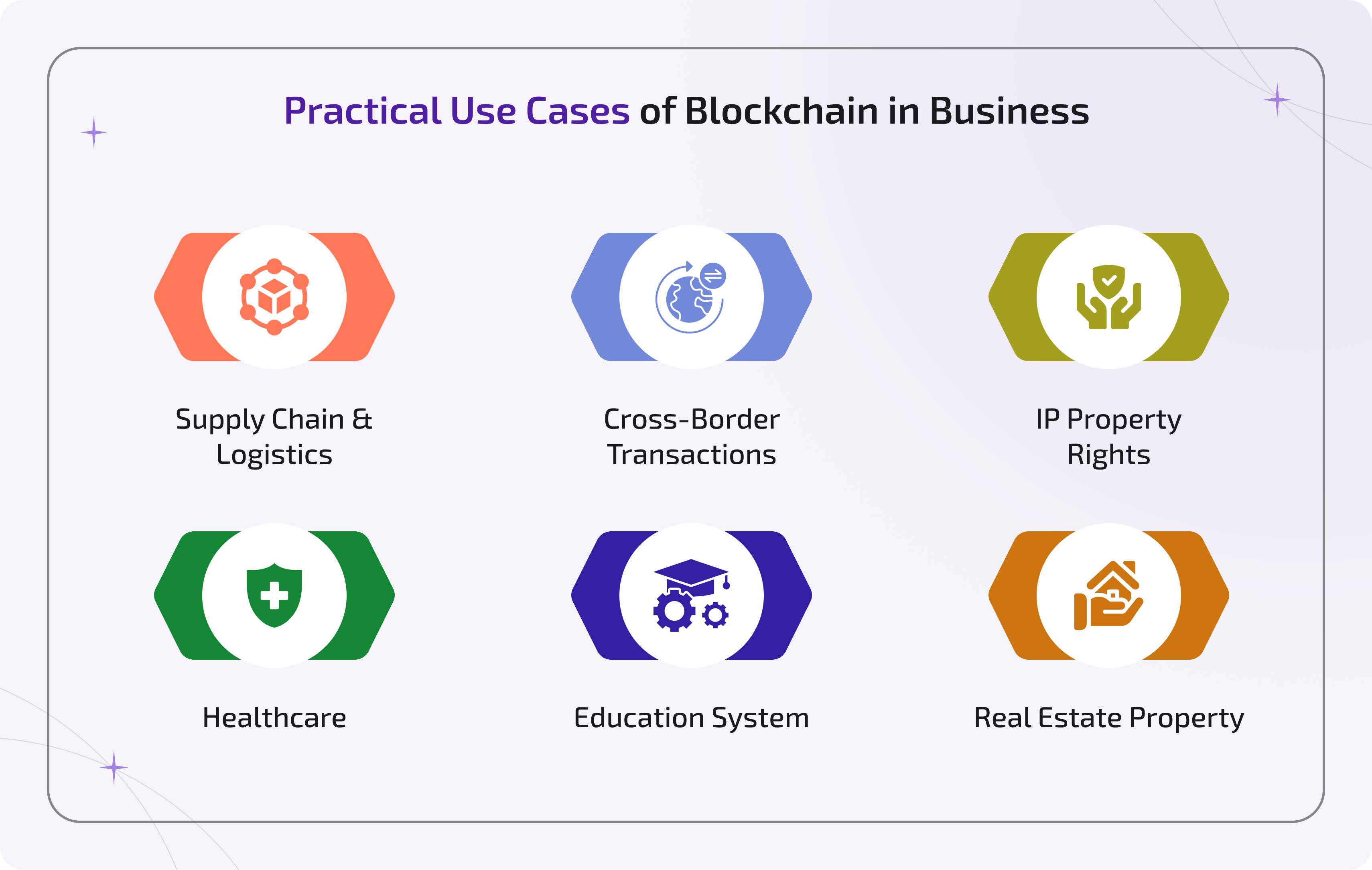
Practical Use Cases of Blockchain in Business
Businesses across industries are using blockchain to improve processes, enhance credibility, and bring in more efficient digital ecosystems. Explore the core blockchain use cases in business to see how this technology is driving practical enterprise applications.
Supply Chain & Logistics
Provides provenance tracking across production, movement, origin verification, and data exchange execution among multiple stakeholders with greater transparency. It helps businesses to prevent possible hacks and build a more secure ecosystem.
Cross-Border Transactions
Allows financial sectors to apply crypto development solutions for businesses, surpassing regular banking systems. Blockchain processes cross-border payment and settlements within seconds, reducing transaction fees and workflow delays significantly.
IP Property Rights
The blockchain systems enable authors, developers, and artists to safeguard their ownership and timestamp their work, establishing verifiable proof of rights. It simplifies property royalty and licensing, protecting against piracy.
Healthcare
Blockchain in the healthcare sector, various hospitals and pharmacies use an on-chain system to protect and share patient information across different channels without compromising their privacy. It ensures verifiable access to sensitive medical records.
Education System
Through intelligent automation, blockchain enables the management and authentication of academic information, certificates, and student credentials. It helps institutions reduce fraud and maintain the trusted ownership & authenticity of essential records.
Real Estate Property
Facilitates property tokenization and digital asset exchange through blockchain, simplifying ownership transfers and reducing the paperwork complexities involved. It enhances trust and accessibility for global real estate investments.
Blockchain Implementation Challenges in Business
Despite the rise of blockchain in business processes, enterprises still go through certain implementation challenges while incorporating it into pre-existing ecosystems. Addressing the following hurdles is a must to ensure practical adoption and scalable growth of a business.
Challenge
Business Value
Regulatory Uncertainity
Jurisdictional regulations differ by operating sector, making it difficult for businesses to execute their long-term compliance plans across certain expected markets
Interoperability Limitations
With different networks operating independently, the lack of standard protocols makes cross-chain communication & data transfers challenging
Credibility Concerns
Though blockchain is designed to be completely transparent and secure, vulnerabilities & high-impact breaches still affect confidence in enterprise adoption
Expertise Gap
As there is a shortage in finding and hiring blockchain experts with expertise, knowledge, and exposure in this field, it makes blockchain implementation for enterprises more complex
Cost & Scalability Constraints
Development and management of blockchain infrastructure at enterprise scale demands considerable investment, which can be a barrier for businesses
Infrastructure Compatability
Existing business systems lack blockchain suitability, requiring technical integration and restructuring, making it a difficult process
How to Integrate Blockchain in Your Business Operations?
Blockchain for business goes beyond simple technology selection; it requires a clear approach to make sure it empowers real-world applications. Explore the following to understand the significant flow for implementing blockchain solutions flawlessly into operations.
Define Business Use-Case
First, determine the ideal business utility where blockchain can pitch measurable outcomes. Analyze traditional processes thoroughly to understand sectors that can benefit from blockchain, such as reducing payment delays, enhancing asset transparency, and securing data exchange.
Pick an Optimal Network
The choice of blockchain network directly impacts data security, transaction speed, efficiency, and control mechanisms. It must align with the core component needs and long-term goals of a business blockchain platform.
The major types of networks include:
Permissioned network
Public network
Consortium blockchain
Hybrid blockchain
Technical Requirements
Before implementing blockchain technology for business, institutional organizations need to build robust technical requirements for a scalable blockchain solution. Key areas to consider:
Suitable blockchain framework
Smart contract development
Blockchain system integration
Security protocol measures
Scalability requirements
Build a Proof of Concept
Developing a blockchain POC enables business enterprises to validate their idea in a controlled environment before full-scale deployment. It enables the team to test the technology’s capability, identify technical gaps, and refine the complete approach on a real-world business utility basis.
Integrate & Monitor
Deploy the blockchain solution within the existing systems while ensuring smooth connectivity and operational business performance. Consistent tracking helps organizations monitor performance, resolve issues, and optimize processes accordingly.
Future Role of Blockchain in Business Operations
The future landscape of blockchain systems is transforming from experimental pilot to mainstream enterprise integration, modernizing the way business enterprises operate and collaborate with one another. Organizations are moving beyond standalone applications toward broader commercial use cases that offer long-term business impact. Emerging technologies like intelligence, IoT, and asset tokenization are expected to boost on-chain innovation by enabling smart operations and programmable assets.
Organizations that foster blockchain investment today will be better positioned to craft trustworthy and reliable digital ecosystems and adapt to the next wave of the decentralized business economy. Here are some of the influential factors behind enterprise blockchain development:
AI Convergence
AI-driven agents are expected to execute transactions, interact with contracts, and manage premium assets autonomously, unlocking new business possibilities for embracing a Web3 future.
Enterprise-Ready Ecosystems
Advancements in permissioned/hybrid blockchain networks, secure custody, and compliant-focused regulations are making enterprise adoption more practical across industries.
Asset Tokenization Boom
As businesses increasingly embrace digitized assets, RWA tokenization is becoming the biggest part of DeFi, enabling efficient asset management and broader market accessibility.
Modern Digital Settlements
Stablecoins are redefining enterprise payment systems by streamlining near-instant settlement methods, treasury management, and financial functional workflows.
Blockchain technology is rapidly becoming a core component of tomorrow’s digital economy, with the blockchain market actively scaling to a trillion-dollar market cap. Turn your business vision into a market-ready solution with BlockchainX.
From strategy to deployment support, BlockchainX offers end-to-end blockchain solutions designed to help enterprises and small ventures to innovate, scale, and unlock new growth opportunities within the Web3 ecosystem. Explore our premium offerings of blockchain technology for companies below:
Core Services
Business Value
Best For
RWA Tokenization
Digitizes RWA assets for better liquidity, fractional ownership rights & market accessibility
Real estate, asset management & private equity, and commodities
Crypto Exchange Development
Builds secure, efficient & fully licensed platforms for seamless digital asset trading
Emerging fintech companies, trading platforms
Crypto Wallet Development
Enables secure storage, management, and transfer of assets across multiple on-chain networks
Crafts transparent and trustless prediction platforms to enable robust event-driven marketplaces
Event-based marketplaces, gaming ecosystem & media
Conclusion
As we conclude, it is clearly visible to witness the evolution of blockchain towards institutional adoption in the decentralized landscape. It has become a key business infrastructure layer reshaping how enterprises manage digital assets, handle transactions, and manage workflows, moving from an early project to a programmable foundation for modern business operations.
More importantly, blockchain is enabling organizations to build reliable digital ecosystems with traceability, intelligence, and robust value exchange suitable for everyday business functionalities. The industry business leaders who embrace a clear approach will be well-positioned to drive long-term value and success in the Web3 ecospace.
Get all the latest posts delivered straight to your inbox.
Get In Touch
Our expert team is professionally well-equipped with hands-on experience as a
blockchain development company. Connect with us; at BlockchainX, we curate your desired
sustainable solution!