White Label Real Estate Tokenization Guide 2026: Step-by-Step Approach
Listen to the Audio :
The global real estate market is slowly heading towards a modern approach, where
tokenization marks a major shift from traditional methods. This white label real estate tokenization platform development is done
to customize exactly to reflect your brand identity with predefined regulations in a quick
way without much complexity. It’s a smart way to combine advanced blockchain technologies
with the reliability of real estate, making it a thrilling way to get into the growing
market of digital real estate.
In this article, we will outline the necessary steps for launching your white label
tokenization platform. Our guide will help both businesses and entrepreneurs get complete
details on how to get into the digital real estate industry.
What Is a White Label Real Estate Tokenization Platform?
A ready-made, customizable software program called a White Label Real Estate
Tokenization Platform enables businesses to convert real estate assets into blockchain-based
digital tokens. Each token, representing a share of property ownership, allows for
fractional investment and facilitates seamless trading.
With the "white label" feature, businesses can easily launch the platform under
their own brand without having to start from scratch. It empowers investors, startups & real
estate companies with safe, transparent & global blockchain-based real estate investment
opportunities.
In the fast-growing digital real estate industry, businesses use a white label tokenization platform development system to reduce
costs, obtain a competitive advantage & expedite market entry. It is an innovative way to
simplify real estate ownership, attract global investors, & reinvent traditional real estate
as a modern, easily accessible investment opportunity.
What Shapes Real Estate Tokenization in 2026?
Rise of institutional-grade RWA adoption
Tokenized debt and revenue-sharing models
Regulatory-focused token standards
AI & data-driven valuation models
Hybrid Web2 & Web3 investor experience
Secondary market infrastructure growth
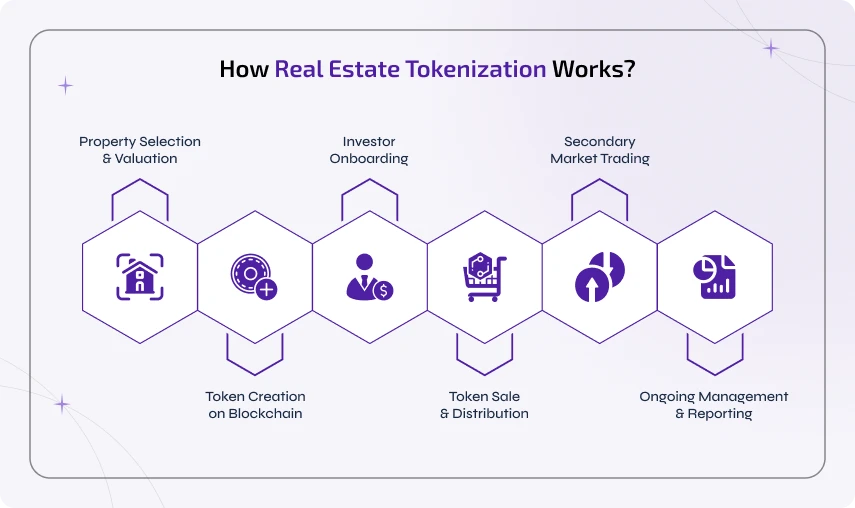
How Real Estate Tokenization Works?
The process of turning property ownership into digital tokens on a blockchain is
known as real estate tokenization. Multiple investors can own a portion of a
property without buying the entire asset as each token reflects a fractional share of the
property. Here’s how it goes step by step of white label real estate tokenization
Property Selection & Valuation
Choosing which property to tokenize is the first step in the process. Experts
analyze its potential returns, legal status and market value. This valuation sets the basis
for a fair ownership distribution and determines the number of tokens that will be created.
Token Creation on Blockchain
The property is divided into digital tokens via smart contracts with blockchain
technology. A portion of the asset is represented by each token. This ensures tamper-proof,
transparent & safe ownership records that investors can readily verify.
Investor Onboarding
Investors are registered with regulations through KYC/AML verification. They
provide secure access by connecting the platform to their digital assets. By taking these
measures—tokenized property ownership can be safely participated in while investors and the
platform are protected.
Token Sale & Distribution
Depending on how much the property is valued at, tokens are sold to investors.
After being bought, tokens are delivered to investors' wallets. Depending on the number of
shares they own, token holders have the right to dividends, rental revenue or capital
growth.
Secondary Market Trading
On platform-integrated exchanges or secondary markets, investors can trade
tokens. This feature makes real estate investing more flexible by increasing liquidity and
enabling investors to buy or sell tokens with ease without requiring full property
transactions.
Ongoing Management & Reporting
The platform uses smart contracts to automatically handle investor payouts, maintenance costs
and rental income. Over time–investors receive regular reports that ensure accountability,
transparency and smooth operations for the tokenised property.
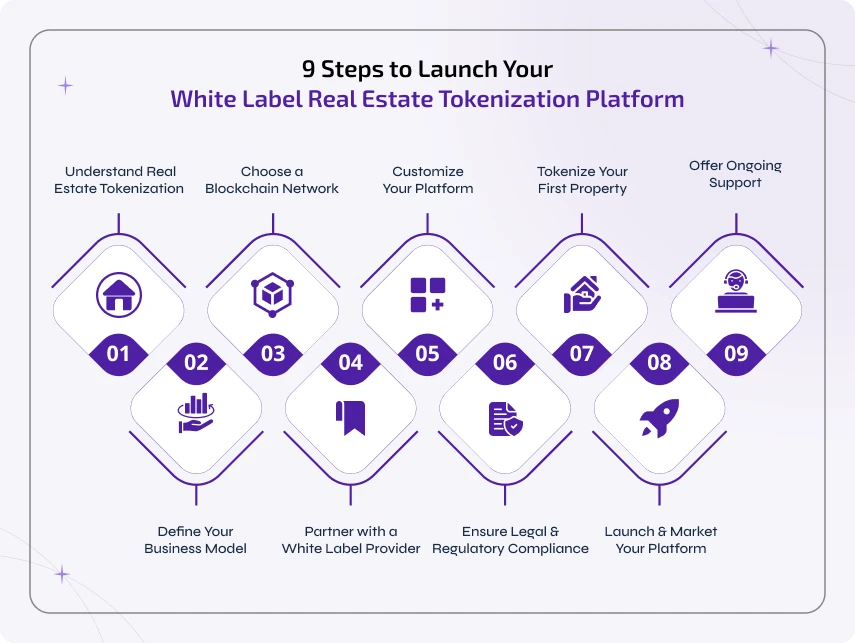
9 Steps to Launch Your White Label Real Estate Tokenization Platform
You can quickly enter the blockchain real estate market to launch a white label
real estate tokenization platform that offers fractional property investing to a global
audience. The steps to take are as follows.
Step 1 - Understand Real Estate Tokenization
On the blockchain, real
estate tokenization turns property ownership into digital tokens. Multiple investors
can participate as each token represents a portion of the property. Understanding this
process implies that all users can access investment possibilities, liquidity and
transparency on your platform.
Step 2 - Define Your Business Model
Choose whether your platform will be used by institutions, real estate tokenization developers or individual investors. List
sources of income such as listing fees, transaction fees & subscription plans. A
well-defined business plan guarantees scalability, profitability and a platform that is
organized for your target market.
Step 3 - Choose a Blockchain Network
Choose a blockchain network between Base, Avalanche, Arbitrum, or Optimism
according to your business requirements. Ensure it offers affordable prices, quick
transactions, and secure smart contracts. The right choice of blockchain network provides a
foundation for a scalable, reliable platform supporting smooth asset management and investor
participation.
Step 4 - Partner with a White Label Provider
Partner with a reliable white label provider that offers pre-made solutions.
Look out for secure infrastructure, investor dashboards, KYC/AML compliance and smart
contract templates. This partnership guarantees your platform runs reliably from day one,
expedites launch & lowers development effort.
Step 5 - Customize Your Platform
Name the platform with your domain, colors and logo. Set up dashboards,
property listings, investor onboarding & token settings. Customization improves user
experience establishes brand identity and guarantees that your platform meets the demands of
real estate owners and investors.
Step 6 - Ensure Legal & Regulatory Compliance
Work with legal professionals to adhere to local laws such as securities and
KYC/AML rules . Maintaining compliance keeps your company safe, fosters trust among
investors and keeps you out of trouble with the law. It guarantees that your platform
functions in the international real estate market ethically and securely.
Step 7 - Tokenize Your First Property
Choose a property, assess its value and develop tokenization smart contracts.
Give investors tokens that reflect a share of ownership. This initial tokenized property
showcases transparency and efficiency, attracts early adopters and shows the features of
your platform.
Step 8 - Launch & Market Your Platform
To advertise your platform, use partnerships, events and crypto marketing agencies. Highlight benefits like fractional
ownership & worldwide accessibility and blockchain security. A strong marketing strategy
attracts investors, ensures a platform launch is successful and builds a reputation.
Step 9 - Offer Ongoing Support
Provide ongoing support to clients—keep an eye on platform performance & carry out upgrades .
Including functions like analytics, cross-chain interoperability protocolor secondary trading maintains
your platform competitive and guarantees a smooth experience for both investors and real
estate owners.
Regulatory Compliance for White Label Real Estate Tokenization Platforms in 2026
Every jurisdiction follows a distinct and strict regulatory framework for white
label real estate tokenization. Explore how a white label ecosystem supports regulatory
requirements across major operating markets through built-in mechanisms.
European Union
MiCA - Markets in Crypto-Assets Regulations.
Delivers smart MiCA-first whitepapers, reserve disclosures, and
blockchain-based enforcement of the strict 14-day investor withdrawal period.
Uses an SPV structure to hold legal title to the property while issued
tokens provide investors with economic rights according to EU standards.
United States
Securities and Exchange Commission, Reg D and Reg S.
Enforces investor eligibility through on-chain accreditation verification
(Reg D) and residency-based access controls (Reg S) to maintain regulatory compliance .
Implements ERC-3643 or ERC-1400 transfer restrictions to automate holding
periods and investor caps through smart contract systems.
United Kingdom
FCA - Financial Conduct Authority.
Enables FCA-compliant fundraising through direct authorized channels while
limiting access to eligible and high-net-worth investors.
Incorporates mandatory risk warnings and cooling-off periods into the
onboarding process to align with UK consumer protection standards.
Singapore
MAS - Monetary Authority of Singapore.
Aligns token offerings with MAS by supporting licensing, applicable
regulatory exemptions and prospectus obligations.
Uses accredited investor authentication and identity-first KYC check to
ensure regulated token trading.
UAE
VARA - Virtual Asset Regulatory Authority.
Ensures token issuance under VARA regulations through the ARVA framework to
support compliant digital asset issuance in the Dubai ecosystem.
Verifies investor identities via Emirates ID and maintains an auditable
transactional record to meet protocol requirements.
White Label Real Estate Tokenization Platform Development Cost in 2026
The investment cost for a white label real estate tokenization ecosystem depends
on the key components involved in the development cycle. From platform licensing to
deployment, each protocol contributes to the overall budget. Refer to the table below for a
comprehensive breakdown of cost estimates behind a fully functional white label platform in
2026.
Key Component
Purpose
Estimated Budget
White Label Platform License
Provides the pre-built tokenization platform & core modules
$15,000 - $40,000
Customization & UI/UX Branding
Personalizes the platform with your brand and workflows
$5,000 - $20,000
Smart Contract Protocol
Configures token issuance and asset management logic
Supports regulatory controls and compliance reporting
$10,000 - $25,000
Asset & Portfolio Management
Manages properties, token holders, and investment portfolios
$5,000 - $ 15,000
Wallet & Digital Asset Integration
Facilitates storage and transfer of digital assets securely
$5,000 - $20,000
Payment & Settlement
Allows fiat, crypto, & stablecoin transactions
$6,000 - $15,000
Live & Maintenance
Launch, track, & maintain the ecosystem
$5,500 - $20,000 (Annual maintenance may vary)
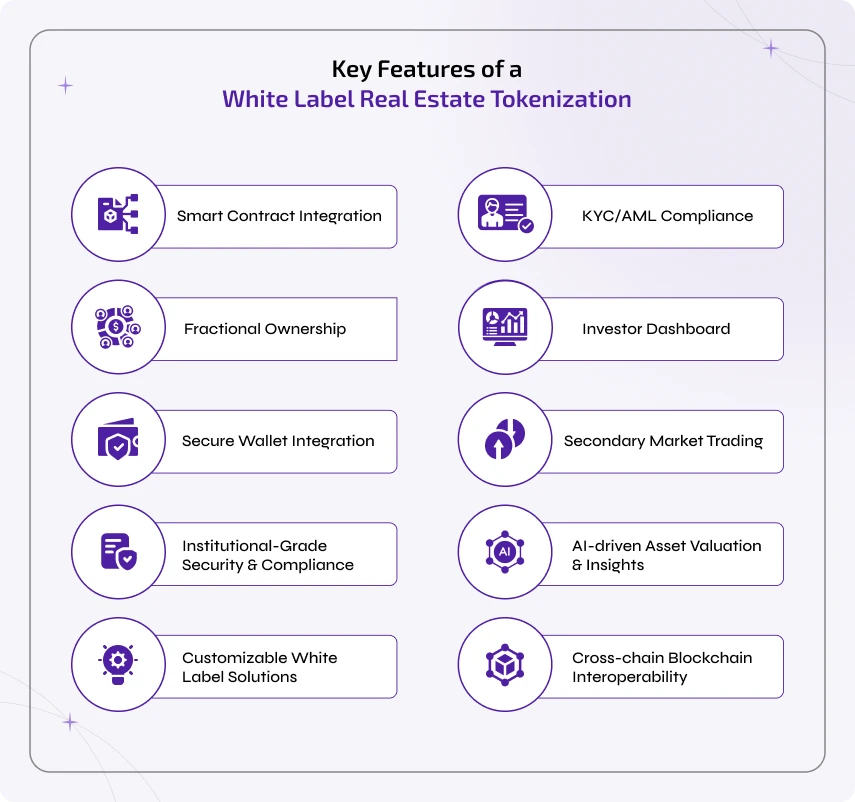
Key Features of a White Label Real Estate Tokenization
White label property tokenization solutions are designed with advanced,
user-friendly features that make property
tokenization easier, boost investor trust and ensure secure operations.
These features offer a smooth real estate investment experience while combining
blockchain innovation, automation and compliance to help businesses in launching their
platforms fast and effectively.
Smart Contract Integration
Important tasks like revenue distribution, automated compliance authentication,
DAO-based property governance, oracle-integrated price feeds, and cross-chain logic, etc are
automated by smart contracts. They ensure transparency, eliminate the need for middlemen,
and reduce human error. As every contract and transaction is safely carried out on the
blockchain, faster, reliable and immutable.
Fractional Ownership
Properties can be split up into digital tokens, each of which represents a
portion of the ownership due to fractional ownership. This tool makes real estate investing
more accessible, inclusive, and affordable for a worldwide audience by allowing investors to
buy small pieces of high-value assets without having to pay large upfront capital
requirements.
Investor Dashboard
Token holdings, real estate performance, transaction history and income reports
are all clearly visible on an easy to use investor dashboard. Investors can use it to
monitor returns and make sound decisions. Real time analytics and data improve transparency,
build trust & make investing simpler for all users.
Secondary Market Trading
After the initial offering– investors buy and sell property tokens through
secondary market trading. It makes real estate investments that were previously illiquid
more liquid. As it is simple for investors to enter or exit their positions, the platform is
dynamic, adaptable and appealing to a wider user base.
Institutional-Grade Security & Compliance
The platform makes use of advanced security features such as MPC wallets, formal
smart contract processing, third-party audits, and hardware-backed key management. Combined
with complete compliance support, it ensures security against illegal access, fraud, and
hacking. This assures large property owners and institutional investors that they can make
safe, regulated tokenized investments.
AI-driven Asset Valuation & Insights
To deliver accurate asset values, AI in
tokenization analyzes performance, market trends, and real estate data. By providing
up to date information on real estate potential and investment risk, it helps investors in
making data driven decisions. This smart innovation uses predictive analytics to maximize
portfolio performance and guarantee transparency.
Customizable White Label Solutions
You can completely customize the platform with your domain, color scheme,
branding and logo. Businesses are able to customize features, processes & design to suit
their own requirements . This flexibility helps create a distinctive, personalized
experience while saving time and cost on product development.
Cross-chain Blockchain Interoperability
Tokens can move across several blockchain networks such as Ethereum, Polygon and BNB Chain
with ease due to cross-chain compatibility. It improves accessibility and scalability to
adaptability. Without being limited to a single network, this feature guarantees that your
platform serves a wide range of traders, assets and blockchain ecosystems.
Best Blockchain Networks for Real Estate Tokenization in 2026
The choice of your blockchain network directly impacts the functionality and
long-term value of your real estate tokenization platform. Each network is backed by
distinct capabilities that influence your ecosystem's operations. The table below outlines
the leading on-chain networks for real estate tokenization in 2026:
Blockchain Network
Notable Features
Core Strength
Ideal Application
Ethereum
Industry-leading contracts with broad developer & institutional
adoption
Robust security & mature ecosystem
Enterprise-grade real estate platforms
Polygon
Supports EVM compatibility, minimal gas fees & transactions within
seconds
High scalability and cost efficiency
Large-volume property tokenization
Avalanche
Customizable subnets, quick finality and EVM support
High throughput & customization
Institutional RWA platforms
Solana
Parallel transaction processing, ultra-low fees and high TPS
Speed & cost-efficient transactions
Real estate marketplaces with high trading activity
BNB Chain
Extensive DeFi ecosystem with affordable transactions
and in-depth liquidity
Pure proof-of-stake, instant finality & efficient consensus
Strong regulatory readiness
Compliant and government-backed real estate projects
Best Token Standards for White Label Real Estate Tokenization Projects
The choice of token standard is essential for building a secure, efficient, and
compliant white label real estate tokenization platform. The following standards mentioned
below are the renowned standards used in modern real estate tokenization projects.
ERC-3643 (T-REX)
ERC-3643 is a permissioned token standard designed for regulated securities,
featuring built-in identity verification and transfer controls. It is widely preferred for
projects that require regulatory compliance from the ground up.
A security token framework combining partition-based ownership, investor
permissions, and document management. It is well-adapted for real estate projects with
multiple ownership classes and regulatory requirements.
Best For : Multi-investor real estate
tokenization and institutional asset offerings.
ERC-1404
This is a type of lightweight security standard that adds transfer restrictions
to enforce compliance during token transactions. It is a practical choice for business
enterprises launching streamlined real estate tokenization ecosystems.
Best For : MVP-stage tokenization platforms and
compliant-first real estate property projects.
ERC-20
ERC-20
provides a flexible foundation for tokenizing real estate assets and can be integrated
with external compliance solutions for regulatory control. It is ideal for platforms that
require customizable compliance and broad ecosystem compatibility.
Best For : Fractional real estate tokenization
with custom compliance.
Polymath ST-20
ST-20 is a security token standard developed by Polymath that extends ERC-20
with built-in compliance and investor verification features. It played a key role in the
early adoption, remaining an important standard in the evolution of real estate STOs.
Best For : Regulated real estate tokenization
projects and security token offerings (STOs).
Benefits of Using a White Label Real Estate Tokenization Solution
Our white label real estate tokenization guide makes it easy for businesses to
get into the blockchain real estate sector. It makes it simpler to create, manage and scale
your platform by providing pre-made tools, customization choices and automation. The main
benefits listed below make it a wise business decision.
Market Your Own Branding
White label real estate platform enables you to launch a completely branded
platform using the name and style of your business. Customizing colors, logos and themes to
represent your company's identity will help you stand out from the competition and gain the
trust of real estate investors and owners.
Quick Deployment
A white label solution enables rapid platform deployment rather than months of
development time. As smart contracts, wallets and dashboards are all pre-built, you can
launch instantly and start attracting investors more quickly saving both time and resources
on development.
Highly Reliable
We build platforms for white label tokenization using trusted
blockchain frameworks. We conduct extensive security testing on them to ensure their stable
and seamless operation. Businesses and investors alike benefit from this reliability which
assures them that ownership records, transactions & investments are safe and completely
transparent.
No Risk or Chance of Loss
Smart contracts and
blockchain technology drive the system ensuring every
transaction is safe and traceable . The software reduces fraud, data manipulation & human
error. By doing this, all parties' financial risks are reduced and ownership rights and
investor funds are well-protected.
Customizable Branding
Your platform's functionality, design and user experience are all easily
customizable. Each aspect, including the process and interface can be modified to meet your
business's goals. Customization gives your investors a smooth experience and helps with
creating a unique brand personality.
Global Investment Accessibility
Blockchain technology enables anyone to invest in real estate anywhere in the
globe. The platform's multi-currency and multi-region functionality makes it easy for
investors from across the world to buy, sell & trade tokens, increasing your reach and
attracting a varied investor base.
Improved Liquidity
Secondary market trading and tokenization make real estate assets extremely
liquid. Investors don't have to wait for long sale processes to trade property tokens. Due
to this liquidity, real estate investing is more attractive and accessible, which encourages
increasing participation from global investors.
Automated Processes
Major processes including ownership transfers, rent distribution and profit sharing are all
automated by smart contracts. This ensures error-free operations, saves time and minimizes
manual labour. Both investors and property owners gain from the platform's increased
efficiency, reliability and transparency due to automation.
Future of White Label Real Estate Tokenization Platforms
The adoption of white label solution in real estate tokenization platforms is
expected to accelerate in the forthcoming years, with 80% of high-net-worth investors and
67% of institutional investors. As digital transformation accelerates and blockchain
technology matures with innovative regulatory frameworks, users are seeking more digital,
liquid investment opportunities.
In the future, this technology will advance in AI-powered property valuation,
multi-chain interoperability, and much more, providing investors with an efficient pathway.
The integration with traditional and financial markets widens user adoption across the
industry, with a high impact on the global real estate markets.
All these make the white label tokenization platform digitally connect with the future of
finance.
Why Choose BlockchainX for White Label Real Estate Tokenization?
During the process, BlockchainX acts as a reliable technological partner. We are
expertise in smart contracts, tokenization and blockchain development guarantees the
security, compliance & scalability of your platform. They offer end-to-end assistance,
streamlining the process for both new and established businesses from concept development to
deployment.
Real estate tokenization offers transparency, liquidity & worldwide accessibility in the
rapidly changing digital economy of today. Businesses stay ahead of the curve, provide a
cutting-edge and effective investment platform & transform their real estate vision into a
digital reality that is ready for the future by utilizing BlockchainX's white label
solutions.
Conclusion
Managing, investing in and selling real estate assets can be made easier by
launching your own white label real estate tokenization platform. By taking the right
steps–companies can build a platform that enables both modern investors and real estate
developers offering a smooth and effective investing experience.
It is not necessary to start from scratch when using a white label solution. A pre-made
adaptable framework maintains your branding and design to operational flexibility while
saving you time, cost & enabling you to focus on growth. This ensures faster market access
and a refined, flexible platform that meets investor demands.
Frequently Asked Questions
White label real estate tokenization is a pre-built blockchain solution that turns valuable property assets into digital tradable tokens for fractional investment. It enables businesses to launch a fully branded tokenization service without building an ecosystem from scratch.
Enterprises are turning to tokenized real estate ecosystems for their businesses to modernize how property investments are traded and managed together. This reduces operational costs,enhancing accessibility to small capital investors worldwide.
An ideal real estate tokenization platform includes secure investor onboarding (KYC/AML), smart contract-based asset tokenization, and secure wallet integration for asset custody. It should offer an investor dashboard panel, automated payouts, and secondary market support for liquidity.
Generally, tokenization protocols generate business income via issuance fees, transaction commissions, and subscription-based plans. Additionally, companies can monetize by incorporating enterprise-grade components, custom integrations, and more.
Tokenized real estate protocols use AI intelligence to streamline functional flow, implement tight compliance systems, and optimize overall crypto asset management. Users are enabled to make better-informed decisions through verifiable insights and predictive analytics.
Get all the latest posts delivered straight to your inbox.
Get In Touch
Our expert team is professionally well-equipped with hands-on experience as a
blockchain development company. Connect with us; at BlockchainX, we curate your desired
sustainable solution!