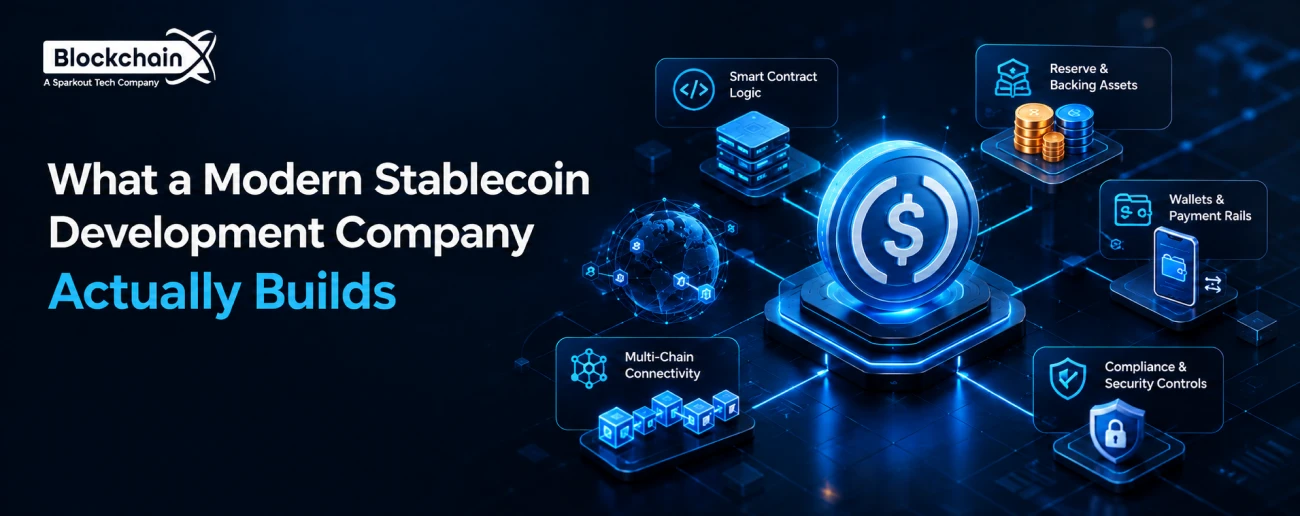
What a Modern Stablecoin Development Company Actually Builds
 By Yokesh Sankar
9 min read
Updated On
By Yokesh Sankar
9 min read
Updated On
How do you actually compare one stablecoin development company with another when they all describe themselves the exact same way? That is the question this guide answers: what has made the global stablecoin market double from earlier years?
This guide comes with not a ranked list, but with what a modern company builds — the actual layers, models and regulatory realities that separate a serious development partner from a vendor still relying on 2021 narratives.
What Used to Be Difficult Isn’t Difficult Anymore: The Token Got Easy, Explained
Building a stablecoin’s smart contract was a technical challenge that has turned out to be simple nowadays. A basic fiat-backed stablecoin, or a token used to mint, burn or pause that is secure and audit-proof, is something blockchain experts can build in less than months.
The growth of this market is evident, where the global stablecoin supply has reached over $314.68 billion by July 2026, which doubled from years back. When a market grows rapidly it gets commoditised easily, and there is the shift a trusted stablecoin development company is built around today. But this difficulty moved to everything around the token.
A token built around the U.S. GENIUS Act, signed into law in July 2025, is not automatically compliant under the EU’s MiCA framework, which set a hard compliance deadline on July 1, 2026. These rules do not match each other, and getting this wrong has real consequences. MiCA’s deadline alone pushed exchanges like Binance, Coinbase and Kraken to exclude non-compliant coins for EU users.
Tether (USDT) holds roughly 59% of the market, while Circle’s USDC has grown to 24%, gaining market share by prioritising compliance at an early stage. Stablecoins that did not prioritise compliance are being disqualified from major exchange listings.
The Seven Infrastructure Layers of a Modern Stablecoin Development
A modern stablecoin development company builds beyond the token contract, covering the full infrastructure required for issuance, reserve management, transactions, compliance and ecosystem integration. Once you accept the token, the next natural question is what actually does the hard part consist of? The real infrastructure sits in the seven layers wrapped around the coin, and here is how it actually works.
Custody & Key Management
This is where the actual backing assets such as treasuries, cash and other reserves are physically held. Real regulated custody comes with multi-party computation (MPC) signing, a bankruptcy-remote structure, a verifiable custodian, segregated accounts and role-based approvals for minting and burning.
Weak custody is the biggest reason stablecoins have collapsed, and it is one of the slow, high-trust foundations that cannot be built instantaneously.
Credit & Payment Data
This mechanism is about making the stablecoin function as productive financial infrastructure, enabling institutions to borrow against it, post it as collateral, or extend short-term credit using the stablecoin without breaking its peg.
Holding a stablecoin in a wallet shows its availability, where lenders accept it as collateral with deep trust and liquidity. Only a forward-thinking stablecoin and blockchain development company designs its data layer with being trusted as real collateral in mind.
Liquidity
Even a stablecoin that is fully backed and compliant remains impractical without sufficient liquidity to move between assets and currencies at scale.
Deep liquidity requires broad exchange access, strong market-making and in-depth stablecoin development services such as cross-chain liquidity, market-maker integrations and redemption that holds large transactions without significant price impact — critical for institutions moving millions.
Settlement & Orchestration
This is the actual mechanics of a transaction finalising: on-chain confirmation times, finality guarantees and much more, which often goes unnoticed by the actual users. It shows how the coin plugs into existing payment rails and competes on both cost and speed, not just innovation.
A capable stablecoin agency builds these connections between interoperability and orchestration, making them into a unified payment layer that enables assets to move seamlessly across the cross-border financial ecosystem.
FX & On/Off-Ramps
Once a stablecoin needs to move across borders or between currencies, it has to undergo actual currency conversion with a fair rate and minimal delay. A reliable FX conversion or on/off ramp makes any USD coin usable for global payments rather than just domestic dollar transactions.
This precisely allows a single-currency stablecoin to support international invoices, currency conversion and rapid global transactions rather than remaining idle.
Compliance & Regulatory
Regulatory readiness goes beyond basic KYC/AML checks. A well-working stablecoin needs proper sanctions screening, transaction monitoring and licence alignment with every jurisdiction where it functions. This is the layer most regulators care about and the one most likely to be limited among vendors.
A proficient stablecoin development company aligns multi-jurisdiction licensing into the coin from day one, not as a hidden slide. Since compliance takes years to build, this layer supports more durable stablecoin operations.
Developer Distribution
A fully functioning stablecoin ecosystem depends on how it actually integrates with other platforms. Well-built APIs, SDKs and sandbox environments with clear documentation allow exchanges, wallets and payment applications to connect without lengthy development, making adoption scalable across a wider ecosystem.
The best development team comes with simplified integrations, making asset adoption easier for platforms across their ecosystems.
The Two Decisions Hiding Inside Choosing a Model: Know What’s Backing
With the core infrastructure established, the decision becomes what kind of stablecoin you are actually going to build, and here your stablecoin development agency plays a major role.
What Backs It
The first decision is to know what is actually behind the peg. Four models dominate the market in 2026, and this determines which regulatory model actually opens the door.
Fiat-Collateralised: The coins are held at a 1:1 pegged value by regulated custodians and are effectively covered by the US GENIUS Act. Both USDT and USDC fall under this, which explains why they dominate the market.
Crypto-Collateralised: This model is decentralised and more capital-intensive, and a new bank-style framework is being built in the EU and US regions. It is backed by on-chain assets held above 100% of the token’s value.
Commodity-Backed: A coin pegged to a physical asset, most often gold. Here the token contract code is straightforward, and the real challenge is securing reserves and proving they actually match the stablecoin supply.
Algorithmic/Hybrid: One of the capital-efficient models that maintains its peg through partial collateral or supply mechanics rather than full backing. Most 2026 frameworks do not accommodate these models.
What It’s Built For
Besides the backing model, it is important to understand what the coin is actually meant to do, because each coin is built for a different purpose.
Asset-Backed Stablecoins: Built around off-chain reserves, these depend heavily on safe custody, reserve tracking and clear attestations to hold users’ trust in the token’s backing.
Decentralised Stablecoins: These trade a central issuer for community rules and use on-chain collateral. The main shift goes into oracle design, smart contract logic and liquidation logic, not day-to-day operations.
Payment-Focused Tokens: Optimised for low fees, speed and settlement finality, where the on/off ramps and orchestration matter more than the collateral mix itself.
Both decisions, backing and purpose, get harder to reverse once regulation enters. Hiring a reliable stablecoin development company is worth it, answering both before writing a single line of code.
The Changing Landscape of Stablecoin Development
There are three different kinds of builders — legacy banks, crypto-native teams and fintech challengers — all working under the same architecture, building similar stablecoins. Smart contracts, token standards and mint-and-burn mechanisms are now so well established that the technology is not the main differentiator. Everyone is building the same primitives to unlock the cheapest, fastest and most audited way to get a token live.
Regardless of the sector they come from, builders stand on identical technical ground. What differs is what each one builds on top of it: the custody relationships that took years to develop, the compliance infrastructure that satisfies more than one regulator at once, and the integrations that make a stablecoin useful in real financial activity.
Each builder genuinely comes with different strengths. Incumbent banks and payment networks bring something a startup cannot, while crypto-native teams bring extraordinary speed to ship, iterate and integrate across chains more rapidly than a regulated institution’s processes allow.
Distribution without technical speed produces a stablecoin that is compliant but heavy and slow to integrate. Speed without distribution gives a stablecoin that is technically elegant but trapped with a smaller user base, lacking institutional trust. Assembling licensing, custody, distribution and developer-grade infrastructure into one clear stack is the real job a trusted stablecoin development company has to do.
The Rules Caught Up With Every Shortcut
No matter which jurisdiction you create your own stablecoin in first, the rules start to look the same. The biggest regulations shaping your development are listed below.
July 2025: GENIUS Act Signed Into Law
The US establishes its first comprehensive federal framework for backing stablecoins, maintaining a 1:1 reserve ratio and covering monthly audits and redemption.
February 2026: OCC Proposes Implementing Rules
The Office of the Comptroller of the Currency released a proposed notice for federally chartered issuers, covering reserves, reporting and supervision.
April 2026: Hong Kong Issues First Licence
HSBC and Anchorpoint became the first two licensed stablecoin issuers under Hong Kong’s new regime.
July 2026: MiCA Compliance Deadline Hits
The EU’s transitional period for non-authorised issuers and certain crypto-asset service providers is subject to national implementation choices.
January 2027: GENIUS Act Takes Effect
The US Treasury’s implementing rules become effective on a date tied to final regulations, happening 18 months after the act.
How to Choose a Stablecoin Development Company
Once you have a clear understanding of the layers, models and regulatory shape, evaluating a vendor gets a lot more concrete. Before you commit to any pitch, here is what you need to actually check.
Reserves & Proof
Able to show a live reserve or attestation dashboard from a past project.
A reputed, verifiable custodian holding the reserve, not an unknown partner.
The dashboard is updated continuously, not once in a while.
Compliance
A complete compliance structure handled by a specialised in-house team.
Ask who the compliance team actually reports to.
Whether they navigate more than one jurisdiction’s licensing process.
Integrations
Ask which exchanges and wallets they are actually live on, not just support.
Whether integration documentation exists and can be shared.
Whether they build proven, real, chain-agnostic infrastructure.
Redemptions
Ask for a description of at least one real liquidity event that happened before.
Ask what happens when a large holder wants to cash out at once.
They have an SLA for redemptions, not just “instant and seamless”.
Pricing
Whether post-launch costs are disclosed before launch, not after.
A clear quote including audits, build, compliance and ongoing operations.
Every additional feature has a measurable cost.
Post-Launch Operations
Who runs the treasury after launch and controls the keys?
Whether ongoing monitoring and reporting responsibilities are defined.
Will they provide a real incident-response process?
Conclusion
In a year when major regulatory regimes have converged on the same reserve, redemption requirements and audits, the expectations for stablecoin builders have changed. Hiring a stablecoin development company in 2026 is worth it when it can clearly demonstrate the specifics — dashboards, named custodians and live integrations — across the infrastructure layers supporting the token development.
Building a stablecoin beyond the token?
Infrastructure, compliance and integrations, with our Coimbatore team.
Frequently Asked Questions
A stablecoin development company does more than write smart contract code. It helps set up custody and manage reserves, works on compliance, and plans for licences in different jurisdictions. It also connects the stablecoin with exchanges and wallet apps and supports consistent post-launch operations.
While the token contract may take only weeks to complete, a broader production launch timeline typically takes several months, which may extend further when pursuing a federal charter under the GENIUS Act.
You do not necessarily need to secure a licence before writing code. Building compliance and choosing the right jurisdiction should be an early decision, since changing compliance later can force you to rebuild core components.
The key difference is stability. A stablecoin is designed to maintain a target value, typically tied to the US dollar through collateral or reserves, while a standard token has no such stabilisation mechanism and fluctuates with market conditions.
Our expert team is professionally well-equipped with hands-on experience as a blockchain development company. Connect with us; at BlockchainX, we curate your desired sustainable solution!


Follow us on


