Stock Tokenization in 2026: Everything You Need to Know
Listen to the Audio :
Stock tokenization is one of the most innovative concepts that integrates the traditional
real-world assets with blockchain technology. Here, traditional stocks are converted into digital tokens,
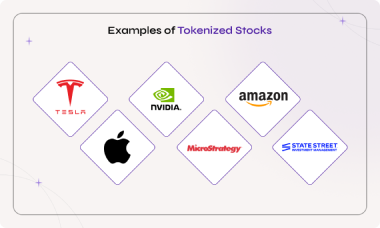
which play a significant role in the modern digital economy. Major companies like Tesla, Nvidia, and
Apple.Inc. are already available in tokenized form across blockchain platforms, enabling market exposure
of its company shares.
According to recent statistics, tokenized stocks have generated $15.12 billion in total spot trading volume in Q1
2026, surpassing the entire volume recorded across the last two quarters of 2025 combined. This
growth demonstrates that security tokens are no longer niche projects but an accelerating market force,
driving increased demand for equity tokenization services across global financial markets.
This blog provides a comprehensive understanding of tokenized stocks, including their
working mechanism, core features, real-time functionality, and notable market examples.
What is Stock Tokenization?
Stock tokenization is the process of converting the ownership rights of standard company
shares into digital, tradable tokens on a blockchain ledger. Each token represents a fraction or full
value of an underlying stock, enabling it to be traded or transferred like traditional shares.
These blockchain-based digital assets are used to provide investors with an innovative way
to track, access, and manage the real-world company shares through digital investment platforms. However,
these tokens are often issued by smart contracts and offer rights similar to those of traditional shares,
including voting rights, dividends, and more.
These tokenized stocks are commonly issued on a permissioned blockchain network such as
Ethereum, Solana, or Polygon. They can be accessed and traded 24/7 with broader investment opportunities.
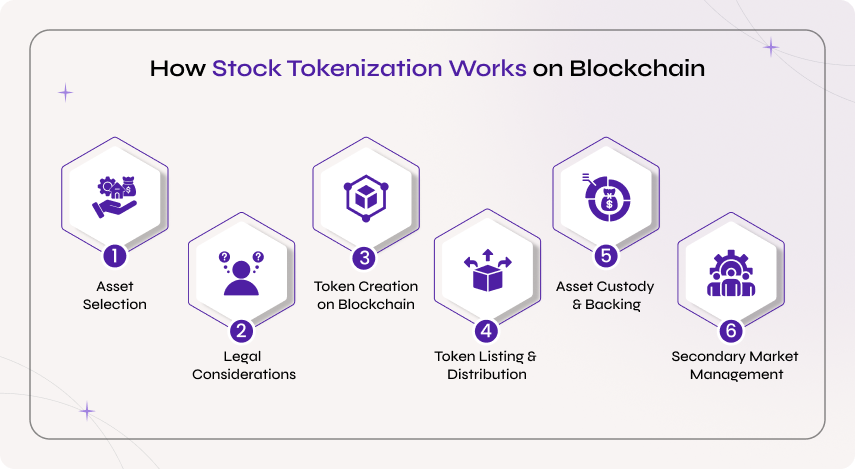
How Stock Tokenization Works on Blockchain
Asset Selection
As an initial step, the asset manager selects a real-world stock to be tokenized.
Once issued, token tokenized equities are listed on a compatible trading platform.
Legal Considerations
The selected stock ensures that each token is structured to align with relevant
security laws, maintaining adherence to financial regulations across various jurisdictions respectively.
Token Creation on Blockchain
Using smart contracts, the digital tokens are now minted on popular blockchain
platforms like Solana, Ethereum, and more to represent the original underlying real-world assets.
Token Listing & Distribution
The tokens will now be listed on the trading platform for public market access.
This enables any user or investor to trade the tokens 24/7 on their own, without any central authorities
or intermediaries.
Asset Custody & Backing
Here, each token containing the actual shares is stored and owned by a licensed
custodian, considering its safety. This also ensures one-to-one backing of the token to improve its
transparency.
Secondary Market Management
Finally, the tokenized stocks will be circulated within the secondary marketplace,
where investors can buy and trade them smoothly with enhanced traceability and efficiency.
How to Build Your Own Stock Tokenization Platform in 2026: Step-by-Step Guide
Building a stock tokenization platform is a structured process that transforms real-world
equities into digital assets. Each step contributes to the well-being and performance metrics of the
platform. Here is the breakdown of the key steps involved in the stock tokenization exchange development
process.
How to Build Your Own Stock Tokenization Platform in 2026: Step-by-Step Guide
Define Business Model
Select Network
Regulatory Bodies
Tokenomics Design
Custody & Asset Backing
Smart Contract Development
Frontend & Platform Layer
Security Audit & Testing
Launch Platform
Step 1: Define Your Business Model
Begin by outlining the types of stocks to be tokenized, target investors, and the business
model, as they are the core factors influencing the overall platform performance. A clearly defined market
scope creates a strong foundation for market requirements and sustainability. Here are some of the major
stocks that can be tokenized.
Individual company’s shares
Exchange-traded funds
Index funds
Bonds (Tokenized fixed income)
Private equity shares
Mutual funds
Treasury securities
Step-2: Select a Suitable Network
The choice of your blockchain affects budget planning, compliance capability, transaction
speed, and cost. Some of the major on-chain networks to take into consideration are:
Ethereum - Best for institutional platforms, EU-regulated tokens
Solana - Best for high trading retail platforms, instant settlements
Polygon - Enterprise-grade exchanges with Ethereum compatibility
Collaborate with blockchain specialists and conduct thorough due diligence on the tokenized
equities, custodians, and jurisdictional sectors to make sure legal authenticity and compliance clarity
within focus markets.
Step-4: Tokenomics Design
Define how each token represents asset ownership, supply protocols, and fractional
distribution of the underlying digital asset by selecting a suitable token standard. This is one of the
crucial technical decisions, as the preferred standard will ensure token compliance, interoperability, and
seamless asset transfers across various exchanges. The most significant token standards include the
following:
ERC-20 (Ethereum standard) - Most widely used and supported fungible token standard for
representing divisible assets such as fractional equities. Not suitable for direct equity ownership
tokens in regulated sectors
ERC-3643 (T-REX) - The only token standard focused on identity-based authentication and
compliant-first security token. Recent reports state that over $32 billion in RWA tokenization is
issued and managed using the ERC-3643 equity token.
ERC-1400 (security token standard) - Often used for US-based equity and bond issuers,
supporting partitioned tokens and complex ecosystems such as senior/junior share classes. Especially
designed for US-regulated offerings, but less portable worldwide than ERC-3643.
Step-5: Custody & Asset Backing
Collaborate with a licensed custodian who holds the underlying equity shares with every
token fully backed by a real-world asset. Each tokenized stock must be backed 1:1 by the underlying asset
held in custody.
Fully-licensed and regulated custodian (Bank/Trust)
Proof of reserves (Asset backing)
Custody agreements (Define rules for edge cases and shutdowns)
Step-6: Smart Contract Development
Build programmable contracts that establish token logic, including governance issuance,
ownership information, transfer data, and license enforcement. These contracts automate the operational
functions, ensuring traceable, tamper-proof, and secure trade execution.
Step 7: Build Frontend & Platform Layer
Develop a full-stack platform using certain frameworks and TaaS
providers that includes an investor portal, dashboard, secondary market support, and compliance
engine. Once done, you can issue the tokens via STOs. It should also include an intuitive frontend
interface with seamless wallet connectivity for trading and asset management.
Step-8: Security Audit & Testing
Conduct comprehensive audits and rigorous testing analysis of smart contracts and
penetration testing to detect vulnerabilities, bugs, or security breaches, and ensure system integrity.
This secures the platform against unnecessary legal shutdowns, exploits, or malfunctions before
deployment.
Step-9: Launch Tokenization platform
Deploy and launch the stock tokenization platform after conducting all the necessary
compliance checks, audits, and system integrations. Once live, issue and manage tokenized security assets
while ensuring smooth user access and transactions.
Step-10: Post-Launch Maintenance
Post-launch process ensures platform maintenance, security upgrades, and performance
enhancements, along with investors’ reporting and verifiable dashboard insights, to maintain platform
trust and stability.
Understanding the Regulatory Framework of Stock Tokenization 2026
Behind every tokenized security is a web of regulatory standards that shape what can be
issued, who can hold it, and how it can be traded. As jurisdictional regulations race to define the rules
of the sector, it is significant to understand the regulatory bodies that participate in the tokenized
stock economy. Here is an elaborated view of how each major market is shaping the next-generation stock
tokenization markets.
Stock Tokenization Regulatory Landscape: What You Need to Know in 2026
Tokenized stocks are governed as traditional financial instruments federally under the
Securities Act of 1933 & the Securities Exchange Act of 1934, with mandatory registration or
exemption, along with strong measures of trading oversight
Every protocol, right from token issuance, custodian control, and trading, must ensure
it follows traditional securities law via the SEC and FINRA-regulated economy
2. United Kingdom
Financial Conduct Authority - FCA
Tokenized stocks fall under the protocol system of the Financial Services and Markets
Act 2000 as regulated financial instruments with strict investor protection and regulations
Issuance and trading must occur through FCA-authorized entities such as regulated
exchanges or MTFs
3. European Union
European Securities and Markets Authority - ESMA(Under MiFID II/MiCA framework)
Stock tokens are generally treated as transferable securities under MiFID II, while
certain crypto-asset service activities may also interact with the MiCA framework, depending on the
token structure
The trading and settlement process must be followed through regulated investment firms,
CSDs, or approved DLT market protocols
4. United Arab Emirates
Virtual Assets Regulatory Authority - VARA
The regulation of digital securities depends on their underlying structure, such as SPV
or security token, falling under virtual asset and securities-linked licensing regimes.
Trading and token issuance require licensing via VARA or ADGM/DIFC financial regulators,
with stringent custody controls.
5. Hong Kong
Securities and Futures Commission - SFC
Digitalized equities are classified as financial protocols under the Securities &
Futures Ordinance. Also, SFC requires complete licensing for token issuance and trading.
Stock tokenization platforms must comply with custody, disclosure, and regulated asset
trading system requirements.
6. Singapore
Monetary Authority of Singapore - MAS
Security tokens are governed as capital market instruments under the Securities &
Futures Act, with strict license verification for token issuance and access
Every custody and trade must align with MAS-licensed intermediaries or market operator
permission
Cost to Build Your Own Stock Tokenization Platform
Before we begin with developing a stock tokenization platform, it is crucial to understand
the cost details and plan the budget before execution. The overall budget depends on factors such as the
platform model chosen, whether white-label or a customized MVP model, as well as the necessary features
and technical structure.
To help you with ideal budget planning, here is a detailed picture of the pricing breakdown
based on the business scale and core components.
Core Component
Purpose
Estimated Budget Range
Legal & Compliance Setup
Company licensing, securities & legal documentation
$15,000 - $80,000
Smart Contract Architecture
Coding regulated token standards with transfer restrictions
$8,000 - $40,000
Platform Development
Web platform, matching order engine & investor panel
$25,000 - $120,000
Frontend Interface
Intuitive trading experience for the users
$3,000 - $15,000
KYC Check
Detect vulnerabilities early
$5,000 - $20,000
Wallet Integration
Access to crypto wallet connectivity & custody
$3,000 - $12,000
Liquidity & Trading Engine
Order matching & token trading
$10,000 - $50,000
Security Audits
Smart contract & platform security testing
$8,000 - $40,000
Cloud Infrastructure
Depends on jurisdiction & securities
$500 - $5,000 (per month)
Maintenance & Support
Updates, bug fixes, and technical support
15-25% of the development cost yearly
Key Note Development cost varies depending on the
type of platform, according to the business needs.
Custody Models Used for Stock Tokenization
Custodian models are central in tokenized equity systems. Take a quick glance at the
comparison table below of custody models used for tokenizing stocks.
Custody Model
Description
Scalability
Compliance
Risk Level
Real-world usage
Direct Custody Model
Regulated custodians, such as banks, hold real shares in 1:1 backing tokens
Medium
Very high
Low
Used in regulated tokenized stock exchanges
Broker-Dealer Model
A licensed broker holds equity shares and maps them to tokens
Medium-High
High
Low-Medium
Used in brokerage-linked token systems
SPV Model
SPV legally owns shares and issues tokens
High
Medium-High
Medium
Used in cross-border token offerings
Third-Party Custody
An independent custodian holds underlying stocks safely
High
High
Low
Used in institutional tokenization setups
On-Chain Trust Model
Trust holds shares; tokens represent ownership rights
Medium-High
Very High
Low
Used in compliant blockchain investment products
Traditional Stocks vs Tokenized Stocks
Features
Traditional Stocks
Tokenized Stocks
Structure
Paper or electronic shares of the asset
Digital tokens of an asset on a blockchain
Ownership Record
Verified and maintained by centralized authorities
Maintained by a decentralized blockchain ledger
Trading Hours
High reliance on the trading hours, with certain limitations
Tokenized stocks provide 24/7 trading opportunities worldwide
Settlement Time
These stocks take a minimum of T+2 or more days for settlement
It offers instantaneous settlements
Liquidity
Depends on the stock exchange hours and is limited
It potentially offers higher liquidity and is available 24/7 globally
Fractional Ownership
Stocks can be traded only as complete shares
Stocks can be easily divided into small fractions
Transparency
Traditional stocks are less transparent and controlled by central authorities
Tokenized stocks provide auditability and verifiable asset ownership
Fee Structure
They offer higher fees due to intermediaries, brokers, and central authorities
They come at minimal cost with their smart contract integration & peer-to-peer support
Security
It is highly vulnerable to theft, cyberattacks, and fraud
It is secured via blockchain consensus mechanisms & smart contracts
Regulatory Compliance
It is regulated by traditional financial authorities
It comes with both security laws and blockchain regulations
Key Features of Tokenized Stocks
Fractional Ownership
Tokenized stocks are divided into small fractional units, making them easier and
more accessible for every user. This allows investors to own a partial ownership of the high-value shares
at an affordable price.
Around-the-Clock Trading
In contrast with the traditional stocks that come with limited time,
blockchain-based tokenized stocks are available 24/7 in the market. This enables investors to trade stocks
with greater flexibility.
Cost-Effective
Investors who look to maximize returns and minimize their costs can prefer this,
as the digitized stocks eliminate the need for central authorities, and companies can save money in huge
amounts.
Increased Liquidity
Tokenization allows users to have fractional ownership of the stocks by enabling
liquidity for traditionally illiquid or restricted assets. This creates fresh market opportunities with
broader investor participation.
Global Accessibility
Using the blockchain networks, the tokenized stocks can be purchased and traded
globally by reducing the regulatory barriers and geo-restrictions. This expands the potential investor
base by making assets more accessible to a wider audience.
Instant Settlement
The transactions are settled instantly through blockchain infrastructure,
eliminating standard T+2 days delays. This ensures the platform has minimal counterparty risks, thereby
increasing investor confidence.
Transparency & Security
All transactions are recorded on a public blockchain by providing an immutable
and verifiable trail of ownership and trade history. This ensures high transparency and enhances trust
among asset investors, and reduces fraud risks.
Faster Fundraising
Unlike traditional fundraising methods, tokenized stocks enable companies or
enterprises to raise funds more quickly to reach a wide range of investors worldwide. This is driven by
increased liquidity, fractional ownership, and blockchain-based processes.
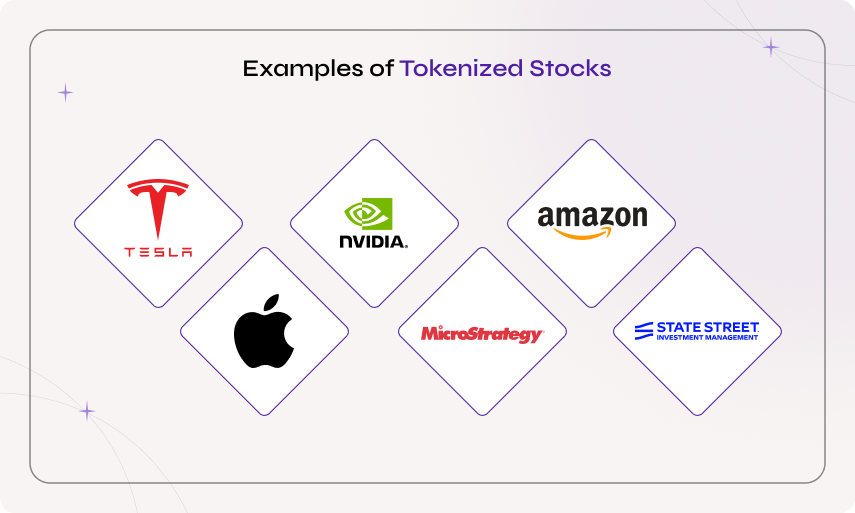
Notable Examples of Tokenized Stocks 2026
The tokenized stocks are transforming the investment landscape by blending traditional
equity with blockchain technology. However, below are some of the popular and best examples of tokenized
stocks in this ever-growing market.
Tesla Token (TSLA)
Tesla token is created using blockchain technology and is referred to as TSLA. It denotes
the tokenized version of Tesla stock.
Here, each TSLA token is represented by a digital asset, which is backed by a 1:1 ratio of
the real Tesla shares.
Some of the popular platforms that support Tesla tokenized stocks are FTX, Swarm Markets,
Binance, and some DeFi platforms.
Apple Share Token (AAPL)
The Apple Share Token (AAPL) allows investors to own a piece of the most valuable company
in the world.
It mirrors Apple’s real-time market price and offers exposure to its price fluctuations.
However, the AAPL is backed by a 1:1 ratio of the actual Apple company shares held in
custody by a licensed third party.
NVIDIA (NVDA)
NVIDIA’s tokenized stock leverages blockchain-based tokens and allows investors to gain
exposure to the company’s market performance.
This tokenized version of NVDA stock uses FTX and allows users to gain a fractional part
of the stock.
Each token is collateralized 1:1 by real NVDA shares held in a regulated reserve, enabling
fractional ownership rights with 24/7 trading accessibility.
MicroStrategy (MSTR)
Gemini has launched a tokenized version of MicroStrategy’s stock, making it accessible on
its platform.
The MSTR stock has become popular in this field due to its significant holdings of
Bitcoin.
This allows users in regions like the European Union to gain exposure to both Bitcoin and
MicroStrategy's stock through a single, on-chain platform.
Amazon (AMZN)
Amazon is one of the largest e-commerce companies, which uses a popular digital token
called AMZN, representing the Amazon stock.
Popular platforms like Binance, Fusang, DeFiChain, and FTX offer AMZN tokenization.
These tokenized shares are often known as xStocks, which are backed by the original shares
and can be traded 24/7 outside the traditional markets.
SPDR S&P 500 ETF (SPY)
It is a type of blockchain-based asset that represents the ownership of trusted shares of
the SPDR S&P 500 ETF.
This is one of the most actively traded exchanges worldwide, serving as a highly liquid
ETF that reflects the performance of the S&P 500 index.
This SPY tokenized asset is basically issued on blockchain platforms like BNB Chain,
Ethereum, or other smart contract platforms.
Redflags & Challenges of Stock Tokenization
As there is a significant rise in stock tokenization, establishing a new era of digital
ownership comes with several legal and technological regulations that businesses must carefully navigate
before their market entry. Explore the red flags and potential risks involved in tokenized stocks.
Red Flag-1: Legal Challenges
The regulatory laws vary by country and are still developing in the Web3 space. Businesses
must adhere to rising legal frameworks for investor protection and asset regulatory protocol systems to
avoid legal and operational risks involved in the stock tokenization.
Red Flag-2: Smart Contract Issues
Digitized tokens depend on the programmable contracts to enable dividends and trading
protocol systems. If these codes of contracts contain hidden system flaws or programming bugs, malicious
actors can easily tamper with them, leading to great financial losses in the market.
Red Flag-3: Liquidity & Fragmentation
While tokenization aims to increase liquidity, the current market is highly fragmented
across different private blockchains and trading platforms. If a token is only tradeable on a niche,
isolated exchange, it can result in low trading volumes and difficulty buying or selling an asset at a
fair price.
Red Flag-4: Asset Custody Risks
The tokenized assets heavily rely on institutional custody protocols, which are still
developing within the Web3 ecosystem for protection. Loss of private crypto keys, custodian failure, or a
hack attack can create significant risks for reclaiming the ownership rights of the digital asset.
Red Flag-5: Technological Standards
Since stock tokenization relies heavily on blockchain infrastructure, it remains exposed to
hacking risks, technical malfunctions, and coding vulnerabilities. Any technical failure in the network
infrastructure or trade execution can interrupt the operational system, which in turn affects the market
credibility and undermines investor confidence.
Stock Tokenization: Major Use Cases Worldwide
Stock tokenization is revolutionizing stock ownership by reshaping traditional capital
markets by introducing more efficient, traceable, and inclusive global investment opportunities. Explore
the real-world applications driving this transformation across various industries.
Real Estate
Property developers can tokenize the shares of residential or commercial projects, allowing
investors to buy fractional equity of ownership with increased liquidity and reduced barriers to entry.
Real estate tokenization allows investors to purchase a small portion of large-scale projects with lower
capital investments.
Financial Services
Stock tokenization modernizes financial services by enabling fractional ownership, automated
compliance, and faster settlement via smart contracts. Banks, asset managers, and private equity firms are
increasingly leveraging private equity tokenization to access digital equity assets with fewer
intermediaries, greater operational efficiency, and enhanced transparency.
Art and Collectibles
Art and collectibles are fractionalized using an art tokenization system to enable easy
investor access to a premium collection of assets. This fractionalization through digital equity shares
improves liquidity and ensures transparent ownership of records, attracting global investors towards it.
Energy & Infrastructure
Energy
tokenization services enable global investors to take part in large-scale infrastructure and
renewable energy projects with minimal investment barriers. This allows companies to raise high capital by
offering fractional equities in specific project entities.
Healthcare
Healthcare companies tokenize equity to fund research, medical innovations, and clinical trials with
transparent tracking of investment usage. Blockchain-based equity systems attract a wider investor base
and maintain a transparent record of equity distribution.
Conclusion
Stock tokenization is a transformative process that leverages a blockchain system to convert
traditional equity shares into digital tokens. By bridging standard financial markets with a blockchain
unit, it completely reshapes the way investors interact and manage tokenized equity assets. This
innovative method enhances the overall accessibility, transparency, and efficiency of the real-world
assets. Now, with a solid understanding of what stock tokenization is and its functional mechanisms, you
can start exploring its potential to redefine ownership rights and shape the future of the global
financial system.
Frequently Asked Questions About Stock Tokenization
Stock tokenization is surging in popularity because it opens up a 24-hour global
trading system and fractional ownership, allowing any individual user to buy fractions of
high-value shares instantly. It has replaced the traditional settlement process with an automation
system, eliminating intermediaries while improving transaction speed, transparency, and building
cost.
One of the standard on-chain networks for stock tokenization is Ethereum, which is
popular for its mature automated contract framework, sophisticated security protocol, and
extensive support for major token standards. However, businesses seeking cost-efficient and
optimized networks can prefer blockchains like Polygon and Solana.
Smart contracts in stock tokenization are self-executing blockchain programs that
execute compliance, identity verification, and dividend payouts without any intermediaries
involved. They permanently lock the terms of the stock token on the network, automatically
preventing restricted or non-verified users from trading.
Blockchain serves as the core layer in tokenizing stocks, as it enables seamless
token issuance, data transfer, and management of digitized assets. As it is a decentralized
system, every process is verifiable, traceable, and trustless in nature.
Tokenized equities are fragmented into tradeable units, allowing investors to buy a
small part of a share, making investments more affordable. This makes premium stocks available to
anyone, regardless of capital.
Get all the latest posts delivered straight to your inbox.
Get In Touch
Our expert team is professionally well-equipped with hands-on experience as a blockchain
development company. Connect with us; at BlockchainX, we curate your desired sustainable solution!