RWA Tokenization in Europe 2026: What You Need to Know
Listen to the Audio :
Today’s financial ecosystem is evolving rapidly than ever before, and this is becoming one of the biggest changes in the rise of real-world asset tokenization. It is clear that RWA tokenization in Europe is becoming mainstream and is expected to be one of the fastest-growing segments in finance.
According to the crypto report, the RWA market has risen from $5 billion in 2022 to about $24 billion by June 2025, and would reach a market place of $2 trillion by 2030. Most of the experts have confirmed that RWA tokenization will move from an emerging trend to a major part of global finance by the end of 2026, and this is possibly going to happen in Europe on its full swing.
Europe's main strategy is to lead RWA tokenization through a well-structured regulation and compliance-first approach. So, let's get to know the evolving landscape of tokenization and identify the significant opportunities within Europe's regulated digital asset ecosystem.
MiCA: European Digital Asset Landscape
Entering Europe’s digital asset market is not just about the technology and innovation. It’s about navigating through a complex set of regulatory environment. In that way, the European digital landscape is growing rapidly and is designed with comprehensive regulatory frameworks to provide legal clarity and protect investors from illegal activities.
Here, MiCA (Markets in Crypto-Assets) regulation is a unified, regulated environment, designed especially for handling digital assets like stablecoins and crypto assets. This legal framework came into existence in June 2023, boosting institutional confidence and providing legal assurance for both service providers and issuers.
MiCA is termed the cornerstone of the European Union, with its ability to create a single set of rules for digital assets. With standardized licensing and transparent operational requirements, MiCA continues to stand as the most secure and innovative environment for digital assets with greater confidence among users.
It ensures that the crypto platforms functioning in Europe follow strict rules for fund protection, user safety, and business transparency, providing clear risk factors and fair pricing for every user. This framework protects users' assets from misuse and empowers users with great trust across the European market.
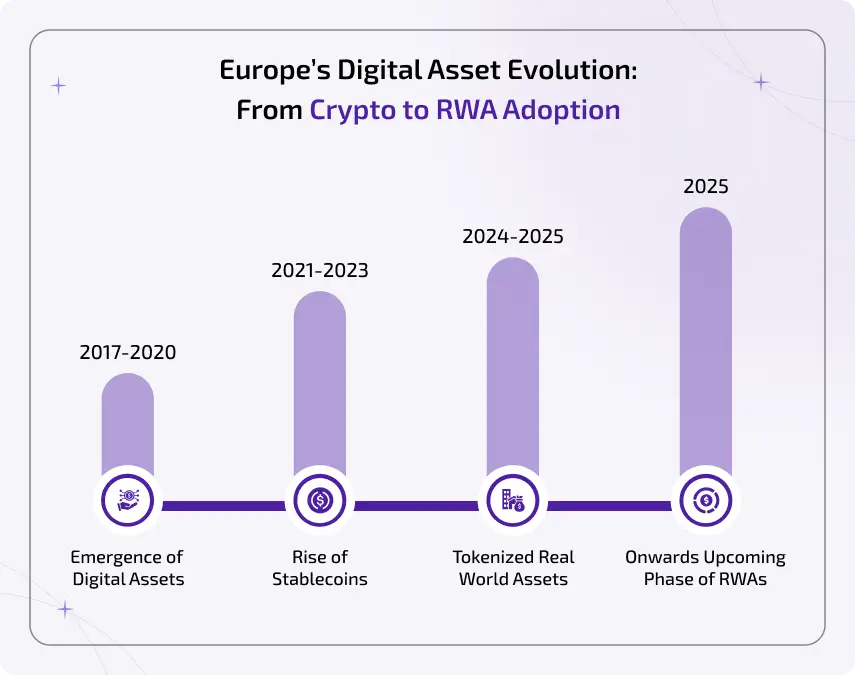
Europe’s Digital Asset Evolution: From Crypto to RWA Adoption
Europe’s digital asset market has undergone a massive transformation over the years from ideal crypto trading to a structured and regulated real-world digital asset ecosystem. With its rapid growth of a utility-focused ecosystem, Europe's shift increases institutional participation in tokenization platforms and demands for asset-backed digital products.
Let's get into the section below to get a clear idea about Europe's RWA transition.
2017-2020: The Emergence of Speculative Digital Assets
The initial stage of Europe’s digital asset evolution was dominated by the hype of cryptocurrency investments. The market was driven by ICOs, leading to market volatility with frequent project failures. Since the regulatory clarity was not sufficient, RWA was adopted by early European users and traders, instead of institutional investors.
2021-2023: The Rise of Stablecoins & Regulatory Compliance
Over the years, with global attention, Europe has started to expand its regulatory frameworks to enhance investor protection and stablecoin adoption. Here came the MiCA regulation, which started to shape the digital asset environment securely with fewer risks. During this period, stablecoins became a widely used and safe digital payment among investors.
2024-2025: The Breakout Phase of Tokenized Real World Assets
Finally, with strong regulatory frameworks, Europe has entirely shifted from crypto to tokenized real-world assets. This paved the way to create a more utility-focused digital economy with enhanced transparency, stability, and fractional ownership.
Retail and institutional investors were widely attracted towards the platform, and thus, Europe’s regulatory structure was positioned as a global hub for RWA.
2025 & Onwards: Upcoming Phase of RWAs
This period was represented as the transition of the European digital asset landscape from crypto to RWA adoption. As mentioned earlier, the tokenized assets will hit a net worth of trillions by 2030, transforming the illiquid assets into tradeable digital tokens.
Explore RWA Tokenization Solutions for Europe | Connect Now
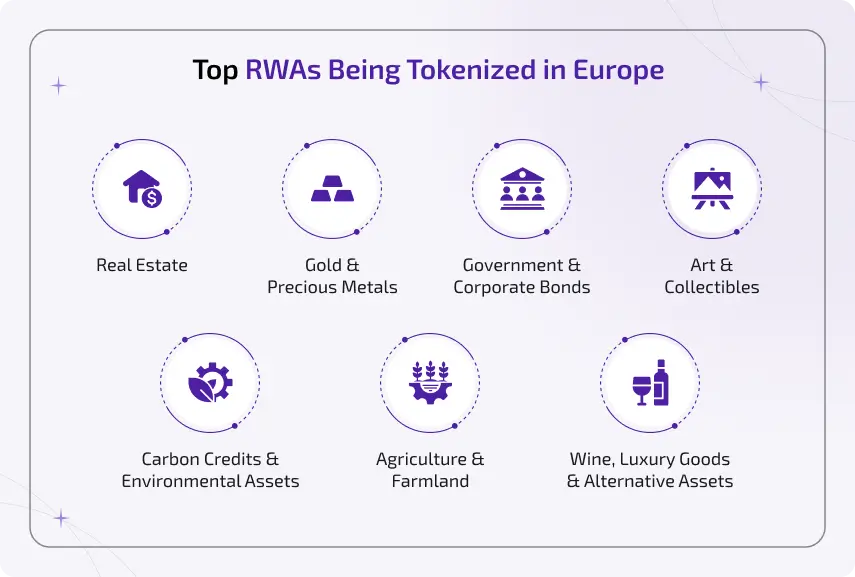
Top RWAs Being Tokenized in Europe
Europe’s tokenization ecosystem is rapidly expanding by converting high-value, traditionally illiquid assets into blockchain-based digital tokens. This includes real estate, commodities, invoices, and bonds. Beyond these tangible assets, tokenization is also applied to intangible assets like royalties, equity shares, and IPs.
This process represents the off-chain assets as digital tokens on a blockchain platform, with increased accessibility, transparency, and liquidity, enabling fractional ownership across multiple asset classes. However, below is a list of popular assets that Europe tokenizes under its regulatory framework.
Real Estate
Tokenized real estate in Europe includes apartments, commercial buildings, and rental properties. Investors can buy fractional shares of the original real-world properties, earn proportional rent, and trade their stakes more easily with low barrier entries.
Gold & Precious Metals
Physical gold and precious metals stored in European vaults are tokenized into digital tradeable units under RWA tokenization. This enables small investors to access fractions of valuable metals and trade them seamlessly without handling physical assets.
Government & Corporate Bonds
Traditional debt instruments such as sovereign bonds and corporate debts are converted into blockchain-powered tokens. This streamlines settlement and secondary trading, and makes high-quality products more accessible to retail and global investors.
Art & Collectibles
High-value artworks and rare items are fractionalized through RWA tokenization, allowing investors to purchase small shares of expensive assets. This opens access to exclusive markets and supports high transparency, tamper-proof blockchain records.
Carbon Credits & Environmental Assets
Tokenization is used to digitize carbon credits, renewable-energy credits, and other sustainability assets. This opens new ways for enhanced transparency and minimizes fraud risks, creating smoother trading for every business that meets ESG goals.
Agriculture/Farmland
Farmlands, yields, and agricultural rights are tokenized to provide great exposure for investors in the agricultural economy. This supports farmers with alternative finance, allowing fractional ownership, and increased liquidity in rural markets.
Wine, Luxury Goods & Alternative Assets
Tokenization enables fractional ownership of fine wines, luxury fashion, and other high-value collectibles. Investors can own fractions of valuable items, track authenticity, and trade these assets without needing custody or storage.
How RWA Tokenization Works in Europe?
RWA (real-world asset) tokenization, with its simple concept, converts traditional assets into tradeable digital tokens on a blockchain platform. Like other countries, Europe also follows legal structuring, asset verification, and compliance token creation, while complying with European regulations like Markets in Crypto-Assets (MiCA). Let’s get into the section below to learn how real-world asset tokenization in Europe works.
Asset Selection & Legal Structuring
The process begins by choosing a real-world asset like a bond, commodity, real estate, art, etc, that follows MiCA regulations and other security laws of Europe. Since each RWA comes with unique qualifications, it is important to choose them wisely.
Asset Valuation
Now, the assets will be checked under the EU's strict regulatory frameworks for confirming originality and ownership. Since every jurisdiction comes with different rules, this step is crucial to avoid legal risks at the earliest.
Smart Contracts & Token Creation
Once the assets are legally structured, they will be transformed into digital tokens on a reliable blockchain platform, and the smart contracts will be created to automate payouts and ownership transfers, eliminating the need for third parties.
Compliance & Investors Access Control
Now, Europe enforces strict investor protection to ensure only eligible investors can trade and hold the asset. To make this happen, identity checks and popular regulatory compliances are done on the real-world assets, before making it live to the market.
Secondary Market Trading
Finally, the assets can be traded instantly on blockchain platforms and can be integrated into DeFi protocols for wider accessibility. The eligible and approved investors can trade the assets and make them legally compliant and secure.
Key Benefits of RWA Tokenization for European Markets
RWA tokenization, with its innovative approach and inclusive technologies, stands as an efficient platform in the European market, serving several institutional investors and global markets with valuable benefits. This financial ecosystem empowers to reshaping of Europe’s landscape with wide investment opportunities.
Discover how you can be part of this evolution and take your next step towards the digital asset economy.
Easy Investment Across the EU
Tokenization enables investors to seamlessly access and invest in the assets across all EU countries without complicated cross-border restrictions. This removes geographical and administrative barriers, making the European landscape more open and accessible for global participants.
Digital Euro Integration
The arrival of the Digital Euro has enabled the tokenized assets to settle instantly within a unified European digital currency. This automates the on-chain payments with minimal payment delays and enhanced liquidity across the European landscape with regulated financial frameworks.
Increased Efficiency for Regulated Markets
RWA tokenization streamlines issuance and enables the European market to simplify settlements in the heavily regulated financial ecosystem. With automated workflows, better accuracy and lower operational cost, tokenization improves the overall efficiency, ensuring compliance with the EU’s strict financial standards.
Faster Settlements
Tokenization in Europe is compatible with T+1 settlement days, with a high market competitiveness, reduced operational risks, and improved liquidity. This instant settlement significantly boosts investors, banks, and businesses to operate more agile financial operations across EU markets.
Strong Regulatory Alignments
With strong regulatory frameworks like MiCA and AMLD, RWA tokenization in the EU is developed clearly, with a solid foundation. This creates a safe, broader environment for tokenized assets and prevents them from any misuse, supporting long-term stability in the EU’s digital asset ecosystem.
Legal Risks & Operational Challenges with RWA Tokenization in Europe
Despite its significant benefits and rapid growth, tokenization of real-world assets in Europe involves various legal risks and challenges within a strict regulatory environment. Most of the tokenization projects face unclear laws, but their legal design and infrastructure enable them to remain standard across jurisdictions. While tokenization promises greater liquidity, businesses must navigate through the evolving rules and go through cross-border legal variations to build a secure, scalable, and regulatory-rich tokenization platform. Below are some of the real risks and challenges associated with RWA tokenization in Europe.
Since the national property rules differ across multiple EU jurisdictions, the token's title and property are unclear.
The RWA token’s tax treatment is often unclear, which leads to complex issues and requires careful planning.
Accurate asset valuation and continuous pricing are crucial for fair trading and preventing market manipulation.
Regulatory fragmentation across EU states is done with legal uncertainty for token issuance.
Different Value-Added Tax (VAT) & capital gains across jurisdictions can create double taxation.
Reliance on oracles to reflect off-chain facts can be risky because a single point of failure can cause wrong information to appear on-chain.
Rigorous audits and clear upgradeability are needed to eliminate bugs and logic flaws, which can lead to online hacks.
Legacy systems are integrated with existing registrars, banks, and corporate record systems for legal clarity.
The Future of RWA Tokenization in Europe
The future of RWA tokenization in Europe is set for strong growth as the region moves toward a more regulated, efficient, and accessible financial ecosystem.
With increasing institutional demand, clearer regulatory frameworks, and advances in blockchain infrastructure, tokenization is assured to unlock liquidity across traditionally illiquid assets such as real estate, bonds, carbon credits, and alternative assets.
Europe’s mature capital markets and compliance-driven environment give a unique advantage in securing and programming financial products. In the future, we can expect broader adoption of tokenized bonds and regulated digital landscapes, supported by robust cross-border standards.
As legality widens and interoperability increases accordingly, tokenized assets will integrate seamlessly into major platforms, making Europe one of the leading global hubs for real-world asset tokenization.
How BlockchainX Helps Businesses Launch RWA Tokenization Platforms
BlockchainX empowers businesses to smoothly launch RWA tokenization platforms by offering comprehensive end-to-end customizable platforms and blockchain development tools. Our solutions help companies to digitize their tangible real-world assets like art, commodities, real estate, and more into blockchain-powered tradable digital tokens.
We play a crucial role in simplifying the tokenization journey using our strategic planning, innovation, and continuous support. However, our expert professionals are ready to build a scalable platform that supports diverse assets and helps businesses to confidently enter the RWA ecosystem.
BlockchainX uses modern token standards to verify that the asset-backed tokens are easily auditable and tradeable.
By fractionalizing the real-world assets, we increase asset participation enabling a wide range of investors to take part in tokenization.
We ensure a safe and transparent record of ownership with advanced blockchain technologies for your real-world assets.
BlockchainX removes intermediaries and traditional boundaries and connects the real-world assets with the global marketplace.
Our experts ensure that every tokenized platform complies with robust regulatory standards to undergo a smooth trading process.
Europe’s tokenization of real-world assets in 2025 is not just a tech experiment, but a valuable platform and tool that causes a major transformation in its capital markets and investment access. It reshapes the financial landscape by bridging traditional assets with modern digital infrastructure.
With its mature regulations and blockchain-backed models, Europe is becoming a leading hub for transparent & efficient asset digitization. Across Europe, the one question right now is how to build a strong regulatory foundation with MiCA, paving the way for a large-scale, compliant tokenization.
Our RWA tokenization services can revolutionize investment, ownership, and asset management across various industries like real estate, healthcare, and finance, witnessing their transformative effects.
If you are ready to build a secure and scalable RWA tokenization platform, or are willing to learn more about tokenization in Europe, partner with our professionals at BlockchainX and gain it.
Get all the latest posts delivered straight to your inbox.
Get In Touch
Our expert team is professionally well-equipped with hands-on experience as a blockchain development company. Connect with us; at BlockchainX, we curate your desired sustainable solution!