Build a Legal & Regulatory-Compliant RWA Platform 2026
Listen to the Audio :
Imagine owning a portion of a luxury home, a government bond, or a gold reserve on the blockchain in a secure, transparent, and legal manner. What used to be futuristic is now happening. Real-World Asset (RWA) tokenization is transforming finance, unlocking trillions of dollars in assets that were once locked up in paperwork and illiquid markets. Predictions show that by 2030, at least $16 trillion in real-world assets will be tokenized, with over $20 billion already tokenized.
Businesses and organizations are rushing to get assets on-chain, from real estate to commodities and private credit. But here's the truth: innovation without compliance fails. Legal and regulatory-compliant RWA tokenization platform development is now necessary for long-term growth, market access, and investor trust. In this blog, we discuss how to create an RWA platform that connects blockchain and traditional finance while being safe, compliant, and future-ready.
What is Legal & Regulatory-Compliant in the RWA Platform?
A digital system known as a Legal & Regulatory-Compliant RWA (Real-World Asset) Platform tokenize real-world assets, such as bonds, real estate, commodities, or invoicing, while strictly complying with financial and legal laws. Unlike cryptocurrency, RWAs represent the actual ownership of tangible or financial assets; compliance is important for both investors and enterprises.
Multiple layers are involved in compliance:
Financial Regulations - Ensure that tokenized assets comply with local and international investment laws. For instance, tokenizing a government bond must adhere to the country's securities laws.
KYC & AML Policies - Verifying the identities of investors and preventing illicit activity like fraud and money laundering .
Investor Protection Rules - Protecting returns, ownership rights, and the proper transfer of assets. For example, ownership of fractional real estate needs to be legally documented .
Audit & Reporting Standards - Delivering complete transparency to regulators and investors through proper paperwork, reporting, and smart contract verification.
An legal RWA tokenization platform compliance builds trust, lowers legal risk, and facilitates smooth participation for international investors. Compliance ensures that your platform functions safely and sustainably in the digital finance ecosystem, whether it is tokenizing a gold reserve, commercial property, or private credit.
Why Regulation Matters in Real-World Asset Tokenization
Real-world asset (RWA) tokenization brings physical and financial assets on the blockchain, including real estate, bonds, commodities, and private credit. Although this innovation opens up global access and liquidity, it also brings with it financial and legal constraints. For this reason, RWA tokenization requires regulation.
In contrast to cryptocurrencies, RWAs stand for real investor rights, ownership, and value. Poor regulation may lead to issues like fraud, unclear ownership, and financial mismanagement. These are the key reasons that regulation is required.
Key Reasons Why Regulation Is Neccessary for RWA
Investor Protection
The underlying asset must have enforceable legal rights for token holders, such as ownership, dividends, or redemption. Without regulation, tokens have no real support, which could result in fraud, disputes, or claims that are worthless if the issuer fails.
Regulations demand clear disclosures, verification of reserves, and recourse processes ensuring that investors know risks, values, and exit options . Unregulated setups frequently suffer irrevocable losses due to frauds, poor management, or hackers .
Preventing Fraud, Money Laundering & Illicit Use
Blockchain's global reach and anonymity make RWAs appealing for laundering funds or evading sanctions. Sanctions screening, transaction monitoring, and strict KYC/AML (Know Your Customer/Anti-Money Laundering) regulations are essential . By reporting suspicious activity and blocking noncompliant users, regulated platforms lower the systemic risks that could cause market instability .
Legal Enforceability and Ownership Clarity
Tokens must use legal entities (such as SPVs, trusts, or custodians) to link to verifiable off-chain assets . Regulation connects blockchain immutability to traditional property/securities law by ensuring that courts recognize on-chain transfers as legitimate ownership changes. Without this, tokens can be challenged as invalid, resulting in irreversible loss (for example, forgotten private keys or disputed title ).
Market Integrity and Liquidity
Low liquidity, manipulation, and opaque pricing afflict unregulated markets . Regulations facilitate compliant secondary trading, consistent disclosures, and institutional participation, resulting in deeper markets. Due to regulatory complexity, most current RWAs emphasize "buy-and-hold," although sandboxes and frameworks allow real 24/7 trading.
Systemic Stability and Institutional Adoption
Banks and funds, among other institutions, require audited and licensed platforms to protect their reputations and legal concerns. The main catalyst of trillions in potential inflows is regulatory clarity. Unregulated projects run the risk of shutdowns, enforcement measures, or asset freezing—all of which have been seen in past cryptocurrency failures.
Tax and Reporting Compliance
Tokenized assets are subject to TDS, withholding taxes, and capital gains . Platforms under regulation manage proper reporting, avoiding penalties for evasion.
Risks of Skipping or Ignoring Regulation
Enforcement Actions and Shutdowns - Platforms face fines, asset freezes, or bans (for example, unregistered securities offers) .
Investor Losses - Smart contract faults, custodial failures, or fraudulent issuers can all result in investor losses .
Legal Disputes - Lawsuits or false claims result from tokens lacking enforceable rights .
Limited Scale - Liquidity remains trapped and there is no institutional money without compliance.
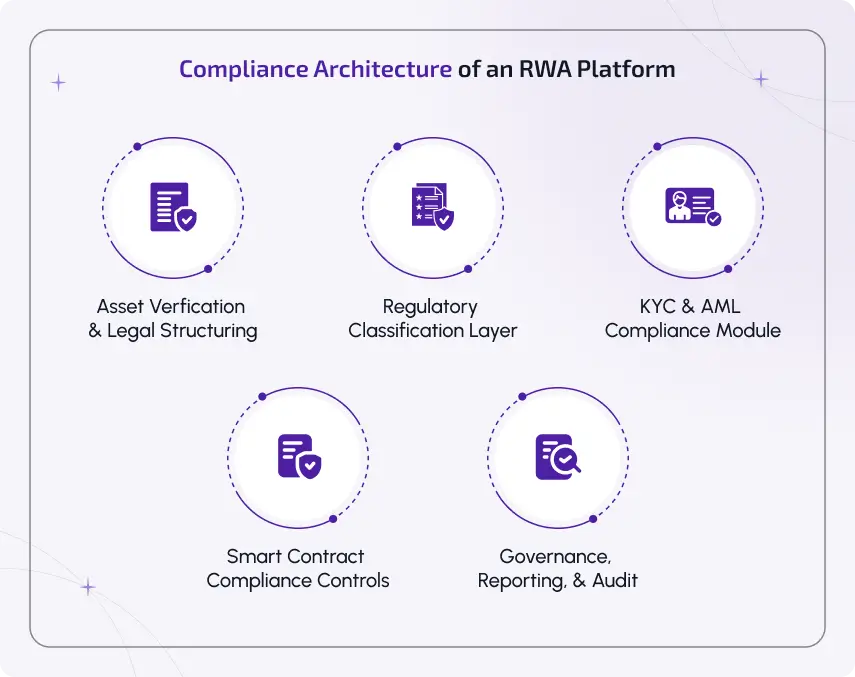
Compliance Architecture of an RWA Platform
A compliant real world asset tokenization outlines how operational, legal, and regulatory requirements are integrated into the system architecture. Compliance must be built into the platform from the beginning rather than added later as RWAs represent real ownership and financial value.
1. Asset Verification & Legal Structuring
Assets go through legal due diligence to verify ownership, valuation, and regulatory eligibility before tokenization. Special purpose vehicles (SPVs) or legal companies are often used to hold assets and legally connect them to digital tokens.
2. Regulatory Classification Layer
This layer specifies whether an asset token is categorized by local regulations as a utility, commodity, or security. It ensures that the platform complies with jurisdiction-specific laws and restricts access as necessary .
3. KYC & AML Compliance Module
Identity verification, risk assessment, and transaction monitoring are all part of user onboarding. This module prevents illegal participation, fraud and money laundering.
4. Smart Contract Compliance Controls
Before any transaction is carried out, smart contracts enforce regulations including ownership limitations, transfer restrictions, lock-in times and compliance checks.
5. Governance, Reporting, and Audit
Regulators and stakeholders can monitor the platform's transparent records, regulatory reporting and audit trails .
How Does a Regulation Work in RWA Platform?
A regulated RWA tokenization platform ensure that tokenized assets, users, and transactions adhere to financial and legal regulations. Regulatory controls are integrated throughout the platform lifespan to provide transparency, investor protection, and legal enforcement since RWAs represent true ownership and value.
Asset Approval & Legal Validation
Before tokenization, each asset is legally verified to ensure ownership, valuation reliability, and regulatory validity . The asset can be tokenized legally through legal frameworks, paperwork, and compliance audits. Only approved assets that match legal requirements are listed and made available to investors.
Investor Onboarding & Compliance Checks
Before using the platform, each user must finish the KYC and AML verification process . The process verifies the identification, eligibility, and risk profile of investors. It ensures adherence to regional and international financial regulations while helping in the prevention of fraud, money laundering, and unauthorized involvement.
Regulatory Controls in Smart Contracts
Regulations like ownership limitations, transfer restrictions, lock-in periods, and jurisdiction-based access controls are all built into smart contracts. By ensuring that every transaction conforms with relevant laws before execution, these automated checks lower the risks connected to manual intervention and compliance .
Ongoing Monitoring and Reporting
The platform keeps an eye on user activity and transactions to identify suspicious activities . To comply with regulatory standards, audit trails and compliance reports are generated automatically. This ensures accountability, transparency, and real-time supervision for platform stakeholders, auditors, and regulators .
Updates & Governance
Governance mechanisms make ensuring the platform adjusts to changing regulatory needs. Compliance standards, smart contracts, and operational policies are regularly updated to match new regulations, assuring long-term legal alignment, platform stability, and investor trust .
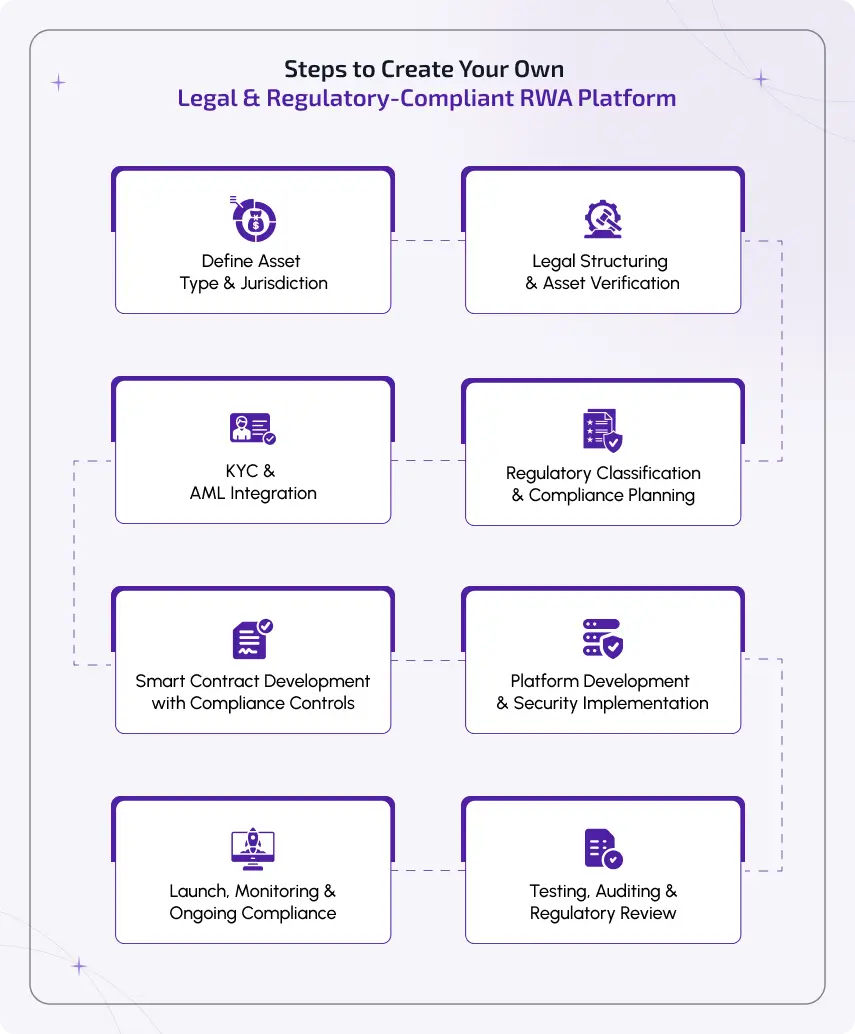
9 Simple Steps to Build Your Own Legal & Regulatory-Compliant RWA Platform
A rigorous balancing act between blockchain innovation and financial regulation is necessary to create a legal & regulatory-compliant RWA platform. Every step must comply to legal standards since real-world assets require verified ownership and investor rights. The steps that follow show how to build a scalable, secure, and compliant RWA platform .
Step 1- Define Asset Type & Jurisdiction
Choose the tangible assets you wish to tokenize first, such as bonds, real estate, commodities, or private credit. Choose the jurisdictions in which your platform will function as national regulations differ. Early clarity helps prevent later license problems and compliance disputes .
Key Considerations
Eligibility for asset classes
Target areas and markets
Local financial laws
Licensing specifications
Step 2 - Legal Structuring & Asset Verification
Ensure that assets are legally owned, valued and suitable for tokenization. Assets are frequently placed under legal companies or SPVs to provide a legally binding connection between actual ownership and digital tokens. For legal enforceability, proper documentation is essential .
Determine which financial laws apply to tokenized assets, such as securities, commodities, or investment products. This classification serves as the basis of your compliance approach by defining investor eligibility, disclosure requirements, and trading limits .
Key Considerations
Security vs utility classification.
Rules for investor accreditation
Disclosure obligations
Tax and reporting requirements
Step 4 - KYC and AML Integration
Build thorough KYC and AML processes to confirm investor identities and track transactions. This helps prevent fraud, money laundering, and illicit activities while adhering to international financial standards and ensures that only compliant users can access the platform .
Key Considerations
Identity verification tools
Risk-scoring systems
Monitoring transactions
Reporting requirements
Step 5 - Smart Contract Development with Compliance Controls
Create smart contracts that automatically enforce laws. These contracts manage ownership transfers, limitations, lock-in times, and jurisdiction-based access, ensuring that each transaction complies with relevant regulations prior to execution.
Key Considerations
Transfer limitations
Ownership restrictions
Rules for lock-in and vesting
Automated compliance
Step 6 - Platform Development & Security Implementation
Create a scalable, safe RWA platform with blockchain integration, asset management tools, and user dashboards. Robust security protocols are necessary to protect assets, user information, and smart contracts against cyber attacks .
Key Considerations
Secure architecture
Encrypting data
Controls over access
Frequent security review
Step 7 - Testing, Auditing & Regulatory Review
Test all platform elements, smart contracts, and compliance processes prior to launch. Vulnerabilities are found and the platform's compliance with legal, security, and operational rules is confirmed by independent audits and regulatory evaluations
Key Considerations
Auditing smart contracts
Checking compliance
Legal assessment
Risk evaluation
Step 8 - Launch, Monitoring & Ongoing Compliance
After launch, keep an eye on platform activity and any changes to regulations. As laws change, update governance guidelines, smart contracts, and compliance processes to maintain investor trust and long term regulatory alignment .
Key Considerations
Continuous monitoring
Updates on regulations
Audits and reporting
Governance management
Benefits of Regulatory Compliant RWA Tokenization Platform
Real-world assets are digitalized in compliance with financial and legal rules due to a regulatory-compliant tokenization platform. Compliance reduces risk, protects investment interests, and improves the integrity of the platform. Additionally, it supports safe, legally enforceable tokenized asset transactions while facilitating institutional participation, transparent operations, and sustainable growth. These are the main benefits.
Legal Security & Risk Reduction
A RWA compliance platform that complies with regulations makes sure that all asset issuance, ownership transfers, and transactions comply to the relevant legal framework. This maintains operational continuity while reducing legal uncertainty, avoiding regulatory mistakes, and protecting the platform from fines, lawsuits, or forced shutdowns.
Ensures that asset tokenization complies to legal frameworks and jurisdictional needs .
Reduces the risk of regulatory penalties, legal conflicts, and operational disruptions .
Token holders' ownership rights are clearly defined and enforced.
Use compliance-driven governance to encourage long-term platform stability .
Increased Investor Trust
Regulatory compliance increases investor trust by ensuring accountability, asset verification, and legal protection. When platforms follow predetermined rules, maintain accurate records, and consistently protect investor interests, investors are more inclined to participate.
Builds trust through transparent investment processes and legally verified assets.
Encourages both professional and retail investors to participate long term.
Enhances platform integrity through audits and regulatory reporting.
Reduces uncertainty and compliance risks to improve investor retention.
Institutional Adoption
Institutions prefer RWA platforms that comply with due diligence and regulatory standards. Compliance enables collaboration with banks, funds, and enterprises, leading to higher-value investments and broader market acceptance.
Complies with regulatory onboarding standards and institutional due diligence.
Allows for collaborations with financial institutions, banks, and funds.
Allows major investments with infrastructure that meets
Improves platform trust in traditional financial markets.
Global Market Access
A platform that complies with regulations can operate in many regions while adhering to local financial laws. Jurisdiction-based compliance enables legal cross-border participation and global investor access without regulatory issues.
Allows international investments under approved legal frameworks.
Supports investor eligibility controls and compliance tailored to a given location.
Increases the platform’s reach in foreign markets.
Reduces regulatory obstacles when expanding internationally.
Enhanced Transparency
Clear reporting, audits, and transaction monitoring are required by compliance, which increases platform operations' transparency. For investors, regulators, and platform stakeholders, this visibility increases accountability .
Provide real time insight into the ownership and transactions of assets.
Keeps thorough audit trails for reporting and compliance needs .
Improves accountability by keeping transparent operational records .
Supports investor confidence and regulatory supervision.
Improved Asset Liquidity
Tokenization that is compliant allows for fractional ownership and regulated trading of formerly illiquid assets. In doing so, legal protections are maintained while market accessibility and liquidity are increased. Within regulatory bounds, investors can buy, sell, or transfer assets more effectively.
Let fractional ownership of assets that are often illiquid.
Enables regulated secondary market trading.
Increases a broader investor base's access to assets.
Improves market efficiency while maintaining compliance.
Long-Term Platform Sustainability
Seamlessly adapts to evolving legal requirements.
Maintains platform stability with compliance driven changes.
Builds long-term regulatory and investor trust .
Supports long-term market viability and sustainable growth
Use Cases for Regulatory-Compliant RWA Platforms
Real-world assets in multiple industries can be securely tokenized via RWA systems that comply with regulations. The main use cases where compliant RWA platforms are influencing traditional asset management and investing models are listed below.
Real Estate Tokenization
Real estate assets can be tokenized using regulatory-compliant RWA platforms, which ensure legal ownership, investor protection, and regulatory security. Real estate investing is more accessible and liquid when properties are publicly managed, traded, and owned in fractions.
Example - A commercial building can be divided into legally valid digital ownership tokens.
Tokenized Bonds & Treasuries
Tokenizing government bonds and treasury securities on compliant platforms can improve accessibility and transparency. Regulations guarantee secondary market trading, interest payments, investor eligibility, and lawful issuance .
Example - Blockchain-based tokens under regulation are used to issue government bonds.
Commodities Tokenization
With regulatory monitoring, commodities like gold, silver, oil, or agricultural products can be tokenized. Compliance ensures clear pricing for safe trading, proper asset backing, and custody verification .
Example - Tokenized physical gold is traded with verified custodial support.
Private Credit & Invoice Financing
RWA systems allow private loans and invoices to be tokenized in a compliant manner, increasing business liquidity. Regulations protect both lenders and borrowers by requiring legal contracts, payback tracking, and open risk disclosures .
Example - Tokenizing business invoices helps to raise short-term working capital.
Private Equity & Fund Tokenization
Tokenization of investment funds and private equity can be done while complying to securities laws. This makes transparent fund management, investor access control, and regulated fundraising viable.
Example - For compliant investor access, private equity fund units are tokenized.
Infrastructure & Energy Assets
Tokenization allows infrastructure projects and renewable energy assets to raise compliant funds. Regulatory control ensures authorized investment structures, income distribution, and long-term transparency.
Example - Revenue rights from solar projects are tokenized for regulated investment.
Legal & Regulatory-Compliant RWA tokenization Solution with BlockchainX
One of the top blockchain development and consulting firms, BlockchainX specializes in safe and unique Real-World Asset (RWA) tokenization solutions. BlockchainX, a trusted Web3 specialist since 2017, provides end-to-end services to convert traditional and tangible assets into blockchain-based digital tokens, including real estate, commodities, artwork, luxury items, and textile inventory.
Our legal RWA tokenization platform development prioritize cost efficiency, improved liquidity, fractional ownership, and regulatory compliance. With a market expected to reach $4.7 trillion by 2027 at a 24.5% CAGR and in line with global tokenization standards, BlockchainX takes a compliance-first approach.
The platform architecture incorporates automatic compliance processes, regulatory controls, and legal validation. Every layer, from investor identification and asset onboarding to compliance smart contract execution, is made to meet regulatory requirements, allowing companies to grow safely and win institutional trust in regulated markets.
We have examined every aspect of the roadmap, including creating asset types, choosing jurisdictions, legal architecture, regulatory classification, ongoing monitoring to governance.
The message is clear: creating a Real World Asset (RWA) tokenization platform that complies with laws and regulations is not only possible in 2026, but also the only sustainable road ahead. Compliance is no longer a burden; it is a basis for institutional capital, deep liquidity, enforced ownership rights, investor trust, and long-term scalability.
Using permissioned token standards like ERC-3643, structured SPVs or trusts, audited custody, proof of reserve, automated compliance checks, or something similar, you can set up your platform to succeed in a market that is expected to grow to a multi-trillion dollar scale over the next ten years. Asset ownership in the future will be tokenized, fractional, transparent, and—most of all—compliant.
Don't wait for regulations to catch up. Build the future-shaping, compliant platform right now. Reach out to BlockchainX now to transform your physical assets into the digital potential of the future.
Get all the latest posts delivered straight to your inbox.
Get In Touch
Our expert team is professionally well-equipped with hands-on experience as a blockchain development company. Connect with us; at BlockchainX, we curate your desired sustainable solution!