10 Steps to Launch Digital Asset Exchange Platform
Listen to the Audio :
The digital asset world is growing faster than ever, and many entrepreneurs are eager to launch digital asset exchange platform offerings that meet real market needs. Daily trading activity at crypto exchanges across the world has strong participation, and many institutions have been growing their interest as well. According to recent data, it is anticipated that the global cryptocurrency exchange market will grow from about USD 85.75 billion in 2026 to USD 314 billion by 2033, thus demonstrating a need for regulated trading venues.
In the latest development, major exchanges are expanding their infrastructure and product offering. Examples include Bybit moving into more extensive financial services and partnerships that serve underprivileged global markets. At the same time, regulatory and market are evolving, with Vietnam opening doors to licensing cryptocurrency insurers, which might create a zone of legitimacy and possibilities for new players. In this blog, we will walk you through the key steps to launch digital asset exchange platform and start your own digital asset exchange platform from idea to go-live.
What Is a Digital Asset Exchange Platform?
A digital asset exchange platform is an online marketplace that enables participants to purchase, sell, or exchange assets-often tokenized and blockchain-based instruments. If you plan to launch digital asset exchange platform, you are essentially building the infrastructure from which traders interact, the system to execute orders, and the security of the digital assets. Many entrepreneurs partner with professional cryptocurrency exchange development services providers to ensure their platform is secure, scalable, and compliant with regulatory standards.
The central system of exchanges comprises a matching engine, which matches buy and sell orders; a wallet system to deposit or withdraw funds; and a user interface for making direct trades and monitoring markets in real time. And, there are compliance systems in place for KYC and AML, security layers for protection of private keys and user data, and liquidity mechanisms for flawless trade performance.
When you build digital asset exchange platform, you are not creating just another trading site, but establishing a regulated financial marketplace. The platform plays a pivotal role in price discovery, liquidity flow, and investor confidence. When developed right, the platform has the potential to be directed at retail users, professional traders, or even institutions seeking secure and compliant access to digital markets.
The Role of a Crypto Exchange Platform in the Digital Asset Ecosystem
A crypto exchange platform is the working backbone of the digital asset economy. It is not simply about buying and selling. When you launch digital asset exchange platform, that directly affects liquidity, market integrity, capital formation, and user trust.
These are the main roles where an exchange platform must contribute in broader terms to the ecosystem of digital assets.
1. Enabling Market Access and Participation
A crypto exchange platform will give structured access to digital markets for retail traders, professional investors, institutions, token issuers, and so on.
It allows users to:
To convert fiat into crypto and vice versa
Trade spot pairs and other supported instruments
Access international markets 24/7
Digital assets would remain scattered and fragmented without exchanges and would thus be illiquid. Exchanges centralize access, hence creating a kind of organized trading environment.
2. Driving Liquidity and Price Discovery
Liquidity is essential for any functioning financial market. A well-structured exchange brings together buyers and sellers through its matching engine and order book system.
Core functions include:
Matching buy and sell orders efficiently
Maintaining transparent order books
Supporting market makers and liquidity providers
Reducing spreads and slippage
When you create crypto exchange platform, your liquidity strategy directly affects trading volume, price stability, and platform credibility. High liquidity can increase users’ confidence and also attract larger traders.
3. Ensuring Secure Custody and Asset Protection
Security is foundational. As custodians of user assets, exchanges are prime targets for infrastructure-related threats due to their high-value holdings.
A robust platform must include:
Hot and cold wallet separation
Multi-signature authorization
Hardware security modules
Withdrawal monitoring and risk controls
Continuous security audits
To build a secure digital asset exchange platform, custody architecture must be designed with institutional-grade standards from day one. Security failure cripples not only the platform but equally the degree of trust in the entire ecosystem.
4. Supporting Regulatory Compliance and Market Integrity
The operational environment of modern exchanges is governed by regulatory frameworks that are constantly evolving. Compliance is philosophized to be optional.
It includes responsibilities:
KYC and identity verification
AML transaction monitoring
Sanctions screening
Reporting of suspicious activities
Record Keeping and Audit Trails
Moreover, a compliant exchange would improve its legitimacy amongst institutions and enable it to enter into a partnership with banks, payment processing entities, and institutional investors. When you start your own digital asset exchange platform, you need to be regulatory ready in which respect the expedience of long-term operations lies.
5. Facilitating Capital Formation and Token Listings
Crypto exchanges significantly contribute to the possibilities of raising capital and accessing liquidity through token listings.
This involves:
Due diligence and listing standards
Technical integration of token smart contracts
Market making coordination
Awareness of surveillance mechanisms for compliance-possible risks
The exchange acts as a guard for the projects and investors depending on the criteria adopted or set down for approval of the listings.
6. Strengthening Ecosystem Infrastructure
Exchanges are expected to serve as part of an ecosystem of digital assets and beyond trading acquisitions.
Offering APIs for developers and institutional integrations
Supporting staking, lending, and yield products
Enabling tokenized real-world assets
Providing analytics and market intelligence
When you create your digital asset exchange platform, what you are actually doing is building the main financial infrastructure that links users, issuers, liquidity, and regulators.
7. Building Trust and User Confidence
At the operational level, trust is the single most important factor ensuring the viability of any exchange. Transparency in regard to charges and reserve management procedures and the disclosure of their compliance routines and the resilience of operations serve to strengthen this trust though time.
Key trust drivers:
Clear fee structures
Proof of reserves mechanisms
Responsive customer support
Incident response transparency
System uptime reliability
A successful exchange becomes a trusted gateway into the digital economy.
A crypto exchange platform is not just a marketplace. It is a liquidity engine, custody provider, compliance hub, and financial infrastructure layer within the digital asset ecosystem. If you plan to launch a digital asset exchange platform, understanding this multi-dimensional role is essential. Your platform’s architecture, security model, compliance posture, and liquidity strategy will determine its impact and long-term viability.
Understanding Different Digital Asset Exchange Models
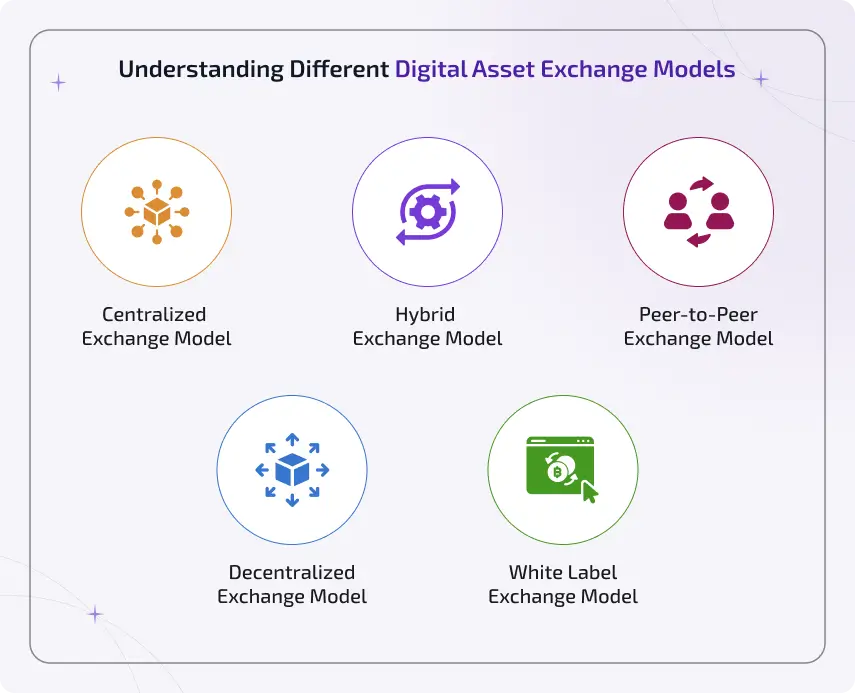
It is important to understand the structural models available, before you launch a digital asset exchange platform. The choice of exchange model will regulate custody, liquidity, compliance, user onboarding, and revenue generation, along with regulatory oversight and long-term scalability. An early selection of the right model reduces operational risks and ensures your strategy is aligned with your business goals. Here are the top digital asset exchange models.
1. Centralized Exchange Model
Centra exchanges, often referred to as CEX, are operated by a single entity that handles user accounts, custody, order matching, and compliance. Businesses planning to build this type of platform often collaborate with a professional centralized crypto exchange development company to design secure custodial systems and high-performance trading engines.
In this model, the platform holds user funds within custodial wallets and carries out trades through an internal matching engine. It maintains centralized order books and overlooks AML and KYC processes. Due to the exchange's control over infrastructure and liquidity management, advanced order types, fiat cash integration, and fundamentally faster execution speeds is achievable.
While the centralized model grants greater control over user experience, liquidity depth and compliance frameworks to build digital asset exchange platforms targeting both retail and institutional clients. Security architecture also becomes a big concern with the territory of custodial risks.
2. Decentralized Exchange Model
The decentralized exchange model (or DEX) operates through smart contracts on a blockchain network instead of being handled by the central operator. Many startups leverage specialized decentralized crypto exchange services to develop automated market maker (AMM) protocols and secure smart contract systems.
Users retain control of their private keys and directly trade through their wallets. Transactions mostly recorded on-chain, while even the fair pricing must be addressed by means of the automated market maker protocol, not the typical means of an order book.
This model shifts the responsibility of custody from the hands of the custodian to the community at large digital ledger. However, it does have several challenges, an outcome with probable fragmented liquidity, a broad range of speed of transactions depending on blockchain, and looming regulations. It has been much more common with projects, which pursue decentralization and rigorous self-custody instead of full-fledged exchange infrastructure.
3. Hybrid Exchange Model
Hybrid exchanges operate by convening centralized performance with decentralized features for custody or settlement.
For example, a hybrid exchange may offer an ultra-speed centralized matching engine yet let users retain control of any particular asset till the trade is actually executed. This model tries to balance transaction speed and security along with transparency.
Create your digital asset exchange platform to achieve a middle ground between differentiating itself from its peers in the digital asset exchange space and ensuring that trade performance stays competitive. However, it requires more complex technical integration.
4. White Label Exchange Model
The white label exchange model helps you to launch your white label digital asset exchange platform using some pre-built infrastructure provided by the technology provider. Many entrepreneurs choose a white label crypto exchange development platform to accelerate time-to-market while minimizing initial development costs.
In this model, you do not build the entire infrastructure from the ground up but rather from a ready-made solution that is licensable. The differences are, however, limited to the opportunities for customization of branding, supported assets, and fee structures and other user interface elements. This reduces time and cost for development.
The white label exchange model suits if you want to launch digital asset exchange platform as soon as possible without a thorough in-house operation on trading infrastructure. However, long-term scalability and customization may stand on the capabilities of the vendor.
5. Peer-to-Peer Exchange Model
A P2P exchange bypasses intermediaries, letting sellers and buyers transact directly, often with escrow facilitating reduced counterparty risks. Companies investing in p2p cryptocurrency exchange software development focus heavily on dispute resolution systems, escrow automation, and fraud prevention tools.
The platform rather does not hold funds in a centralized wallet but instead, it facilitates transaction matching as well as dispute resolution. This model is particularly efficient in areas experiencing limited banking access or strict capital restrictions.
Operationally lighter than a full centralized exchange, the model calls for greater emphasis on strong fraud detection systems and user verification to sustain trust.
Choosing the Right Model
Pick an exchange framework that matches the needs of the target audience, taking into account their compliance priorities, monetary influence, and long-term objectives. If you aim to launch digital asset exchange platform for institutional participation, the centralized or hybrid model would provide greater operational control. On the other hand, decentralized structures (DEX) would be quite desirable, perhaps, where a preference is for more decentralization and a reduction of custodial interventions.
Before development begins, understanding these models helps you to launch digital asset exchange platform in a manner conducive to compliance with regulations and ongoing growth.
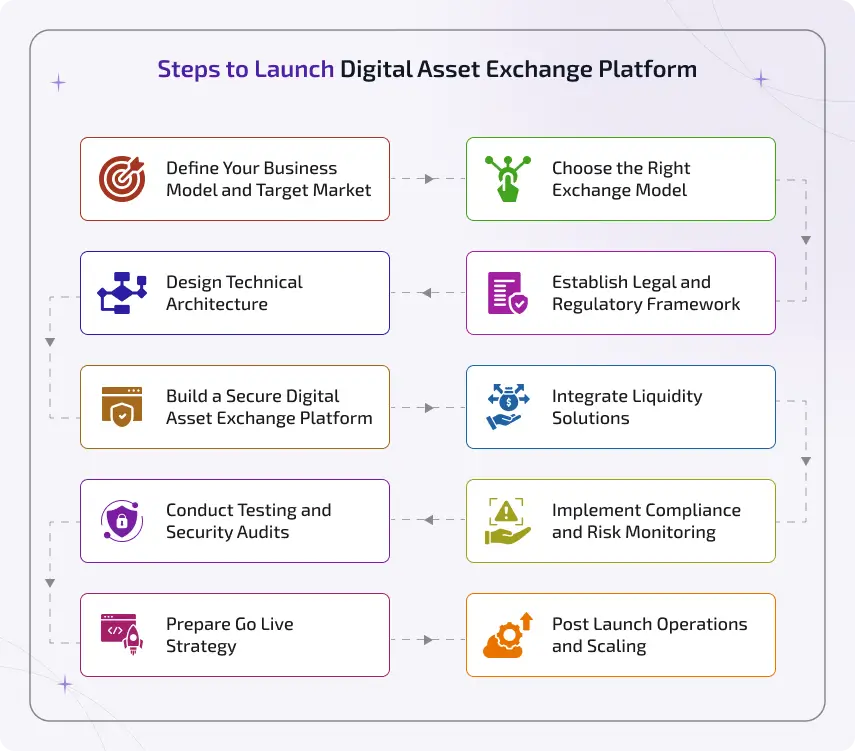
Steps to Launch Digital Asset Exchange Platform
If you plan to launch a digital asset exchange platform, the process needs structured planning across the legal, technical, operational, and security domains. A successful launch centres on not just software deployment. It is all about constructing financial infrastructure that can handle liquidity, compliance, and user trust.
At this point, you will be ready to define:
1. Define Your Business Model and Target Market
Describe for whom you build these platforms, be it retail traders, professional traders, institutions, or markets like real-world asset tokenization.
At this point, you will be ready to define:
Revenue model such as maker and taker fees
Supported asset classes
Geographic focus
Competitive positioning
Clarity at this stage helps you build digital asset exchange platform with the right architecture and compliance structure.
2. Choose the Right Exchange Model
Select whether your platform will operate as a centralized, decentralized, hybrid, or white label exchange.
If speed to market is your priority, you may choose to launch your white label digital asset exchange platform using an established technology provider. If long term control and scalability are critical, building core infrastructure internally may be more suitable.
The choice here shall involve the custody design, liquidity management, and regulatory obligations.
3. Establish Legal and Regulatory Framework
Seek legal advice before getting further into development, to know what licensing processes you have to go through in the jurisdiction your exchange is to be based.
This includes:
Company registration
AML and KYC framework setup
Data protection compliance
Financial reporting obligations
Terms of service and user agreements
When you launch digital asset exchange platform, regulatory readiness directly impacts banking partnerships and payment integrations.
4. Design Technical Architecture
To build digital asset exchange platform, you must design a robust technical foundation that includes:
Matching engine for trade execution
Order book management system
Wallet and custody infrastructure
API layer for external integrations
Admin and monitoring dashboard
As this framework must offer scalable solutions and be low latency and high availability, it will host it on cloud infrastructure that has appropriate redundancy features for resilience.
5. Build a Secure Digital Asset Exchange Platform
Every layer in the development process must intrinsically tie security with it. To build a secure digital asset exchange platform, you will need to deploy:
Hot and cold wallet separation
Multi signature authorization
Hardware security modules
Encrypted data storage
Multi factor authentication
Regularly observe and keep a detailed log
Before deploying a secure platform, regular penetration testing must be executed alongside third-party audits.
6. Integrate Liquidity Solutions
Liquidity determines whether traders stay on your platform. Without sufficient order book depth, users experience slippage and poor execution.
You can improve liquidity by:
Partnering with professional market makers
Aggregating liquidity from other exchanges
Offering fee incentives for high volume traders
Liquidity strategy should be finalized before public launch.
7. Implement Compliance and Risk Monitoring
Use identification verification systems for on-boarding. Add Anti-money Laundering (AML) transaction monitoring capabilities. Set up withdrawal limits and notification for unusual transactions.
High compliance standards shield you from legal risks and effectively enhance confidence from financial partners.
8. Conduct Testing and Security Audits
Before going live, perform:
Functional testing
Load and stress testing
Security audits
Wallet reconciliation tests
User acceptance testing
Testing ensures system stability under real trading conditions.
9. Prepare Go Live Strategy
Avoid launching to the full public immediately. Instead, consider:
Closed beta with limited users
Gradual increase in withdrawal limits
Active monitoring of trading activity
Dedicated support team during launch phase
Gradually deploying the system minimizes the likelihood of encountering operational issues.
10. Post Launch Operations and Scaling
After you launch digital asset exchange platform, focus on continuous improvement.
This includes:
Monitoring system performance
Adding new asset listings
Expanding liquidity partnerships
Enhancing security controls
Updating compliance systems as per the changes in regulations
The long-term success will lie in operational discipline, user trust, and a reliable platform.
To launch digital asset exchange platform, it requires lots of capital and legal prerequisites, but with the right mechanism, it could become a very scalable financial infrastructure business. By following structured plans and by concentrating on security, liquidity, and regulatory preparedness, you are likely to launch digital asset exchange platform that is competitive and economically sustainable in today's very fast evolving digital economy.
Challenges in Launching a Digital Asset Exchange
The opportunity is vast when you plan to launch a digital asset exchange platform, but the challenges become equally demanding. Due to the exchanges being involved at the intersection between finance, technology, and regulation, the process for execution makes it relatively complex.
Regulatory Uncertainty
A significant obstacle is how to keep up with changing frameworks while meeting the demands of regulation. Due to the different requirements across jurisdictions, companies often have to deal with levels of compliance with the various demands of KYC, AML, transaction monitoring, and reporting. It can greatly delay operations or limit market access unless appropriately addressed from the start.
Security Risks and Custodial Exposure
Cryptocurrency exchanges are becoming major targets for cybercrime due to high volumes of customer funds. Defects with their wallet architecture, key management, and processes of monitoring can result in considerable loss. Build a secure digital asset exchange platform by embedding security protocols into custody systems, infrastructure, and operational workflows.
Liquidity Acquisition
To decrease transaction slippage and spreads, the concern is raised from a scarcity of liquidity. The liquidity and appreciation of trade volumes are two aspects that emerging markets depend on. Liquidity-related partnerships on incentivized and fee-sharing plans are essential before the actual launch.
Banking and Payment Integration
Risk perception of digital assets makes it difficult to secure a reliable banking relationship. Payment rails, fiat-gateways and changes in the settlement systems must all fall under regulatory compliance and strictly observed operational practice.
Technical Complexity and Scalability
Claims for a high-performance matching machine, order books in real time, secure wallet frameworks, and interoperate programming functionalities demand strong engineering capabilities. Downtime, latency, or system crashes are issues that will directly impact user trust.
Trust and Brand Credibility
Newer platforms often find themselves in competition with established exchanges having deep liquidity and brand recognition. Trust is acquired through transparency, having the proof of the reserves, acknowledging the users' problems, and keeping their uptime high.
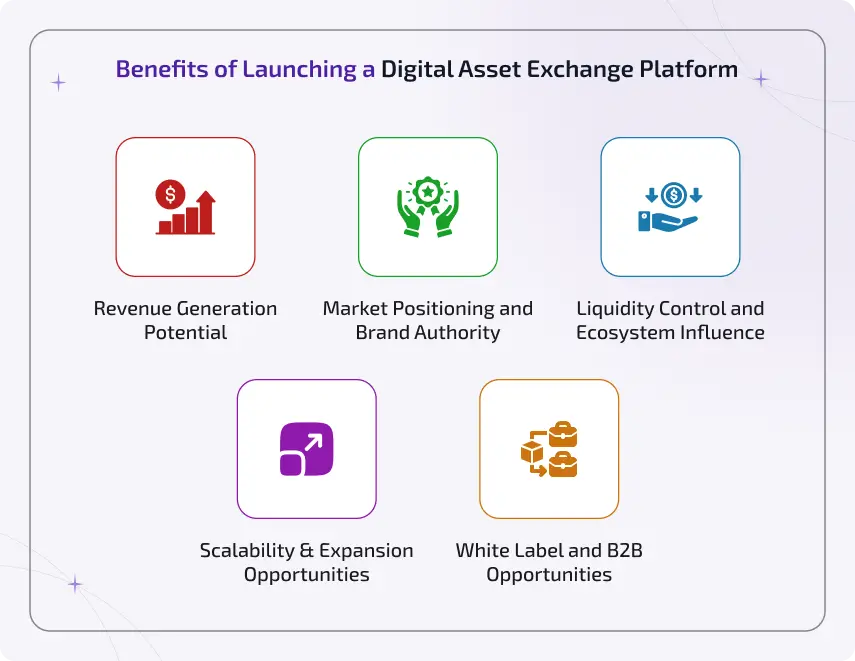
Benefits of Launching a Digital Asset Exchange Platform
There are many strategic and financial advantages if you go about it right when you launch digital asset exchange platform.
Revenue Generation Potential
Exchanges make money through trading fees, listing fees, withdrawal fees, margin interest, and staking services. The revenue potential scales with the trading volume, which scales proportionally with market activity.
Market Positioning and Brand Authority
An exchange signals your business as part of the infrastructure in the digital asset ecosystem, building credibility for brand while making potential partnerships with token issuers, liquidity providers, and financial institutions possible.
Liquidity Control and Ecosystem Influence
Exchanges truly do set the stage for price discovery and capital formation. By managing listings and liquidity, the platform provides captivating market dynamics and acquires groundbreaking blockchain projects.
Scalability and Expansion Opportunities
Exchanges can expand into derivatives, lending, staking, institutional custody, and tokenized asset trading once operational stability has been achieved. This is to launch digital asset exchange platform as a multi service financial ecosystem and not just another trading venue.
White Label and B2B Opportunities
You can also launch your white label digital asset exchange platform serving other brands and regional partners. This creates more revenue streams without directly tapping into every retail user.
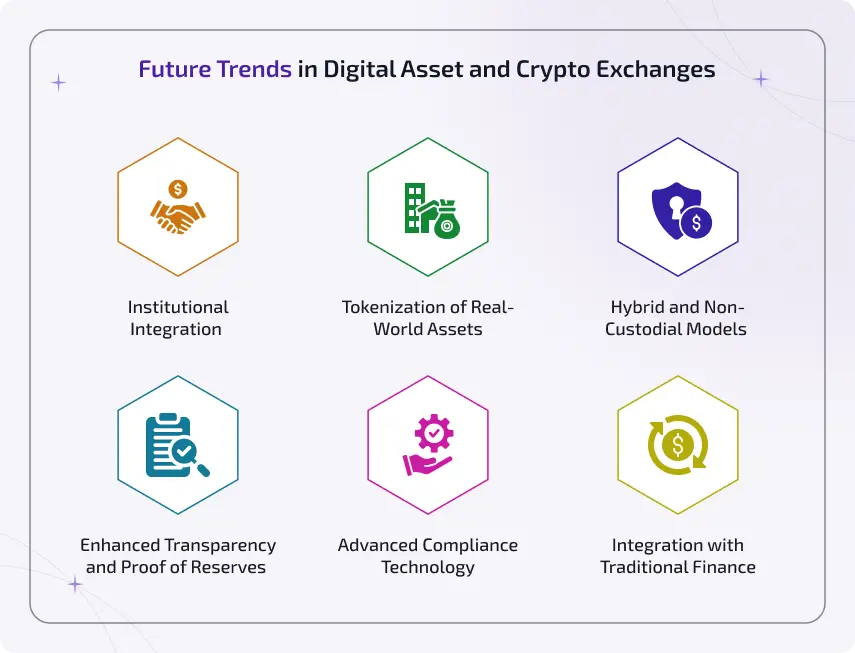
Future Trends in Digital Asset and Crypto Exchanges
The exchange industry is dynamically changing. Recognition of potential trends gives you information enabling sustainable platform management when you launch a digital asset exchange platform.
Institutional Integration
More and more institutional participants are entering the crypto space. So, exchanges are implementing better custody procedures, compliance systems, and more-intuitive reporting to meet institutional requirements.
Tokenization of Real-World Assets
Digital exchanges are now on the verge of supporting real estate tokenization, commodities, bonds, etc. This would mean that the digital trading arena will include many real-world assets than mere cryptocurrencies.
Hybrid and Non-Custodial Models
There is an increasing demand for hybrid models merging the speed of centralized markets with the custody characteristics of decentralized technologies. This allows the end users to safeguard their funds while enjoying performance.
Enhanced Transparency and Proof of Reserves
After the experience of earlier market disruptions, exchanges are gradually shifting towards creating a system where it adopts proof of reserves systems and is transparent in its reporting to strengthen user confidence.
Advanced Compliance Technology
Artificial intelligence driven AML monitoring and automatic regulatory reporting are setting new standard features. Compliance technology is evolving into more of a competitive advantage from a regulatory burden.
Integration with Traditional Finance
The partnerships between digital exchanges to engage with traditional finance continues to rise. Examples include fiat settlement integration, cross asset trading, and improved regulatory clarity in major markets.
The launching of the exchange demands strong capital investment, regulatory compliances, and and technical expertise. Yet, the ability to launch digital asset exchange platform is one of the most scalable and transactional ventures within the digital economy with the right execution strategy. Proper planning, secure designs, and clarity of long-term relevancy can make the exchange merely jump into the market or become the trusted financial infrastructure provider.
Conclusion
The creation of an exchange requires more effort than just deploying trading software. When you launch a digital asset exchange platform, you are creating a financial infrastructure which balances regulation, security, liquidity, compliance and user trust. The selection of an exchange model together with custody system design and liquidity management plans establishes the path towards achieving permanent success. To launch a digital asset exchange platform, it requires both strong regulatory compliance and institutional level security measures.
The strategic planning process establishes the path towards successful operation for both those who launch digital asset exchange platforms from scratch and those who use white label solutions. The organizations that build a secure digital asset exchange platform with established governance systems and operational control will achieve the greatest success in the changing digital asset market.
Why BlockchainX Is the Right Partner for Digital Asset Exchange Development
At BlockchainX, we understand that choosing the right development partner is most important when you plan to launch digital asset exchange platform that meets enterprise and regulatory standards. Our deep technical experience is allied with strong regulatory insights to help you launch digital asset exchange platform that is scalable, secure, and performance driven.
If you aim to go onto the market with a white label or launch digital asset exchange platform that can be completely customized, we provide flexible engagement models tailored to your goals. We will build a secure digital asset exchange platform, through security architecture, liquidity integration, and ongoing technical assistance, ensuring longevity and growth.
Get all the latest posts delivered straight to your inbox.
Get In Touch
Our expert team is professionally well-equipped with hands-on experience as a blockchain development company. Connect with us; at BlockchainX, we curate your desired sustainable solution!