What Is Keyless Signature Infrastructure?A Practical Guide for Businesses
 By Yokesh Sankar
11 min read
Updated On
By Yokesh Sankar
11 min read
Updated On
Key Takeaways
KSI checks data integrity without storing any secret keys. This washes out the key management risk, which is often a big security issue.
KSI also makes a tamper-proof audit trail that can be independently verified regardless of the time.
KSI depends on hash functions and holds up better against future quantum attacks than ECC or RSA.
It focuses on proving data integrity and enabling verification, rather than building on smart contracts or storing data.
KSI stands as a better alternative to public blockchains with tamper-proof evidence and transparency without governance trade-offs or cost and speed.
Detecting data manipulation has now become a key task for every business by 2026. Traditional signing solutions are known to leave holes where the keys are leaked, stolen, or simply laid out wide open with huge admin rights. However, the Keyless Signature Infrastructure (KSI) takes another road, providing verifiable proof that your data is real and hasn't been touched. Records may be independently verified on their own without involving any secrets or private keys.
KSI should be a great option for those working on teams dealing with compliance, audits, and legal documents, there shouldn’t be any big security issues on your end. If you’re still trying to wrap your head around what exactly sets KSI apart from the usual digital signature system and want some insights into how things work under the hood, then this guide should clear up any confusion. Here is a practical look at what KSI is and when it makes sense for your business.
What is Keyless Signature Infrastructure?
Keyless Signature Infrastructure (KSI) is a technology that proves digital data is not changed without relying on cryptographic keys or trusted third parties. It was developed by Guardtime, an Estonian company, which has a main focus of protecting Estonia’s government systems, including registry records and e-health, with each second producing a global hash tree where its root hash is publicly recorded.
In simple terms, traditional digital signatures (PKI) depend on private keys, where if a key is leaked or stolen, every signature made with it becomes questionable. Here, KSI neglects this weakness by replacing keys with hash functions and a publicly verified record. Your data is turned into a unique digital fingerprint called a hash that is published widely and cannot be rewritten. A digital signature shows you which mathematical path we took from your data to our published record.
You can use this to re-determine both that your data has been kept the same (as before) and that you are seeing it now at the same moment. This makes KSI especially useful for compliance records, audit logs, and legal evidence, and even the place where integrity matters more than keeping the data secret.
How Does Keyless Signature Infrastructure Work?
KSI uses a simple four-step process to turn records into hashes and create a public record that proves they have not changed. Here is what happens at each stage.
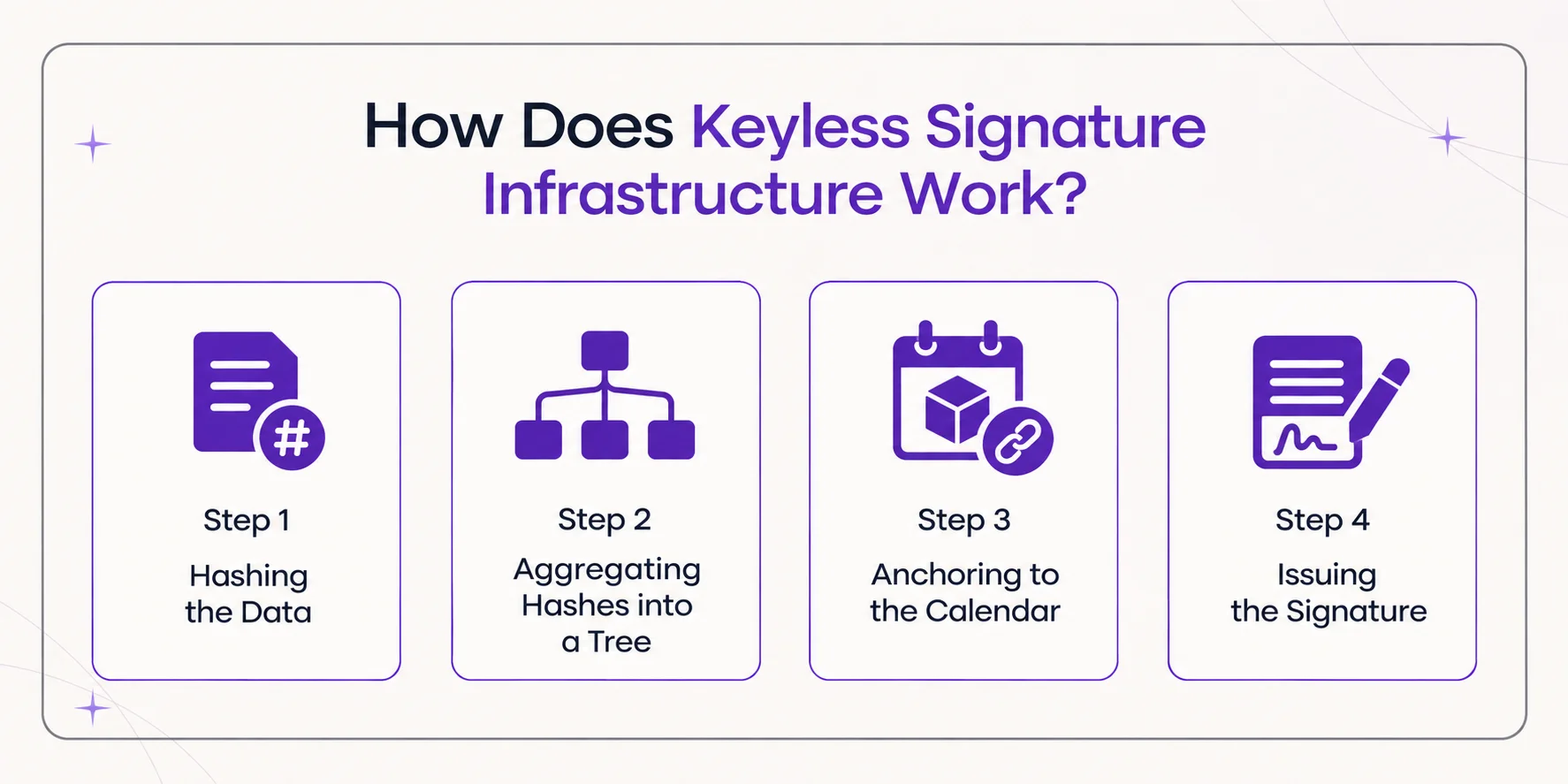
Step 1: Hashing the Data
As for what a blockchain really is, at its most basic level, imagine a log entry (or file, or document, or whatever) has been passed through some kind of cryptographic hash. This generates a short, unique digital fingerprint. The hash is sent to the KSI network, so the original data never leaves your environment. Any change in even one character in the data produces a completely different hash.
Step 2: Aggregating Hashes into a Tree
Hashes from every system and user are collected in short rounds, where each round is paired and hashed together repeatedly in a structure called a Merkle tree. This allows the network to handle large data effectively without much risk and struggle.
Step 3: Anchoring to the Calendar
The hash of each round is added to a calendar at every second, forming a continuous chain of hashes at every entry, tied to a specific moment. At certain periods, the hash calendar is published widely in both public and independent places, so it cannot be changed later.
Step 4: Issuing the Signature
The signature you receive is the chain of hashes linking your data to the published calendar entry or value. It contains no secret key and is simply the mathematical proof of where your data sits in the tree.
How Verification Works Here:
To check a record, any user can hash the original data again, follow up the path in the same signature, and check whether the result matches with the published value. If it is the same, the data remains unchanged at the recorded time. If a single bit has been changed, the result will not match, and the tampering is uncovered.
Is Keyless Signature Infrastructure Really “Keyless”? What It Actually Means
Yes. Keyless means the signature itself has no private key behind it. It describes how the signature is created and verified. So, there is no way to leak, steal, or use it to disregard a signature.
In a traditional digital signature, trust depends on a private key. But a KSI signature has no such key behind it, which is directly built from a value and a publicly published record. Businesses use these credentials to access the KSI service, but they have no control over who can submit the data and stay valid if they are compromised. Trust also moves to strong hash functions and the public record, rather than to RSA or ECC keys.
- Access needs authentication and credentials to control who submits the data, but never in the form of a signature.
- In KSI, trust transfers to the published record, and verification depends on a public record that cannot be rewritten or altered.
- It’s now a question of trust, with KSI using only cryptographic hash functions rather than ECC or RSA, both of which are far more quantum resilient.
Keyless Signature Infrastructure vs Public Key Infrastructure: Key Differences Explained
Which one should I choose, KSI vs. PKI? That really depends on what exactly you want to protect & prove. They both enable businesses to trust digital data in very different ways, and researchers at Guardtime have investigated how KSI and PKI complement each other in pre- and post-quantum environments. Here’s how to get that side-by-side comparison view below:
| Key Factors | KSI (Keyless Signature Infrastructure) | PKI (Public Key Infrastructure) |
|---|---|---|
| Trust Anchor | Hash functions and a public record | Private keys and certificate authorities |
| Core Mechanism | Hash functions and a published hash calendar | Asymmetric cryptography (RSA, ECC) & certificates |
| Key Management | No signing keys to protect or rotate | Keys must be rotated, stored & revoked |
| Timestamping | Built in with provable time | Needs a separate timestamp service |
| Verification | Anyone can verify using the public record & data | It depends on certification validity & CA trust |
| Quantum Resilience | Considered more resilient | RSA & ECC are vulnerable |
| Verification Dependency | Relies on the published calendar record | Relies on the certificate chain & CA trust |
| Long-term Validity | Stays verifiable for years because of the public record | Loses validity when certificates expire or algorithms weaken |
| Operational Overhead | Low with no key lifecycle to manage | High, covering storage, key generation, rotation & recovery |
| Connectivity | Needs access to the KSI network to sign | Can sign offline with a local key |
| Revocation | No revocation lists or status checks are needed | Needs CRLs or OCSP to revoke compromised certificates |
| Legal & Standards | New with fewer formal standards | Long-established with strong legal recognition |
| Best For | Compliance, audit logs & legal evidence | Authentication, encryption & secure connections |
KSI vs Public Blockchains vs Traditional Timestamping: How to Compare
As mentioned before, all of these techniques establish the fact that the data exists at a certain point in time and hasn’t been changed since then. The only difference lies in how much they cost, how fast they are, and whom you need to trust. With this comparison in mind, you can easily see where we fit in compared to other services based on public blockchains and timestamping services.
| Aspect | KSI | Public Blockchains | Traditional Timestamping (TSA) |
|---|---|---|---|
| Trust Model | Hash functions & a widely published record | Decentralized consensus across thousands of nodes | A single timestamp authority and its signing key |
| Scalability | Handles large volumes by aggregating hashes | Limited by block size & network congestion | Scales well, but depends on one provider |
| Data Storage | Only hashes, no customer handling data | Transactions & rarely data on-chain | Signed timestamp token |
| Cost | Low & predictable, with zero transaction fees | Varies with network fees | Usually low per timestamp |
| Throughput | Built for massive, per-second aggregation | Limited by block size & fees | Per-request signing |
| Centralization | Permissioned | Fully decentralized | Fully centralized |
| Privacy | Private (hashes only) | Public ledger | Private |
| Best For | High-volume enterprise records, audit logs & compliance | Open, trustless systems | Simple, low-volume timestamping with established standards |
Note: For a detailed and related comparison of distributed ledgers, explore our in-depth analysis on hashgraph vs blockchain for a deeper understanding.
Why Businesses Are Adopting Keyless Signature Infrastructure
KSI helps to turn every record into independently verifiable proof with minimal overhead and fewer security risks. Here is what it delivers in real-time and makes it a practical choice.
No Key Management Burden
With KSI you don’t have to worry about storing, rotating, backing up, or recovering signing keys. You can't attack what there’s nothing to steal; your signature consists of hashes only, and there's no private key hidden underneath.
Independent Verification
This means that partners, customers, auditors, and regulators are able to audit our records by looking at the data as well as the public record; there is no need for anyone to trust one particular vendor, certificate authority, or administrator. That creates huge amounts of confidence in us.
Enterprise-Scale Speed
Each record is then aggregated by KSI in a thousand-hash-per-second round and thus signed in about 1 sec. This makes it possible to manage huge volumes of data without any block confirmation or mining delay. Hence, it can be used as an appropriate system for high-throughput businesses.
Long-Term Validity & Quantum Resilience
KSI relies upon hash functions instead of ECC/RSA; therefore, you can keep your past records as long as you want while being assured they will remain verifiable (without having to re-sign them). This makes them more resilient against future quantum computing threats with better holding capability.
Tamper-Proof Audit Trails
Each record or document comes with a stamp indicating the precise time it was created that can’t be altered. This makes it more auditable and reliable and much easier to defend with verifiable history against auditors or regulators who question them.
Data Privacy by Design
Submit hashes to our KSI network, keeping your sensitive information inside your environment. You’ll have verifiable proof that customer information, contracts, and other internal records haven’t been compromised. Also, it is confirmed with a Guardtime patent note that your raw input entering the calendar cannot be used to recover the original input.
Future Proofing
Records signed today remain verifiable for years from now. This is because verification depends on published values and open hash functions rather than vendor-specific tools. This minimizes the amount of work needed to migrate if your rules, systems, or technologies evolve.
Protection Against Insider Tampering
Even if they had full system access, admins couldn't even begin to attempt to change/alter your records/hashes. Insider edits and manipulation become easier to detect and remove the need to easily spot instead of being taken on trust.
Limitations and Risks to Consider Before Adopting KSI
Before adopting KSI to your security, it’s crucial to understand its requirements, integration, and operational dependencies to check whether it fits your specific use case. So below we have mentioned some important limitations & risks associated with KSI adoption, which every business needs to think about before switching to KSI:
-
It Does Not Protect Confidentiality:
You need to maintain proper access control and encryption and more such security mechanisms along with KSI because even though KSI cannot encrypt or hide the data, it will ensure that any record or sensitive data is not changed.
-
It Proves Integrity, Not Identity:
KSI proves that data has not been altered and was established when it existed, but it does not establish the signer’s identity. Businesses need additional authentication or PKI mechanisms for proper identity verification.
-
It Relies on Strong Hash Functions:
Using hash functions and the published record, KSI replaces key-based trust with trust. Hash functions are considered quantum-resilient, but security still remains unbroken over time.
-
Integration Takes Planning:
Though KSI connects via APIs, businesses must individually decide how to store proofs, what to sign, and how to verify each of them later. Without a clear process, it’s hard to realize.
-
Standards & Legal Are Still Maturing:
Since KSI is new to the field, businesses in regulated sectors should prioritize and confirm whether the approach is eligible for their specific compliance needs, unlike PKI-based signatures.
-
Depends on a Service Provider & Connectivity:
Outages or connectivity issues can delay because of the signing requirements. Here, the calendar is also operated by a provider individually, making it more centralized than public blockchains.
-
It Cannot Prove a Record Was Accurate:
KSI protects the integrity of data after it is signed and not its correctness before signing. Incorrect or fraudulent information can still be preserved securely.
Real-World Examples of Keyless Signature Infrastructure in Use
KSI is already running in action, helping various critical systems, logs, infrastructures, and records in practice. Here are the real-world examples of how it is used.
1. Estonian Government Systems
- KSI supports a wide range of Estonian government functions, including e-health, e-law, e-banking, and much more.
- With the beginning of government and Guardtime’s formal cooperation in 2011, public and internal records, and even logs were secured against insider threats.
2. Estonian Health Records
- Guardtime partnered with the Estonian e-Health Authority to protect over a million health records, with the integration of KSI into Oracle’s database engine.
- Patient’s data still remains private, and only the signatures are passed on, and still checking on if any tampering happens.
3. Government-Wide Rollout
- Estonia’s framework agreement is set to make it available for all government authorities through its X-Road data exchange platform.
- This framework has turned KSI from a single project into a shared public infrastructure.
4. National Registries & Public Records
- KSI is used to help and protect data integrity across Estonian registries for business, property, health, succession, and many other official records.
- It detects unauthorized changes and gives officials verifiable proof of record, where the public records remain unused.
5. Defense & Enterprise Partnerships
- Beyond Estonia, Guardtime also serves defense and military clients.
- It works with Lockheed Martin, announcing a work collaboration with the company in 2017, and Ericsson being its one past partner.
6. Telecom & Critical Infrastructure
- Verizon announced it would offer KSI-based services on its Virtual Network Services platform, aiming to help government customers and large enterprises protect critical supply chains and infrastructures.
Industry Use Cases for Keyless Signature Infrastructure
Different industries face different types of integrity risks, but KSI can help them out all with one approach. Here is a sector-by-sector look at how KSI simplifies and delivers its value.
| Industry | What Gets Signed | Key Benefits |
|---|---|---|
| Banking & Finance | Transactions, ledgers & regulatory reports | Blockchain in finance & banking makes easy audits & rapid detection of manipulation or frauds. |
| Supply Chain & Logistics | Inspection records, shipment events & handoffs | Pairs with blockchain traceability solutions with a shared, verifiable history. |
| Healthcare | Medical reports, consent forms & prescriptions | Unauthorized changes are found while patient data stays private & conscious. |
| Government & Public Sector | Court records, official notices & registries | Provides stronger public trust for every official record. |
| AI & Data Science | Experiment logs, training datasets & model logs | Provenance of data is not altered but supports auditability in every AI result. |
| Cybersecurity & IT | Configuration files, system logs, software & records | Rapid detection of unauthorized changes. |
| IoT & Manufacturing | Quality checks, sensor readings, device & maintenance logs | Blockchain in IoT development comes with tampered readings or firmware updates. |
| Insurance | Claims files, policy documents, & adjuster reports & records | Provenance of claims & policy records is not altered after submission, helping to detect fraud. |
How Quantum Readiness Is Keyless Signature Infrastructure
The majority of digital signatures today depend on RSA or elliptic-curve cryptography, which is expected to break by quantum. Here, the signatures made with keys have a high chance of being forged, and old records signed with them could lose their proof value.
KSI plays a better shift here by relying on hash functions instead of private keys. This is why there is no signing key for a quantum attacker to recover or use the forged records, while the Guardtime researchers have proved their work on quantum-immune keyless signatures with proved identity. For records that must stay verifiable for 10 to 30 years, for example, financial archives, medical, or legal records, their longevity stays for decades with practical advantage.
KSI is a quantum-based resilient and not quantum-proof one. It depends on hash functions staying secure and does not cover identity or encryption.
How to Implement Keyless Signature Infrastructure: A 7-Step Roadmap
Making KSI work in real time is all about planning and verification. It covers a practical 7-step process, covering what to sign and how to keep verification running. Let’s get to know how to put KSI to work in your organization in the right way.
Step 1: Define What You Need to Prove
Define what you want to prove by starting with a business activity like tamper detection, audit readiness, or legal evidence based on your idea. Set clear goals, like deciding which records you need to sign in and how strong your proof or document needs to be from the start.
Step 2: Identify the Records to Sign
List the data that matters the most alone. This may be such a system: access, contract, financial record, security logs, or any software build. Instead of signing everything at the same time, prioritize highly risky or regulated records first.
Step 3: Choose a KSI Provider & Deployment Model
You need to compare these providers by considering network stability, standards support, how often they stay up, and what they charge. You can also check items such as legal, service terms, overall cost, data storage, and similar points that are necessary.
Step 4: Integration with Existing Systems
Sign in to the workflows that need document approvals or log creation. Here, KSI connects through SDKs and APIs, which makes the majority of the systems integrate without rebuilding themselves. For example, Guardtime makes its KSI SDKs available as open-source on GitHub.
Step 5: Set Up Hashing & Proof Storage
Hash records are stored locally only using fingerprints, which leave your environment after years; further, they insist on storing each signature alongside the original record. Your proofs stay safe until you check them later.
Step 6: Checking & Ongoing Monitoring
Firstly, you need to verify that the signatures are valid and their integrity from time to time through an audit. Then, set alerts for any mismatch and pair KSI with identity tools such as PKI or access controls. Since KSI proves integrity and time, it doesn’t know who signed it.
Step 7: Optimize & Review
Start with one use case. Test it first. Check what happens. If the results look solid, then widen the scope. Make sure there’s one person who owns the work, and write stuff down about what they actually do and how they do it. It helps. Keep a longer plan for changing the hash function later.
Alternatives and Complementary Technologies that Work Beyond KSI
Looking at options beyond KSI? Here are the major technologies and alternatives for proving integrity that fill the gaps that are missed in KSI. Get to know the other technologies that give businesses stronger and more complex protection systems.
| Technologies | How It Relates to KSI | Best Used For |
|---|---|---|
| Public Blockchains | Alternative: it is fully decentralized but slow & fee-driven | Trustless & open systems with no single controlling party |
| PKI & Digital Signatures | Complementary: adds signer identity | Supports secure connections, encryption & proving who signs |
| Timestamping Authorities | Alternative: it is simple & fast with heavy dependence on one authority’s key | Functions with low-volume testing with established standards |
| Hash-Based Signature Schemes | Alternative: Quantum-resistant signatures with keys | Long-term & key-based signing in a post-quantum plan |
| Hardware Security Modules (HSMs) | Complementary: it protects confidentiality which lacks in KSI | Keeps sensitive data private & restricts unauthorized users |
How BlockchainX Can Help You Build Data-Integrity Systems
BlockchainX is a blockchain development company, founded in 2017, and is successfully working with over 250+ clients under various blockchain solutions. The company is not a KSI provider; instead, it helps businesses design and build data-integrity systems using various approaches such as anchoring hash trees to a public blockchain, integrating a KSI service, or deploying a permissioned ledger.
- Assessing which records need tamper-proof verification and which technology suits them with our blockchain consulting services.
- We anchor hash trees and automate verification logic on public chains using smart contract development, backed by a full smart contract audit.
- Using its enterprise blockchain development team, the company designs and builds permissioned ledgers for verified compliance records.
- The company also creates APIs and applications that link together proof storage/signing/verification to users’ existing systems.
- Clearly applying data-integrity systems across different sectors, including insurance, healthcare, financial services/banking, etc.
Conclusion
As data becomes more valuable and tampering harder to detect, businesses switch to finding a practical way that proves records have not been altered. It’s the Keyless Signature Infrastructure (KSI) that delivers by replacing private keys with hash functions with long-term validity and better resilience.
If you want to protect your business data, the key idea is simple: keep the records unchanged. This applies whether you use KSI, a permissioned ledger, or a public blockchain. If you’re interested in finding out more about what’s possible and how we can set things up to help you preserve data integrity as needed, our BlockchainX sales team would love to hear from you. Reach out.
Frequently Asked Questions
KSI is an approach to prove that digital data has not been changed and to explicitly show when it has existed. It uses hash functions and a publicly published record instead of private signing keys that anyone can check.
KSI was developed by Guardtime in 2008, an Estonia-based company. It began to protect the Estonian government systems, including the registry and health records.
KSI is often termed as a type of blockchain, since it uses hash-link records that are tamper-evident. However, it works differently from public blockchains and has no minting or consensus and is controlled by a service provider rather than a decentralized network.
No, it doesn’t store your data. Only a hash, which is a short fingerprint of your data, is sent to the KSI network, where your original data stays in your own systems with full privacy protection.
KSI relies on hash functions rather than ECC or RSA, which are considered quantum-resistant rather than traditional signatures. Identity components may still use quantum-vulnerable keys unless they are upgraded.
Our expert team is professionally well-equipped with hands-on experience as a blockchain development company. Connect with us; at BlockchainX, we curate your desired sustainable solution!


Follow us on


