Is Polymarket Legal or Not? A Global Compliance Guide
Listen to the Audio :
Key Takeaways:
Polymarket is
legal in a few countries, but in others it can be restricted, or regulated
Compliance ends
up mattering as much as the underlying tech for prediction market platforms
In the United
States, CFTC prediction market rules keep getting evolved and that keeps shaping what the
legal landscape looks like
Strong KYC/AML
execution together with the right licensing matters a lot if you want long-term operation
If you want a
prediction market platform that can actually expand you need a compliance-first attitude
globally
Introduction:
Prediction markets have moved beyond niche crypto experiments and into a rapidly
growing global industry. And somehow, one question keeps coming up again and again in
investors, regulators, and entrepreneurs: Polymarket is legal or not? As prediction markets
become more mainstream, people have started to treat Polymarket legality as something more
important than before.
In a recent Research analysis, global prediction market trading volume surged
from under $5 billion per month in 2025 to almost $24 billion in April 2026, showing market
growth that feels almost unprecedented.
Then there’s the added momentum. In June 2026, the U. S. CFTC put out newer
rules for prediction markets, basically to make a clearer compliance route, including
platforms like Polymarket. This also hints at increased institutional acceptance, along with
tighter regulatory attention.
So, is Polymarket legal in 2026? The answer depends on jurisdiction, licensing
terms, compliance expectations, and those shifting financial rules worldwide. This guide
explores everything businesses and users need to know about legal compliance for Polymarket
software and global prediction market regulations.
What is Polymarket?
Polymarket is a decentralized prediction market platform, built on blockchain
technology that helps people buy and sell shares tied to the probability of what might
happen in the future events. Like from election outcomes, and even cryptocurrency prices, to
big company announcements, and other worldwide moments, users place their funds behind what
they believe will actually unfold.
For Example:
Will Bitcoin reach $150,000 this year?
Will a country enter a recession?
Will a company launch a new product before a given date?
Will a specific political candidate win an election?
Instead of traditional betting, Polymarket functions more like a marketplace,
users trade event contracts whose prices fluctuate based on market sentiment and
probability.
Key Features of Polymarket
Blockchain-based
settlement
Real-time market
pricing
Non-custodial
architecture
Transparent
transaction history
Global
accessibility
Event-driven
trading markets
The platform is often viewed as a hybrid between financial derivatives markets
and information forecasting systems.
As interest in prediction markets continues to grow, so do questions about
Polymarket legality. Many users and businesses want to know, "Is Polymarket legal?" The
answer depends on much more than the technology itself. Factors such as local regulations,
CFTC prediction market regulations, licensing requirements, and the broader regulatory
framework prediction market platforms operate under all play an important role.
The CFTC's Stance on Polymarket
The biggest factor deciding whether Polymarket is legal in the United States
comes down to where the CFTC stands.
Back in 2022, the CFTC hit Polymarket with a $1.4 million fine, claiming it was
running event based binary options markets without the right registration, and the agency
also told the firm to stop selling contracts that did not follow the rules.
After that, the whole regulatory environment has changed significantly.
Why Did the CFTC Intervene?
The CFTC viewed many of Polymarket's contracts as:
Commodity
derivatives
Event contracts
Binary options
Swap-like
financial products
Under U. S. law, those products really do need proper registration, and some
ongoing oversight.
Major Regulatory Developments
Year
Event
2022
Polymarket settles with CFTC and restricts U.S. operations
2025
Polymarket gains access to regulated U.S. market infrastructure
through licensed entities
Recent CFTC actions indicate a shift from enforcement-first approaches toward
establishing clearer regulatory frameworks for prediction markets.
Key CFTC Focus Areas
CFTC regulations
prediction market oversight
Derivatives
trading compliance
Event contract
classifications
Consumer
protection
Market integrity
Insider trading
prevention
Anti-manipulation safeguards
This marks one of the most important developments in CFTC prediction market
regulations.
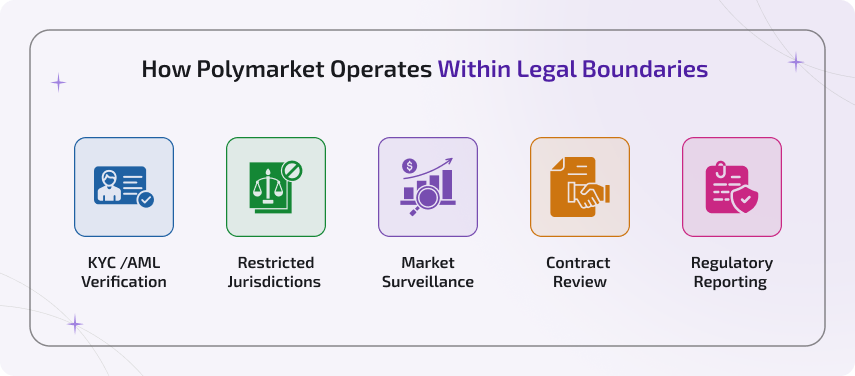
How Polymarket Operates Within Legal Boundaries
Modern prediction markets survive by building compliance directly into their
infrastructure.
When people ask "Is Polymarket legal?", the answer often comes down to how the
platform is structured and whether it follows the regulations of the jurisdictions in which
it operates.
The strongest argument supporting why Polymarket is Legal in certain
jurisdictions is the growing emphasis on regulatory controls and user protection.
Legal Compliance Mechanisms
1. KYC and AML Verification
Most regulated platforms implement:
Identity
verification
Sanctions
screening
Anti-money
laundering checks
Transaction
monitoring
This supports strong KYC/AML implementation standards.
2. Restricted Jurisdictions
Users from prohibited regions are blocked through:
Geo-fencing
IP monitoring
Residency
verification
3. Market Surveillance
Compliance teams monitor:
Insider trading
Manipulation
Wash trading
4. Contract Review
Event contracts are screened to ensure compliance with:
CFTC regulations
prediction market requirements
Public interest
standards
Market integrity
rules
5. Regulatory Reporting
Platforms maintain:
Audit trails
Trade reporting
Record retention
Risk disclosures
6. Technical Controls
Wallet screening
Identity
verification
Sanctions
screening
Blockchain
analytics
Fraud detection
systems
Prediction markets align themselves with financial services standards and
derivatives trading compliance requirements. Many regulators view prediction markets more
favorably when they operate under financial services regulations rather than gambling laws.
The Difference Between prediction market and Traditional Gambling
One of the biggest debates surrounding Polymarket legality is whether prediction
markets are gambling.
Traditional Gambling
Prediction Markets
Fixed odds
Dynamic market pricing
House profits from losses
Platform earns transaction fees
Entertainment-focused
Information discovery-focused
Limited market transparency
Transparent market data
Gaming regulation
Financial regulation
Operator sets odds
Market determines probabilities
No secondary trading
Positions can be traded anytime
Closed betting system
Open market participation
Limited forecasting value
Real-time predictive insights
House controls liquidity
User-driven liquidity
Minimal compliance checks
Strong KYC/AML implementation
Gaming license required
May require Designated Contract Market (DCM) compliance
Betting activity
Event-based trading activity
Local gambling laws apply
Subject to CFTC prediction market regulations
Why Regulators Treat Them Differently
Prediction markets are often viewed as:
Financial
instruments
Information
markets
Event
derivatives
Rather than pure gambling.
However, some regulators still classify certain event contracts as wagering
activities.
This ongoing debate fuels the distinction between:
Gambling vs prediction market regulation.
As the industry evolves, the compliance standards and the transparency aspect
keep getting reinforced, and this continues to support the idea that Polymarket is legal
under certain regulatory frameworks, in some circumstances, at least.
Grasping this nuance is crucial when asking Is Polymarket legal, and when trying
to figure out Polymarket legality across different countries, and in different regulatory
environments.
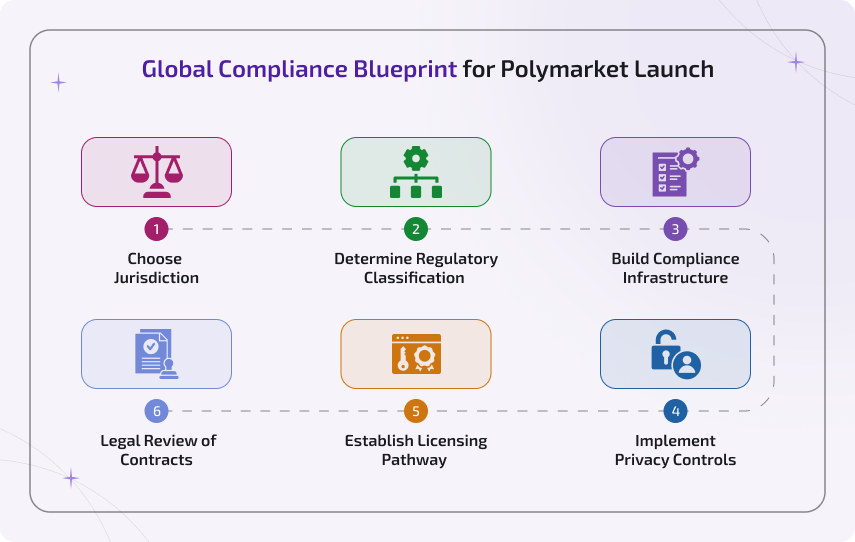
Global Compliance Blueprint for Polymarket Launch
Entrepreneurs looking to launch a compliant prediction market should follow a
structured legal framework. Understanding the regulatory framework prediction market
operators must follow is essential for long-term success
Step 1: Choose Jurisdiction
Select a country with:
Digital asset regulations
Financial innovation policies
Regulatory clarity
Step 2: Determine Regulatory Classification
Your platform may fall under:
Derivatives exchange
Financial marketplace
Gaming operator
Virtual asset service provider
Step 3: Build Compliance Infrastructure
Include:
KYC onboarding
AML monitoring
Risk scoring
Fraud detection
Step 4: Implement Privacy Controls
Support:
GDPR compliance blockchain requirements
Data retention policies
User consent management
Step 5: Establish Licensing Pathway
Potential licenses include:
Financial market licenses
Designated Contract Market approvals
Gaming licenses
VASP registrations
Step 6: Legal Review of Contracts
Every event market should undergo:
Legal review
Regulatory review
Risk assessment
Many businesses look into Offshore prediction market legal frameworks, to make
operations easier, but regulators are paying more attention to these setups lately. And it
seems that just Jurisdictional arbitrage is getting less effective, because governments are
working together more closely and improving international enforcement, in practice.
Polymarket Legal Status by Country (2026)
Whether Polymarket is legal depends a lot on the jurisdiction you’re in.
Country
Status
Notes
United States
Partially Regulated
Subject to CFTC oversight
United Kingdom
Restricted / Case Specific
FCA and gambling considerations
Canada
Provincial Review
Varies by province
Germany
Regulated Environment
MiFID II regulations may apply
France
Highly Regulated
Financial and gaming oversight
Singapore
Restricted Licensing Model
MAS approval may be required
UAE
Emerging Framework
Depends on financial free zone structure
New Zealand
Limited Availability
Regulatory review required
Argentina
Jurisdiction Specific
Provincial differences apply
Important Note
Prediction market legality is dynamic.
A platform may be legal in one jurisdiction while prohibited in another.
This creates challenges related to:
Offshore prediction market legal structures
Cross-border compliance
Jurisdictional arbitrage risks
Businesses should always seek legal advice before moving into other countries.
The reason is regulatory categories keep shifting, even if the business thinks it already
understands the field.
Who Can Use Polymarket?
Who can use Polymarket depends on local laws, the platform’s own terms, and the
compliance expectations that regulators set. In most cases eligibility comes down to:
User Requirements
Minimum age compliance
Identity verification
Residency restrictions
AML clearance
Restricted Users
Many platforms prohibit:
Sanctioned individuals
High-risk jurisdictions
Restricted territories
Politically exposed persons without enhanced due diligence
Institutional Participation
Prediction markets are no longer used exclusively by retail participants.
Growing interest comes from:
Hedge funds
Trading firms
Research institutions
Political analysts
Economic forecasting organizations
This institutional adoption is one reason regulators are beginning to view
prediction markets through a financial services lens rather than purely as betting
platforms.
Licensing Requirements for a Legal Prediction Market Platform
For businesses asking whether Polymarket is Legal, the more important question
is often: What licenses are required to operate legally? A compliant prediction market
generally requires one or more licenses.
Potential Licensing Models
Financial Market License
Used when contracts are classified as derivatives.
1. Designated Contract Market (DCM)
A DCM is a regulated marketplace approved to list derivatives contracts.
Designated Contract Market (DCM) compliance typically involves:
Market surveillance
Risk controls
Reporting obligations
Governance standards
2. Derivatives exchange authorization
It is a regulatory approval to operate a marketplace for trading derivative
contracts.
The compliance typically involves:
Risk management controls
Clearing & settlement requirements
Market integrity & surveillance
Recordkeeping & trade reporting
3. Alternative Trading System registration
Gaming License
Some jurisdictions classify prediction markets as wagering products.
This may require:
Gaming operator licenses
Consumer protection measures
Responsible gaming policies
Betting exchange permissions
Virtual Asset Service Provider (VASP)
Required when:
Crypto payments are accepted
Digital asset custody is offered
Additional Regulatory Considerations
KYC/AML implementation
MiFID II regulations
Derivatives trading compliance
Consumer protection laws
Audit mechanisms
Capital reserves
Cybersecurity controls
A properly structured licensing strategy can significantly reduce regulatory
risks.
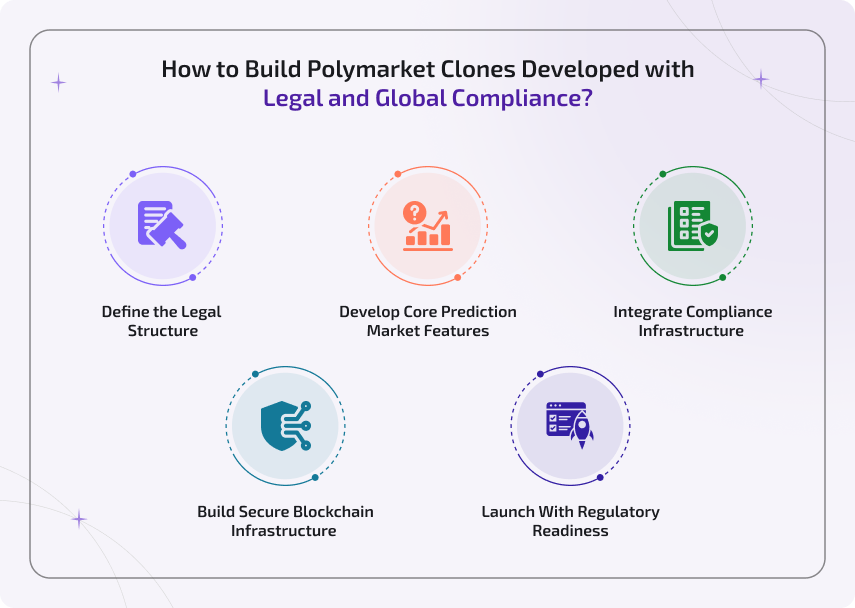
How to Build Polymarket Clones Developed with Legal and Global Compliance?
Many entrepreneurs focus first on technology and user experience. However,
successful prediction market platforms begin with legal compliance for Polymarket software
and regulatory planning.
If your goal is to roll out a platform where Polymarket is legal across
different jurisdictions, then compliance has to be worked in, at every layer of the
platform.
Step 1: Define the Legal Structure
Before development begins, determine:
Target markets
Licensing requirements
Regulatory obligations
Compliance framework
Legal entity structure
Your legal strategy should guide platform development rather than being added
later.
Step 2: Develop Core Prediction Market Features
A compliant Polymarket clone typically includes:
Event creation engine
Trading marketplace
Liquidity management
Wallet integration
Settlement mechanisms
User dashboards
Market analytics
Step 3: Integrate Compliance Infrastructure
Modern platforms require advanced compliance systems, including:
KYC/AML implementation
Geo-restriction tools
User risk scoring
Audit logs
Transaction monitoring
Sanctions screening
These systems are vital for keeping Derivatives trading compliance intact and
also meeting the global regulatory expectations.
Step 4: Build Secure Blockchain Infrastructure
A legally compliant platform should leverage:
Smart contract audits
Multi-signature controls
Secure custody solutions
Blockchain analytics
Automated settlement systems
Strong blockchain security helps with broader legal compliance too for the
Polymarket software requirements.
Step 5: Launch With Regulatory Readiness
Before going live, ensure that:
Legal reviews are completed
Required licenses are obtained
Compliance officers are appointed
Risk management policies are documented
Market surveillance systems are active
The most successful prediction market platforms in 2026 are not simply
blockchain applications. They are fully compliant fintech ecosystems designed to operate
within a global regulatory framework prediction market environment.
FREE CONSULTATION
Wondering If Polymarket Is Legal? Build a Compliant Prediction Market
Platform
If you're exploring whether Polymarket is Legal,
we help you build a compliance-ready prediction market platform tailored to global
regulatory requirements.
Prediction markets are no longer some niche ideas. They are moving fast into a
more capable tool to forecast pretty much everything, from elections and market swings to
sports results and wider global happenings. And while the question “Is Polymarket legal?”
really depends on where you are, plus the licensing obligations, and the regulatory
framework involved. Compliance is becoming equally important as innovation, even when the
technology itself is pushing ahead.
We cover everything from smart contracts and blockchain integration to
compliance-ready architecture, and also a smooth trading experience for everyday users. In
the end, we help turn fresh prediction market concepts into platforms people genuinely trust
and actually enjoy using.
Frequently Asked Questions
Not always. Many regulators view prediction markets as financial or
information markets because users trade event contracts rather than place
traditional bets. However, the classification depends on local laws and
platform structure.
Yes, it can operate globally, but only if the company has the right kind of
licensing, plus proper compliance measures, and also jurisdiction specific
restrictions that apply where users are.
No, blockchain technology can boost visibility, harden security, and make
settlement happen faster, but whether it is legal depends on regulatory
compliance, licensing approvals and the real laws in each jurisdiction the
platform reaches, so it is not the same everywhere.
Get all the latest posts delivered straight to your inbox.
Get In Touch
Our expert team is professionally well-equipped with hands-on experience as a
blockchain development company. Connect with us; at BlockchainX, we curate your desired
sustainable solution!