Why Your Business Is Losing 5–7% on Every International Payment
Listen to the Audio :
Stepping into global markets feels like the way to unlock bigger opportunities in your business. Every delay, every hidden fee, and every compliance hurdle in an international payment can have a significant impact. While a cross border payment looks efficient, it deducts a certain portion of your funds as hidden intermediary fees.
In today’s fast-paced global ecosystem, even a 2-3% hidden fee on currency conversion can lead to a 5-7% loss per transaction. For businesses handling regular international payments, this isn’t just a minor loss; it’s a drastic drain that can lead to heavy loss when unnoticed. No worries; there are solutions.
Understanding where and how the loss occurs is the first step towards controlling cross-border payment loss. Get through the blog below to know how businesses are losing 5-7% on every international payment and how modern solutions overcome the loss effectively.
What are International Payment Systems?
International payment systems are advanced, technology-driven mechanisms that facilitate the transfer of money beyond domestic borders via card networks, banks, and online payment platforms securely. This financial network usually runs globally, connecting individuals from different locations.
They act as trusted intermediaries, helping transactions operate smoothly across borders within legal boundaries. Unlike traditional payment methods, these international systems rely on standardized operations and reduce friction in global trade with improved financial accessibility.
They are designed to support and handle large volumes of transactions while ensuring security and adherence to international financial regulations.
Why Do Businesses Lose 5-7% on Every International Payment?
Every international payment may appear simple, and you might think that only a small amount of fees is charged for cross-border payments. But actually no. Behind every transaction lies a complex chain of financial processes that silently costs simple charges that are unaware of it.
The hidden leakage of this loss might be simple, but it actually ranges from 5 to 7% for transactions alone. Understanding where the real money goes is a crucial factor for every business aiming to optimize and protect its global transactions and margins. Let’s see where the real problem lies.
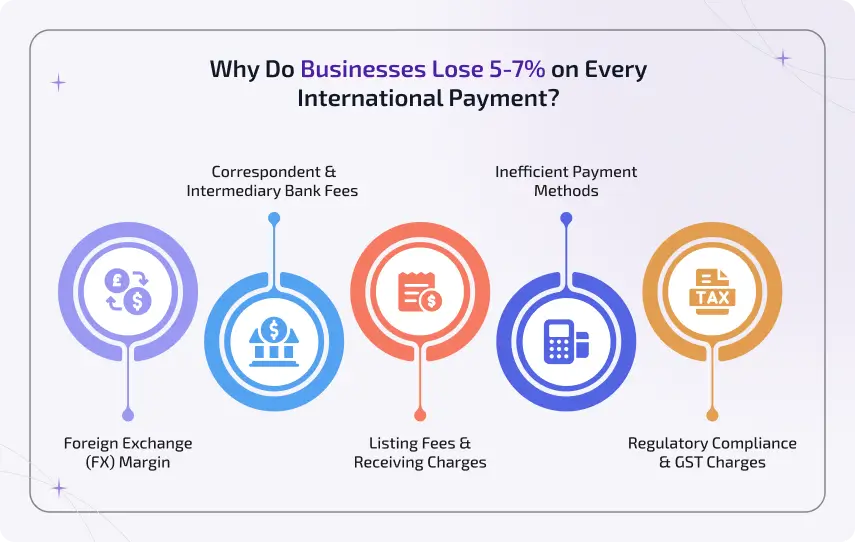
Foreign Exchange (FX) Margin
This is the largest source of loss, which takes a significant portion of 5-7% from the currency conversion loss. Instead of using the real mid-market exchange rate, financial institutions like banks and payment providers add a markup rate of 1.5% to 3.5% on top of the actual rate.
This clearly shows that for high-value transactions, even a small percentage of difference can end up being huge losses, making it the biggest cost driver. This lack of margin visibility is rarely shown as a separate fee and comes with hidden charges.
Correspondent & Intermediary Bank Fees
International business payments often move through a chain of intermediary banks via the SWIFT network, especially when there is a lack of a direct relationship between the sending and receiving banks. Each bank in the chain deducts a service fee for processing and routing the payment, which typically ranges from $10 to $30 per bank.
In rare scenarios, if a single international payment solution for businesses passes through more than intermediary banks, say, for example, if it passes across 2 to 4 banks, businesses incur a cumulative loss of $20 to $100 or more.
Listing Fees & Receiving Charges
Even after the money is sent, that is beyond sending charges. Businesses also face charging fees at the receiving end. These charges are often deducted before the funds are credited, and the bank may impose incoming wire fees that range between $10 and $30 per transaction or even higher for premium banking services.
In rare cases, businesses using financial platforms or marketplaces will also face listing fees, especially when it’s tied to global service networks, and these charges can range from 0.5% to 2% depending on the provider.
Inefficient Payment Methods
Traditional international payment solutions, especially those processed through legacy systems, are often inefficient. They come with outdated infrastructure that requires manual interventions, multiple validations, and delayed settlement cycles, which often lead to increased operational costs.
For instance, wire transfer charges range from $15 to $30 per transaction, where settlement times can take about 2-5 business days. Indirect losses happen with the integration of manual intervention, which paves the way for delayed work and reduced cash flow efficiency.
Regulatory Compliance & GST Charges
Cross border payment is often subject to strict regulatory frameworks such as KYC and AML, which are the silent killer of business losses. The majority of financial institutions rely heavily on compliance infrastructure, where costs are indirectly passed on to businesses through service charges.
The international payment charges may also attract GST on financial services, where businesses may lose up to 18% on applicable fees. In addition to this, regulatory overhead can contribute over 0.5% to 1% of the total transaction cost, and delays occurring in international payment solutions for business due to compliance checks can directly impact the transaction value.
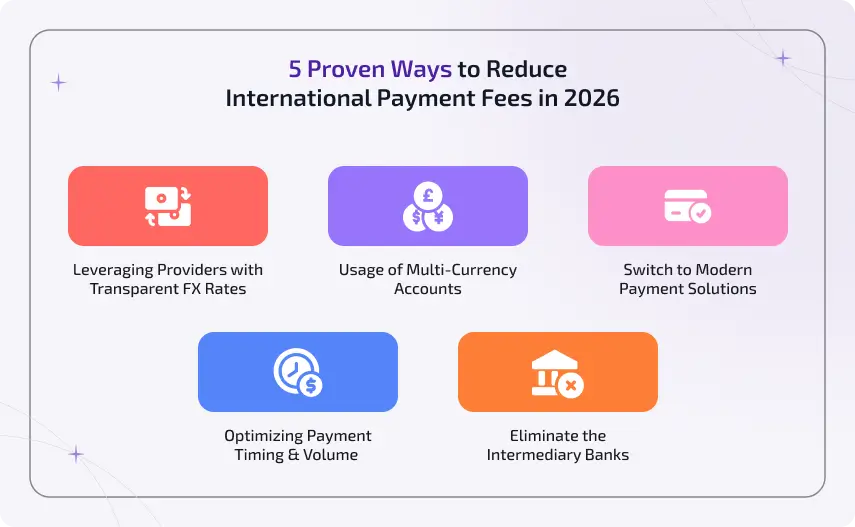
5 Proven Ways to Reduce International Payment Fees in 2026
Wondering how to reduce international payment fees? Cutting down cross-border business payment from 5-7% is a crucial process in today’s globalized marketplace. Especially when dealing with frequent or high-value cross-border transactions, multiple charges will be hidden, where businesses need to access smarter strategies and modern financial solutions to remove them.
In 2026, the most effective strategies that focus on removing intermediaries and minimizing international payments are listed below for your reference. Watch them and learn to retain more value from every transaction.
1. Leveraging Providers with Transparent FX Rates
One of the most strategic ways to reduce the international payment cost is to choose a provider who offers mid-market exchange rates with high transparency.
Traditional banks often hide their profit by offering 3-5% on currency conversion, which increases the total transaction cost.
So, choose a wise provider who utilizes mid-market rates and charges a clear upfront fee by saving thousands of dollars annually.
2. Usage of Multi-Currency Accounts
Creating a separate bank account in every country is a nightmare. Instead, use a multi-currency account that gives you local bank details across multiple countries within a single application.
This method eliminates the need for repeated conversions, which plays a major role in cost leakage and helps businesses avoid losses from volatile currency fluctuations.
To make it clear, payments received in USD and paying suppliers in EUR can hold funds in both currencies or convert when exchange rates are favorable.
3. Switch to Modern Payment Solutions
Modern solutions use payment orchestration, which finds out the best and cheapest route for your money, unlike traditional banking systems.
Wire transfers, which cost $20-$40 per transaction, can be reduced significantly to 1-2% or less with modern solutions, guaranteeing faster settlements.
Businesses handling frequent international transactions can use this method, which leads to long-term savings.
4. Optimizing Payment Timing & Volume
Strategic planning of payment timing and volume can make a noticeable difference in reducing costs.
Instead of doing multiple small transactions, they make fewer, larger payments instead.
The process of monitoring exchange rate trends and executing conversions during optimal times assists in protecting against financial losses. The ability to save money through exchange timing improves when there is a 1% improvement for high-value transactions.
5. Eliminate the Intermediary Banks
Intermediary or correspondent banks are a major source of hidden fees in international payments. Each bank involved in the transaction process may deduct $15–$50 or more, leading to unpredictable costs.
Using payment providers that offer direct transfer routes or local settlement networks by smart contract development, businesses can bypass the intermediaries completely.
This not only reduces transaction fees but also speeds up processing time and ensures that the intended amount reaches the recipient with improved transparency and reliability.
Industries Most Affected by International Payment Losses
International business payment losses, especially for industries with high volumes or large ticket sizes, undergo a greater impact, draining up to 5-7% of transaction value. Sectors operating on frequent international transactions lose billions of dollars annually due to various factors like intermediary fees, delayed settlements, and more.
The section below clearly explains to you the most affected industries
E-commerce & Marketplaces
Global e-commerce often deals with processing payments from all around the globe and across various currencies.
They are the most affected sectors, with their high transaction volumes and currency volatility, and even small FX markups can lead to substantial losses of 3-10%.
SaaS & IT Service Providers
These companies often serve global clients and receive payments in multiple currencies. They face foreign exchange expenses because they conduct international business activities, which require them to process payments multiple times.
The companies experience financial losses through their continuous expenses, which cause 3-5% cost leakage to their total net revenue.
Manufacturing & Supply Chain Businesses
Manufacturers with global suppliers and distributors regularly make cross-border payments.
The process of making international payments faces disruptions because of three factors, including payment delays, foreign exchange market fluctuations, and charges from intermediary payment processors, which cause higher costs.
Financial Services & Investment Firms
International investment companies, remittance services, and asset management firms handle high-value transactions, which cause substantial financial losses from even minor percentage reductions.
The industry requires payment systems to provide transparent, fast, and cost-effective solutions because payment inefficiencies create significant problems for their operations.
Travel & Hospitality Industry
Every day, travel, tourism, and hospitality businesses handle international bookings together with international payment transactions.
The total costs of currency conversion fees and payment gateway charges, together with refund-related transaction expenses, can reach 5% during peak seasons and when businesses process high volumes of international transactions.
Import & Export Businesses
The international trade companies experience the greatest impact because they constantly handle substantial international payments, which require both sending and receiving operations.
The profit margins of 2% face direct impact from currency fluctuations, intermediary bank fees, and delayed settlements, which occur during the bulk order process.
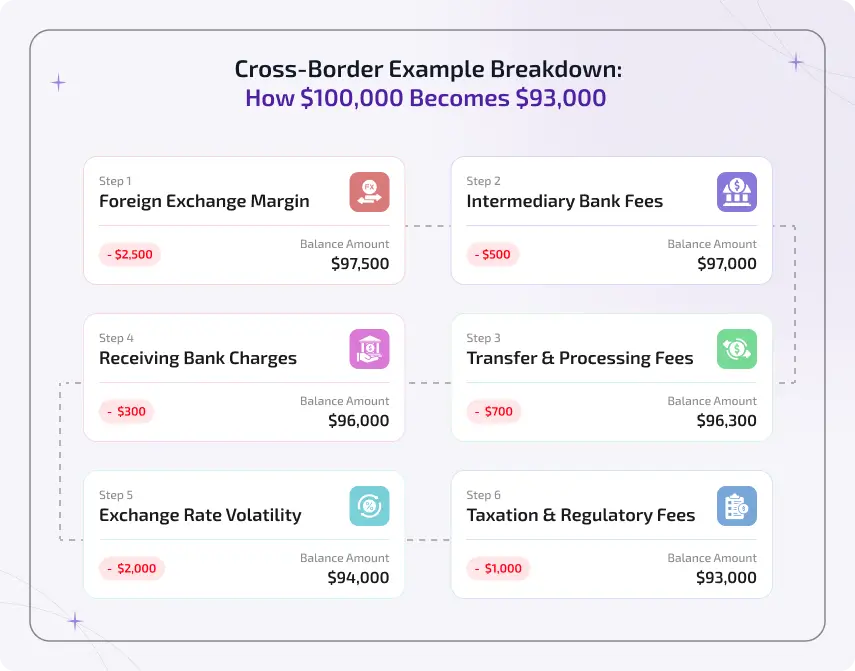
Cross-Border Example Breakdown: How $100,000 Becomes $93,000
Many businesses assume that an international business payment might be a straightforward transaction. But it’s actually not. In reality, a simple payment goes through several financial systems where margins, fees, and inefficiencies are applied through every stage and gradually reduce the overall value.
To make it clearer, let’s break down an example of how $100,000 drops down to around $93,000, making businesses face a 5-7% loss on every international payment.
Step 1: Foreign Exchange Margin
It is the major and initial deduction that happens during an international business payment. In this case, banks and payment providers skip the real-time mid-market exchange rate and include a hidden markup of about 2-3% based on the currency pair and provider. In the back, this deduction often goes unnoticed.
Loss Amount: $2,500
Balance Amount: $97,500
Step 2: Intermediary Bank Fees
Once the payment is initiated, instead of moving from the sender’s bank to the recipient’s bank, it passes through two to three intermediary banks that facilitate the transfer. Each bank charges a handling fee, which costs about $10 to $50 per bank. Here, the deductions or the intermediaries involved are invisible.
Deducted Amount: $500
Balance Amount: $97,000
Step 3: Transfer & Processing Charges
The intermediaries, that is, the banks and payment providers, charge a certain fee for initiating and processing the transaction. Depending on the type of provider, the charges vary from $20 to $50 per transfer, which includes service charges, transfer fees, and backend processing fees.
Deducted Amount: $700
Balance Amount: $96,300
For larger volumes of transactions, the pricing percentage may vary, which contributes a major part to the overall cost factor.
Step 4: Receiving Bank Charges
Once the payment reaches the recipient’s bank, it’s the final deduction stage where additional charges are applied for handling incoming international transfers. This charge is deducted before the funds are credited back and typically ranges between $10 and $30, which can increase anytime depending on the bank and service level.
Deducted Amount: $300
Balance Amount: $96,000
Step 5: Exchange Rate Volatility
One of the hidden value losses occurs in this stage. Generally, international payments are not always instant. They take about 2-5 business days during which exchange rates fluctuate. If the currency value decreases, the transaction value will continue to decline. This kind of situation mostly occurs in currency markets where there is high volatility.
Deducted Amount: $2,000
Balance Amount: $94,000
Step 6: Taxation & Regulatory Charges
One of the hidden value losses occurs in this stage. Generally, international payments are not always instant. They take about 2-5 business days during which exchange rates fluctuate. If the currency value decreases, the transaction value will continue to decline. This kind of situation mostly occurs in currency markets, where volatility is high.
Deducted Amount: $1,000
Balance Amount: $93,000
This example clearly breaks down that what started as a $100,000 international payment can be significantly reduced to $93,000 with a loss of 5-7%. Even a small and unnoticed charge at each stage adds up to a significant loss for businesses with frequent or high-value cross-border transactions.
Signs Your Business is Overpaying for Cross-Border Payments
Signs of cross-border overpayment include many factors. Here is a curated list of those. Businesses often lead to unnecessary losses per transaction, which are often invisible. By recognizing the indicators of high cross-border costs, businesses take control and significantly reduce international payment charges.
Inflated Foreign Exchange: Banks often add hidden FX markups upto 1-3% to the real exchange rate, which significantly increases transaction cost.
Slow Settlement Times: Payments taking 3-5 business days can lead to additional losses due to currency fluctuations.
Frequent Currency Conversion: When multiple conversions are made between currencies, FX charges increase due to an additional 2-4% in loss.
Lack of Cost Transparency: Hidden fees like the intermediary charges or processing costs create a lack of visibility and thus make it impossible to calculate.
Recurrent Payment Failures: Transaction costs rise when payments are delayed and when the penalties and additional charges are applied automatically.
Why Traditional Banking Systems Cause Higher Costs for International Payments
Traditional banking systems are often not curated to suit today’s rapidly evolving global economy. It’s where they rely on certain factors, all of which increase the overall cost for every international cross border payment.
In a traditional international transfer, banks often lack direct relationships. So, they use intermediary banks to bypass payments. Here is where each intermediary bank deducts a certain amount, increasing the overall transaction cost.
Legacy systems often involve batch processing and manual validations, which increases the overall operational cost.
Delays in settlement lead to currency fluctuations, which often take about 1-5 business days for an international payment. This heavily impacts the cash flow.
Instead of real-time exchange rates, intermediary banks often add FX margins of 1-3%, significantly inflating the overall cost of currency conversion.
Traditional banking systems come with various charges like processing fees, wire charges, intermediary costs, and much more, combining unpredictable changes that can exceed up to 3-5% per transaction.
Banks heavily rely on regulatory compliance for every cross border transaction. This cost compliance is passed on to the customer as service fees or service charges.
Modern Alternatives to Reduce Global Payment Costs
Traditional international payment solutions are often expensive and inefficient, which can be overcome with modern alternatives in a smarter way. In 2026, these solutions offer a transparent, faster, and low-cost alternative to the high-fee platforms attracting global businesspeople.
The tabulation below provides the modern alternatives that help you cut down on losing 5-7% on every international payment.
Alternatives
How It Helps
Popular Examples
Cost Benefit
Fintech Cross-Border Platforms
Provides cross-border payments with better FX rates and much lower transfer fees
Stripe, Payoneer, Wise
0.5-2% fees vs 5-7% traditional
Blockchain-Based Payments
Enables seamless international transactions with better FX rates and much lower transfer fees
USDC, Ripple, Bitcoin
<1% fees with instant settlement
Local Payment Networks
Uses domestic payment systems instead of international wire routes
SEPA, UPI, ACH
Reduces transfer fees with improved payments
Modern Wallets & Payment Gateways
Simplifies international payments with an integrated fee structure
PayPal, Amazon Pay, Skrill
Faster access with 2-3% predictable fees
Multi-Currency Wallets & Accounts
Hold & transact in multiple currencies without repeated conversions
Airwallex, Wise Business, Revolut Business
Saves 1-3% on repeated FX conversions
How BlockchainX Helps Businesses Reduce International Payment Losses
Still confused about what are international payment systems and how to reduce cross-border payment? It’s now about using new technology; it’s a strategic approach that requires deep domain expertise and the ability to use the right infrastructure.
BlockchainX, a leading enterprise-grade blockchain and fintech solution provider, enables businesses to reduce international payment costs with its advanced, optimized solutions. Our experts apply proven tactics and address the root cause of traditional losses, helping to retain more value from every transaction with high confidence.
BlockchainX implements intelligent conversion strategies for smart currency handling and conversion logic.
Our experts analyze and restructure payment routes to eliminate unnecessary costs and banks.
We integrate optimized liquidity solutions with real-time rates to reduce delays and prevent losses with high transparency.
BlockchainX supports instant cross-border transactions across multiple currencies and digital assets.
We help businesses handle high-volume cross-border transactions efficiently with tailored crypto payment gateway development solutions built for global scale.
Our developers provide consistent ongoing support and maintenance to track payment performance with full optimization.
Conclusion
Cross border payments are an unavoidable factor in international business dealings. Since it is a multi-layered financial process, a certain amount will be deducted at every step. But this consistency of losing 5-7% on every international transaction is not right, as it affects pricing strategies and overall profitability.
Addressing this isn’t just about cutting costs, but it’s the strategy of choosing the right partner, modern payment solutions, and better systems to prevent it actively, turning international payments more efficient and controlled. Ready to minimize your international payment cost? Connect with BlockchainX and take the next step to discover smarter payment solutions.
Get all the latest posts delivered straight to your inbox.
Get In Touch
Our expert team is professionally well-equipped with hands-on experience as a blockchain development company. Connect with us; at BlockchainX, we curate your desired sustainable solution!