Best Crypto Marketing Strategies That Work in 2026: 10 Proven Tactics
By Yokesh Sankar15 min readUpdated On
Listen to the Audio :
Crypto marketing strategies in 2026 are not just about influencing or advertising an innovation; they go beyond that, serving as the driving force behind successful projects. These approaches stand as the key drivers of project promotion, user education, and building a loyal user base.
In the evolving digital ecosystem, crypto markets have become highly competitive, with a large user base expected to reach 993.4 million by the end of 2026. In such a crowded market, using the right marketing strategies has become crucial to gain good project visibility and reach.
In this blog, let’s explore the dominant strategies provided by the leading crypto marketing agencies.
What Is Crypto Marketing?
Crypto marketing is all about promoting innovative crypto projects like new blockchain platforms, digital tokens, and Web3 exchanges to reach a targeted audience and the maximum possible users. It implements expert strategies such as community building, KOL collaboration and partnerships, and trustworthy campaigns to attract investors worldwide.
Marketing is not just about enhancing the project’s visibility; it’s about building trust through data and transparency. This is made possible by focusing on the project's core value, its functionalities, and real-world use cases and promoting sustainable growth in a highly competitive landscape.
Top Crypto Marketing Strategies That Actually Work in 2026
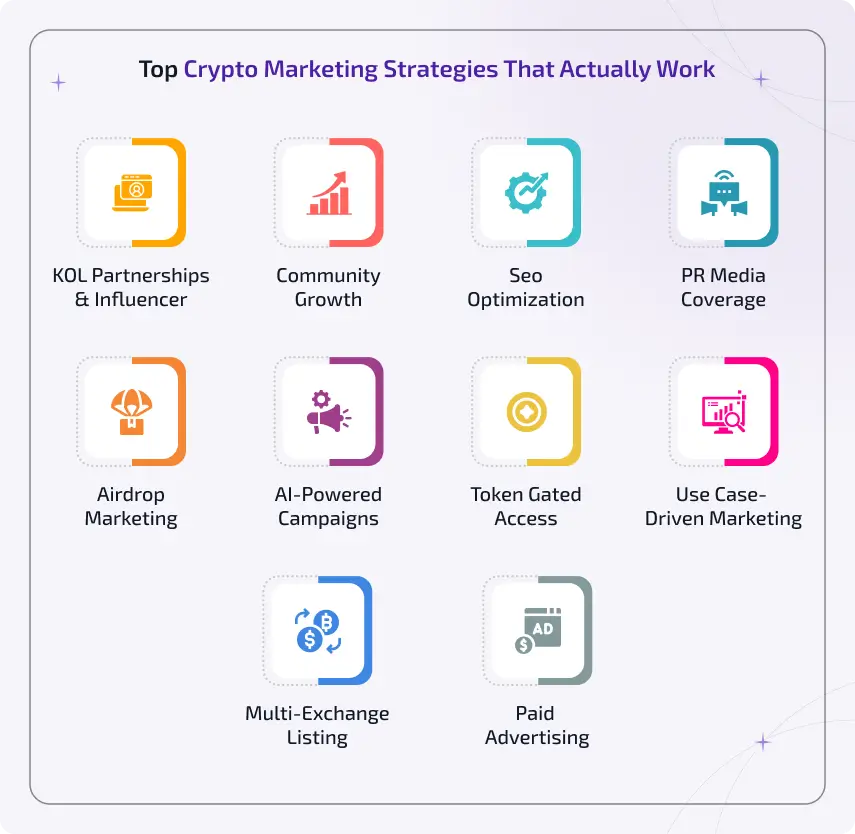
Crypto marketing has developed beyond hype-driven advertising into more strategic, value-based, and practical approaches. Successful innovators now rely on proven Web3 marketing strategies to promote their projects. The following handpicked list highlights the leading crypto marketing strategies at present.
1. KOL Partnerships and Influencer Marketing
KOL (Key Opinion Leaders) strategic partnerships establish a strong foothold in the industry, making it one of the top crypto marketing strategies.
The voices of highly respected figures are more likely to be trusted by numerous followers, which creates a good impression, with increased visibility and long-term value in the market.
Rather than a one-time project promotion, consistent partnerships can deliver an enhanced participation level, contributing to the project’s overall success.
2. Community-Led Growth
Considered one of the best crypto marketing strategies in the ecosystem, community-led growth fosters active, engaged user participation.
This approach goes beyond short-term hype, naturally building a loyal user community that becomes a part of the project beyond playing the investor role alone.
They share their key insights, feedback, and opinions that eventually contribute to the organic growth of the project in the market.
3. SEO Optimization
Search engine optimization is a high-impact crypto project marketing strategy, as it plays an essential role in the dynamic digital environment.
By refining website content, blog posts, and landing pages with suitable keywords, venture projects attract organic traffic from users searching for market solutions.
It also has strong credibility, as higher search rankings often provide a trustworthy environment for users.
4. PR Media Coverage
Public Relations (PR) marketing focuses primarily on branding the blockchain project through media coverage and mainstream news outlets to build trust among the users and investors.
This strategy creates genuine brand awareness and visibility by featuring projects in reputed and most trusted publications like Cointelegraph, Decrypt, and CoinDesk.
It enhances the project's positioning and recognition through crypto PR marketing services in a highly competitive market while supporting its long-term growth.
5. Airdrop Marketing
This is a token distribution technique where the projects provide free tokens to the users in exchange for completing simple tasks assigned as part of the strategy.
Beyond rewarding early users, an airdrop marketing agency builds strong brand awareness by promoting its projects in communities on X (formerly Twitter).
This engages users effortlessly, making it the most profitable crypto marketing strategy that promotes the project within a shorter period.
6. AI-Powered Campaigns
Artificial intelligence is integrated to create a personalized, smart, and systematic environment for users, traders, and investors.
In this strategy, AI algorithms and tools are used to analyze the user behavior patterns and data to deliver better outcomes to the right audience.
They run personalized campaigns through emails, suggested ads, and content recommendations to increase user participation and engagement levels within the markets.
7. Token-Gated Access
One of the safest crypto project marketing strategies that offers exclusive access to content and communities to users who hold particular tokens or NFTs.
Users can hold tokens to receive rewards, updates, or premium access through these engaged communities.
This approach strengthens user loyalty and encourages long-term participation of the audience by creating valuable ownership within the ecosystem.
8. Use Case-Driven Marketing
In this crypto growth strategy, real-world use cases and practical value are given more weight than mere product hype.
This stands out as trustworthy and credible among other strategies, as it focuses on transparency and applicable solutions.
By communicating clearly, projects promote sustained growth benefits rather than short-term gains.
9. Multi-Exchange Listing
For crypto projects, it's crucial to increase their market visibility. So, multi-exchange listing is the best way to reach a targeted audience.
In this method, the projects list their tokens in various exchanges to increase their investor accessibility, which in turn attracts new users within the ecosystem.
It improves the trading volume, making it easy for users to trade tokens without any limitations.
10. Paid Advertising
Paid advertising is a cryptocurrency project marketing strategy that allows projects to reach a wider audience through publishing targeted advertisements on Google, Twitter, and Reddit.
They place native ads and relevant banners directly on high-traffic networks and crypto-related websites to enhance the project’s visibility.
They offer immediate results and support conversions when executed effectively for the right users.
BlockchainX, a top crypto presale marketing agency, specializes in DeFi, RWA tokenization, and more, and offers powerful crypto strategies for startups and businesses to grow in the Web3 landscape. To know more about our marketing strategies, reach out to our team today!
How to Make an Effective Crypto Marketing Strategy
Building your own crypto marketing strategy starts from a clear understanding of your project’s purpose, target audience, and the right choice of channels and objectives, which are the driving force behind a scalable marketing foundation. The following are the major steps involved in the process:
Step 1: Establish the Project’s Purpose
Clear goals are the seeds for shaping the overall marketing growth. This step involves establishing the main purpose of your innovation, such as brand presence or user acquisition.
Step 2: Know Your Target Audience
Identify and be sure of who the target is—traders, investors, general, or long-term users. This will provide insights to tailor your platforms and brand your products effectively while also enhancing their reach.
Step 3: Present Your Value Proposition
This is a core step where you must highlight your project’s value proposition that makes it stand out in the competitive landscape. Emphasize the real-world utility and key capabilities of your platform.
Step 4: Choose the Right Channels
Not all users are available on every platform. Traders will be active on exchange platforms, whereas investors prefer following news media. So, project promotion with the right strategy is very important to engage users effectively.
Step 5: Engage Your Community
Through social media platforms like Telegram and Discord, you can attract and make audiences interact and support the project’s growth organically. It also builds an active community with a loyal user foundation.
Step 6: Track Performance and Analytics
Track the data analytics using core metrics like user behavior, traffic, and conversions. It would help you to understand the performance level and where it needs refinement. This keeps campaigns effective and aligned with goals.
Step 7: Optimize Continuously
You need to improve strategies based on insights from performance records to deliver the best outcomes. It helps optimize the project consistently and upgrade the overall performance and quality.
Key Crypto Marketing Trends in 2026
The crypto marketing system has become a more trusted and transparent environment, focusing primarily on user expectations and requirements. The points below will provide a clear view of the key trends of crypto marketing services in 2026.
Marketing has shifted from instant hype and short-term gains to real-world utility, where users started valuing trust-based outcomes and transparency.
The investor accessibility has expanded in multiple ways, attracting new users globally, thereby boosting market liquidity.
Crypto is valued as a long-term, yield-generating asset class in the ecosystem supported by its institutional reserves and reward-bearing financial products.
Stablecoin usage is popularized for cross-border payments & transactions, expanding their crypto market size of $307.6 billion, with USDT at $187 billion (61%) and USDC at $75.2 billion (24%).
Projects are now prioritizing a community with a loyal and engaged user base as a core strength over shallow metrics like product impressions or followers.
AI and smart automation have been widely used for customization and analyzing user behavior patterns to boost audience participation and conversions.
Compliance and legal standards must be followed more strictly to avoid potential risks and enhance the transparency level for trusted users.
The strategies are backed by real value with accurate on-chain data for tracking market functioning and user participation rate, enabling better-informed decisions.
Estimated Budget Breakdown of Crypto Marketing (2026)
There is no single standard crypto marketing budget. Published agency guides suggest most projects put roughly 30–40% into KOLs and community, 15–20% into PR and content, and 10–15% into SEO, with the rest split across paid ads, airdrops and testing. The split below is an illustrative starting point for a typical token launch. Adjust it to your stage, audience and results.
Strategy
Purpose
Suggested Share
Priority
Influencer & KOL Partnerships
Build trust and audience reach
23%
High
Community-Led Growth
Build an active, loyal user base
20%
High
PR Media Coverage
Build brand credibility
10%
High
Educational & Content Strategy
Educate users and build trust
10%
High
SEO Optimization
Grow organic traffic
10%
High
Paid Advertising
Drive targeted traffic where ads are allowed
7%
Medium
Airdrop Marketing
Attract early users and wallets
6%
Medium
Use Case-Driven Marketing
Show real-world value
4%
Medium
Multi-Exchange Listing
Marketing around listings (fees excluded)
4%
Medium
AI-Powered Campaigns
Personalize campaigns and targeting
2%
Medium
Token-Gated Access
Reward holders with exclusive access
2%
Medium
Email Marketing
Retain users and nurture leads
2%
Medium
Exchange listing fees are usually budgeted separately from marketing. Tier-2 exchanges can charge roughly $20,000 to $300,000, and top-tier listings cost far more once market making and liquidity are included. Paid ads are a small share because Google and Meta restrict crypto advertising and require certification. Airdrop tokens come from your supply and are not counted in this split.
Crypto Marketing Funnel: From Awareness to Referral
A crypto funnel strategy is a multi-layer approach that guides potential investors from initial discovery of the project to becoming loyal members or token holders. Each layer focuses on moving users closer to trust, consideration, and action.
It is called the funnel strategy, as its shape mirrors how users drop off at each stage of the journey. Let’s look into the elaborated version of each layer in crypto marketing strategies:
Awareness Layer
This is the initial stage, which focuses on presenting the new venture project to a global audience and building broader market visibility. It's about earning user attention and creating brand awareness rather than instant conversions with the help of the right marketing channels like Twitter, Discord, or earned media.
The key metrics include target reach, website traffic, social media engagement, and impressions.
Acquisition Layer
The primary goal of the acquisition layer is to bring interested users to take their first step by onboarding and registering on the platform. It performs actions like sign-ups and wallet integrations.
The channels that include landing pages, paid ads, airdrop campaigns, and KOL promotions encourage users and investors to register. Key metrics include CPA, registration level, and wallet connection rate.
Activation Layer
This stage emphasizes turning the new users into active participants by creating a seamless and valuable first user-interaction with the platform. This engages the audience through simple tasks assigned by the exchange or participation in the airdrop or paid campaigns.
Key metrics include measurable session engagement, user time on the platform, and first transaction within the digital ecosystem.
Retention Layer
Retention layer centres on keeping users active, engaged, and committed to the crypto project, encouraging them to return to the platform consistently. Its main purpose is to build long-term connections and prevent users from dropping off after the initial usage.
Key metrics include DAU/MAU (daily and monthly active users), churn rate, and token-holding duration. This layer uses community engagement, incentive programs, and email marketing to retain users.
Referral Layer
This is solely focused on existing users to encourage, invite, and bring new participants into the platform. It is achieved through an incentive referral program, bounty campaigns, and rewards being distributed to users who bring in new participants.
Key metrics include the number of invites, referral rate, and viral coefficient. This offers cost-efficient growth, promoting users into a major part of the project.
Why Do Most Crypto Marketing Strategies Fail in 2026?
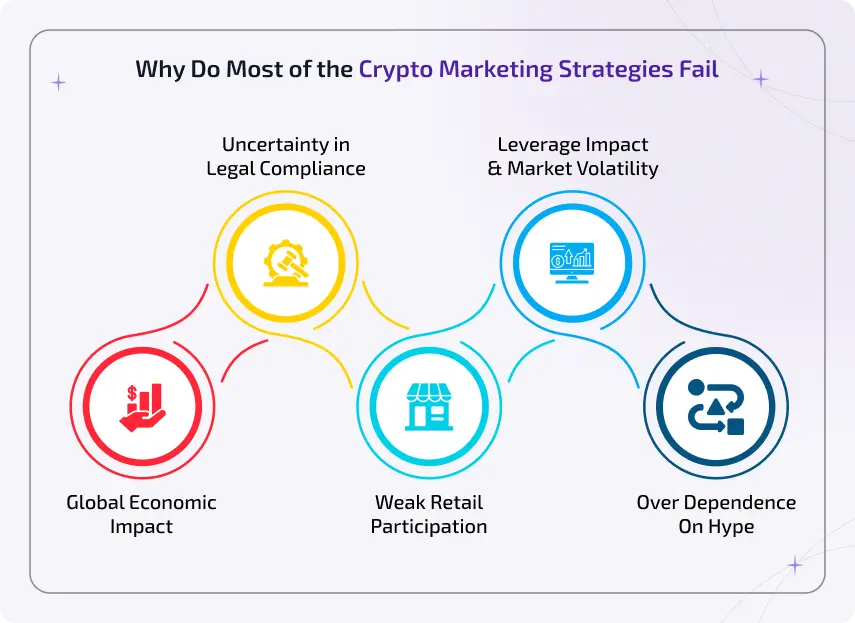
Despite the strategic growth of the crypto industry, many projects have showcased a decline in 2026. Marketing strategies are failing due to weak communication of value, poor market adaptability, and more. The following points elaborate on the reasons behind the fall of crypto marketing strategies at present:
Global Economic Impact
Macroeconomic conditions such as interest rate hikes, price inflation, and financial slowdown directly affect market performance globally. These external factors can weaken the user's confidence, limiting the participation and growth of the market.
Regulatory Uncertainty
Constantly evolving regulations create a vague and uncertain condition for the crypto projects and investors. This lack of clarity can limit market expansion and delay the efforts of the platform. Projects must quickly adapt to the changes to sustain their market credibility.
Weak Retail Participation
Due to price variations and volatility, investors stay cautious, leading to lower engagement levels and weak market performance within the digital ecosystem. Decline in retail interest drastically reduces investor participation in the crypto market.
Leverage and Market Volatility
Mass liquidation of leveraged positions creates a huge impact and sudden downward momentum on crypto prices. These forced exits cause an uncertain condition, increasing the market volatility and negatively impacting the consistency and investor participation.
Over-Dependence on Hype
Depending too much on hype focuses on short-term gains and attraction rather than delivering real value to the users. This fails to build trust and confidence. As a result, once the hype of the project fades, it loses its user attention and participation level in the market.
Real-World Crypto Marketing Case Studies
This mix of crypto marketing case studies in 2026 represents a potential success or failure based on objective, trust, and execution. Let’s take a closer look at what worked, what didn't, and the major reasons behind it.
What Worked
The user-based strategies and real-world accessibility are the reasons behind the two successful projects mentioned below. They showcase how projects reached their peak through audience trust, engagement, and user experience.
Binance: Community Building
Rather than lavishly spending money on paid advertising, Binance moved a step forward by building a result-driven community using interactive campaigns, incentive referral programs, and trading contests, which led to the long-term growth of the platform.
Why did it work?
As the Binance platform gave priority to long-term value and user engagement, it built a trusted and consistent environment for users, making it successful.
Pudgy Penguins: Bridging Web2 and Web3
Pudgy Penguins expanded their marketing by bringing an established NFT brand into Walmart retail stores as physical “Pudgy Toys” with a blockchain QR code that reached non-crypto users as well. They turned an NFT brand into a tangible consumer product.
Why did it work?
It connected everyday users easily, as it was accessible by combining physical items with digital ownership, bringing both Web2 and Web3 users together.
What Failed
Not all crypto innovations became successful, especially without user authenticity, transparency, and proper validation. The following examples will highlight how misaligned approaches can lead to project failure.
Polkadot: Fake Followers and Bot Traffic
Polkadot allocated a large amount of capital funds towards KOL influencers' promotions, but most of the followers were fake, that is, bots and inactive user accounts, leading to the failure of the projects. It resulted in low reach, fake users, and poor conversion rates.
Why didn’t it turn out well?
Their marketing lacked proper tracking of influencers, leads, and verification of inactive accounts of users. With low participation or trust levels, it failed.
OneCoin: Hype Without a Product
OneCoin was globally broadcast and hyped as “Bitcoin Killer” through social events and referral promotion programs without having a real and functional blockchain product. It relied on mere hype tactics and turned out to be a Ponzi scheme.
Why didn’t it turn out well?
It collapsed as it was a fake investment scheme where new investor money was paid to early users, which led to a greater loss of trust and capital.
Conclusion
In conclusion, crypto marketing strategies demand a transformation from short-term hype to real value validation, trust-building, and utility in 2026. Each technique plays a significant role in creating a well-built market presence within the ecosystem.
With the usage of the right channels and approaches, businesses can easily adapt to market expectations and enhance the project’s visibility and credibility in the market. Further, verifiable data analytics and consistent effort help in achieving a sustainable position and leaving a lasting impact in a dynamic crypto industry.
Want to learn more about crypto marketing strategies? Contact BlockchainX experts and take advantage of our crypto marketing services.
Frequently Asked Questions
A cryptocurrency marketing strategy is a comprehensive plan or techniques implemented to promote Web3 projects through credibility, an active community, and real-world utility in a skeptical market.
Some of the ideal DeFi marketing strategies for launching a new digital token include KOL influencer marketing, PR media, community-driven growth, and airdrop/bounty campaigns that create project awareness, enhance trust, and increase participation effectively. Partnering with an experienced ICO marketing agency can further strengthen launch visibility and investor reach.
To reach a focused audience, niche projects rely on highly interactive marketing channels such as X (Twitter), Telegram, Discord, SEO, and content marketing to improve the brand's market visibility in the crypto industry.
Yes. Artificial intelligence makes every marketing tactic more scalable and efficient, making sure that the right content reaches the right audience. AI-powered data-driven campaigns, verifiable analytics, and systematic audience targeting help meet user expectations and provide a better trading experience.
The marketing strategies are falling short due to over-dependency on new product hype, poor audience targeting, and a lack of transparent value in the market. Ignoring these factors weakens the project’s overall crypto growth, turning it into a failure.
There is no fixed budget, but many projects allocate 6–12% of a raise to launch marketing, and monthly spend usually runs from $5,000 to $30,000. Most guides put the largest shares into KOL partnerships and community building, followed by PR, content and SEO. Keep a small reserve for testing, and budget exchange listing fees separately.
For tracking on-chain data analytics, community campaigns, and user patterns, top Web3 projects use tools like Galxe, Dune Analytics, and Cookie3. Additionally, they use platforms like Telegram to help connect with a wider audience network.
A crypto agency must possess distinct marketing ideas, professional expertise, and an extensive global network within the highly performing digital landscape. With the right agency partnership, businesses can show a powerful market presence, growth, and effective user adoption.
To build an effective crypto marketing strategy, focus on a clear purpose, target audience, and strong value. Always go for trust-backed systems and the real-world utility of projects over short-term hype. The right combination of channels and data-driven values enhances its reach and engagement level.
Get all the latest posts delivered straight to your inbox.
Get In Touch
Our expert team is professionally well-equipped with hands-on experience as a blockchain development company. Connect with us; at BlockchainX, we curate your desired sustainable solution!

 By Yokesh Sankar