Crypto Exchanges SEC Regulations USA 2026 : New Guide
Listen to the Audio :
The Crypto exchanges SEC regulations landscape is going through a major transformation as the Securities and Exchange Commission is paying far more serious attention over the digital asset ecosystem.
Strengthening SEC regulations on crypto exchanges should lead to clearer classification, stricter compliance standards, and, above all, increased protection for the investors. These developments are expanding into broader US crypto exchange regulations, encouraging them to adopt stricter reporting standards, custody solutions, and token evaluation processes.
Let us dig deeply into SEC's regulatory movement, which is defining the future operational architecture of crypto exchanges.
To meet evolving SEC expectations, platforms need reliable and compliant trading architecture. Our cryptocurrency exchange software development solutions provide a strong foundation for building secure, regulation-ready exchanges.
Why SEC Regulations on Crypto Exchanges Are Becoming Stricter
Crypto exchanges SEC regulations are strengthening due to increased digital asset institutionalization and SEC’s focus on minimizing structural risks within the crypto markets. In order to strengthen integrity in the market, protect the interests of investors, and create consistent regulations in the domain, the SEC regulations on crypto exchanges got stricter.
Key Drivers Behind Stricter Oversight
There is rampant fraud and manipulation signals ascending the severity of the crypto exchanges SEC regulations.
Increasing institutional participation is driving the need for more predictable SEC regulations on crypto exchanges.
There is an incidental effect of a harmonized regulatory environment, impacting new US crypto exchange regulations.
There exists the SEC's mentality of freshening up outdated frameworks, cascading into modified SEC crypto exchange rules.
Increased pressure on exchanges to register themselves as ATS or broker-dealer type of entities.
Greater collaboration between the blockchain-forensics firms will make the reports validate.
Applying a unified set of laws would be advantageous to improve SEC regulations impact on crypto operations.
Eventual harmonization in compliance with the evolving SEC regulations on crypto exchanges among the worldwide crypto space.
The level of crypto exchanges SEC regulations may seem similar at first glance, but a detailed reading suggests a shift towards greater transparency, resilience, and worldwide links. New SEC regulations on crypto exchanges start to commodify the features of this very magnitude into custody, full surveillance, full disclosure, and governance.
Anyone falling into this group which will not be able to always adhere to measures provided for broader US crypto exchange regulations concerning would have with which to claim that it has abided securely, lawfully, and beneficially under the terms of forthcoming norms.
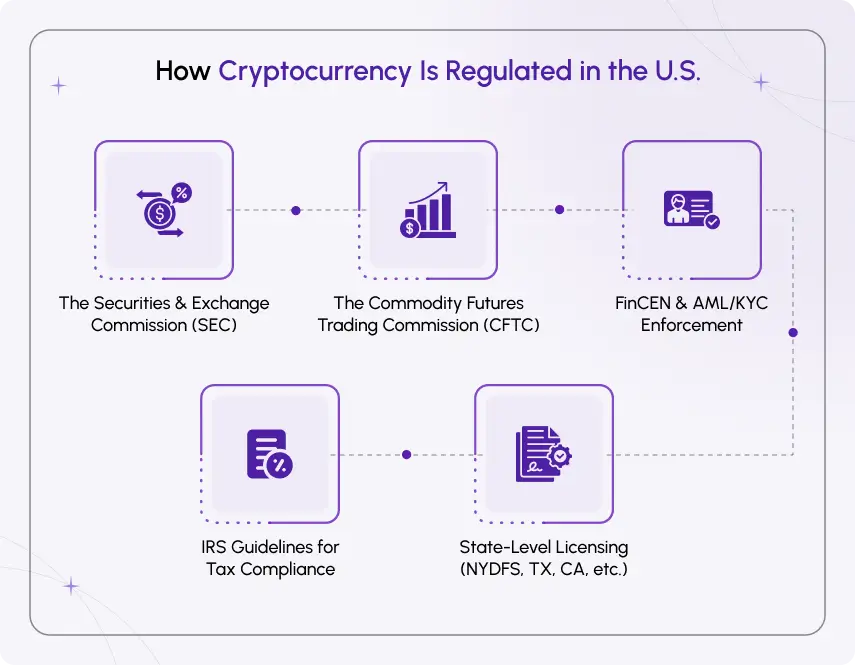
How Cryptocurrency Is Regulated in the USA
Cryptocurrency regulation in the United States is based on a structured approach in which the activities related to the digital assets are supervised by different regulatory agencies. This structure, which heavily borrows from the crypto exchanges SEC regulations, mainly pore over the classification, listing, and handling of digital assets for trading platforms.
Amending the SEC regulations on crypto exchange implies a wish to make the legal operation smoother, to add protection for the investors and, on another hand, to cut down the systemic risks in a digital economy.
1. The Securities and Exchange Commission (SEC)
The SEC regulates:
Tokens that have been treated as securities
Crypto trading platforms that are similar to securities exchanges
Investor disclosure and issuer transparency
Market manipulation prevention mechanisms
The recent SEC crypto exchange rules eventually made the exchanges change their status and become either brokers, ATSs, or stock exchanges.
2. The Commodity Futures Trading Commission (CFTC)
The CFTC deals with the following issues:
Supervising crypto-based commodities like Bitcoin
Enforcing derivatives, futures, and other products connected with the crypto market and having leverage through them.
Monitoring the market to keep it stable and to prevent fraud.
The issue considered by the SEC is not looked at by the CFTC, which focuses on crypto exchange regulation concerning commodities.
3. FinCEN and AML/KYC Enforcement
FinCEN enforces:
Making sure that the Anti-Money Laundering rules are in place and are followed.
Verifying the identities of the customers through the KYC process.
Transaction monitoring process and desolation of possible illegitimate actions.
Due to dynamic changes in the US crypto exchange regulations, the platforms would need to implement the most advanced identification systems to be able to remain compliant.
4. IRS Guidelines for Tax Compliance
Tax compliance is regulated by the IRS:
The reporting of the income.
Capital gains from the asset sale.
The taxation for the crypto-to-crypto transaction.
By providing the end-users with tools that ease the tax reporting process and documentation, the exchanges are bound to comply with the tax regulations.
5. State-Level Licensing (NYDFS, TX, CA, etc.)
States require:
Money transmitter licenses.
Cybersecurity audits.
Financial reserve requirements.
The state-level legislation for cryptocurrency exchange compliance is a challenge, to deal with, amongst others, for the nationwide exchanges.
Regulatory Roles in the USA Crypto Ecosystem
Regulator
Primary Role
Impact on Exchanges
SEC
Classification and regulation of securities
Drives crypto exchanges SEC regulations and token listing restrictions
CFTC
Oversees commodities & derivatives
Foresees the future of platforms dealing in derivatives
FinCEN
Enforcement of AML/KYC
Commands transaction monitoring
IRS
Tax compliance
Requires accurate reporting
State Regulators
Licensing & reserves
Impact operational expansion
How SEC Regulations on Crypto Exchanges Fit into the Broader USA Model
The SEC is the major regulator in the crypto exchange supervision in the USA. The strong SEC regulations on crypto exchanges are explicitly for the following requirements to be met by such exchanges:
Inception of the custody model that is transparent
Authentication of the issuer to verify their identity
Provide the company's audited financial and operational reports
Deploy the tools for the monitoring of the market in real-time
Setting up the segregation of the customer's assets
All these requirements are the main reasons for the United States Securities and Exchange Commission (SEC) to influence very much the shape of the crypto exchange landscape that is to come and to totally alter the way platform providers build their structures and compliance functions.
How SEC Regulations Will Shape the Future Crypto Exchange Model
The next generation of crypto exchanges will very much be under the umbrella of the new crypto exchanges SEC regulations that aim to bring about the heightened transparency, custody that simulates the institutional grade, and markets that become a lot more transparent and accountable.
The very first steps of the SEC regulations on crypto exchanges are making them better fit into the compliance-like setups in the institutional-grade ones and the areas of compliance, auditability, and risk management. These are no more be considered as features of platform design but like the core components that cannot be separated.
1. Exchanges Will Transition Toward Full Regulatory Licensing
Future exchanges will operate under
They will obtain broker-dealer registrations
Have their ATS (Alternative Trading System) applications approved
Even be given full securities-exchange licenses
This step will be a cornerstone for the financial markets being dragged into the new era and crypto trading will get the same legal treatment as the traditional regulated markets.
2. Token Listings Will Follow Strict, Pre-Defined Compliance Pipelines
The exchanges will have to pass through a lot of stages for token listings, including:
Security classification algorithms
Issuer-identity verification
Technical code audits
Economic-risk scoring
Through these actions, the situation of the non-registered securities will be dramatically decreased and the trust in the market will be additionally fortified.
3. Custody Models Will Become More Institutional
The platform likely consisting of the stricter crypto exchanges SEC regulations will be:
Custody accounts that are separated and regularly examined
Security based on Multi-party computation (MPC)
Partnerships with qualified custodians
Safeguarding of assets further covered by insurance
This will in turn make the nation's economy and the investors to be more secure and gain.
4. Real-Time Market Surveillance Will Become Mandatory
High-tech surveillance systems are going to be actively working as watchdogs for illegal activities on the market such as:
Wash trading
Insider activities
Front-running
Spoofing and manipulation patterns
The utilization of AI analytics will play a significant part in effectively applying the new SEC regulations on crypto exchanges.
5. Exchange Infrastructure Will Become More Transparent and Auditable
The following requirements will be essential:
Automated KYC/AML flows
Transaction-risk scoring
Wallet reputation analysis
Regulatory reporting APIs
The compliance systems are interconnected and working in accordance with the cryptocurrency exchange compliance without the user experience being affected.
6. Integrated Compliance Engines Will Power Future Exchange Operations
The future exchange model will implement compliance systems interconnected and working in accordance with cryptocurrency exchange compliance without affecting user experience.
Automated KYC/AML flows
Transaction-risk scoring
Wallet reputation analysis
Regulatory reporting APIs
7. Hybrid CeFi–DeFi Models Will Emerge Under SEC Oversight
Exchanges will be required to have:
Regulated on-chain clearance
Permissioned smart contracts
Compliance embedded DeFi protocols
The result will be the development of new and improved products and services, that are also in line with the US crypto exchange regulations.
Future Outlook: What the SEC-Driven Exchange Model Looks Like
Exchange Component
Current Approach
Future Approach: SEC-Compliant Mode
Token Listings
Flexible, inconsistent
Rule-based, audit-backed
Custody
Internal wallets
Qualified, segregated custody
Compliance
Manual checks
Automated compliance engines
Transparency
Limited
Complete operational disclosure
Trading Oversight
Basic monitoring
AI-powered surveillance
User Protection
Moderate
Institutional-grade safeguards
It is expected that strict crypto exchanges SEC regulations will be the future of the digital asset trading landscape, and thus the exchanges will be transformed into platforms that are transparent, secure, and suitable for institutions.
The most impactful crypto trading platforms will be characterized by their focus on addressing compliance issues as their main priority instead of simply complying with regulations, as SEC regulations on crypto exchanges continue to evolve.
Key SEC Rules Impacting Crypto Exchanges
With the evolution of crypto exchanges SEC regulations, several basic rules are reshaping the ways that digital asset platforms operate, manage risk and remain compliant, following the Securities and Exchange Commission’s lead.
These initial SEC regulations on crypto exchanges lay down the criteria as what assets can be listed, how the custody is to be handled, and what trading protections are to be put in place. They could be said to be the combination of all of those rules that the future compliant, transparent, and institution-ready exchanges will be governed by.
There might be transactions of securities-type assets that will require officially registering establishments such as:
A national securities exchange
A broker-dealer
An Alternative Trading System (ATS)
Major established enterprises that are allowing trading in financial products such as securities will have to establish proper crypto exchanges SEC regulations for security, similar to what has in traditional markets.
2. Token Classification and Securities Determination Rules
The SEC expects exchanges to implement:
Checking the Classification of Security
Declaration of Token Issuers
Due diligence for on-chain and off-chain
Identifying and Labelling Risks
These rules create an entire ecosystem that has a significant effect on the implementation of crypto exchange regulation. Hence, it will decide which assets can legally be listed.
3. Custody and Safeguarding of Customer Assets
Evolving crypto exchanges SEC regulations puts down the following conditions in regard to the trading platforms:
Customer funds are protected
Have the asset custody procedures scrutinized
Form alliances with competent custodians
Attain insurance or protection mechanisms
Consequently, the platforms are made to a good extent to reduce mismanagement risks and also improve investor protection.
The new crypto exchanges SEC regulations are going to compel the creation of systems that can:
Identify wash trades
Prevent spoofing
Mitigate frontrunning activities
Disclose insider trading
Report any unusual trading activity
The incorporation of frameworks for the prevention of manipulation with different techniques as a prerequisite for discussing the problem of efficient order matching.
5. Mandatory Transparency & Reporting Standards
Exchanges must offer the following:
Proof-of-reserves or validation of the equivalent assets
Financial statements
Reports with operational transparency
Real-time market data and liquidity information
The reporting standards that have been mentioned in detail, will highly enhance the market integrity and credibility.
6. Strict AML/KYC Enforcement
The platforms must implement the following enforcements as per USA regulatory alignment:
Improved identity verification process
Assessment of transaction risks
Investigation of sanctions violations
Detection of improper activities
This helps to align with the broader US crypto exchange regulations.
7. Safeguards for Investor Protection
The exchange platforms must adopt:
Very clear and impressive risk warnings
Registration processes that are very secure
Fee structures that are transparent
Asset is secured with strong protection mechanisms
These measures support reducing the SEC regulations impact on crypto investors. The Crypto exchanges SEC regulations are significant for businesses to establish a more organized, clear, and responsible regulatory environment.
By adapting operations with the shifting crypto exchanges SEC regulations, the platforms will be able to not only improve their security but also reduce the risks associated with non-compliance and win the trust of retail and institutional users to a greater extent.
The ongoing growth in SEC regulations on crypto exchanges will imply that the platforms which consistently adopt stronger custody, surveillance, and reporting systems will be the ones most capable of growing their business in the fully regulated digital asset market.
Challenges Crypto Exchanges Face in Meeting SEC Standards
Crypto exchanges are met with significant challenges as they are required to train their operational infrastructures in alignment with the new federal standards due to the tight crypto exchanges SEC regulations.
Moreover, SEC regulations on crypto exchanges are becoming a big issue as it requires the platforms to totally re-do their own systems, ameliorate the compliance architectures, and execute the very strict data governance models, all commonly connected with high costs and operational difficulties.
The biggest obstacles that make the path towards a fully SEC compliant crypto exchange are the following:
1. Ambiguity in Token Classification
From the perspective of the Securities and Exchange Commission, the whole matter of clarifying the status of digital tokens as securities is fraught with uncertainty.
Why It’s Difficult
The application of the Howey Test vis difficult to apply uniformly as there are varied token models.
Wrong categorization of tokens by exchanges may trigger violations of SEC crypto exchange rules.
The exchanges would need to hire legal and financial experts to review and reclassify their entire asset list.
2. High Cost of Building Robust Compliance Infrastructure
The exchanges are required to spend huge amounts of money on the following in order to be entirely achieving cryptocurrency exchange compliance:
Automated reporting systems
AML/KYC applications
Global monitoring algorithms
Custody and segregation of funds methods
Incident response and auditing systems
Such developments need funds in millions, especially for global exchanges which have to keep up with the US crypto exchange regulations.
3. Strict Custody and Asset-Protection Requirements
The SEC has demanded strict restrictions for the asset protection system including the following aspects:
Credible custodians
Proof of reserves
Protected client accounts
Robust private key management
24/7 monitoring and breach detection
Numerous exchanges will be compelled to build their custody system anew so that it can be complied with these regulations.
4. Increased Reporting and Disclosure Obligations
The new crypto exchanges SEC regulations have resulted in the imposition of reporting and disclosure obligations that have been described as supervision of intensity:
Comprehensive transaction reporting
Detailed risk disclosure
Quarterly compliance filing
Reporting market manipulation
Token issuance clarity
These obligations slow down the process particularly for those trading platforms with large volumes.
5. Enforcement Risks and Legal Exposure
Strengthened SEC regulations on crypto exchanges, has led to the following repercussions:
Fines amounting to millions of dollars
Temporary or permanent trading bans
Assets delisted against the issuer's wish
Top management subjected to civil lawsuits
Closure of business by the regulators
The unpredictability of the legal struggle complicates the investment planning process and prolongs the growth timeline of the platform.
6. Technology Gaps and Legacy Architecture
Old exchanges depending on outdated systems and manual processes present compliance challenges with SEC standards.
They run into problems like:
No real-time reporting capability
Lack of modular KYC/AML systems
Difficulties in implementing rule-based surveillance
Low system scalability
Security risks
The most significant obstacle is reinventing the system while it is operational.
7. Multi-Jurisdictional Conflicts
Global exchanges encounter different rules which are contradicting in nature across different markets.
Example conflicts:
Region
Requirement Clashes
USA (SEC)
Alludes many tokens as securities
EU (MiCA)
Provides a structured licensing model
Asia
Some refer to tokens as commodities or digital assets
It is an enormous operational and financial strain to orchestrate crypto exchanges SEC regulations with non-US rules. The SEC regulations on the crypto exchanges industry are getting stricter and that means the legal, technical and financial hurdles are being increased.
Exchanges have to struggle with the entire issue from token classification to custody standards, reporting, and global compliance conflicts which entails that they need to change their whole infrastructure. The first ones who will be able to make their infrastructures ready will have the greatest chance for the future of crypto exchanges under SEC governance.
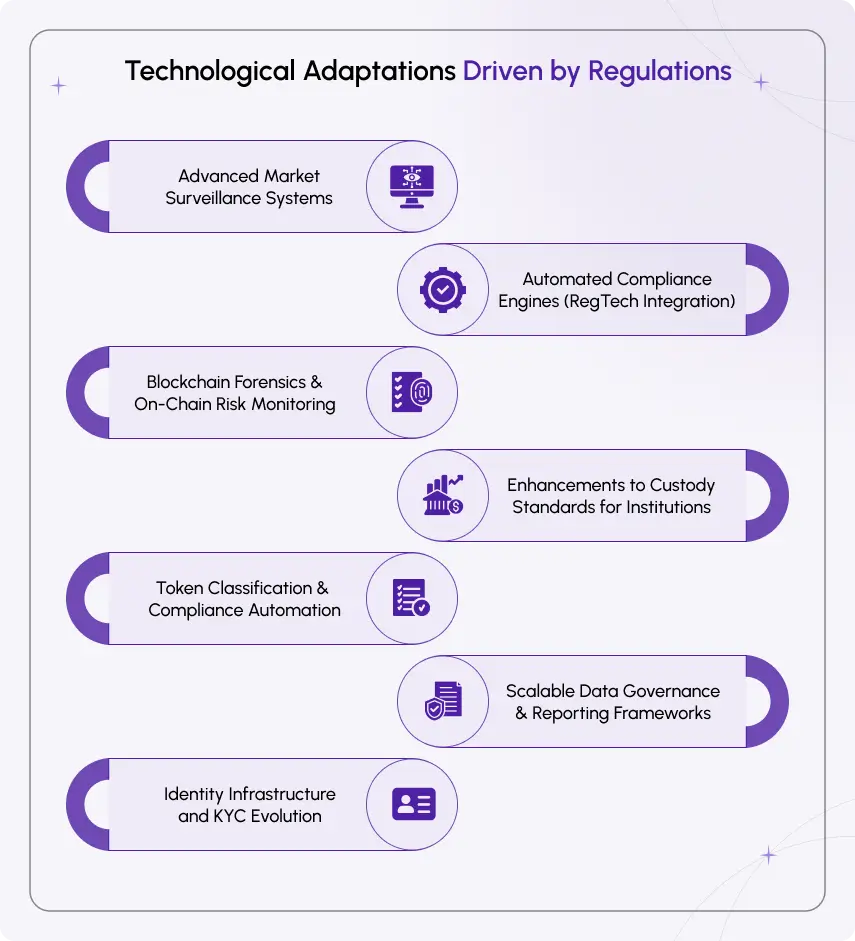
Technological Adaptations Driven by Regulations
Crypto exchanges SEC regulations may lead to a significant change in the technological infrastructure of digital asset platforms.
The stricter SEC regulations on crypto exchanges forces the trading platforms to transform their entire architecture, implement regulatory compliance through automated processes, and employ top-notch systems that can even meet the requirements of institutional investors.
All the technology changes are aimed at the emergence of achieving a fully SEC compliant crypto exchange framework. It is impossible to escape the impact of the regulatory pressure on the technology adaptations, and the latter ones are the most important.
1. Advanced Market Surveillance Systems
Exchanges must mandate the measures used for monitoring in real-time to comply with SEC crypto exchange rules. Through which fraudulent practices could be detected in the crypto exchanges, among other things, such as:
Spoofing
Layering
Washing
Cross-platform manipulation cross
Trading done by insider
AI-based analysis systems automatically detect activities marked by such signs and the exchanges can therefore satisfy the strictest cryptocurrency exchange compliance mandates.
The SEC is setting certain standards which imply that the process of making reports and carrying out audits would constantly be done very tightly. Last generation compliance engines have been evolving through:
Form filing
Patterns of transactions analysis
Scoring risk on a continuous basis
Management of AML/KYC process
Infrastructure for regulating tokens
So, the exchanges continue to have a compliance procedure and at the same time there are no unnecessary manual delays created when they are still complying with the hard US crypto exchange regulations.
3. Blockchain Forensics and On-Chain Risk Monitoring
The trading of cutting-edge technologies and their application in the detection of such phenomena as:
The existence and spread of frauds
Wallets that are sanctioned and thus considered risky
Laundering of money
Hacking attempts across chains
Crypto exchanges SEC regulations are enforced through forensic systems that make every single transaction traceable.
4. Enhancements to Custody Standards for Institutions
The SEC regulations on crypto exchanges sets a high standard for the crypto custody system and they must provide:
Multi-party Computation (MPC)
Hardware Security Modules (HSM)
Isolated wallets
Automated reconciliation
Self-custody monitoring
These modifications will reduce the counterparty risk and align with the SEC's custody rules that they are expecting.
5. Token Classification and Compliance Automation
The Securities and Exchange Commission tests each security through the Howey Test to establish its category and the exchanges then implement the automated token-reviewing systems that examine the following:
Token utility
Governance structures
Revenue associations
Risk factors
Models of whitepapers
Platforms are prohibited from listing assets in violation of the SEC crypto exchange rules.
6. Scalable Data Governance and Reporting Frameworks
The regulations stipulate conditions for data storage, its traceability, and openness. The exchanges are being updated to be equipped with:
Logging systems that are proof against tampering
Organized compliance dashboards
Different repositories for storing high-frequency trade data
Layers of audits that incorporate automatic validation
These systems can turn compliance with the rising demands of crypto exchanges SEC regulations.
7. Identity Infrastructure and KYC Evolution
The exchanges must implement the following measures in their processes:
Biometric verification
AI-based identity authentication
Continuous risk assessment
AML-based transaction monitoring
Identity reconciliation across different platforms
This is an essential requirement if the exchanges want to meet the cryptocurrency exchange compliance expectations.
Table: How Regulations Influence Key Technology Upgrades
Regulatory Requirement
Technology Adaptation
Result
Insider Trading Monitoring
AI Surveillance Engine
Trading Integrity SEC Efficacy
Competent Disclosure
Automated Reporting Tools
Effective, Timely Filing
Custody Mandates
MPC+HSM Custody
Protection for Investor Assets
Classification of Security Tokens
Token Risk Analysis
Reduced Legal Exposure
Identity Verification
AI-Powered KYC/AML
Effort to Strengthen Compliance Readiness
The cryptocurrency platforms are being forced to upgrade technologically by virtue of the crypto exchanges SEC regulations.
The whole spectrum at present ranging from surveillance being AI supported to custody being in the form of a modern-day bank and automated compliance engines undergoing the process of renovation for higher levels of security, transparency, and compliance with the law.
Such innovations will basically define the future of crypto exchanges under SEC oversight.
How BlockchainX Helps You Build SEC-Ready Crypto Exchanges
As a leading cryptocurrency exchange development company, BlockchainX focuses on providing digital asset platforms that are fully compliant and at the same time highly secure based on the emerging regulatory standards.
These platforms not only adapt to the requirements of contemporary regulation, but they also take compliance to such an extent to address the concerns of businesses and point towards the SEC.
These are the important features that make BlockchainX a reliable partner in regulated crypto exchange development:
Integration of KYC/AML: Compliance becomes easy because we establish the following: automated verification, sanctions screening, and the use of risk scoring.
Audit Trails & Reporting: We have introduced built-in records that cannot be tampered with for real-time reporting, while following up on SEC's requirements for review.
Secure Custody & Wallets: The wallet infrastructures that we have built for the MPC/HSM method and the custody that segregates them are the best available institutional-grade asset protection.
Role-Based Access & Admin Dashboards: The company provides role-based access and admin dashboards that are well-secured and monitored.
Our wide-ranging technological experience together with compliance-oriented engineering guarantees that businesses can operate within the secure and fully compliant crypto trading platforms. It helps the businesses to regulate the various factors like the SCA, AML, and KYC.
BlockchainX is the first and still the best option if you choose to deal with the technical difficulties of building a compliant crypto exchange - you will be provided with everything you need, from the development tool to the architecture that operates in a stricter regulatory environment and gives you access to the market.
Get all the latest posts delivered straight to your inbox.
Get In Touch
Our expert team is professionally well-equipped with hands-on experience as a blockchain development company. Connect with us; at BlockchainX, we curate your desired sustainable solution!