10 Quick Steps to Create Your Own Sports Prediction Market in 2026
Listen to the Audio :
Nowadays, sports are not only about watching matches but also play a vital role for fans to debate and predict their opinions on who is going to win. It turns all those opinions and predictions into a collective forecast of outcomes, which can be done using real money or virtual stakes. That is exactly what happens when you create your own sports prediction market.
As the sports prediction market is a place for fans, traders, and data enthusiasts to join and predict the outcomes for winning a match, the number of goals scored by the team, or which player plays best.
Rather than just relying on a single expert to set the odds, these prediction markets use collective intelligence from a group of participants. With derived insights, the result is remarkably surprising.
By 2026, sports prediction markets will no longer be experimental as it refines how fans engage with games. sports prediction market developments are growing demand in startups and enterprises.
What are Sports Prediction Markets ?
A sports prediction market works like a stock market. But instead of buying shares in companies, you are buying shares in outcomes. This approach has made users to easily develop sports prediction market platforms across various regions without any limitations.
For instance, consider a cricket match between two teams, A and B. Here, fans or participants will predict which team will win the match before it ends. Each outcome is represented through a contract, which ranges from 0 to 100 and this contract is calculated based on the market's collective value.
If Team A comes with a contract trading at 0.50, then the probability of winning chance for Team A is 50% for that particular match. The prices in a prediction market vary with each trader's opinions, data, and instincts. Investors can purchase the contract if the market value is reduced and sell when the market value is increased.
10 Quick Steps to Create Your Own Sports Prediction Market in 2026
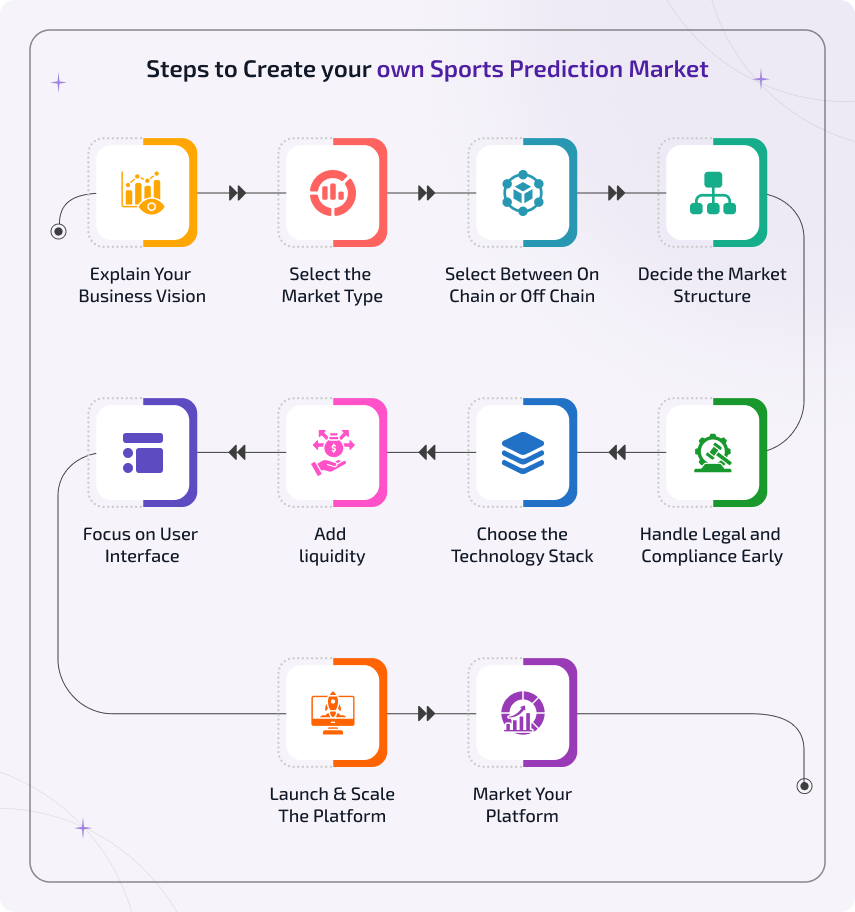
The sports prediction market development process involves creating a reliable and beginner-friendly platform to make a secure place for users to bet and trade on their opinions of future outcomes. Here is the detailed process.
Step 1: Explain Your Business Vision
Start the development process by deciding what type of prediction market you want to develop and which type of users can access it. This indicates the usage and purpose of the platform. Then, determine whether the platform is for fans, usual traders, or both, and the type of trading the platform supports, whether real money or virtual tokens.
Step 2: Select the Market Type
Decide which market type will be suitable for your prediction platform. To choose it, consider market types, binary, multi-outcome, and scalar. Here, each market type denotes specific functionality like a simple yes/no outcome, more than two options, or range-based predictions which is suitable for ideal users.
Step 3: Select Between On-Chain or Off-Chain
Choosing between the on-chain or off-chain format decides how your platform will function. Here, the on-chain platforms use blockchain and smart contracts, which come with high transparency and are in decentralized format. Meanwhile, off-chain platforms run on traditional servers and are much easier to control due to their rapid speed.
If the investor is crypto-friendly then on-chain will be the right choice. In case you prefer a smoother performance, the off-chain will be better. The right choice depends on your investor need.
Step 4: Decide the Market Structure (AMM or Order Book)
You will also need to decide how trading will work.
AMM (Automated Market Maker): Prices adjust automatically based on demand. AMMs are usually easier to launch and manage in the early stages.
Order Book: Users place buy/sell orders like a stock exchange. Better for advanced traders.
If you are starting, keeping the trading system simple can help attract more users.
Step 5: Handle Legal and Compliance Early
Before building anything, it is important to look at legal and compliance requirements. Sports prediction markets fall into different regulatory categories by country. So, you need to carefully analyze the licenses and regulations and complete the KYC processes. Undergoing this process in the early development stage will help you avoid major issues.
Step 6: Choose the Technology Stack
Once done with the planning, the next step is to choose the necessary technology stacks, including blockchain networks, front-end, backend, APIs, and much more. Payment integration is also key. You can support cards, UPI, or crypto. Security should never be an afterthought because users are trusting your platform with their money.
Step 7: Add Liquidity
Liquidity is another important factor. A prediction market only feels alive when people are actively trading. Liquidity integration must be done early to reward early users. This case of providing incentives and promotions attracts a wider user base towards the platform.
Step 8: Focus on User Interface
User experience plays a major role in the success of a prediction market. Both beginner and experienced investors must be able to use the platform with a simple sign-up process, making deposits and withdrawals smoothly. If the interface is difficult to understand and use, investors will not stay for a long time within the prediction platform.
Step 9: Launch and Scale The Platform
Finally, launch the platform and make it popular gradually. Start with one sport or a few market types. Test everything properly and then collect user feedback. Once the system runs smoothly, you can expand to more sports and advanced features. A best blockchain development company like BlockchainX will definitely offer end-to-end support to bring out a highly efficient platform.
Step 10: Market Your Platform
To create your own sports prediction market is a mix of smart planning, strong technology, and understanding how sports fans think. Once done with the platform, market it in various ways and make it popular among global investors and traders.
Sports communities
Influencer partnerships
Social media campaigns
SEO content about prediction markets
Referral programs
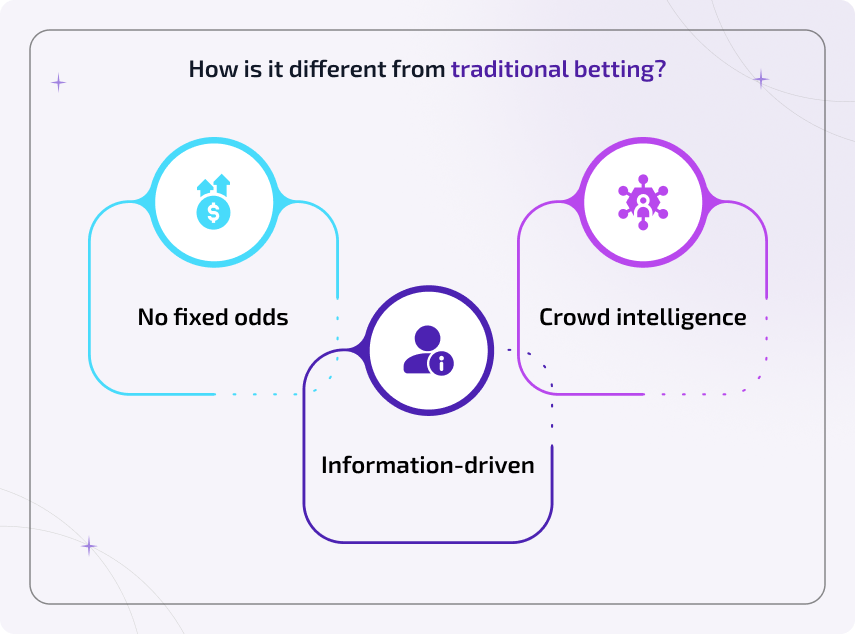
How is it different from traditional betting?
Although prediction markets may resemble betting, they operate very differently, especially for anyone planning to build your own sports prediction market.
No fixed odds: Prices escalate based on demand and supply.
Information-driven: News like injuries, weather, or team changes instantly affects prices.
Crowd intelligence: Instead of one bookmaker setting odds, thousands of participants shape them.
In many ways, prediction markets behave more like financial markets than gambling platforms. Skilled participants analyze statistics, historical performance, and real-time data to make informed decisions. This is why many founders now prefer to create sports prediction market platforms rather than traditional betting products.
Why the Sports Prediction Market Matters in 2026
Sports prediction markets are more important than ever in 2026. Hardcore fans now do more than just engage in them as a pastime. They are now useful to companies, analysts and tech developers who wish to develop long-lasting and scalable sports prediction platforms. Build a sports prediction market that scales and lasts.
Smarter fan engagement
The modern fan wants to participate in the game, not just watch it from a distance. Passive viewing is transformed into active participation by prediction markets.
When fans have even a tiny interest in a result, they pay closer attention to what is happening, monitor player performance and remain involved throughout. Prediction markets are now a potent tool for leagues and platforms to foster user loyalty and retention due to this deeper involvement.
The power of collective intelligence
Because prediction markets draw on collective intelligence, they frequently make accurate predictions. Thousands of participants' collective knowledge is reflected in them rather than depending on a single expert.
By 2026 these markets usually yield some of the most accurate probability estimates available due to the involvement of global participation, AI insights and advanced analytics. Working together, teams of broadcasters and analysts now view prediction market data as a useful indicator of expert and public sentiment.
A data-driven sports culture
Because of the increased focus on data in sports, prediction markets flourish. They constantly take in information on player statistics, biometrics, the weather, tactical choices and even sentiment on social media. Market prices swiftly take into account all of this information, producing a real-time dynamic snapshot of how the world anticipates a match to play out.
Greater transparency and efficiency
Prediction markets are based on actual trades between participants as opposed to traditional betting systems, where bookmakers set and modify the odds. Here, the prices are set by buyers and traders and not by intermediaries. With clear regulations and blockchain-based infrastructure, users will access these markets with more equity and reliability.
New opportunities for skill-based participation
Prediction markets give more credit to regulated research than to good fortune. Athletes can achieve consistent performance over time if they understand the sport much more easily with attention to analytics and have the ability to carefully manage risk. This has encouraged more people to develop sports prediction market strategies as serious analytical tools.
This has created a new category of sports enthusiasts: part fan, part analyst, part trader. For many, prediction markets are less about winning big and more about being right.
Economic and technological relevance
Markets for sports predictions are important because they spur innovation. By 2026, they are closely linked to real-time data feeds, smart contracts, automated payouts and forecasting tools driven by AI.
Fintech, data science and entertainment are all combined in many platforms that use digital infrastructure to operate internationally. As a result, they support the larger digital economy.
Ethical and regulatory evolution
By 2026, many governments have started to make a clear distinction between traditional gambling and skill-based prediction markets. More responsible participation models, improved regulations and enhanced consumer protection have resulted from this.
These regulations now distinguish these platforms from gambling, making it safer to build your own sports prediction market in compliant jurisdictions.
Difference Between On-Chain and Off-Chain Sports Prediction Markets
Choosing the right architecture is critical when you develop sports prediction market platforms in 2026. Here is a clear comparison.
On-chain Sports Prediction Markets
On-chain prediction markets operate entirely on blockchain networks using smart contracts.
Key characteristics:
All trades and payouts are recorded on-chain
High transparency
Often use cryptocurrencies or tokens
Settlement handled automatically via smart contracts
Pros:
Trustless and censorship resistant
No central authority controls outcomes
Global access
Cons:
Slower transactions during network congestion
Higher transaction (gas) fees
Requires blockchain knowledge for users
On-chain sports prediction markets are popular among native Web3 users who value transparency and decentralization as their major base.
Off-chain Sports Prediction Markets
Off-chain markets operate on centralized servers, similar to traditional platforms.
Key characteristics:
Supports rapid execution with smooth UI/UX
Prices and settlements managed by the platform
Supports fiat payments easily
Pros:
High-speed trading and scalability
Lower costs per transaction
Easy to onboard
Cons:
Requires trust in the platform
Less transparency compared to blockchain
Hybrid Models in 2026
Many modern platforms use a hybrid approach, off-chain trading for speed, with on-chain settlement for transparency. This balances performance with trust and is becoming the industry standard.
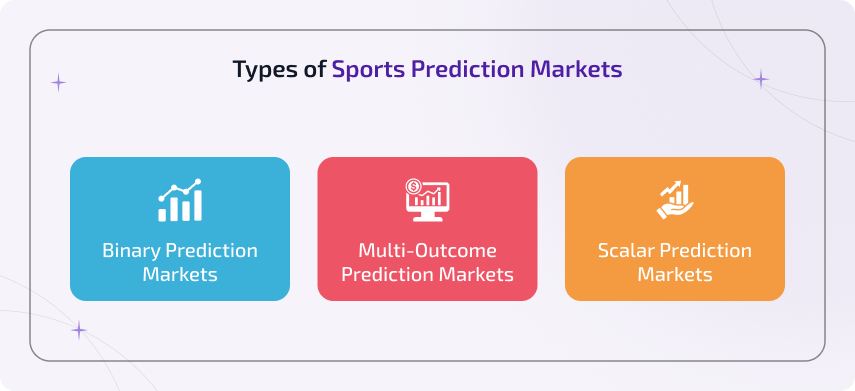
Types of Sports Prediction Markets
When you create sports prediction market systems, understanding the market formats and trends is an essential step to attract both beginners and advanced users. These markets are upgrading themselves into a sophisticated digital platform that combines passion for sports, data intelligence and financial mechanics all together.
Whether you are building a platform or participating in one, understanding how to create a sports prediction market and its market types is a crucial thing. The following three markets dominate the sports platform in 2026.
1. Binary Prediction Markets
Binary markets have only two possible outcomes.
Examples:
Will Team A win the match? (Yes / No)
Will Player X score a goal? (Yes / No)
Why They Value:
Simple and beginner-friendly
Highly liquid
Easy to price and settle
Binary markets are ideal for quick predictions and casual users.
2. Multi-Outcome Prediction Markets
Multi-outcome markets offer more than two possible results.
Examples:
Team A wins / Team B wins
Which team wins the tournament?
Why They Value:
More realistic for complex sports events
Higher engagement
Ideal for league events
These markets apply to football leagues, cricket tournaments, and similar events.
3. Scalar Prediction Markets
Scalar markets focus on predicting within a specific numerical value.
Examples:
Calculating the runs to be scored in the entire cricket match?
Expected goals (0-1, 2-3, etc.)
Why They Value:
Ideal for data enthusiasts
Allows nuanced predictions
Works well with advanced analytics
Scalar markets are popular among professional traders and analytics-focused participants.
Choosing the Right Market Structure: AMM vs Order Book
If you are about to build your own sports prediction market in 2026, then the choice between AMM and order book will be a major factor. Since these market structures directly affect liquidity, UX, and scalability, consider the explanation below and choose a wise one that suits your needs.
AMMs are great for early stage platforms, niche sports, and casual users
An AMM is a system where prices are set automatically by an algorithm rather than by matching buyers and sellers directly. Users trade against a pool of liquidity instead of another person. In sports prediction markets, AMMs adjust prices based on how much money flows into each outcome. If many people believe Team A will win, the price for that outcome rises automatically.
You can trade instantly, anytime
No need to wait for someone on the other side
Prices always exist, even in small or niche markets
Order books are ideal for high liquidity events and advanced traders
An order book is closer to how traditional stock exchanges work. Users place buy and sell orders at specific prices, and trades only happen when those orders match. In a sports prediction market, this means participants actively set the prices they believe are fair. If someone agrees, the trade executes.
Highly accurate price discovery
Ideal for experienced traders
Better for high volume, competitive markets
That is why many modern sports prediction platforms use a hybrid model. AMMs provide baseline liquidity, while order books take over when trading volume increases. Choosing the right structure is not about picking a winner. It is about matching the structure to your users, your sports focus, and your long-term goals.
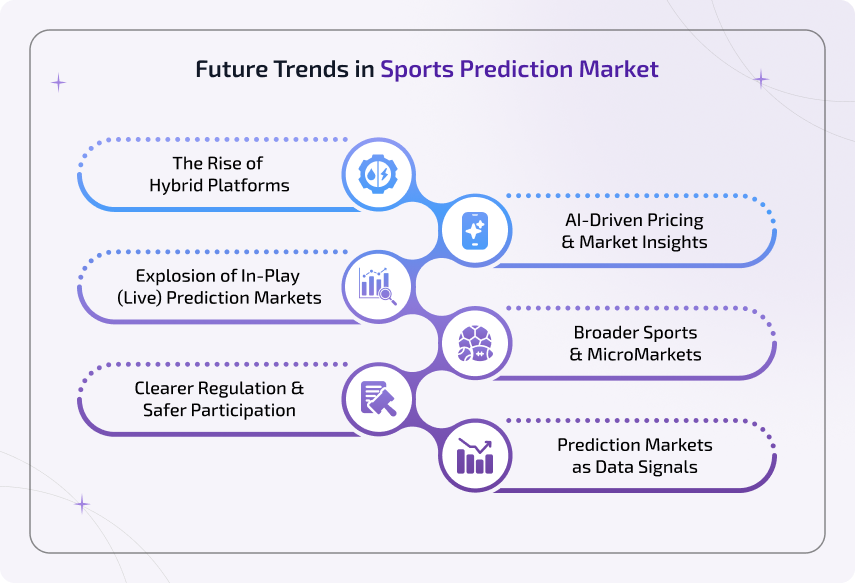
In 2026 and beyond, prediction markets will evolve rapidly, making it a turning point for investors who look to build a sports prediction market platform on their own.
The rise of hybrid platforms that combine off-chain speed with on-chain settlement
AI-driven pricing and market insights processing injuries, weather data, and live stats in real time
Explosion of in-play (live) prediction markets
Broader sports and micromarkets including player-level predictions and regional leagues
Clearer regulation and safer participation models
Prediction markets becoming data signals for teams, media, and analysts
Choosing between AMM and order book structures is about knowing your audience and your scale. Meanwhile, the future of sports prediction markets is getting more popular and wider than ever, while users are becoming more informed and updated.
Conclusion
Sports prediction markets are not just about predicting with opinions and guessing who wins the match. They represent a major shift in how people interact with sports, turn opinions into investments, and convert fans into active participants.
In 2026, the possibility to create your own sports prediction market is no longer challenging. Whether you aim to build a prediction platform or simply explore this growing space and the evolving technologies, we at BlockchainX are ready to guide you with our experts who come with collective intelligence.