Asset Setup
Asset Gets Prepared for Tokenization
Choose an asset and complete legal structuring before tokenization begins.
- Real estate
- Shares
- Funds
The rapid rise of blockchain-powered finance is pushing businesses to build a tokenization platform like Securitize and enter the growing digital securities market. From real estate and private equity to treasury funds and bonds, digital securities tokenization is changing the way assets are issued, managed, and traded across the world.
The demand for RWA tokenization services is growing fast as businesses look for smarter ways to issue, manage, and trade digital securities through blockchain-powered platforms. From real estate and private equity to treasury funds and bonds, digital securities tokenization is reshaping how assets move across global markets pushing more businesses toward scalable, regulation-ready tokenized securities platform solutions.
Businesses exploring how to build a tokenization platform like Securitize are now prioritizing KYC AML integration, investor onboarding platform features, smart contract automation, and digital asset compliance to create scalable, regulation-ready tokenized securities platform solutions through advanced Securitize platform development strategies.
Securitize is an investment platform that helps businesses turn real world assets into regulated digital securities. Instead of following the usual fundraising routes, packed with paperwork and middlemen, and with those long settlement cycles, Securitize makes the entire process easier, using blockchain technology.
The platform allows companies to tokenize assets like real estate, private equity, investment funds, and debt instruments, while keeping solid digital asset compliance standards.Securitize is gaining attention by the way it blends blockchain technology with real financial compliance.
The platform includes features like KYC AML integration, smart contract automation, and a streamlined investor onboarding platform, so the process becomes much easier for both businesses and investors. Today, companies that want to build a tokenization platform like Securitize are also going in the same direction, they follow similar STO platform development and Securitize platform development approaches, to launch scalable and regulation-focused tokenized securities platform solutions.
Asset Setup
Choose an asset and complete legal structuring before tokenization begins.
The reason many businesses want to build a tokenization platform like Securitize is because the platform solves a real problem in traditional investing. Normally, issuing and managing securities takes time, legal coordination, paperwork, and multiple intermediaries. Securitize simplifies most of this using blockchain technology and automation.
Everything starts with the asset itself. A business first decides what it wants to tokenize. It could be:
Real estate
Company shares
Investment funds
Debt products
Revenue-sharing assets
Before anything goes live, the asset is legally structured based on local regulations. This part matters because a tokenized securities platform cannot operate properly without regulatory approval and documentation in place.
After the asset setup is completed, investors begin registering on the platform. This is where KYC AML integration becomes a major part of the process.
Instead of manually reviewing every investor, the platform automates verification steps like:
ID verification
AML checks
Accreditation validation
Risk screening
Document verification
A strong investor onboarding platform helps businesses onboard users faster while still maintaining proper compliance standards.
Once compliance checks are completed, blockchain-based security tokens are issued. These tokens represent ownership or investment rights linked to the asset.
This is where smart contract automation plays an important role. Smart contracts automatically manage things like:
Ownership tracking
Dividend payouts
Transfer permissions
Investor limits
Lock-in periods
Automation helps businesses to reduce operational work and improves transparency.
Approved investors can purchase, and hold tokenized assets directly in blockchain wallets. Compared with the traditional investment setup, it feels much swifter, and smoother, overall.
This simplified investment flow is one of the biggest reasons companies are trying to build a tokenization platform using modern blockchain infrastructure instead of traditional financial software.
One thing that makes Securitize different from many ordinary crypto platforms is its focus on ongoing digital asset compliance. The platform continuously monitors investor activity and token transfers to make sure transactions remain compliant with securities regulations.
Businesses building a Securitize clone usually focus heavily on compliance automation because regulations around digital assets are becoming stricter globally.
At the end of the day, businesses exploring how to build a platform like Securitize are not just building another crypto platform. They are creating a regulated investment ecosystem where blockchain technology, compliance, and investor accessibility work together in a much more efficient way than traditional systems.
Partner with BlockchainX, a leading RWA tokenization development company, to create secure, compliant, and scalable asset tokenization solutions.
Building a Securitize clone needs more than just blockchain development, you need that whole pile of stuff to work together. If you want to build a tokenization platform like Securitize, then it’s really about compliance architecture, financial infrastructure, smart contract engineering, cybersecurity, investor operations, and legal automation too.
Below is the complete step-by-step process to build a tokenization platform like Securitize.
The first step is identifying which asset category your platform will support.
Different assets require different regulatory structures and token standards.
Common tokenized assets include:
Real estate
Equity shares
Private funds
Bonds
Commodities
Carbon credits
Treasury assets
Alternative investments
Real estate platforms prioritize fractional ownership
Fund tokenization platforms require investor accreditation
Bond tokenization platforms focus on settlement automation
When you are planning to build a tokenization platform like Securitize, the compliance workflow, blockchain selection, and smart contract design, are determined by your business model.
Picking the blockchain is the next move, once you decide to build a tokenization platform like Securitize. Security, scalability and broader adoption tend to steer the choice. Firms usually pick networks that meet these needs. Common blockchains used for STO platform development include:
| Blockchain | Advantages |
|---|---|
| Ethereum | Strong ecosystem and institutional adoption |
| Polygon | Lower gas fees and high scalability |
| Avalanche | Enterprise-focused tokenization infrastructure |
| Stellar | Fast settlement and financial applications |
| Solana | High throughput and low transaction costs |
Most businesses building a tokenized securities platform prefer Ethereum-compatible ecosystems because of mature smart contract support and institutional trust.
A compliant tokenization platform requires security-focused token standards.
Common standards include:
ERC-1400
ERC-3643
ERC-20 with compliance layers
ST-20
Security token protocols with transfer restrictions
These standards help implement:
Investor whitelisting
Transfer restrictions
Jurisdiction control
Lock-up periods
Compliance automation
Corporate action management
This becomes the foundation of your smart contract automation system.
KYC AML integration is one of the most critical parts of Securitize platform development.
Without compliance verification, digital securities platforms cannot legally onboard investors.
Your platform should support:
Identity verification
Address verification
Biometric validation
AML screening
PEP checks
Sanctions monitoring
Accreditation verification
Risk scoring
An automated investor onboarding platform improves user trust and reduces compliance delays.
Smart contracts power the operational backbone of tokenized securities platforms.
Key smart contract functionalities include:
Token issuance
Dividend distribution
Compliance enforcement
Ownership tracking
Voting rights
Vesting schedules
Redemption logic
Secondary transfer validation
When smart contract automation is well designed it lowers the day-to-day operational workload, and it can increase transparency too.
More and more businesses now automate full securities workflows using blockchain based compliance logic while trying to build a tokenization platform like securitize.
A modern investor onboarding platform should provide seamless digital access to tokenized investments.
Essential dashboard features include:
Investor registration
Wallet connectivity
Investment history
Tax reports
Dividend records
Token balances
Secondary market access
The user experience should feel similar to modern fintech investment platforms while maintaining institutional-grade compliance.
Digital asset compliance is the core differentiator between utility token platforms and regulated security token ecosystems.
Your compliance engine should enforce:
Jurisdiction restrictions
Investor accreditation rules
Holding periods
Transfer approvals
Ownership thresholds
Regulatory reporting
Tax compliance
This layer ensures all token transfers remain legally compliant in real time, which is essential when businesses build a tokenization platform like Securitize.
Institutional investors expect enterprise-grade custody infrastructure.
A Securitize clone should support:
Non-custodial wallets
MPC wallets
Institutional custody
Hardware wallet support
Multi-signature wallets
Asset recovery mechanisms
Security architecture is critical because tokenized securities represent real financial ownership.
Liquidity is one of the biggest advantages of digital securities tokenization.
Your platform can integrate:
ATS systems
P2P trading modules
OTC trading desks
Decentralized liquidity pools
Regulated secondary exchanges
A well-designed secondary market increases investor participation and platform growth.
Before launch, the platform must undergo:
Smart contract audits
Penetration testing
Compliance reviews
Legal assessments
Infrastructure stress testing
AML process validation
Security and compliance failures can severely damage investor trust.
Institutional tokenization platforms require enterprise-grade risk management before deployment.
To build a tokenization platform like Securitize, businesses need real compliance systems, dependable blockchain infrastructure, easy investor onboarding, and automation of smart contracts that work together from the very start.
Launch a scalable and regulation-ready platform with advanced smart contract automation, investor onboarding, and digital asset compliance features.
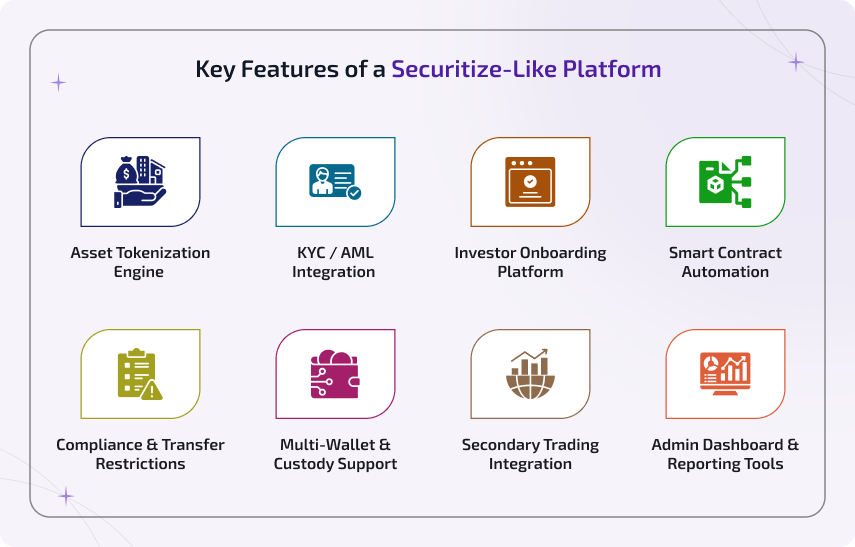
Businesses trying to build a tokenization platform like Securitize often end up needing more than basic token creation functionality. Modern investors also want a safe onboarding flow, smooth day to day asset management, clear and trackable transactions, and solid compliance infrastructure within a single platform.
Below are a few of the key features businesses build into a Securitize platform development plan.
The tokenization engine is the core feature of the platform. It allows businesses to convert real-world assets into blockchain-based digital securities.
This can include:
Real estate
Equity shares
Investment funds
Bonds
Alternative assets
A strong tokenization engine is essential for scalable digital securities tokenization.
Compliance verification is one of the most important parts of every regulated tokenized securities platform.
A proper KYC AML integration system should support:
Identity verification
AML screening
Accreditation checks
Risk assessment
Sanctions monitoring
This sort of setup helps businesses onboard investors in a secure way, while still keeping compliance standards on track.
A smooth onboarding flow is an essential deal for retaining investors. Businesses that want to build a tokenization platform like Securitize, tend to lean heavily on making the investor journey feel simple and clear, like easy navigation.
Key onboarding features include:
Investor registration
Wallet connectivity
Document uploads
Compliance verification
Investment access management
A well-designed investor onboarding platform improves both usability and trust.
Modern tokenization platforms rely heavily on smart contract automation to reduce manual operational work.
Smart contracts usually handle:
Token issuance
Ownership tracking
Dividend distribution
Transfer restrictions
Investor permissions
Governance rights
Automation helps to boost efficiency and also it reduces dependency on intermediaries.
Having solid digital asset compliance infrastructure is one of the major reasons businesses decide to invest into enterprise-level STO platform development.
Compliance modules generally manage:
Jurisdiction restrictions
Investor eligibility
Transfer approvals
Holding periods
Regulatory reporting
This helps platforms maintain legal compliance across different regions.
Security is extremely important when dealing with digital securities. A professional platform should support multiple wallet and custody options.
This usually includes:
Non-custodial wallets
Institutional custody
Multi-signature wallets
Hardware wallet integration
Many businesses building a Securitize clone prioritize wallet security to improve investor confidence.
Liquidity is one of the biggest advantages behind blockchain based securities. Secondary trading, it’s where investors can actually swap tokenized assets more efficiently.
Common integrations include:
P2P trading
OTC transactions
Secondary marketplaces
ATS integrations
That kind of setup also helps widen investor participation and boosts platform scalability, over time.
A central admin panel helps businesses manage assets, investors, compliance and transactions more efficiently overall.
Key admin features include:
Investor management
Asset monitoring
Compliance reporting
Transaction analytics
Revenue tracking
So, if businesses are exploring how to build a platform like Securitize, they usually end up putting serious effort into reporting and analytics tools, because those tools really support long term operations.
More businesses are trying to build a tokenization platform like Securitize, because the traditional investment systems are often slow and expensive and also hard to scale without headaches. Blockchain driven investment platforms on the other hand make fundraising, investor management, and asset distribution a lot more streamlined.
Businesses no longer want to depend only on local investor networks. With a secure investor onboarding platform and proper KYC AML integration, companies can onboard investors globally with fewer delays.
Benefits include:
Faster investor onboarding
Reduced paperwork
Wider investor reach
Easier compliance management
With digital securities tokenization, businesses can basically split up a high value asset into smaller investment units, and this tends to make investing more reachable.
Popular tokenized assets include:
Real estate
Private equity
Investment funds
Bonds
Alternative assets
This is one major reason companies are investing in tokenized securities platform solutions.
Traditional securities management still involves manual approvals and operational delays. With smart contract automation, businesses can automate:
Token issuance
Ownership tracking
Dividend payouts
Transfer restrictions
Investor permissions
This improves efficiency while reducing operational complexity.
Businesses building a Securitize clone are focusing heavily on digital asset compliance as regulations around tokenized assets continue evolving.
This usually includes:
AML monitoring
Investor verification
Accreditation checks
Compliance reporting
Jurisdiction restrictions
Large financial institutions are already entering the tokenization market at scale. Recent reports show the tokenized real-world asset market surpassed $30 billion in 2026, with institutional giants like BlackRock pushing adoption ahead through the BUIDL fund on Securitize.
BlackRock recently expanded its tokenization strategy with new on-chain investment products, highlighting rising institutional confidence in blockchain-based securities infrastructure. This growing momentum is encouraging more startups and enterprises to explore how to build a platform like Securitize through scalable STO platform development strategies.
If you want to build a tokenization platform like Securitize, it must bring blockchain infrastructure, compliance systems, investor management, plus security features together into a single, smooth ecosystem.
This is the core component of the platform that converts real-world assets into blockchain-based digital securities.
Common assets include:
Real estate
Equity shares
Investment funds
Bonds
Alternative assets
This forms the foundation of digital securities tokenization.
A reliable investor onboarding platform allows companies to bring investors smoothly, while still having compliance standards in check. Key features usually include:
Investor registration
Wallet connectivity
Document uploads
Accreditation verification
Investment access approval
Strong KYC AML integration is essential for every regulated tokenized securities platform.
This generally includes:
Identity verification
AML screening
Risk assessment
Sanctions monitoring
Compliance checks
Smart contract automation helps organizations run several platform tasks without any manual intervention.
This usually manages:
Token issuance
Ownership tracking
Dividend payouts
Transfer permissions
Governance rights
Businesses investing in Securitize platform development prioritize strong digital asset compliance infrastructure to manage regulatory requirements efficiently.
This system handles:
Jurisdiction restrictions
Investor eligibility
Transfer approvals
Regulatory reporting
Transaction monitoring
Security plays a major role while building a Securitize clone.
Most platforms support:
Non-custodial wallets
Institutional custody
Multi-signature wallets
Hardware wallet integration
Secondary trading improves liquidity and investor participation.
A modern platform may support:
P2P transfers
OTC trading
Secondary marketplaces
ATS integrations
All these components work together to help businesses build a tokenization platform like Securitize with better scalability and operational efficiency.
Transform real-world assets into secure digital securities with enterprise-grade STO platform development and seamless KYC AML integration.
The blockchain architecture behind a tokenized securities platform is typically built using a hybrid infrastructure model.
| Layer | Purpose |
|---|---|
| Frontend Layer | Investor dashboard and issuer portal |
| Application Layer | Business logic and workflow management |
| Compliance Layer | KYC AML integration and restrictions |
| Smart Contract Layer | Token issuance and automation |
| Blockchain Layer | Immutable transaction records |
| Storage Layer | Secure off-chain document storage |
| Security Layer | Encryption, authentication, monitoring |
A professional STO platform development approach uses both on-chain and off-chain systems.
Token ownership
Transaction records
Smart contracts
Settlement
Voting systems
Identity verification
Legal documents
Compliance records
Investor databases
Reporting systems
This hybrid approach improves scalability and also maintains regulatory standards.
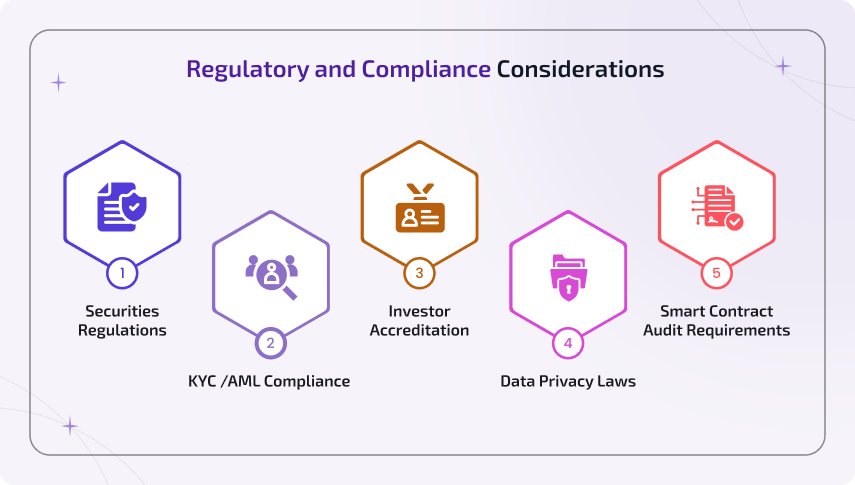
Regulatory compliance is the foundation of every successful digital securities tokenization platform.
Ignoring compliance can result in:
Regulatory penalties
Investor restrictions
Trading bans
Platform shutdowns
Legal disputes
Your platform must comply with local securities laws such as:
SEC regulations
MiCA framework
FINRA requirements
DLT Pilot Regime
Regional investment laws
Businesses must implement strong anti-money laundering frameworks.
Certain investment products may only allow accredited investors.
Platforms must comply with:
GDPR
CCPA
Data localization rules
Regulators increasingly expect audited smart contract infrastructure.
Many institutional platforms now prioritize compliance-first architecture because regulators are closely monitoring tokenized securities ecosystems.
The demand for regulated digital investment platforms is growing rapidly, and more businesses are now looking to build a tokenization platform like Securitize to stay ahead in the evolving blockchain economy. From digital securities tokenization and smart contract automation to secure KYC AML integration and scalable investor onboarding platform systems, every component plays an important role in building a successful tokenized securities platform.
As regulations become clearer and institutional adoption continues increasing, businesses investing in STO platform development and strong digital asset compliance infrastructure are expected to gain a major advantage in the future digital asset market. BlockchainX helps businesses simplify this journey through secure, scalable, and enterprise-grade Securitize platform development solutions tailored for modern investment ecosystems.
Our expert team is professionally well-equipped with hands-on experience as a blockchain development company. Connect with us; at BlockchainX, we curate your desired sustainable solution!
Follow us on


