Table of Contents
9 Step-By-Step Guide to Build a Oil & Gas Tokenization Platform
Listen to the Audio :
It still feels unbelievable how tokenization has reshaped the digital world with its innovative dimension, where oil and gas assets are emerging as key players in the ecosystem. As this transformation continues to evolve, businesses are just looking to build an oil & gas tokenization platform to unlock fresh investment possibilities in the market.
The high-scale funding projects, such as Upstream (energy resource exploration and production), Midstream (pipelines, storage), Downstream (reserves/refineries), and other revenue royalties, can be tokenized using blockchain , extending their investor accessibility to these assets. This shift is gradually opening doors for investors globally, offering cross-border transactions, fractional ownership, increased liquidity, and robust security for highly valuable assets.
By tokenizing the energy assets into digital tradable tokens, the industry is extending its hands by providing a reliable, transparent, and highly accessible investment environment. Let’s dive deep into its working system, crucial steps, primary benefits, and core functions.
What is Oil and Gas Tokenization?
Oil and Gas Tokenization is the process of converting the ownership rights of the real-world oil and gas assets into tradable digital tokens. The assets include crude oil, pipelines, natural gas reserves, drilling projects, and royalty incomes. The blockchain technology used enables faster, transparent, and secure ownership transfers and trading in the market.
These assets are generally illiquid in nature, especially the highly valuable reserve or drilling projects that require large capital. By using RWA tokenization, the assets can be divided into fractional ownership, engaging the small capital investors, thereby increasing global participation. This approach fosters energy companies to unlock various investment opppourtunities increasing the liquidity and overall market accessibility.
9 Steps to Build a Oil & Gas Tokenization Platform
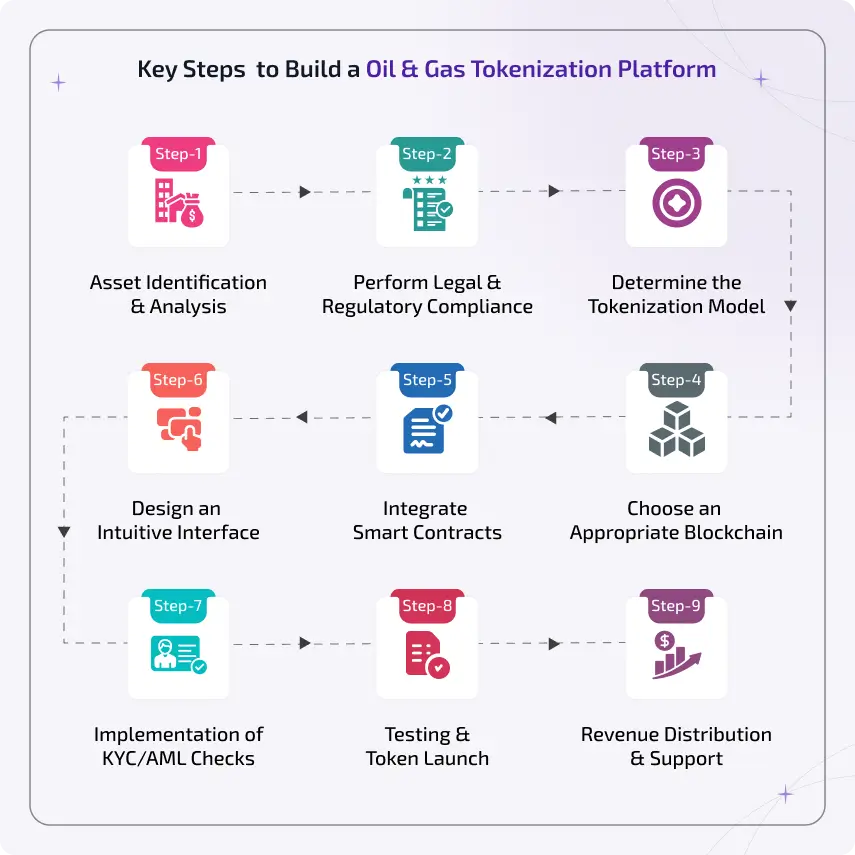
Developing a successful platform begins with selecting a suitable asset through platform testing and launch. Each step is significant to ensure that the system is legally licensed, audited, and secure for usage. The following are the main steps involved in developing a well-structured oil & gas tokenization platform:
Step-1: Asset Identification and Analysis
Select the oil or gas asset, such as drill projects, pipelines, or gas reserve that has to be tokenized after conducting a thorough feasibility audit to analyze its production potential. Along with this, check the market value of the asset to determine its investment capability and the trading performance in the market.
Step-2: Perform Legal and Regulatory Compliance
Oil and Gas tokenization must comply with the safety regulations and regional restrictions. It includes legal approvals, verifying ownership rights, and establishing a neat regulatory structure for the digital tokens. This enables secure and traceable transactions on the platform.
Step-3: Determine the Tokenization Model
Once legally verified, the tokenization model must determine how the token will be defined to represent the asset ownership. The model can represent the royalty income, fractional ownership, or shared revenue rights. This clarity helps with token supply, distribution, and transparency in trading.
Step-4: Choose an Appropriate Blockchain
Selecting the compatible network for the token performance is an important part of the process, as blockchain is responsible for scalability, security, and overall performance. To ensure accuracy, implement price oracles to determine real-time data from the external sources.
Step-5: Integrate Smart Contracts
Building smart contracts enables an automated system to enhance transaction flow, performance, and overall operations. This manages token issuance, asset ownership transfers, and distributions in accordance with predefined guidelines. The contracts aim to offer a safer, secure, and transparent operating ecosystem.
Step-6: Design an Intuitive Interface
Design a simplified interface that gives easy access to beginners for smooth navigation and a user experience. The platform should include features such as token purchase options, integration of wallets, and transparent asset information for both new and experienced users.
Step-7: Implementation of KYC/AML Checks
Every oil & gas tokenization platform must ensure user security and trust by implementing the required Know Your Customer/Anti-Money Laundering verification to keep the system in check. This allows secure and transparent participation, protecting from the cyber hacks and vulnerabilities.
Step-8: Testing and Token Launch
After complete testing and conducting necessary security audits, the tokens will be officially launched on the chosen blockchain network for public access. This step makes sure that the distribution of the token process and the system work seamlessly without any interruptions, system flaws, or attacks.
Step-9: Revenue Distribution and Support
After the launch, the tokens are distributed evenly on a public exchange according to the predefined structure. Investors can purchase, sell, or trade tokens that represent their ownership rights. Along with continuous monitoring and post-launch support with regular upgrades, receiving user feedback helps protect the platform from random hacks or attacks.
For developing a highly performing tokenization platform with an efficient oil & gas tokenization platform service, it generally takes around 2-4 months of time. Join hands with our expert team at BlockchainX to build a super-efficient oil & gas tokenization platform.
How Oil and Gas Tokenization Works
Tokenizing physical energy assets involves a structured process that transforms them into digital tradeable tokens. It evaluates the valuable asset, which is thoroughly tested and tokenized for enhancing accessibility for the investors. Here is a detailed description of the working process of oil and gas tokenization:
Asset Identification & Validation
The first step includes identifying the asset that has to be tokenized, such as drilling projects, pipelines, or crude oil reserves. The selected asset is evaluated completely for its market value and its production capacity.
Token Minting
Once verified, the digital tokens representing the ownership rights of the highly valuable oil or gas asset are created on a suitable blockchain network for investor access. Each token determines a specific unit.
Listing & Trading Access
Tokens are listed on a supported exchange or suitable platform for public access, allowing investors to buy, sell, or trade tokens representing the value of the asset. The trading enhances the liquidity and enables the easy transfer of ownership rights.
Profit Distribution
The rewards or profits will be distributed to the token holders after the revenue is generated from the listing. It is automatically distributed through smart contracts, ensuring transparency and security of the assets.
Redemption
The token holders can redeem or burn the tokenized oil or gas asset based on the predefined conditions. This enables the investors to convert the token into a significant real value asset or potential returns.
Want to build your own platform for oil & gas tokenization? Try Demo / Get Started
Benefits of Oil and Gas Investment for Investors
The tokenization concept of blending blockchain in the oil and gas industry has increased the demand globally, with various useful benefits from tax incentives, portfolio diversification, and high income generation. This approach attracts users, fostering active participation in the markets. Some of the important advantages of oil & gas investment for the investors are listed below:
Tax Advantages
Investment in tokenized oil & gas assets blockchain, such as drilling projects, offers certain tax advantages through the deduction of regular tax. It might deduct the operational or exploration tax, reducing the overall burden based on regional regulations.
Portfolio Diversification
Oil and gas investment enables investors to add the energy sector to their portfolio. They can reduce the potential risks involved, thereby maintaining stability in long term investment programs across different industries.
Strong Investment Return and Passive Income
Due to the growing demand for oil and gas reserve projects, there are strong financial returns from the markets. The investors receive passive income generated from the revenue of the energy production.
Inflationary Hedge
The energy assets act as a hedge during the inflationary periods, where the rising resource prices gradually increase the value and demand of the assets. This tokenization investment helps investors to preserve the value of their capital over time.
Support the Domestic Market
The revenue generated from the oil and gas projects strengthens the local energy supplies and production, maintaining a balance and supporting economic growth within the region that enhances the domestic market and supply.
High Global Demand
As various industries such as transportation, power generation, and manufacturing organizations highly rely on the requirement of oil and gas production, there is a high demand for energy assets in the global market.
Real-World Use Cases of Oil & Gas Tokenization Platform
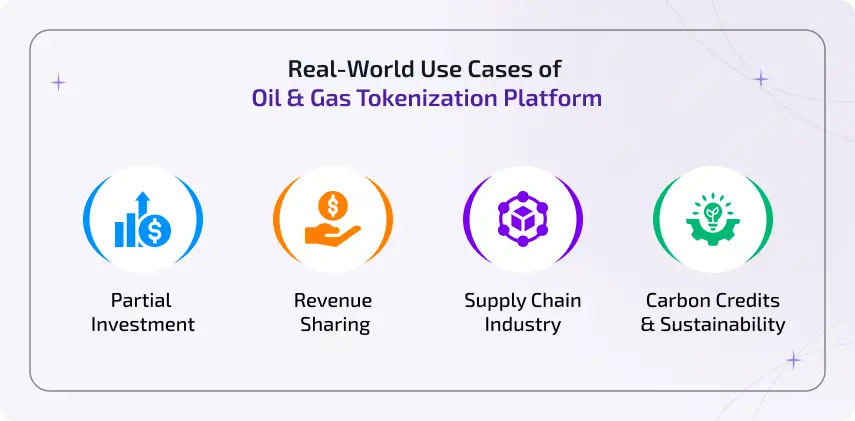
The energy industry plays an important role in the global economic market today. With the integration of a blockchain network, the highly valued projects can be tokenized, improving efficiency and investor participation. It enables more practical applications across different industries. Some of the significant real-world use cases of the oil & gas tokenization platform are listed below:
Partial Investment
The large capital oil and gas assets, such as government drilling projects, oil fields, or energy reserves, can be transformed into fractional ownership. This divides the asset ownership into small portions, allowing participation of small capital investors to be a part of highly valued projects.
Revenue Sharing
The income generated from the tokenized assets, such as oil/natural gas production and operations, will be proportionally distributed among the token holders. The payout process is automated through smart contracts and ensures transparent and secure management.
Supply Chain Industry
In the supply chain industry, as tokenization is done via smart contracts, the complete process, from production to storage, is automated, and transactions are recorded, making it a trusted source for the users. This enhances efficiency, thereby reducing system delays.
Carbon Credits and Sustainability
To maintain sustainable energy operations, companies use blockchain technology to record carbon emissions during the oil/natural gas production and their environmental impact. Companies that reduce emissions receive credits, which can be tokenized and traded, improving more investor participation.
Future Outlook of Creating Oil and Gas Tokenization
The tokenization of real-world commodities, especially the high-demand oil and gas assets, is redefining the trading operations and execution in the global market. As we can witness, the market size for tokenized assets has expanded from $860 million in the year 2023 to $2.3 billion by the second quarter of 2025.
It is expected to reach beyond current possibilities by 2030 within the ecosystem. Let’s explore the future perspectives of oil and gas tokenization development through the points given below.
The tokenization concept has been transforming from being a pilot project to a livestream market that has seen an incredible shift from the traditional markets, enhancing liquidity, security anf overall efficiency.
The energy assets, such as drill projects, gas reserves, etc., are expected to become an important part of the ecosystem, attracting all types of capital investors globally.
Oil and Gas tokenization will witness a diverse global adoption and participation in the future, especially in regions like the Middle East and Southeast Asia, by the year 2030.
The oil & gas assets are anticipated to be integrated in a more advanced way with the Decentralized Finance (DeFi) system for using it as collateral for lending, borrowing, and other financial operations.
Implementation of fractional ownership has improved accessibility to the assets that were once limited to big shots, allowing every retail participant to be a part of high capital investment with low entry barriers.
The tokenization platforms may convert the royalties of revenue generated from energy assets to an advanced level, creating a new form of capital-generating digital asset.
IoT sensors and digital twins may be integrated with the platform for producing real-time data using the sensors and programmed software automatically, without manual involvement, for clear monitoring of the operations performed.
Conclusion
Offering the most practical way for participating in the highly valued oil and gas tokenization projects, the industries expand their market worldwide, encouraging audience engagement. From providing fractional ownership rights to revenue sharing, these platforms are highly reliable and trustworthy, which clearly benefits both organization and the investors.
With the growing demand and accessibility of energy assets in the market, energy tokenization has become the most essential tool in the blockchain ecosystem for investors. This has opened a new avenue for connecting participants from worldwide. This structured approach continues to attract industry stakeholders and users, highlighting its growth and future endeavours in the market.
Get In Touch
Our expert team is professionally well-equipped with hands-on experience as a blockchain development company. Connect with us; at BlockchainX, we curate your desired sustainable solution!


Follow us on