Art Tokenization in 2026: Complete Guide to Trends & Innovations
Listen to the Audio :
People with more money have always been able to access the art world's most valuable pieces. However—this art tokenization guide is rapidly transforming this landscape. Blockchain technology makes art more accessible.
Tokenization allows artists, investors and collectors to interact with art in new ways. This technology's continued advancement is changing the way that people purchase, sell and value art. Let us examine how tokenization is fostering a more vibrant and inclusive art industry in the future.
Art Tokenization
Art tokenization is the process of converting digital or actual artworks into blockchain-based digital tokens that enable easy trading and ownership division into smaller portions. This opens up the art market by enabling a large number of people, rather than just wealthy collectors, to possess fractions of high-value pieces, often linked to a QR Code for verification and easy access to ownership data.
This is vital for 2026 because the global fractional art market, which was already valued at $1.8 billion in 2024, is predicted to expand quickly, increasing the accessibility, transparency, and liquidity of art investment for both institutional and individual investors. Imagine a world where ‘Sunflowers’ by Vincent van Gogh is not only beautiful art in a museum but also a digital representation that is safe on a blockchain.
Each token represents a piece of ownership which means that many people can own this history piece together. That is what the art tokenization process does.
Book Your Free Art Tokenization Consultation with Our Experts Today Connect now!
The Current State of the Art Industry
Many factors are currently transforming the art world and the industry is undergoing a dynamic transition.
The market is fixing after a rapid expansion that peaked in 2021 with auction sales and average prices stabilizing.
This development has buyers and sellers rethinking their plans. This is causing buyers to be more cautious and value-oriented
The move to digital is also speeding up the growth of digital art and NFTs which gives artists and collectors new ways to work.
More and more people are interested in a wider range of artists including historical figures, established mid-career artists and modern artists whose work engages with social and political problems.
These changes show the desire for work that has meanings beyond looks and speaks to peoples current emotions. The art world is currently trying to find a new price balance.
The current state of the market is influencing both auction predictions and gallery prices.
It is important to find a successful combination in this process between ensuring artists and sellers get fair value and attracting buyers with low prices.
The focus on quality and the growth of digital platforms and collectors' changing needs are all making the art world more dynamic and open to more people even though it is going through a time of readjusting.
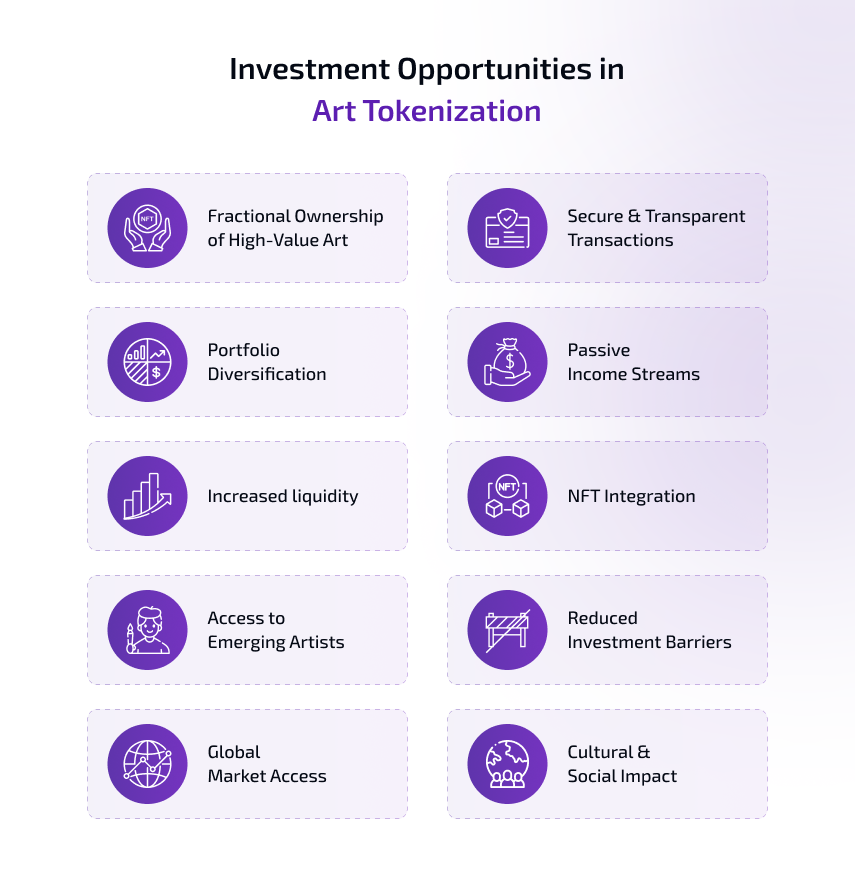
Investment Opportunities in Art Tokenization
Fractional ownership of High-value art
Tokenization makes it possible for investors to purchase fractional shares of expensive artwork that were previously only available to the very rich. Because of this democratization—people may now purchase famous works by well-known artists allowing them to possess a piece of cultural history.
Portfolio diversification
Tokenized art exposes an investment portfolio to a non-correlated asset class. Even during economic downturns—art frequently maintains or increases in value serving as a hedge against market stability.
Increased liquidity
Tokenized art may be traded quickly and readily on blockchain platforms in contrast to traditional art which might take years to sell. For investors looking for flexibility—art is now a more attractive alternative as of its increased liquidity.
Access to emerging artists
Tokenized platforms frequently include new artists' works allowing investors to encourage and profit from their development. When a lesser-known artist's fame rises—early investment might pay off nicely.
Global market access
By removing geographical restrictions—blockchain technology allows art investors to participate in a worldwide market. This global access enables a higher demand for tokenized artworks and a wider range of investment options.
Secure and transparent transactions
Blockchain ensures the security of every transaction as well as the authenticity of the art’s provenance which is verifiable and reduces the possibility of fraud in the art market and increases investor trust.
Passive income streams
Some tokenized artworks earn royalties or show leases. While maintaining their token— investors can profit from continued revenue.
NFT integration
NFTs (Non-fungible tokens) and digital art are becoming popular investment options. Auctions can sell some of these digital assets for millions of dollars and investors can trade or sell them separately. Through tokenization—investors can explore the markets for both digital and physical art.
Reduced investment barriers
Tokenized platforms help art investment by lowering entry costs. Investing less can nevertheless expose investors to valuable art.
Cultural and social impact
Buying tokenized art promotes sustainability, cultural preservation and marginalized artists. This appeals to socially aware investors by giving financial profits a deeper meaning.
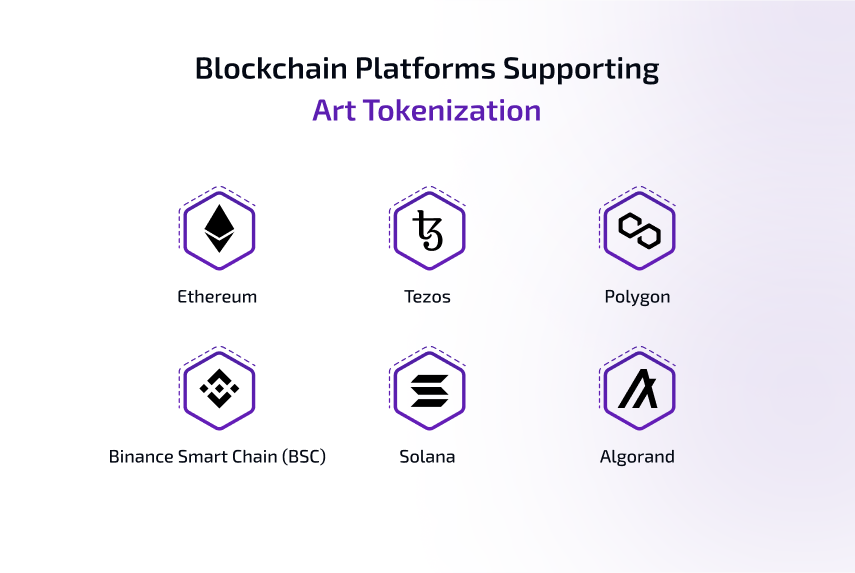
Blockchain Platforms Supporting Art Tokenization
Ethereum
Known for its robust smart contract capability—Ethereum is the most well-known blockchain for art tokenization. It drove the creation of non-fungible tokens (NFTs) widely used in art tokenization guide.
Key features
Support ERC-721 and ERC-1155 standards allowing for batches and unique NFTs
Hosts the largest marketplaces including Rarible and OpenSea
Tezos
A popular choice for ecologically aware projects—Tezos is a sustainable blockchain platform that places a high priority on minimal energy use.
Key features
Eco-friendly proof-of-stake system
Transaction fees are reasonable as compared to Ethereum
Polygon
Polygon is an Ethereum Layer-2 solution that offers quicker and less expensive transactions while still being compatible with apps that use Ethereum
Key features
The gas prices are exceptionally cheap
The smooth interaction with Ethereum enables users to take advantage of its security
Binance Smart Chain (BSC)
Binance smart chain is a popular platform for large-scale art tokenization service since it offers a low-cost and high-speed blockchain solution
Key features
Compatibility with Ethereum-based tools
Supports NFT trading and creation via Binance NFT Marketplace and BakerySwap
Solana
Solana is a high-performance blockchain platform that can process thousands of transactions per second and is renowned for its remarkable speed and scalability
Key features
Fast settlement times and cheap transaction costs
Huge scalability for trading NFTs at large volumes.
Algorand
Known for its quick and safe transaction processing—Algorand is a carbon-neutral blockchain
Key features
Provide energy efficient operations with no effect on the environment
Tokenizing art and digital assets is a simple and affordable process.
How Art Tokenization Empowers Artists
Artists now have unparalleled power, visibility and revenue opportunities due to art tokenization. Through the blockchain artists mint their work as tokens avoiding traditional gatekeepers like auction companies and galleries. They can determine their own prices, sell directly to customers throughout the world and retain ownership rights
Automated royalties are one of the main benefits. Smart contracts generate constant revenue by guaranteeing artists a share of each subsequent resale. Additionally— tokenization reduces art fraud and safeguards creators by offering proof of provenance and legitimacy.
Tokenization helps artists in creating autonomous & sustainable careers in the digital age whether they are experienced experts or up and coming talent.
How Artists Can Benefit from Art Tokenization
Global reach
By allowing artists to showcase their work to a worldwide audience—tokenization broadens their market beyond local borders.
Fractional ownership
By allowing artists to sell a portion of their artwork—a larger spectrum of investors and collectors can purchase it.
Royalties on resale
By using smart contracts to get royalties every time their work is resold—artists can be ensured they will always have continued earnings.
Provenance and authenticity
Blockchain technology makes things clearer and reduces fraud by ensuring the artwork’s origin and authenticity.
New revenue streams
There are new ways for artists to make money from their work after tokenization—so they can support themselves.
Ownership control
To maintain their artistic integrity—artists should control the distribution and sale of their works.
Security and transparency
Blockchain creates a safe and permanent record of all transactions and protects individual artists' rights.
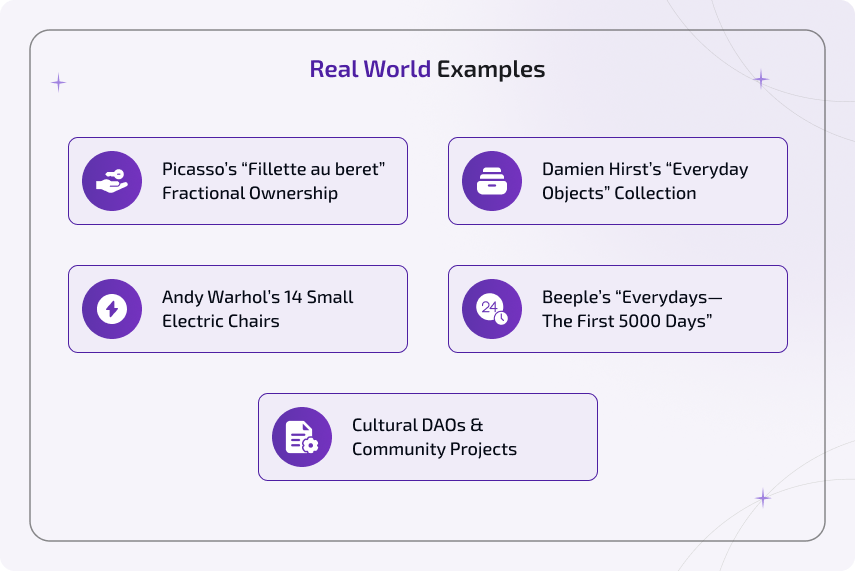
Real World Examples ( Or ) Case Studies
The following case studies of art tokenization show how this trend is being put into practice:
Picasso’s “Fillette au beret” Fractional Ownership
A Swiss bank split Pablo Picasso's 1964 painting into 4,000 tokens, enabling about 50 investors to own small parts of the masterpiece. This showed how tokenization can broaden access to high value art.
Damien Hirst’s “Everyday Objects” Collection
By partnering with a blockchain platform, famous modern artist Damien Hirst allowed a worldwide audience to participate in a unique art collection by issuing tokens that represented ownership of everyday objects.
Andy Warhol’s 14 Small Electric Chairs
By partnering with a blockchain platform, famous modern artist Andy WarholThe Maecenas platform tokenized a well-known Warhol piece, selling fractional shares to collectors around the world and opening up access to a traditionally expensive piece of art for more investors .
Beeple’s “Everydays—The First 5000 Days”
The $69.3 million NFT sale of digital artist Beeple at Christie's shown how tokenization may unlock enormous market value for digital art and get widespread attention.
Cultural DAOs & Community Projects
Organizations such as Cultural DAOs combine shared ownership of art assets with community governance by co-owning and managing artworks through tokens.
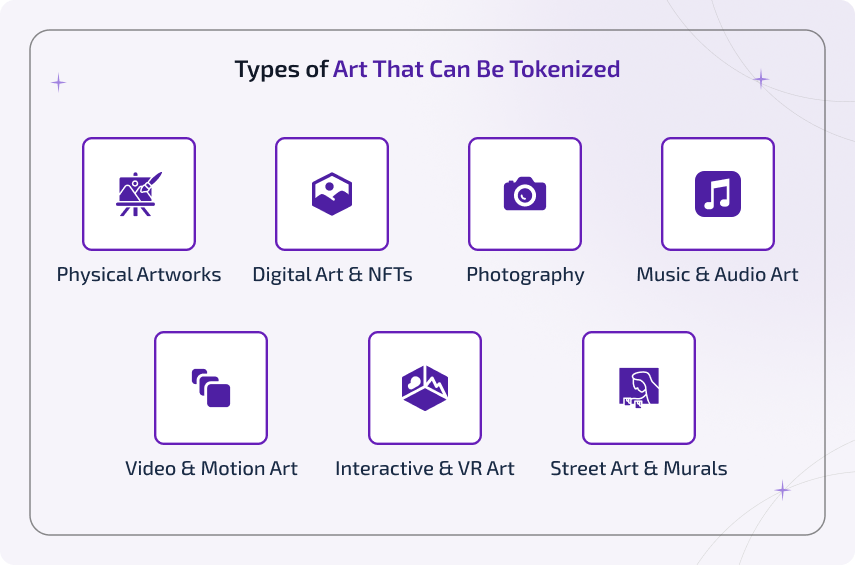
Conventional artwork, sculptures, prints, and collectibles can be fractionalized and digitalized to allow for multiple people to own a portion of the same piece.
Digital Art & NFTs
Blockchain marketplaces allow for the tokenization and trading of art made only for digital platforms, including generative art, animations and illustrations.
Photography
Tokens can be created from iconic or limited edition images, giving buyers ownership rights without requiring the original print to be transferred.
Music and Audio Art
It is also possible to tokenize songs, albums, and sound art, giving investors or fans a share in the royalties or rights.
Video and Motion Art
Animations, motion graphics, and short films can all be represented as tokens, with the potential value shared by all token holders.
Interactive & VR Art
Immersion art assets can be tokenized and traded for artwork created for virtual reality or interactive digital experiences.
Street Art and Murals
Well-known street art or murals can be tokenized for fractional ownership, especially when paired with digital provenance and authentication.
By converting ownership of digital or physical artwork into blockchain-based tokens—art tokenization opens up new avenues for transparency, accessibility and investment. But it also brings with it serious legal and regulatory issues. Tokenized arts as securities which subject it to strict laws like the EU’s MiFID II or the US’s Howey Test is a crucial factor.
To prevent fraudulent activity, platforms that facilitate art tokenization must ensure adherence to know-your-customer (KYC) and anti-money laundering (AML) regulations. Clear agreements that specify what customers own, whether complete ownership, fractional shares or display rights are necessary for intellectual rights (IP) rights.
Furthermore depending on the jurisdiction token issuers have to handle intricate tax systems including value-added taxes and capital gain taxes. As blockchain is transparent and immutable data protection laws like GDPR provide additional difficulties.
Custodian agreements for tangible art must cover issues of liability, maintenance and storage. As this new approach develops it is essential to respect regulatory frameworks and take advantage of blockchain’s potential to democratize the art market.
Art Tokenization—Innovations and Future Trends
Advanced technology integration
Provenance tracking technologies powered by AI will reduce fraud and boost authenticity
AR will enable virtual art galleries and interactive art interactions
Sustainable blockchain technologies will reduce energy use.
Developed regulatory frameworks
Governments and institutions setting explicit criteria will make tokenized art investments safer and more compliant.
Globally standardized regulations will simplify tokenized asset trading
Hybrid market models
Collaboration between blockchain platforms and traditional art organizations will expand art exhibitions and sales.
Tokenizing collections can help museums and galleries earn funds or attract digital native collectors.
Growth of Digital Art and NFTs
The use of NFTs for digital art will blur the line between the real and virtual art markets
Tokenized art which facilitates easy trade, purchasing and selling will dominate the online marketplaces.
Global accessibility
Through the art tokenization guide—emerging market artists and collectors will be able to participate in the global art industry.
Sustainability focus
Art tokenization will be aligned with environmental sustainability objectives due to green blockchain solutions.
BlockchainX is committed to helping consumers and businesses to capitalize on tokenization possibilities. As pioneers in token and blockchain development—we offer you the expertise, knowledge and trust to effectively deal with this changing digital environment.
Convert your works into useful tokens to increase the worth of your artwork right now—Use BlockchainX to tokenize right now.
Get all the latest posts delivered straight to your inbox.
Get In Touch
Our expert team is professionally well-equipped with hands-on experience as a blockchain development
company. Connect with us; at BlockchainX, we curate your desired sustainable solution!