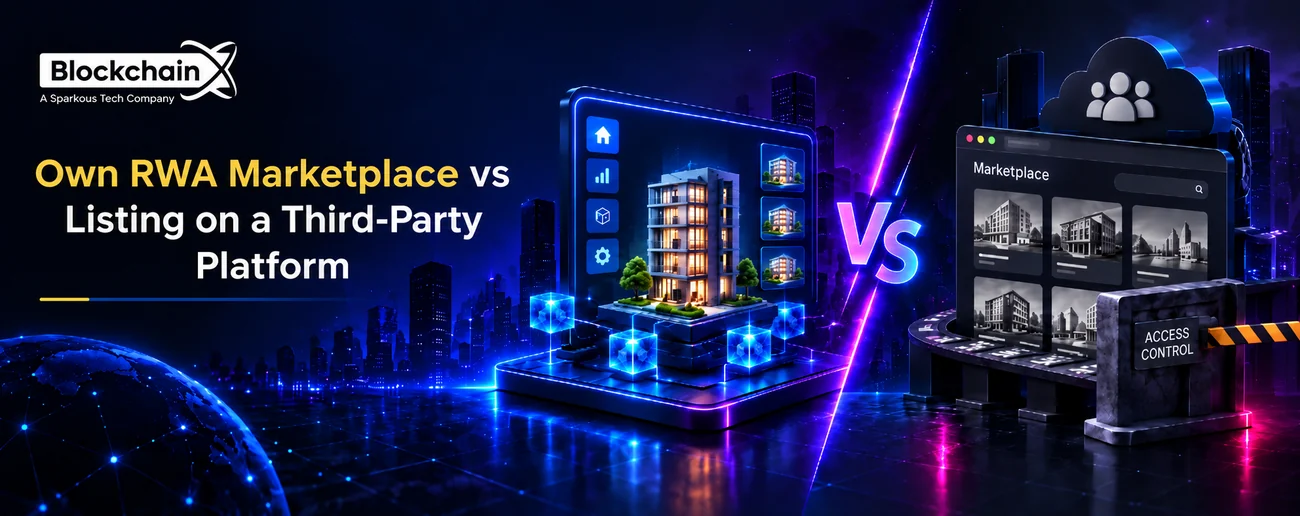
Own RWA Marketplace vs. Listing on a Third-Party Platform: Which Is Better?
 By Yokesh Sankar
10 min read
Updated On
By Yokesh Sankar
10 min read
Updated On
The majority of asset owners doubt whether they should own an RWA marketplace or list on one. Building your own RWA marketplace from the ground up may look like the best way to control your branding, investor access, fees, and liquidity. But for U.S. issuers, the decision is not theirs. If a token qualifies as a security, federal securities rules shape how it is issued, transferred, and resold.
The SEC’s Rule 144 guidance outlines the conditions for the public resale of restricted securities, where regulatory matters are the most important when the RWA market booms toward institutional scale. As of March 2026, tokenized real-world assets have crossed $25 billion in on-chain value, nearly four times the $6.4 billion from the previous year.
For issuers, the real question is: build or list? Here’s how to tell which model actually works with you, balancing control, compliance, cost, and liquidity.
What is an RWA Marketplace?
An RWA marketplace is an infrastructure where tokenized assets are displayed for investors for seamless trading. At its broadest, every functional marketplace combines four functions and is branded in its own way. The SEC’s 2026 guidance clearly distinguished tokenized securities based on their trading and structure.
Onboard and Verify Investors: Manages the KYC/AML audits, accreditation status, eligibility criteria, and investor access effectively.
Issue Compliant Tokens: Wraps the asset in a token standard or economic rights with relevant transfer restrictions.
Host Primary Distribution: The initial sale to investors in a compliant environment under securities registration.
Enable Secondary Transfer: Provides a mechanism for eligible asset holders to transfer or trade after token issuance.
The three terms issuance platform, marketplace, and trading venue all come under one platform with different roles. The issuance platform is the place to create, structure, and distribute the tokens, and the marketplace is where investors and tokenized assets come together across primary and secondary transactions. And finally, the ATS or other regulated market infrastructure goes beyond the trading venue to facilitate securities trading between the buyer and the seller.
By the way, you don’t need to own the entire RWA marketplace; instead, a third-party platform is enough if you just need issuance or investor distribution. But if you actually need control over investors, listings, primary sales, and secondary transfers, it’s better to build your own RWA marketplace platform.
Which RWA Marketplace Model Is Right for You?
Stuck between building a new platform, white-label, or listing on a third-party RWA marketplace? If you already have investor access and repeat issuance demand, owning an RWA marketplace will be the right choice. If you need speed, access, or validation, a third-party tokenization platform is usually more practical. Besides, a White-label infrastructure platform stands in between, providing more control without building it from scratch.
| What describes your position? | Recommended route |
|---|---|
| Your first tokenized deal with zero investors | Third-party platform |
| Capital needs within the next quarter | Third-party platform |
| You have an investor base, but no in-house blockchain team | White-label infrastructure platform |
| You have three or more deals and own a distribution already | Own marketplace |
| Your structure is non-standard and needs highly customized workflows | Own marketplace |
| The investor data feeds a larger strategy to widen your business | Own marketplace |
| The marketplace is the business you are building | Own marketplace |
| You are still validating the market demand | Start third-party, build, then |
What Does a Listing on a Third-Party Platform Mean: A Brief Explanation
Listing on a third-party marketplace is an established platform that opens the gateway for your tokenized asset to reach investors instead of building and operating on your own. Here, you provide the asset and the deal structure, and the platform on its own provides much of the marketplace functionality with investor access.
Your Listing on Third-Party Infrastructure
The platform owns the KYC records, investor accounts, onboarding process, listing rules, and the trading environment. Your asset appears on its marketplace; the underlying compliance infrastructure and platform experience remain under its control.
The Mechanics Behind It
The journey usually involves five stages: due diligence by the platform, an SPV or legal wrapper around the asset, issuance under the platform’s own token standard, marketplace listing, and ongoing servicing based on NAV updates and reporting.
Understanding the Cost
The economics commonly include an origination fee, which is 2-5% in the raise, secondary trading spreads on any resale activity, and an ongoing AUM fee. Among these, listing time is the fastest of all three routes, typically taking two to six weeks.
What Do Third-Party Platforms Bring
The highest advantage is distribution. Instead of taking months to build an investor network, you can easily get access to an existing pool of infrastructure that is expensive and compliant.
What Do You Give Up?
The trade-off is limited. You give up the entire investor relationship, pricing, fees, customer data, and the marketplace rules. You also depend on the platform, marking third-party listings rapidly with less flexibility.
Building and Owning an RWA Marketplace: What It Really Involves?
Running your own RWA marketplace means you have a separate high responsibility for the platform’s technology, investor experience, compliance, custody connections, transaction flows, and much more. This creates greater control and makes the entire system more operational.
The Full Marketplace Stack
An owned marketplace can span across several layers, including smart contracts, compliance and KYC/AML infrastructure, investor portals, custody integrations, primary & secondary functionality, and data infrastructure. The more of this stack you own, the less dependent you are on external platforms.
| Component | Core Tech Stack | Purpose |
|---|---|---|
| Blockchain Network | Ethereum, Polygon, Base | Asset tokenization and blockchain transactions |
| Smart Contracts | Solidity, OpenZeppelin | Asset issuance and protocol automation |
| Frontend | React.js, Next.js | User interface and investor portal |
| Backend | Node.js, NestJS | Business logic and API management |
| Cross-Chain Infrastructure | LayerZero, Chainlink, CCIP | Multichain connectivity and interoperability |
| Cloud & DevOps | AWS and Google Cloud | Infrastructure deployment, hosting & management |
| Database | PostgreSQL | Structured off-chain data management |
| Wallet Connectivity | Metamask, WalletConnect | Protect user access and transactions |
| Storage | IPFS, Filecoin | Secure storage of asset documents |
| Security & Auditing | OpenZeppelin, Hacken | Risk mitigation & enhances platform security |
Three Ownership Routes
It is not necessary to build an RWA marketplace entirely in-house. You can either customize, build white-label, or work with a licensed platform while keeping full ownership. However, the approach entirely depends on your budget, compliance requirements, in-house capabilities, and flexibility.
What Does Ownership Actually Buy?
The value goes beyond having your own branded platform. It gives control over:
Cap tables: Greater visibility and control over ownership records
Pricing: Control over listing, transaction, and marketplace economics
Investor relationships: Direct access to investor data and engagement history
Issuance: Reusable infrastructure for launching multiple assets
Enterprise value: The marketplace itself can become a strategic business asset
The value of owning the marketplace becomes clearer when you look at a live example. See how tokenized asset marketplace like RealWorld.fi works in practice, built around real-world collateral.
The Privileged Key Problem
Greater control also creates greater responsibility. Compliant token standards like ERC-3643 include administrative functions such as forced transfers and token freezes. This insists that you need clear answers to questions: who controls the privileged keys, when can the holder’s tokens be frozen or transferred, what approval governs the actions, and who has the legal responsibility if misused?
The Risk Nobody Talks About: No Investors
The most overlooked failure mode is building an impressive marketplace without building market demand. A technically strong platform has little value if investors are not actively participating. Before investing in the infrastructure, validate your asset supply, liquidity strategy, and repeat issuance potential against risks.
Asset Supply + Investor Demand + Liquidity = Marketplace Success
The Third Option: White-Label RWA Infrastructure
A white-label infrastructure sits between two extremes: you license a pre-configured platform, build everything from scratch, or list on an existing third-party marketplace. The vendor handles everything, such as token issuance, investor portals, compliance integrations, and custody connections, to avoid developing from scratch.
Your cost actually covers licensing, setup, infrastructure, transaction, maintenance, or issuance fees, depending on the provider, and what it never includes is investor acquisition. The software gives you the infrastructure and not the market.
The biggest question is not just, "What does the platform provide?" But what actually happens when we leave? Before signing, establish who owns the contract, investor identity data, and compliance records. See vendor lock-in and what they travel with you for, since white-label is where lock-in risk is highest and least visible.
Ready to own your RWA marketplace end-to-end - no fee-sharing, no platform lock-in?
Let's scope your custom tokenization platform.
The Regulatory Boundaries of RWA Marketplace Development
The regulatory question is not simply, "Are you building an RWA marketplace?" It means, "What exactly does your platform do?" In the U.S., the analysis is whether a platform brings together securities trading interests, while information-only or issuance platforms fall outside the framework.
U.S. Trigger Test: Rule 3b-16(a) together brings buyer and seller orders of securities under the non-discretionary method to facilitate transactions.
Marketplace or Bulletin Board? A platform that only displays asset information or connects buyers and sellers together may not perform the same function as bringing trading interests together. This is the distinction that affects the platform’s regulatory obligations.
ATS License: An ATS is not a standalone license; it functions within the broker-dealer regulatory framework, filing the applicable Form ATS with the SEC.
April 2026 UI Carve-Out: The SEC found a targeted user interface under its amended framework. But it does not cover the underlying trading, custody, brokerage, and settlement activity.
Transfer-Agent Rules: A transfer-agent registration is not necessary to manage a tokenized cap table. It questions whether Form TA-1 applies when your activities meet the federal transfer agent definition.
EU: MiFID II, Not Simply MiCA: Tokenized securities that qualify as financial instruments fall under MiFID II and not MiCA.
DLT Pilot Regime: The EU framework of RWA tokenization in Europe provides a certain DLT-based market infrastructure with a €6 billion aggregate threshold for eligible instruments.
UAE: Regulation varies by jurisdiction with VARA, ADGM, DIFC, and new federal authorities, each overriding different activities and locations.
| Setup | Regulatory Trigger | What It Means For You |
|---|---|---|
| US: order book, matching engine, or rules-based AMM | Meets both prongs of Rule 3b-16(a), an exchange | Register under §6 or use Reg ATS (broker-dealer + SRO membership) |
| US: bulletin board, bilateral trades | Fails prong 2 of 3b-16(a) | Not an exchange, but may still be a broker under §3(a)(4) |
| US: front end only, no execution/custody | Covered by the April 2026 staff statement | Unregistered OK if no solicitation, flat fees, conflict disclosure |
| US: running your own cap table | TA-1 only if §12 is registered | Most private issuers exempt |
| EU: venue for tokenized shares, funds & bonds | MiFID II, not MiCA (Art. 2(4)) | Needs MiFID II, Regulated Market, or DLT Pilot authorization |
| EU: DLT Pilot Route | Reg (EU) 2022/858 | 6 authorized infrastructures EU-wide; EUR 6bn cap (100bn is proposal only) |
| EU: commodity-backed token, no security rights | May qualify under MiCA Title III | The one case MiCA actually applies to RWA |
| Dubai: RWA-backed token venue | VARA Category 1 licensing | Federal CMA takes over if it's a security |
| ADGM | Digital Securities under FSMR s.58(2) (b) | FSP for operating an MTF; the crypto regime doesn't apply |
| DIFC | Investment token regime | Exchange/MTF/OTF license, not a crypto license |
| Singapore | Organized market under the SFA | Approved Exchange or Recognized Market Operator |
The Liquidity Question Nobody Answers Honestly: What Actually Matters
Tokenizing an asset doesn’t create buyers or secondary-market liquidity. It is the RWA market that makes it technically transferable, which actually depends on factors such as the trading frequency, number of active investors, transfer eligibility, and asset appeal.
For U.S. securities, Rule 144 limits when restricted tokens are sold publicly, requiring a six- or twelve-month holding period of delaying secondary trading. Recent 2026 turnover data reveals that tokenized real-world assets have surged 10x in recent years, now totaling $30B, with nearly half in U.S. Treasury debt, proving that every tokenized asset will be liquid.
In RWA, the participation breadth matters more than headline asset value, where active holders create more potential and trading opportunities. This matters far more than how big or valuable the asset is.
However, a platform with an existing and active holder base genuinely qualifies for a high liquidity advantage. Building your own venue doesn’t manufacture that audience. A recent report on tokenized real-world assets has briefly explained the gap between the total value represented on-chain, distributed, and trading.
How Much Does Each RWA Marketplace Development Cost?
There is no fixed price tag for an RWA marketplace because vendors often use the same term for every different scope. Roughly, the real drivers of cost in real time are the scope of secondary trading, depth of custody integration, and the number of jurisdictions. The three routes that have different cost profiles are:
Listing: It is the lowest infrastructure burden, where you pay for access to an existing marketplace rather than building the stack. Costs include a 2-5% origination fee, AUM fees (success-based), and the lowest upfront cost.
White Label: Mid-range approach. You typically pay setup, recurring subscription, and licensing fees, often with maintenance, transaction, or revenue-share costs, avoiding full custom deployment costs.
Custom-Build: High initial investment because you own the entire integration. With production-ready platforms, you can almost figure out the jurisdiction count, secondary-trading scope, and custody depth.
The initial build is only part of the entire budget. But the recurring costs that everyone misses easily are the audits per upgrade cycle, KYC renewal per investor, transfer agent fees, claim renewal, legal review per new offering, and ongoing security monitoring.
| Cost Line | Market Range | What’s Included | Suitable For |
|---|---|---|---|
| Custom Build | $100K–$350K, $150K–$1.8M, $800K–$3M (three separate sources) | Contracts, compliance layer, investor portal (others cost extra) | Issuers with non-standard structures & repeat deal flow |
| White Label Setup | $25K–$50K + $300–$1,500/mo; $40K–$120K; $100K–$500K | Pre-configured contracts & portal (investor acquisition & legal review are separate) | Having a warm investor base but no in-house engineering team |
| Listing on a Platform | 2–5% origination fee, plus secondary spreads and AUM fees | Access to existing investor base & KYC infrastructure | First-time issuers or anyone needing rapid capital |
| Smart Contract Audit | $5K–$20K simple, $40K–$100K mid-complexity, $150K+ enterprise; $5K–$20K per remediation pass | Code review & vulnerability testing | Any team developing compliance-bearing contracts |
| Transfer Agent | Reg CF $2K–$5K/yr; Reg A+ $5K–$15K/yr | Cap table maintenance & recordkeeping for §12-registered classes | Issuers whose security class is registered under §12 |
| Legal Per Offering | Reg CF $10K–$30K; Reg D PPM $12K–$25K specialist or $50K–$75K+ big law; Reg A+ Tier 2 $75K–$150K | Documents & exemption compliance | Issuers budgeting by exemption rather than deal size |
| Accredited Verification | $0.55–$3.00 per check, or $1.35–$3.39 with AML screening | Identity verification per investor (renewal checks are separate) | High-volume issuers should model this as a recurring line, not a one-time cost |
| KYC/AML | ~$45–$200 per individual; CPA/attorney letters $150–$500+; entities 1.5–2.5x | Income, net worth, and professional-letter verification for Rule 506(c) | Issuers running Rule 506(c) offerings specifically |
Every month on someone else's platform there is a margin left on the table.
See what a white-label RWA marketplace costs vs. your current listing fees.
The Migration Path of RWA Infrastructure: What You Own & What You Don’t
Utilizing an open token standard doesn’t technically mean you can easily exit from a vendor. Your token contract and holder balances become portable, whereas critical components, including identity registries, compliance modules, claim issuers, and off-chain KYC data, may remain controlled by the vendor.
Before signing anything, there are three questions to ask yourself. Here they are:
1. Who owns every contract?
Make sure the ownership comes to the token, and compliance modules, identity registry, identity registry storage, and related contracts are assigned to your entity or multisig and not to the vendor. If your vendor owns any of them, get contract ownership assigned to your multisig.
2. Is your identity registry dedicated or shared?
If the data is shared across the vendor’s client base, taking your data with you doesn't mean taking the contract. This is the hidden lock-in that is rarely noticed before signing.
3. Who signs investor claims, and can KYC evidence be exported?
A vendor-controlled claim issuer creates a costly choice. But switching really means either keeping them as a trusted issuer or redoing KYC for every holder. This lock-in switching cost is one of the rarely revealed upfront costs among users.
RWA Marketplace Models: Which Model Gives You More Control?
No single model works for every issuer. Each route comes with a different level of control, commitment, and responsibility. The differences become clearer when all three models are placed side by side. Let’s take a glance at them.
| Key Consideration | Third-Party Listing | White Label Infrastructure | Owned Marketplace |
|---|---|---|---|
| Launch Time | 2-6 weeks | 4-12 weeks | 4-12 weeks |
| Upfront Investment | Low, success-based fees | Moderate, depending on scope | High upfront investment |
| Investor Relationship | Platform-controlled | Issuer-controlled | Issuer-controlled |
| Initial Liquidity | Access to an existing holder base | No built-in liquidity | No built-in liquidity |
| Brand Ownership | Platform-led | Your brand on vendor infrastructure | Fully branded |
| Regulatory Perimeter | Handled by the platform structure | Depends on the trading model | Primarily yours |
Currently, RWA platforms increasingly combine investor relationships, liquidity, and regulatory responsibility, making it the most important thing to factor in, rather than the platform label.
Which Model Fits You? Score Yourself With the Five-Minute Fit Test
Want a quick answer? You can reach it in two ways: work through the scorecard or identify the profile that fits your requirements. Either way, the decision comes down to three clear choices.
The Ten-Question Scorecard
Answer the ten yes/no questions about your distribution, deal flow, and capacity. Each yes adds a point, and the score maps directly to one of the three routes.
The Three Reader Profiles
Preferring a quick route? Find the profile that looks most like your business and get your marketplace verdict. Tap the one that sounds like yours.
White Label is the best choice. You own the investor relationships, so don't pay for distribution twice to justify building from scratch.
Third-party platform. Your priority is finding investors, not building infrastructure. Validate demand before investing in your own venue.
Own it. When the marketplace is your business, you need to control the infrastructure.
From Third-Party Listing to Your Own Marketplace Model: The Practical Path
Choosing between listing, white-label, and owning isn’t a permanent decision; it’s a sequence that moves you through as your situation changes accordingly. Most issuers fail to pick the right route on their first try, and that’s actually common among beginners.
You don’t have to build your own RWA marketplace from day one, and for many issuers the smartest path is to list first, validate demand, and then build it later. A third-party platform is what lets you test investor interest, then understand the transaction activity, and prove that you have enough issuance volume to justify the reason for owning the infrastructure.
By the way, once you have proper repeat issuances, a growing investor base, and a clear business case, you can gradually move towards white-label or fully owned infrastructure. But make sure to plan it properly before you sign any of the platform agreements. Also, make sure you have a clear idea of who owns the contract, investor data, compliance records, and other critical infrastructure.
Think beyond the first launch: choose a model that works today while keeping the ownership the same to own the infrastructure tomorrow.
Frequently Asked Questions
The choice entirely depends on your personalized goals. Listing on an existing marketplace wins on rapid market access with a lower upfront cost and built-in investor reach. On the other hand, building wins on greater control over branding, fees, and compliance workflows. For a long-term market business and repeat issuances, owning the infrastructure pays off over time.
The cost can vary significantly based on asset class, custody model, compliance scope, and jurisdiction. A basic MVP ranges around $25,000-$50,000; a custom marketplace can reach $100,000-$150,000, and enterprise platforms require high investment.
There is no single fee structure that applies across the industry. Common charges include a 2-5% origination fee, issuance fees, ongoing AUM fees, listing fees, and more. What you pay depends heavily on the asset type and the specific platform, so make sure to compare structures before finalizing them.
The platform itself does it. The marketplace holds the KYC/AML records, the underlying investor data, and the trading account, leaving the issuer with limited visibility. This is the core trade-off of listing. Before listing, clarify who manages investor communications, who owns customer data, and what happens to those relationships if the asset leaves.
Yes, only in the case when your trading mechanism meets both prongs of Rule 3b-16(a) - order matching plus non-discretionary execution. In the U.S., an ATS operates within the broker-dealer framework under Regulation ATS, where the requirement depends on the asset list, jurisdictions, and the transactions.
Not automatically, but sometimes the token contract and its balances migrate. Compliance modules, identity claims, smart contract permissions, and custody setup usually don’t migrate. The safest approach is negotiating transfer rights and a clear exit before the tokens are issued.
Tokenization creates a digital representation of an asset, but it doesn’t create liquidity automatically. The real barrier in secondary trading includes securities law, investor eligibility restrictions, transfer limits, and more. This remains one of the unresolved problems in the market.
It is a pre-built infrastructure that is configured with smart contracts, an investor portal, and a compliance layer, rather than building from scratch. You can license or customize the existing infrastructure and launch it under your own brand. It’s often the practical choice for businesses wanting ownership with more control.
Not sure whether you should build or list?
Our real-world asset tokenization experts review your issuance plan and jurisdiction and help you build both models, which means we assess whether a third-party platform, white-label infrastructure, or your own marketplace is the best fit for your issuance strategy.
Get In Touch
Our expert team is professionally well-equipped with hands-on experience as a blockchain development company. Connect with us; at BlockchainX, we curate your desired sustainable solution!


Follow us on


