What is Renewable Energy Tokenization? Complete Guide 2026
Listen to the Audio :
The renewable energy market is growing at a pace that has never been seen before. Solar, wind, and other green energy projects are growing rapidly to meet global climate goals. However, one major challenge still exists: how can we effectively fund, trade, and monitor these projects?
Traditional funding methods are frequently unclear, costly, slow, and only available to large investors. This is where renewable energy tokenization comes in, an effective innovation that is changing how the world manages and invests in green energy.
Tokenization makes green investments more accessible, liquid, and reliable than ever before by turning renewable energy assets—such as solar farms, wind turbines, Renewable Energy Certificates (RECs), and power purchase agreements—into digital tokens on a blockchain.
In this comprehensive guide, we will go over how renewable energy tokenization works, its primary benefits, practical applications, and the reasons it's becoming a major trend in sustainable finance.
What is Renewable Energy Tokenization?
Renewable energy tokenization is a blockchain-based process for converting physical energy assets like solar farms, wind turbines and renewable energy certificates (RECs ) into digital tokens. These tokens give investors a more flexible and effective method to participate in renewable energy projects by representing ownership, energy output, or revenue rights.
For instance, Sun Exchange allows anyone to own solar panels and earn income from the electricity they produce, while Power Ledger allows users to exchange tokenized solar energy directly. Similarly—WePower assists energy producers in raising funds by tokenizing future energy output.
Renewable energy tokenization is transforming the funding, trading, and scaling of clean energy projects worldwide by facilitating fractional ownership, reducing entry barriers, and guaranteeing transparency through blockchain.
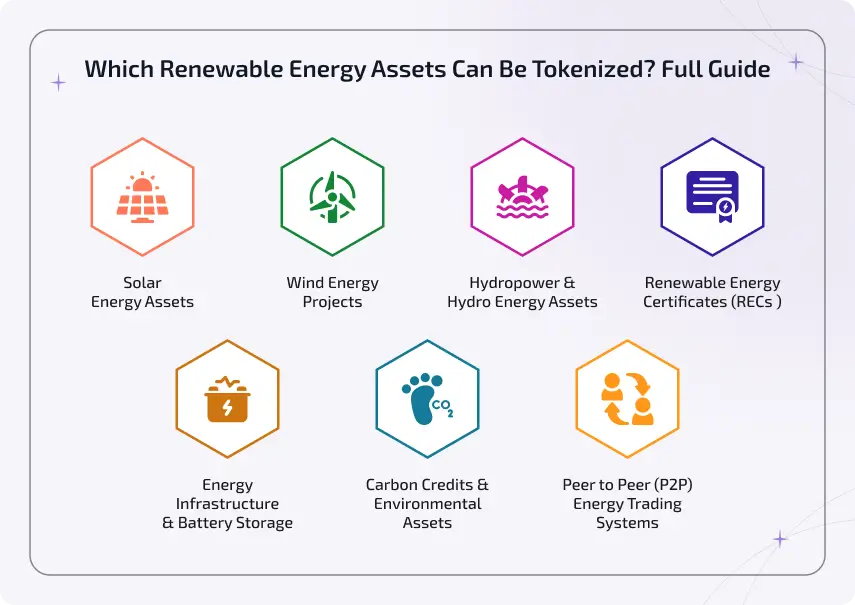
Which Renewable Energy Assets Can Be Tokenized? Full Guide
A broad range of tokenized renewable energy assets is emerging as ideal candidates for tokenization as blockchain technology continues to transform the energy industry.
Renewable energy tokenization opens up new investment options, increases liquidity and improves transparency along the supply chain by turning tangible and environmental assets into digital tokens.
The following are the main renewable energy assets that are prepared for tokenization:
Solar Energy Assets
Solar energy projects are one of the most popular tokenized assets because of their scalability and consistent returns.
This covers large-scale solar farms, business solar installations, and rooftop solar panels. Investors can buy a fractional ownership in these assets and get paid according to how much electricity they generate. Platforms like Sun Exchange have already shown how individuals invest in solar panels and profit from energy output.
Wind Energy Projects
Another strong option for a renewable energy tokenization platform is wind farms.
These projects are ideal for fractional ownership models since they usually need a high upfront cost. Wind energy tokenization allows various investors to fund wind turbines and share revenue from power generation increasing accessibility and scalability.
Hydropower and Hydro Energy Assets
Hydropower plants both small and large-scale, can be tokenized.
These assets are attractive to investors since they offer steady, long-term energy output. Tokenization unlocks funding for new hydro projects while providing consistent returns based on energy output.
Renewable Energy Certificates (RECs )
RECs serve as proof that electricity has been generated using renewable resources
Tokenizing RECs allows the use of blockchain technology for more effective tracking, trading and verification. As a result, issues like double-counting are no longer common, and market trust in carbon offsets improves .
Energy Infrastructure and Battery Storage
Battery storage units and other energy storage devices are becoming increasingly vital to keeping a balance in the supply of renewable energy .
Tokenizing these assets could attract funding for infrastructure development. Returns from energy storage services and grid stabilization can be advantageous to investors.
Carbon Credits & Environmental Assets
Tokenization is also gaining traction for environmental assets like carbon credits.
Businesses and individuals can simply trade and verify their environmental effect by turning carbon offsets into digital tokens. The result is a transparent, efficient carbon market that supports global sustainability goals .
Peer to Peer (P2P) Energy Trading Systems
Tokenization allows decentralized energy trading platforms, allowing users to purchase and sell excess renewable energy directly.
Platforms such as Power Ledger have already enabled peer to peer energy exchanges, allowing customers to become energy producers and traders in a decentralized economy.
The Reasons These Assets Are "Tokenization-Ready"
Measurable Output - IoT and smart meters provide oracles access to real-time data.
Revenue Generation - Clear cash flows from energy sales, RECs, or PPAs.
High Capital Needs - Fractional ownership is highly valuable due to its high initial costs.
ESG Demand - Verifiable green assets are in high demand among impact investors.
Why Renewable Energy Tokenization is Gaining Popularity?
Renewable energy tokenization is becoming more prevalent because it combines financial innovation with sustainability .The following are some main causes of its rising uptake:
Growing interest in green energy solutions
High interest in investments based on blockchain
Transparent and safe investing methods are necessary.
Demand for opportunities involving fractional ownership
Global drive towards decentralized finance (DeFi)
Technology and sustainability have combined to form a new investment ecosystem.
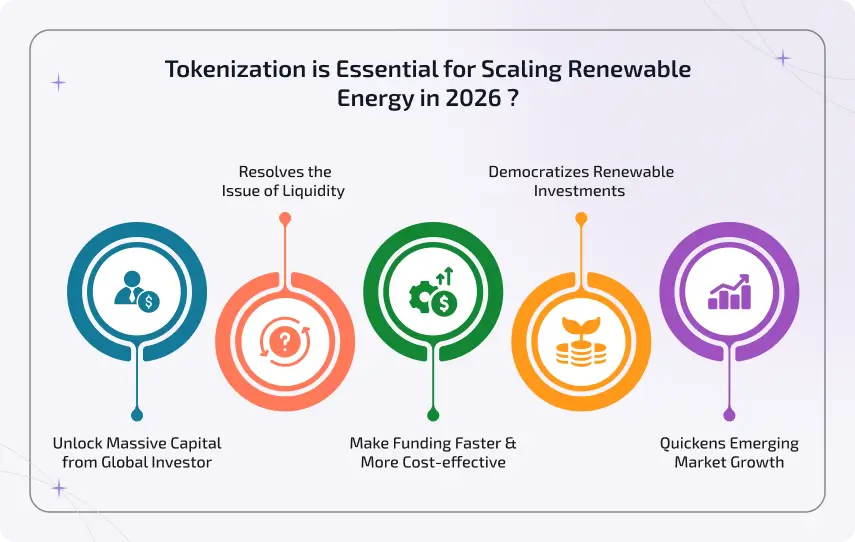
Tokenization is Essential for Scaling Renewable Energy in 2026 ?
To reach worldwide net zero goals–the renewable energy sector must grow at a remarkable pace. The International Renewable Energy Agency (IRENA ) estimates that annual investment in renewable power generation must increase from USD 486 billion in 2022 to over USD 1.3 trillion by 2030.
Broader clean energy investment needs are much higher with entire energy transition investments expected to reach USD 5 trillion per year in the future years to stay on a 1.5°C track.Traditional finance methods cannot bridge this large financial gap.
For this reason, renewable energy tokenization has become crucial to the industry's growth. The following explains why tokenization is not only helpful but also essential for the future of renewable energy :
1. Unlock Massive Capital from Global Investors
Large renewable energy projects have traditionally relied on institutional investors, banks and private equity.
Tokenization allows for fractional ownership enabling retail and small investors globally to join with small amounts ( as low as $50-$100 ). This opens up a much broader global pool of money that was previously untapped.
2. Resolves the Issue of Liquidity
Tokenized renewable energy assets are extremely illiquid, with capital being locked in for 10 to 25 years.
Due to its ease of trading on secondary markets, tokenized assets have lower risk and attract more investors.
3. Make Funding Faster & More Cost-effective
Traditional finance involves time-consuming and costly due diligence.
Blockchain tokenization eliminates middlemen, automates processes with smart contracts, and significantly reduces project development time and costs
4. Democratizes Access to Renewable Energy Investments
Individuals and local populations, not just large organisations, can now invest in green energy due to tokenization.
This enables local people to actively invest in solar farms, wind projects, and other green energy tokenization efforts, which leads to higher engagement and public support for sustainable development .
5. Quickens Emerging Market Growth
Funding is an issue for many high potential renewable energy projects in regions like Asia, Africa, and Latin America.
Tokenization makes cross border investments possible, enabling global micro-investors to finance projects in poor countries. This accelerates renewable energy deployment where it is most needed.
Investment Opportunities in Tokenized Renewable Energy
One of the most potential investment areas in the global clean energy transition is tokenized renewables. Renewable energy tokenization is opening up fresh opportunities for both institutional and private investors by merging the efficiency, transparency, and liquidity of blockchain technology with the stability of real renewable assets.
Tokenization makes it simpler than ever to participate in the fast growing green energy industry by enabling fractional ownership, global access, and real-time trading, in contrast to traditional energy investments.
Why Are Investors Turning to Tokenized Renewable Energy ?
Strong market trends and rising investment are supporting the growing interest in tokenized renewable energy:
Investment in renewable energy reached $1.9 trillion globally in 2025, indicating a rise in the demand for sustainable infrastructure.
The renewable energy tokenization industry is predicted to grow at a CAGR of 28.4% reaching about $19.7 billion by 2033
The broader asset tokenization industry is estimated to hit $16 trillion by 2030 with energy infrastructure appearing as a key component.
The International Renewable Energy Agency states that massive financial inflows are necessary to scale renewable energy which makes innovative funding approaches like tokenization crucial.
Let's examine the main investment opportunities according to the creation and capture of value :
Direct Asset Ownership (Stable, Long-Term Returns)
Investors can own fractional shares in physical renewable energy assets like hydroelectric plants, solar farms, and wind turbines via tokenization.
Through power generation and long-term power purchase agreements (PPAs), these assets generate passive revenue. People can invest in solar panels and profit from real energy production through platforms such as Sun Exchange.
Ideal for - Investors looking for a lower chance and steady, predictable profits
Energy Trading & Market Participation
Tokenized ecosystems allow investors to participate in decentralized energy markets where real-time electricity trading is possible.
Users directly buy and sell excess renewable energy on platforms like Power Ledger opening up opportunities for dynamic pricing and active revenue production.
Ideal for - Investors seeking market-driven returns and active trading.
Future Energy Token Investments (Early-stage Growth)
Multiple platforms allow developers tokenize future energy output and sell it up front to raise capital.
For example, WePower offers investors the opportunity to acquire tokens representing future electricity supply at discounted rates, giving potential for substantial profits as energy demand grows.
Ideal for - Those who are prepared to take on a low level of risk for higher growth potential.
By digitizing assets like carbon credits and renewable energy certificates (RECs) —tokenization is revolutionizing environmental markets.
Global trading of these tokenized assets allows investors to make revenue while supporting environmental projects. Blockchain promotes transparency and eliminates concerns like double-counting .
Ideal for - ESG conscious investors and businesses seeking rewards and impact .
Tokenization goes beyond energy generation to infrastructure, including smart grids and battery storage systems.
Energy balancing, grid services, and storage optimization are important areas for the future of renewable energy. Investors can fund these essential components and gain from them.
Ideal for - Long term investors considering infrastructure for next generation energy.
Notable Platforms & Projects (2026)
Platform
Focus Area
Type of Opportunity
Enel (ebitts)
Solar & wind farms
Fractional ownership + bill credits
Power Ledger
RECs & Peer-to-Peer Trading
Energy credits & trading
Sun Exchange
Solar panels (Africa)
Own panels, earn from electricity
WePower
Future energy output / PPAs
Tokenized energy sales
DAMREV
Solar, wind, hydro
Fractional clean energy assets
Zoniqx / Stobox
ESG & Energy funds
Compliant security tokens
Key Benefits of Renewable Energy Tokenization
Renewable energy tokenization is transforming the clean energy industry by improving investor accessibility, efficiency, and transparency .Below are the key benefits driving its adoption :
Fractional Ownership
Renewable energy tokenization allows for fractional ownership by dividing up large-scale projects into smaller digital tokens. This makes clean energy investments more accessible and increases funding options for solar, wind and other renewable energy projects globally by allowing investors to participate with lower capital .
Enhanced Liquidity
Compared to traditional investments, tokenized renewable energy assets offer liquidity since they can easily be traded on digital platforms. The ability for investors to buy or sell tokens at any moment increases market efficiency and makes investments in renewable energy more dynamic, scalable, and investor-friendly .
Global Accessibility
By removing geographic constraints, renewable energy tokenization enables investors globally to take part in sustainable energy projects. By connecting global investors with renewable assets—platforms like WePower increase funding options and speed the adoption of sustainable energy in many different regions.
Transparency and Security
Every transaction is safely recorded and easily verified due to blockchain technology. Renewable energy tokenization offers total transparency, lowering fraud risks and boosting trust in energy investments while allowing investors to track ownership, performance, and profits in real time .
Lower Costs
Renewable energy tokenization lowers transaction and operational costs by eliminating middlemen like brokers and financial institutions. Both project developers and investors gain from this cost effectiveness which lowers the cost of renewable energy investments and increases total profitability.
Renewable Energy Tokenization vs Traditional Investment Models
Factor
Renewable Energy Tokenization
Traditional Investment Models
Accessibility
Enables fractional ownership, which allows investors worldwide to participate with small amounts.
Requires a large amount and is often restricted to institutions or high-net-worth investors
Liquidity
Token buying and selling on digital platforms are easy with high liquidity
Long lock-in periods and few exit opportunities lead to low liquidity
Transparency
Blockchain guarantees real time, safe, and transparent ownership and transaction monitoring
Limited transparency due to complex documentation and reliance on middlemen
Investment Speed
Digital platforms and smart contracts allow faster fundraising & transactions
Approvals, paperwork, and several middlemen all add to slow processes
Cost Efficiency
Automate processes and cut out middlemen to lower costs.
Legal fees, brokers, and admin activities all drive up costs
Global Reach
Open to worldwide investors with smooth cross-border involvement
Restricted by business, legal and geographic obstacles .
How Renewable Energy Tokenization Will Evolve by 2030
Renewable energy tokenization is rapidly evolving from early pilots to a widely used financing and trading system. Through 2030 and beyond, the industry will be shaped by a number of key trends as blockchain in tokenization grows in line with the global energy transformation.
The most important upcoming trends to keep an eye on are as follows :
By 2033, the tokenization market for renewable energy is expected to exceed USD 19.7 billion growing at a compound annual growth rate of 28.4%. By 2030— the real world asset (RWA) tokenization market is predicted to reach $16 trillion, with the energy infrastructure sector leading the way.
By 2027, more than 60% of global asset managers plan to broaden their exposure to tokenized real world assets due to factors including liquidity, transparency and ESG alignment. Solar energy tokenization, wind energy tokenization, and storage projects are attracting more institutional investors as participants.
2. Deeper Integration with AI, IoT & Smart Grids
Blockchain + AI - AI will improve grid balance, automated trading, energy forecasting, and dynamic token distribution .
IoT and Real-Time Oracles - Blockchain will receive real-time production data from smart meters and IoT sensors, allowing for precise REC/GO verification, automated token minting, and income distribution.
This convergence supports peer-to-peer energy trading in real time and more precise ESG reporting .
3. Extension Beyond Wind and Solar Power
Although solar and RECs are now in the lead role, upcoming growth will include:
Long-duration energy storage (LDES) and battery storage tokens
Green hydrogen production facilities
Renewable energy projects that combine solar,wind and storage
Community energy projects and microgrids
Tokenized carbon credits linked directly to renewable projects
4. Advanced DeFi Integration & New Financial Products
The use of tokenized renewable assets as collateral for yield farming, DeFi lending, and structured products will grow. Expect :
Flexible hybrid PPAs
Automated dividend-yielding tokens
ESG funds and tokenized green bonds
Secondary markets with more liquidity
5. Democratization & Emerging Market Acceleration
Tokenization will provide funding for high potential projects in Latin America, Asia and Africa via fractional ownership and international microlending. Decentralized and community-owned energy solutions will become popular, encouraging local participation.
6. Convergence of the Carbon Market and Sustainability
The voluntary and compliant carbon markets will more easily integrate with tokenized renewable energy. Plan for verified net-zero solutions for businesses, direct on-chain credit retirement, and carbon-negative blockchains.
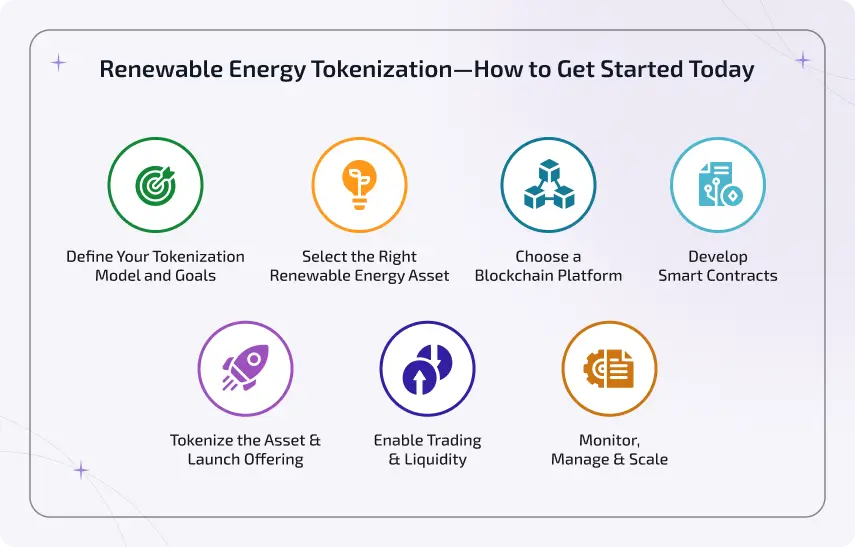
Renewable Energy Tokenization—How to Get Started Today
To begin tokenizing renewable energy, a mix of blockchain use, legal compliance, and strategic planning is required. Adopting a structured strategy ensures smooth and sustainable entry into the tokenized energy ecosystem, no matter whether you are an investor, startup, or energy developer.
Here's a step by step tutorial to get you started:
1. Define Your Tokenization Model and Goals
First, decide what you want to tokenize : carbon credits, solar farms, wind farms, or renewable energy certificates (RECs).
Make your goals clear such as increasing liquidity, energy trading, fractional ownership, or fundraising. Choosing the right legal structure and technology is helped by a defined model.
2. Select the Right Renewable Energy Asset
Select a tokenization-ready asset depending on:
Reliable energy production
Stable revenue streams (for example, PPAs)
Investor appeal and scalability
Regulatory viability
Due to their proven demand and performance– assets like solar and wind projects are frequently chosen.
3. Choose a Blockchain Platform
Pick a blockchain network that facilitates security, scalability and smart contracts.
Ethereum, Polygon and other enterprise grade blockchain systems are popular options. Token generation, trading, and management are all made easy with the proper infrastructure.
4. Develop Smart Contracts
Make smart contracts that specify:
Structure of ownership
Model of revenue distribution
Tokens Pricing and Supply
Governance mechanisms
These contracts automate tasks like energy-based returns and dividend payments.
5. Tokenize the Asset & Launch Offering
Convert the chosen renewable energy asset into digital tokens, then use a token offering platform to launch them.
Depending on your target investors, you can select crowdfunding, public offers, or private sales.
6. Enable Trading & Liquidity
Add trading features to your platform or list your tokens on secondary trading platforms.
One of the main benefits of tokenization is liquidity, making it easy for investors to buy and sell tokens.
7. Monitor, Manage & Scale
After launch , keep an eye on investor activity, energy production, and performance.
Tokenize additional assets to grow your business and maintain transparency by using blockchain analytics and reporting tools.
Renewable Energy Tokenization Development with BlockchainX
One of the top blockchain development companies, BlockchainX, focuses on green energy tokenization solutions. We help companies, utilities, and renewable energy providers in turning clean energy assets like solar farms, wind turbines, hydroelectric facilities, Renewable Energy Certificates (RECs), and others into safe, convertible digital tokens.
With more than 150 blockchain engineers and 9+years of expertise, BlockchainX offers end-to-end RWA tokenization development services to build tokenization systems that are investor-ready, scalable and compliant.
Why Choose BlockchainX for Renewable Energy Tokenization?
Specialized Green Energy Projects - Innovative solutions for tokenizing carbon credits, battery storage, wind, solar, and hydro.
Full-stack Development - From smart contracts creation to building platforms and integrating them with IoT oracles and smart meters.
Regulatory Compliance - Support for global standards, MiCA, SEC-compliant architecture, and security tokens.
End-to-End Ecosystem - We build broad systems, such as dashboards, trading markets, automated revenue distribution, and ESG reporting tools, in place of token issuance.
Proven Track Record - Strong emphasis on Real-World Assets (RWAs) Tokenization in the energy and other industries.
Conclusion
Renewable energy tokenization is evolving how clean energy projects are funded, managed and traded, as we've discussed throughout this blog. Tokenization opens huge new prospects, whether you are a developer who needs faster funding, an investor seeking sustainable profits or a company trying to align with ESG goals.
Traditional, illiquid infrastructure investments are already giving way to easily available, marketable digital assets. Renewable energy tokenization makes use of blockchain technology to increase global involvement, efficiency and transparency .
Early adopters stand to benefit financially and strategically as the shift to renewable energy advances. In the end—tokenizing renewable energy is about democratizing access and allowing everyone to participate in creating a sustainable future not simply about innovation .
Get all the latest posts delivered straight to your inbox.
Get In Touch
Our expert team is professionally well-equipped with hands-on experience as a blockchain development company. Connect with us; at BlockchainX, we curate your desired sustainable solution!