Private Equity Tokenization: A Complete Guide in 2026
Listen to the Audio :
The global private equity market is experiencing quick growth, with assets under management projected to exceed $8 trillion in the next few years.
Despite the growth, more investors steer clear of private equity investments due to the complex investment structures, long lock-in periods, and high entry barriers. These prospects were mostly restricted to high-net-worth individuals and institutional investors for decades .
Private equity tokenization is one of the most significant innovations from this change, which is revolutionizing the ownership, distribution, and trading of private assets.
Private equity tokenization gets attention in modern finance as investors and financial institutions look for more accessible and effective investment strategies.
This article covers what private equity tokenization is, how it operates, its main pros and cons, and the reasons it is emerging as a significant trend in private market investment.
Understanding Private Equity Meaning
Private equity refers to capital investments made in private enterprises that are not publicly traded on public exchanges. These investments are often made by private equity firms, venture capital investors, or institutional funds to support business growth while generating high long term returns .
Unlike public market investments, private equity seeks to acquire ownership stakes in firms and actively improve their business performance. Investors support firms strategically and financially to help them expand and increase their market value.
Private Equity Tokenization
Private equity tokenization is the process of turning ownership of private equity assets into digital tokens on a blockchain network. These assets may consist of shares in private enterprises, investment portfolios, or venture capital funds.
A fractional portion of ownership in the underlying asset is represented by each token. These tokens can be safely stored, moved, and traded while keeping clear ownership records due to blockchain technology.
Long lock-in times, complicated papers, and high entry hurdles are common features of traditional private equity investments. Because of these obstacles, many investors have traditionally found it difficult to participate in private equity markets.
Equity tokenization makes this process easier by digitizing asset ownership and automating transactions with smart contracts. This increases the efficacy of investment management and lessens paperwork.
Fractional ownership is another important benefit of private equity tokenization. Investors can buy fractional shares in private equity funds by dividing large assets into smaller digital units.
This approach increases the efficiency, transparency, and accessibility of private market investments for a wider range of investors.
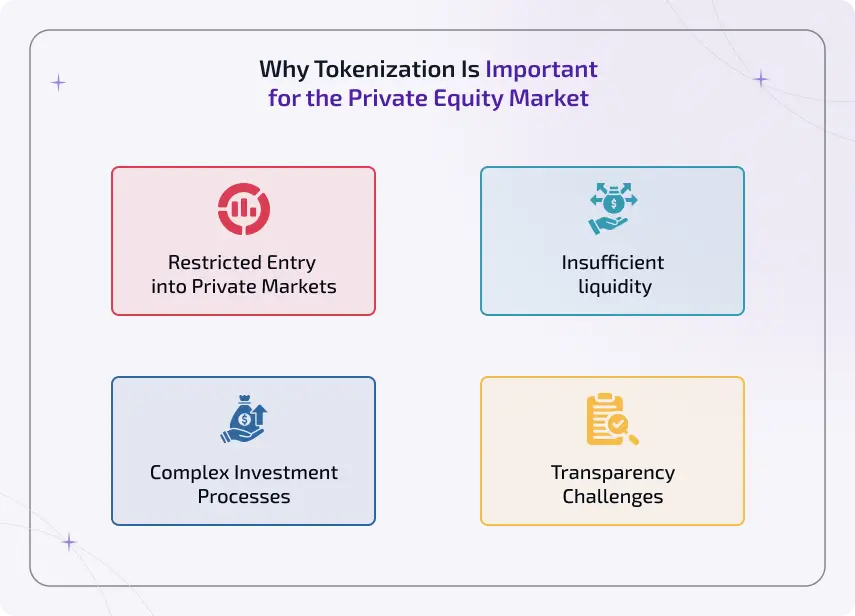
Why Tokenization Is Important for the Private Equity Market
As the private equity market has grown rapidly in recent years, several issues continue to limit investor's access to it and its effectiveness. Many investors find it difficult to access traditional private equity investments due to their high capital requirements, long lock-in periods, and complex legal processes. Private equity tokenization is becoming an effective solution as the need for more adaptable investment choices grows.
Restricted Entry into Private Markets
Most private equity opportunities are exclusively accessible to high-net-worth individuals and institutional investors. Smaller investors seeking exposure to high-growth private enterprises are restricted in their participation.
Tokenization makes fractional ownership possible, which reduces the capital requirements for smaller investors to take part in private equity options.
Insufficient Liquidity
Typically, private equity investments have long holding period'sup to five to ten years. Investors cannot simply sell their shares before the investment cycle ends, limiting liquidity.
The potential for tokenized equity assets to be sold on secondary digital marketplaces could increase private equity investment liquidity.
Complex Investment Processes
The investment process is slow and ineffective since traditional private equity transactions require a lot of paperwork, legal processes, and manual verification.
Through the use of smart contracts to automate investment transactions and reduce administrative complexity, blockchain technology streamlines these processes.
Transparency Challenges
The lack of real-time transparency in private market investments may lead to gaps in expertise between fund managers and investors.
Blockchain-based tokenization increases transparency and enables investors to confirm ownership and transaction history by recording transactions on an unchangeable distributed ledger.
How Tokenization Solves These Problems
By introducing blockchain-based digital ownership through tokenization, fractional investments, increased transparency, and more effective transactions are made possible. Tokenization helps to create a more accessible, liquid, and effective investment environment by using blockchain technology to modernize private equity.
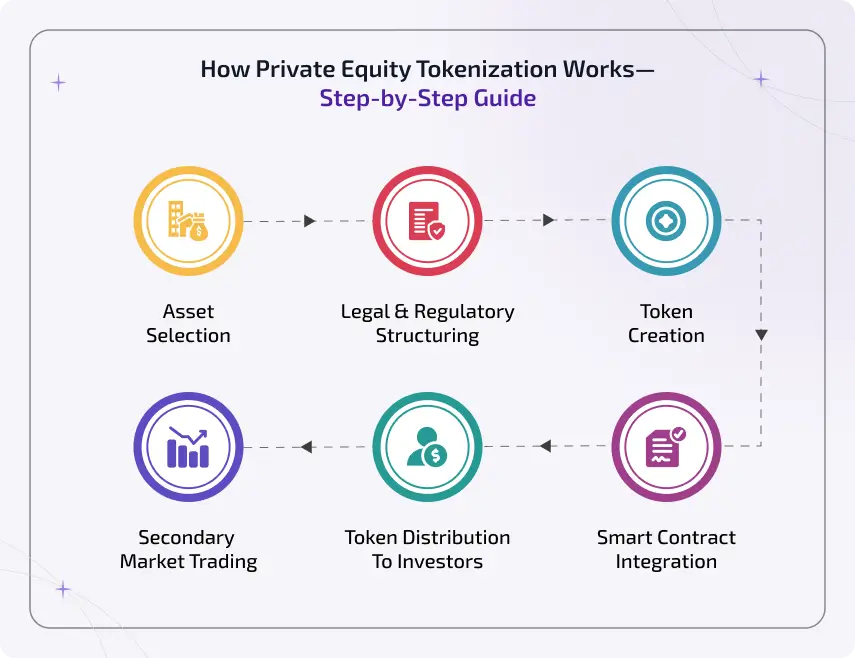
How Private Equity Tokenization Work's Step-by-Step Guide
Private equity tokenization converts traditional private equity assets into blockchain-based digital tokens that signify ownership in the underlying investment. The process makes private equity investments accessible and effective by combining blockchain technology with financial architecture.
Typically, the tokenization process consists of a set of key elements.
Asset Selection
The first step is identifying which private equity asset will be tokenized. A private company's shares, venture capital funds, private investment portfolios, and other private market assets could be examples of this.
To determine the asset's value, ownership structure, and tokenization eligibility, it must be assessed.
Legal & Regulatory Structuring
The asset must abide by legal and financial standards before tokenized equity. This phase ensures that the tokenized asset meets legal criteria related to investor protection, securities regulations, and compliance standards.
Proper legal structuring encourages transparency and investor trust.
Token Creation
Digital tokens are generated on a blockchain network after a legal framework has been set. Each token is part of a private equity asset.
Large assets can be divided into smaller digital units using this method, making it easier for investors to buy them.
Smart Contract Integration
Using smart contracts automates investment processes. These blockchain-based applications manage tasks like:
Verification of ownership
Token transfer
Investor rights
Profits or dividend distribution
Smart contracts increase operational efficiency and reduce manual operations.
Token Distribution To Investors
After their creation, tokens are made open to investors via compliant digital marketplaces or tokenized investment platforms.
Investors can buy tokens representing some of the private equity investments.
Secondary Market Trading
The ability to trade on secondary markets is one of the main benefits of tokenization. Investors might be able to purchase or sell their tokenized assets on digital marketplaces that allow tokenized securities.
Compared to traditional private equity investments, which usually have long lock-in periods, this increases liquidity.
Understanding the Key Components of Tokenization of Private Equity
Private equity tokenization consists of several key components that allow traditional private assets to be turned into blockchain-based digital investments. These factors build a safe and effective tokenized investing ecosystem by combining blockchain technology, financial structuring, and regulatory frameworks.
Underlying Private Equity Asset
The asset being digitized is the basis for tokenization in private equity. Shares in private businesses, venture capital funds, private investment portfolios, and other alternative assets may fall under this category.
Asset Valuation & Structuring
The asset must be thoroughly assessed and structured before tokenization. This process sets the asset's value and the distribution of ownership among digital tokens.
Digital Token Creation
A blockchain network is used to issue digital tokens that signify ownership of the underlying private equity asset. Every token represents a unique portion of the investment.
Smart Contract Integration
Smart contracts automate important investing operations like token issuance, ownership transfers, and profit sharing. This automation boosts operating efficiency and lowers administrative costs.
Investor Compliance and Verification
Investors usually go through identity verification protocols, including KYC (Know Your Customer) and AML (Anti-Money Laundering) checks, to adhere to financial regulations before participating in tokenized investments.
Tokenization Platforms
The technology framework required to issue, manage, and track tokenized assets is provided by tokenization platforms. These systems facilitate digital transactions, asset management, and investor onboarding.
Secondary Markets Infrastructure
Investors can purchase or sell tokenized private equity assets on digital marketplaces using a trading mechanism. Compared to traditional private equity investments, this attribute leads to higher liquidity.
Important Use Cases of Private Equity Tokenization
Equity tokenization, which converts traditional private assets into blockchain-based digital tokens, creates new opportunities throughout the investing ecosystem. This method enables a wide range of applications in today's financial markets. Among the major uses are:
Early Stage and Startup Funding
By providing investors with tokenized equity' tokenization enables startups and emerging businesses to raise funds. Companies can offer fractional ownership through digital tokens rather than relying only on institutional investors or venture capital organizations. This allows investors to engage in high-growth private enterprises while also helping startups reach a larger investor base.
Tokenization of Private Equity Funds
Private equity fund shares can be tokenized by asset managers, allowing investors to buy smaller portions of the fund using digital tokens. This concept simplifies investor participation while reducing the high capital requirements that tend to come along with traditional private equity funds. Consequently, a greater number of investors can be exposed to diverse private equity portfolios.
Secondary Market Liquidity
The lack of liquidity is a major barrier for private equity ventures. Tokenization opens up the option of secondary market trading, in which investors can buy or sell tokenized shares on digital markets. For investors who might wish to exit their investments before the traditional lock-in period expires, this gives them additional options.
Global and Cross-Border Investment
Private equity tokenization allows investors from multiple countries to participate in opportunities for investment without any complex cross-border protocols. Blockchain-based platforms facilitate safe and transparent transactions, which help businesses grow their investor networks and attract global funding.
Portfolio Diversification For Investors
Tokenization enables investors to allocate their funds among several private equity opportunities through fractional ownership. Investors can distribute their funds among several private enterprises, funds, or portfolios rather than making large investments in a single asset. This enhances portfolio diversification and reduces investment risk.
Institutional Asset Digitization
Financial institutions and asset managers are exploring tokenization to digitise private equity assets. Institutions can enhance operational efficiency, upgrade investment infrastructure, and attract a wider spectrum of investors interested in digital asset markets by turning traditional assets into blockchain-based tokens.
Real-World Examples of Private Equity Tokenization
Private equity tokenization has already begun to be executed by several financial institutions and blockchain platforms to modernize investment markets. These real world projects show how blockchain is being applied to enhance investor access and digitize private assets.
Securitize
A well known digital securities platform called Securitize enables businesses and asset managers to tokenize real-world financial assets, such as private equity. The platform ensures regulatory compliance while offering end-to-end infrastructure for issuing blockchain-based securities. Securitize uses tokenization to make asset management and investor onboarding easier for businesses.
Highlights
Supports compliant issuing of tokenized securities.
Offers regulatory and investor onboarding resources.
You can handle tokenized private equity assets.
tZERO
tZERO is a capital markets platform that uses blockchain technology to make trading tokenized securities easier. It offers infrastructure that allows digital securities for issue and trade of digital securities that represent private investments on regulated platforms. The company's main goal is to increase private capital market's liquidity and transparency.
Runs a blockchain-based infrastructure for capital markets
Supports tokenized securities to be traded
Emphasizes transparency and market effectiveness
ADDX
ADDX is a digital investment platform that provides users access to tokenized equity market assets. The platform helps investors buy fractional ownership in alternative investments and private equity firms using tokenization technology. A wider range of investors can access private markets due to this strategy, which drastically lowers investment thresholds.
Allows fractional private equity investment
Gives access to institutional-grade assets.
Reduces the minimum investment needs.
Tokeny
Tokeny offers tokenization solutions that assist financial institutions in digitizing real-world assets like private equity investments. The platform facilitates the secure issuance, transfer, and management of tokenized assets. Its structure maintains an effective digital asset infrastructure while assisting with compliance with global requirements.
Highlights
Provides infrastructure for tokenizing assets.
Supports the lifecycle management of digital assets
Favours scalability and regulatory compliance
Polymath
Polymath is a blockchain platform that makes it easy to create and manage security tokens that represent ownership of real-world assets. Companies can use the platform's tools to arrange and issue tokenized equity while adhering to regulations. Polymath aims to close the gap between blockchain-based digital assets and traditional finance.
Highlights
Allows the creation of compliant security tokens
Provides tokenized equity infrastructure.
Supports the digital transformation of financial assets
Which Token Standards Are Used in Private Equity Tokenization?
Token standards define the technical basis for creating and managing digital tokens on blockchain networks. These standards make sure that ownership rights, compliance regulations, and transaction protocols are correctly encoded into blockchain-based assets in private equity tokenization.
Different token standards offer a wide range of features, including regulatory compliance, investor authentication, and safe ownership transfers. When tokenizing private equity investments, the following criteria are frequently applied:
Token Standard
Purpose in Private Equity Tokenization
Key Capability
ERC 1400
A security token standard created especially for regulated financial assets like investment funds and private equity.
Supports restricted transfers and compliance regulations.
ERC 20
A popular token standard that enables assets on blockchain networks to be represented as fungible digital tokens.
Allows platform interoperability and effective token issuance.
ERC 3643 (T-Rex)
A permissioned token standard was created for institutional investments and regulated digital assets.
Only verified investors can hold or transfer tokens.
ERC 1155
A multi-token standard that enables several asset types to be managed via a single smart contract.
Improve efficiency in managing various tokenized assets.
When creating private equity tokenization platforms, choosing the right token standard is crucial. The framework that is selected dictates how investors engage with tokenized assets in blockchain-based financial ecosystems, how digital securities function, and how compliance regulations are enforced.
Private Equity Tokenization vs Traditional Private Equity
Private equity tokenization is changing the structure and accessibility of investments. Blockchain technology offers more flexibility, better liquidity, and wider investor participation than traditional private equity.
The main distinctions between tokenization private equity and traditional private equity are shown in the table below.
Factor
Traditional Private Equity
Private Equity Tokenization
Accessibility
Limited to high-powered people and institutions
Available to a wider spectrum of investors through fractional ownership.
Minimum Investment
High capital requirements
Low entry barriers and lower investment levels
Liquidity
Long lock-in durations (5'10 years)
Enhanced liquidity via secondary token trading
Transparency
Limited access to asset performance
Blockchain technology enables real-time tracking
Transaction Speed
Due to paperwork and middlemen, it is slow.
Faster transactions with smart contracts
Ownership Structure
Complex legal contracts
Digitized ownership via blockchain tokens
Global Access
Regulatory and geographical constraints
Easy cross-border investment opportunities
Private equity tokenization is increasing the market's efficiency and inclusivity, even though traditional private equity is still a powerful investment model for institutional players. Tokenization is creating new opportunities for asset managers and investors in modern financial markets by lowering barriers and enhancing liquidity.
How Investors Can Participate in Tokenized Private
Tokenized private equity is easier to invest in than traditional private markets. Investors can now access opportunities that were previously only available to large organizations by using blockchain-based platforms.
Here is a simple, detailed process that investors often adhere to
Step 1 - Choose a Tokenization Platform
The first step for investors is to choose a reliable tokenization platform or digital asset that provides access to private equity options. Tokenized assets and investors are connected by these platforms.
Step 2 - Complete KYC & Compliance Checks
Users must meet regulatory criteria and finish identity verification (KYC) before investing. This ensures that tokenized assets are only accessible to eligible investors.
Step 3 - Explore Available Investment Opportunities
Investors can browse various tokenized private equity offerings after verification. These could be alternative investment assets, private companies, or venture funds.
Step 4 - Invest in Fractional Ownership
Investors can buy fractional tokens that represent a share in the private equity asset rather than making large investments. This reduces the entry barriers significantly.
Step 5 - Store Tokens in a Digital Wallet
The tokens are kept securely in a blockchain-based digital wallet after purchase. Investors have complete control over their digital assets using this wallet.
Step 6 - Monitor & Monitor Investments
Investors can use the platform to monitor their investment's performance in real time. Blockchain ensures asset data accessibility and transparency.
Step 7 - Exit or Trade Investments
Investors may hold their tokens until the investment matures for potential gains or sell them on secondary markets, based on the platform's availability.
The Future of Private Equity Tokenization
Institutional investors are using tokenized private equity to update traditional investment models.
Retail investors will be able to access high-value private market possibilities with less capital requirements as fractional ownership continues to grow.
Blockchain will make cross-border investment easier by lowering geographical obstacles and simplifying international transactions.
Smart contracts will automate critical investment processes, lowering manual intervention, expenses, and operational delays.
Blockchain will enable real-time tracking of ownership, transactions, and asset performance, greatly increasing transparency.
Financial institutions will create tokenization platforms frequently to remain competitive in the emerging digital asset market.
Blockchain-based innovations and traditional private equity will be used to create new investment products and hybrid financial models.
Private Equity Tokenization Development with BlockchainX
It takes more than just blockchain integration to build a private equity tokenization platform. It involves integrating a smooth investor experience, secure technology and regulatory compliance into a unified ecosystem. BlockchainX is committed to providing comprehensive rwa tokenization solutions that meet changing market demands and modern financial norms.
Rather than providing one-size-fits-all platforms, BlockchainX partners closely with companies to create solutions that are tailored to their asset type, investor base, and legal needs. This approach guarantees that every platform is future-ready, scalable, and compliant.
BlockchainX simplifies the entire tokenization process, from implementing blockchain-based ownership models to organizing private equity assets.
BlockchainX helps firms remain ahead of the growing demand for digital investment solutions by creating strong private equity tokenization platforms that are built for long-term success in the changing financial landscape.
Get all the latest posts delivered straight to your inbox.
Get In Touch
Our expert team is professionally well-equipped with hands-on experience as a blockchain development company. Connect with us; at BlockchainX, we curate your desired sustainable solution!