Precious Metal Tokenization: A Complete Guide for 2026
Listen to the Audio :
Tokenization is a process of bringing a digital identity for assets and creatives in the digital space that is backed by blockchain-powered smart contracts. When it comes to Precious Metal Tokenization, this guide explains how the process converts real-world metals into digital representations (tokens) on blockchain networks, ensuring transparency, liquidity, and secure ownership.
Eventually let us unleash the potential of Precious Metal Tokenization, benefiting multiple sectors like supply management, logistics, that also opens up a larger investor pool.
What is Precious Metals tokenization?
Precious metals include Gold, silver, platinum, nickel, bronze, and any other metal with a good market value. The tokenization process is a way of representing assets in the digital form on the blockchain, whose ownership can be represented, traded, stored, and transferred.
As these tokens represent ownership for a certain quantity of tokens, where the token holder gains the ownership of the physical asset along with the digital token.
Through Blockchain advancements, from token initiation to the current status of the token can be traced, traced, and stays unaltered in the distributed ledgers, where transaction safety and transparency are achieved.
Therefore giving complete assurance for investors to make fearless investments, which would bring actual returns. Eventually, this also adds up to the profile of the investor mentioning diverse investments made.
Traditional Precious Metals vs Tokenized Metals
Curious about how traditional metals differ from tokenized ones? Let’s clear up that with a quick comparison.
Traditional Precious Metals
Traditional metal mining involves significant environmental consequences while digital tokenization comparatively cuts down the long process and is more sustainable for the environment and of course a better investment instrument.
The usual and very common way of investing in metals is through traditional precious metal purchases which typically involves buying physical forms of the asset as bullion or coins. Being a trusted investment choice over the centuries for its tangible ownership opportunity.
While its drawbacks continue to prolong. From storage costs or warehousing costs to gaining insurance, risk of theft, traceability, and more.
Tokenized Metals
Through Precious metal tokenizations, these drawbacks and shortcomings are individually addressed. Through digital representation, physical assets are stored securely in vaults and blockchain's transparency and accessibility give clear visibility of the asset transactions, which is also immutable. The most highlighted feature is its ease of buying, selling, and trading.
Say you will need to buy Gold as an investment, while choosing to get physical gold will involve more logistics and practical difficulties, making charges, etc. Instead when you buy gold as a token on blockchain the logistics and practicals are eliminated, while its market value stands the same, and as it grows it also continues to grow.
And the major benefit here is the possibility to make investments in small units, through the concept of fractional ownership, inviting small-scale investments.
Working Of Precious Metal Tokenization
Precious metal tokenization as the name suggests the tokens here are backed by precious metals. For instance let's take Gold here as the precious metal that has to be tokenized. And you being the gold merchant, who wanted to tokenize your gold can now reach out to the blockchain developer team and avail their asset tokenization service.
What happens here is you being the owner and the one having authority of the asset also be the custodian with whom the physical asset is safely procured. While with the blockchain team, they will help you curate tokens for the bullion assets in which each bullion will be associated with the token or portion of the token.
Vitalising on IoT and other advanced services, the token can be enhanced with improved functionalities apart from just representing gold. Once the token is minted and listed for sale or in DEX, the token transactions are recorded along with the buyer details on the network.
This gives more clarity on tokens transactions, utility and more. While this can be matched with the equivalent asset from the custodian. The token buyer is considered the investors here who have the power to maximize the return while the physical asset stays under the custody of the custodian.
Precious Metal Tokenization Process
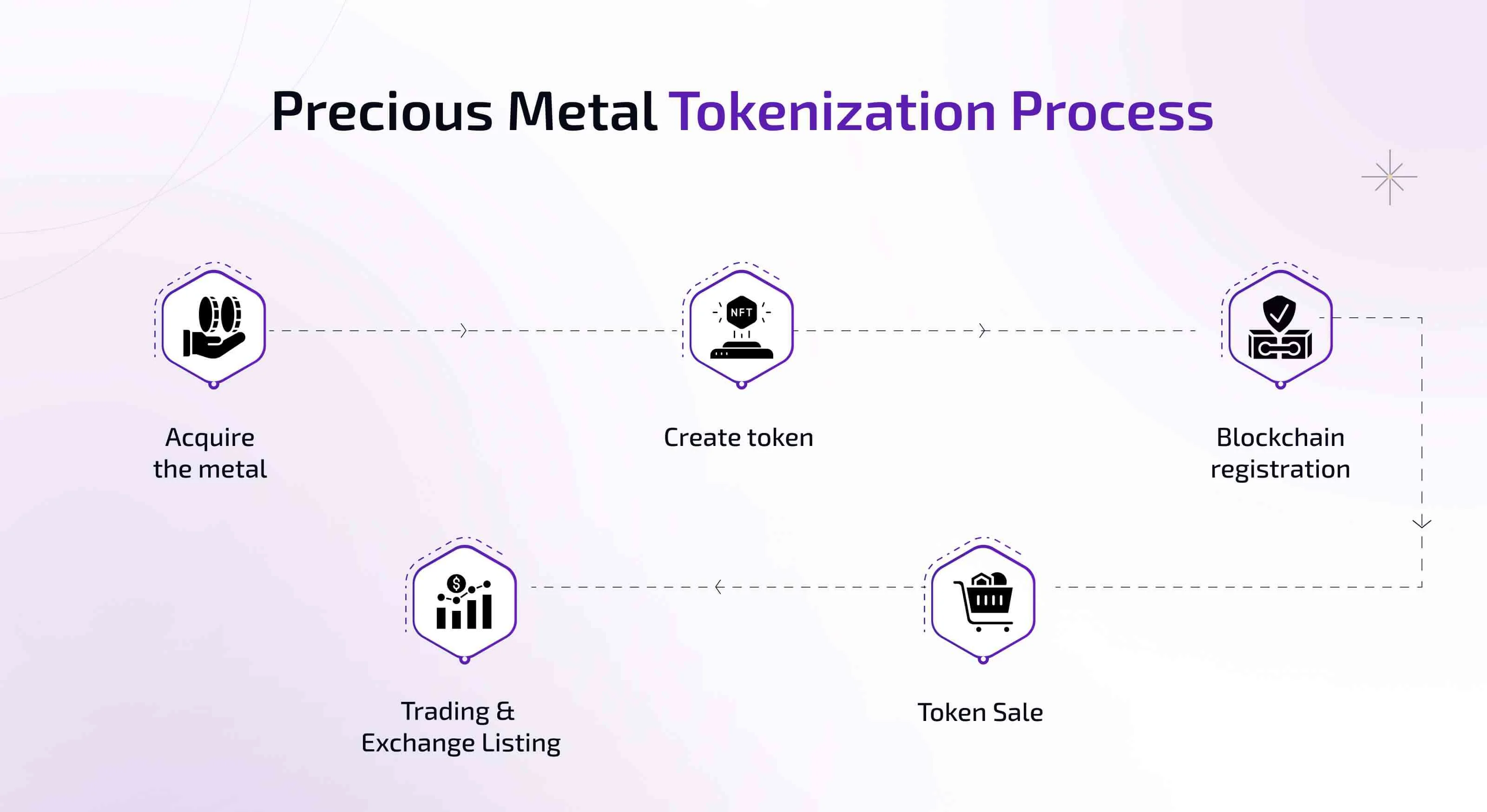
Breaking down the process of tokenization into small steps for better understanding.
1. Acquire the metal
The precious metal supplier can choose to store their metals in a vault and open it for purchase as digital tokens.
2. Create token
For creating digital tokens, on the network, tokens are created by defining their purpose, functionality, and value known as tokenomics. Here the metal quantity and the token quantity are measured as equal parts.
3. Blockchain registration
By registering them on the blockchain networks, on the chain, smart contracts are integrated to min the token, which creates a secured permanent record to ensure ownership.
4. Token Sale
The precious metal tokens are now ready for sale, they can be listed on ICO or another token sale platform to invite investors to buy, which eventually based on the demand increases the liquidity of the token.
5. Trading and Exchange Listing
The purchased token can be listed on trading platforms and decentralized Exchanges for buying equivalent tokens. The token value and metal value are coefficients of each other.
Benefits With Real Life Use Cases Of Precious Metals Tokenization
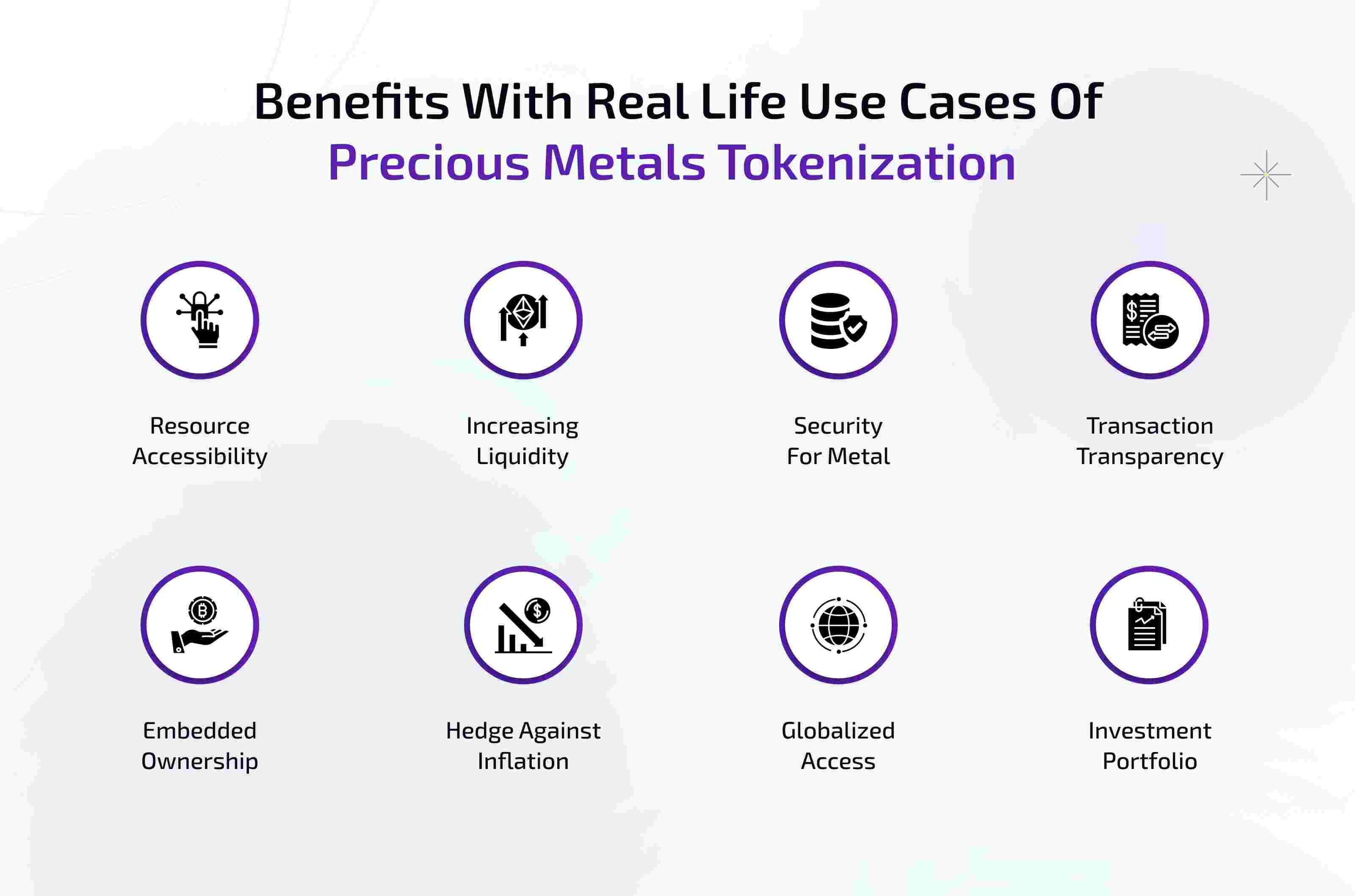
1. Resource Accessibility
Through Precious metal tokenization, the accessibility of resources is simplified, while it also opens up opportunities for investors from different margins to participate.
2. Increasing Liquidity
To trade tokenized metals is easy and possible to do, without any time restrictions while physician metal transportation itself involves a great deal of complications.
3. Security For Metal
With Precious metal tokenization, the technology backs it and ensures secured transactions while it also protects token ownership as it's recorded on the blockchain.
4. Transaction Transparency
Blockchain being highly transparent yet being served, the transactions related to tokenized precious metals are open to building trust among investors.
5. Embedded Ownership
The main advantage of tokenization on blockchain is the ability to own assets irrespective of the size of the investment. Based on the inventor's choice investments are made.
6. Hedge Against Inflation
Metals are already a good hedging mechanism, through tokenization it become even more accessible in the market for a comparatively wider crowd.
7. Globalized Access
By tokenizing Precious metals are open to access from anywhere anytime, overcoming geographical restrictions, and making it accessible globally.
8. Investment Portfolio
For investors who are looking to make a variety of Investments, opting to invest in tokenized assets would be a great choice.
Popular Precious Metals that Can be Tokenized
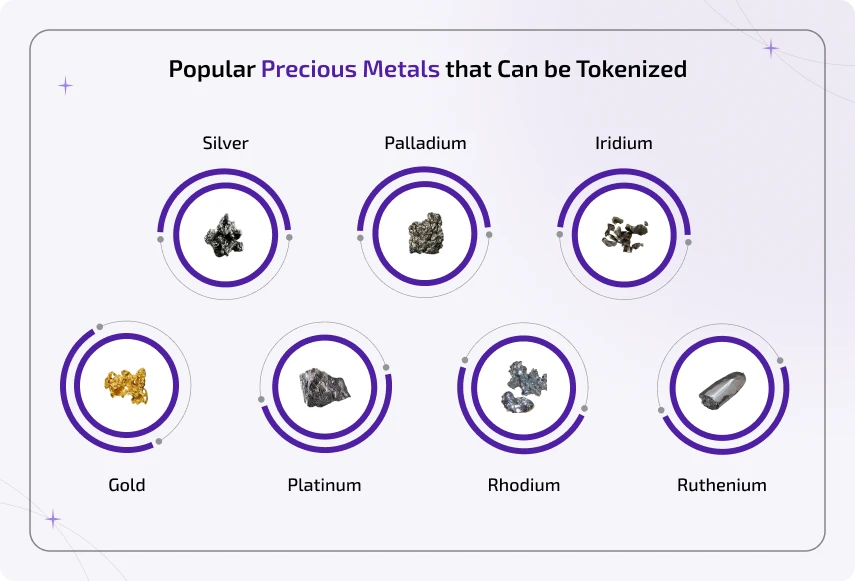
Precious metal tokenization is the conversion of tangible assets like gold, silver, platinum, and more into verifiable tokens with full transparency and security on a blockchain platform. Here, each metal comes with a unique market value and potential, bridging the gap between physical assets and the digital finance landscape.
Gold Tokenization
Gold tokenization is the predominant form of precious metal tokenization, where physical gold is digitally converted into tokens on a blockchain platform. Here, the gold-backed tokens like Tether are separately stored in secure vaults. These tokens support seamless cross-border transfers with reduced risks, ensuring fractional ownership.
Silver Tokenization
Tokenized silver represents a small unit of the real-world silver assets, supporting both industrial and investment purposes. With its demand in solar, electronics, and medicine, silver enhances market accessibility for retail investors and provides transparent trading options. They can be effortlessly transferred, exchanged, and traded among global using silver tokenization solutions.
Platinum Tokenization
This tokenization is one of the rarest methods, which is widely used in the jewelry, energy, and automotive sectors to diversify portfolios. Investors can easily participate in the platinum markets digitally, with improved liquidity and transparency in pricing that were traditionally limited to industrial sectors and large-scale traders.
Palladium Tokenization
It represents fractional ownership of a metal called Palladium, which is often used in automotive, green energy, and catalytic applications. Here, each token is linked to physical palladium bars, with on-chain verification of custody and supply chain. This method improves liquidity with faster settlement times and gives endless access to global users.
Rhodium Tokenization
Tokenizing rhodium enables investors to participate in its high-demand market with increased accessibility and liquidity. They are primarily used in high-end alloys and automotive catalysts, offering fractional ownership to investors. Through this ownership, rhodium becomes more transparent, transferable, and divisible.
Iridium Tokenization
Iridium is a highly durable and rust-resistant metal which is widely used in the aerospace, chemical, medical, and electronics sectors. This tokenized metal ensures secure and transparent trading within the digital finance landscapes, where users can diversify their asset portfolios. This enhances investment opportunities across blockchain markets.
Ruthenium Tokenization
Ruthenium-backed tokens are widely used in electronics and chemical applications. This tokenization metal is widely well known for its price volatility and is open to secure and transparent transactions.
It enhances liquidity, introduces transparency to an opaque commodity segment, and integrates ruthenium into modern token-based asset management systems.
Use Cases and Real-World Examples
1. Gold Investments in Fractions
In general, Tokenizing precious metal creates fractional ownership and makes physical gold into affordable units for easy accessibility. This paves the way for small retail investors to easily access and participate in a wide range of trading worldwide.
Example: Paxos Gold, also represented as PAXG, is a digital asset backed by physical gold reserves. Here, each PAXG token is backed by one fine gold ounce, which is safely protected in the London secure vaults.
2. Instantaneous Settlement
In contrast with the traditional trading methods, blockchain-based methods use gold as their precious metal and offer settlements, reducing the need for central authorities and eliminating human traders.
Example: The Perth Mint Gold Token offers blockchain-based digital ownership of physical gold stored safely by the Perth Mint in central vaults. This token is available to trade 24 hours a day and 7 days a week with high efficiency and is also known as PMGT in short.
3. Increased Transparency and Traceability
The gold trading process records every integrated transaction using blockchain technology. In essence, this increases the transparency, safety, and tracking of the precious metals throughout the entire supply chain. With this enhancement in the tokenized asset’s clarity, fraud risks are being minimized.
Example: Blockchain technology uses a tamper-proof record of precious metals like gold and silver to make it transparent to users. These precious assets can be digitally purchased, stored, and accessed in secure vaults easily.
4. Uninterrupted Trading
Unlike traditional markets, tokenized precious metals enable round-the-clock trading in the market with high transparency, eliminating the limitations. This allows investors to access the asset with increased liquidity, accessibility, and transparency.
Example: Tokenized digital representation of gold, like Tether Gold, in short known as XAUT, can be traded anytime on the blockchain platforms with greater flexibility. This tokenized precious metal offers enhanced market reach with quick transactions.
5. Seamless Digital Transactions
In contrast with the traditional trading methods that undergo issues in customs, insurance, and transportation, the digital tokens of tokenized precious metals like gold and silver can be transferred worldwide easily with high efficiency.
Example: DigixGlobal is a popular asset tokenization built on the Ethereum blockchain to represent physical gold. It enables to transfer of all the DGX gold-backed tokens across borders seamlessly, eliminating the banking systems and transportation cost.
6. Compliance Standards & Asset Custody
A certified custodian holds the tokenized precious metals securely by complying with several regulatory frameworks based on the jurisdictions. This ensures investors' protection and the integrity of the tokenized precious metals.
Example: Kinesis uses a fully regulated system and a third-party auditing firm to ensure compliance with the financial regulations. This platform offers asset-backed tokens such as KAU for gold and KAG for silver, respectively.
7. Risk Management and Portfolio Diversification
By creating digital tokens for the physical precious metals, tokenization increases risk management and portfolio diversification seamlessly. It denotes the fractional ownership of the metals and increases liquidity among users.
Example: Cache Gold (CGT) is one of the best examples of risk management and portfolio diversification. It represents 1 gram of pure gold and allows retail investors to safeguard investments through diversification strategies with enhanced transparency.
Future Innovations of Precious Metal Tokenization
The future of precious metal tokenization is widely seen as a major shift in both traditional finance and digital markets. Tokenized precious metals preserve the intrinsic value of physical metals and add complete efficiency and transparency to blockchain markets. As of early 2026, the tokenized gold market has crossed over $5 billion in market cap, offering fractional ownership and greater accessibility for investors. Compared to the traditional investing methods, tokenization makes precious metals not just a digital investment but makes them more investable and connected to the broader financial ecosystem for the future.
Integration with DeFi and digital finance bridges traditional commodities with programmable, blockchain-based financial services.
Following the success of gold and silver, the rise of other industrial metals like aluminum, nickel, and copper is tokenized with high value.
Institutional adoption and regulatory clarity are done for mainstream deployment in 2026.
AI and IoT are used in tokenized metals for real-time validation to increase the metals' transparency and security.
Future metal tokens focus on aligning with global ESG frameworks and carbon footprint metrics that are digitally recorded and audited.
Conclusion
Unlocking the future of investment, tokenizations have played a pivotal role in the global market. Eventually, precious metal tokenization is an opportunity that is promising to promote and encourage both small-scale and medium-scale investment pools which is also a great platform to kickstart investments.
Our Team of experts in real world asset tokenization development are open to customize your Precious metals tokenization services.
With a good market reputation and hands-on experience over the years, the team at our precious metals tokenization company can seamlessly fulfill your expectations, which paves way to create a buzz in the market. Opening new investment avenues and a promising future for investments.


