How to Create Your Own Metaverse Virtual World
If the last few decades were the internet era, the coming decades will be for the Metaverse. The Metaverse will make the virtual world more interactive, immersive, and collaborative than the internet. Before we get into how to build a virtual reality world, it's a good idea to start with what a metaverse is and build from there.
So, get ready for an informative read as we intend to share everything you need to know about Metaverse and how to build a Metaverse world.
What is Metaverse?
A Metaverse is a virtual realm where the real world and the internet collide. It is a persistent, shared space in which users can interact with one another and with their surroundings. A metaverse can be used for many different things, such as social networking, online gaming, and business collaboration.
Metaverse is frequently compared to traditional video games or virtual worlds, but there are some important distinctions. First, a metaverse is intended to be realistic and believable while also offering a high level of interactivity and flexibility. Second, unlike most video games, a metaverse is intended to be used by a large number of people at the same time. Finally, a metaverse is constantly evolving and expanding, with new possibilities emerging.
How to Build a Metaverse Virtual World?
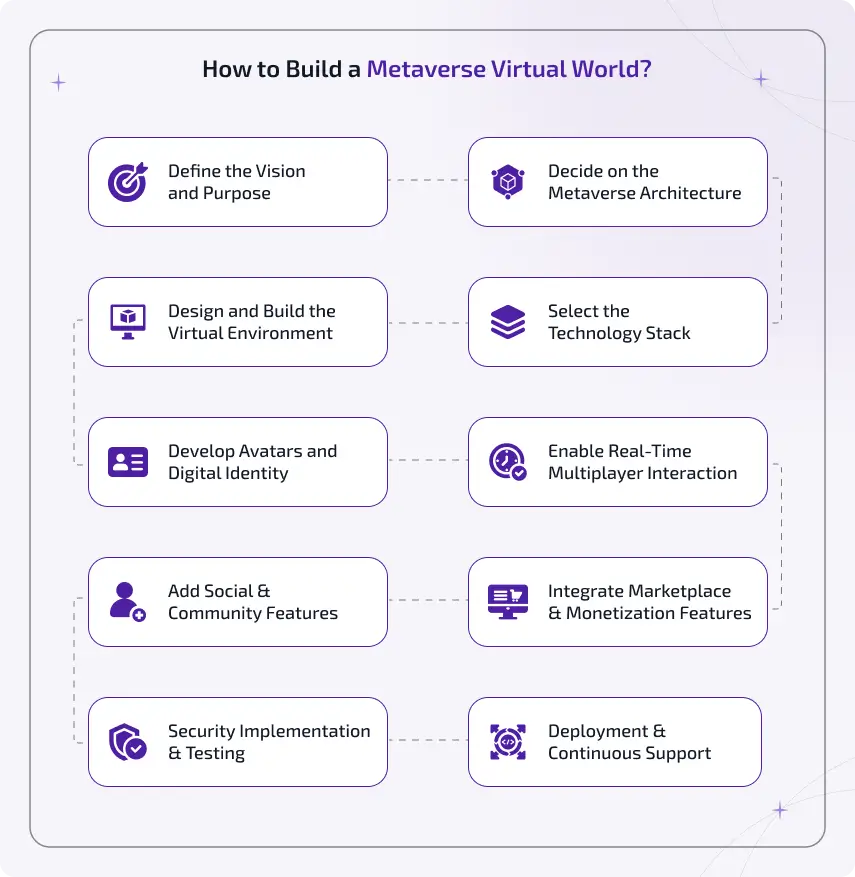
Step 1: Define the Vision and Purpose
Like other development processes, Metaverse development also needs to start with deep research and analysis, and it should clearly explain your core vision and purpose. Identify your target user and explain how each metaverse excels in its own way, benefiting global users. Determine whether your metaverse platform should be centralized, decentralized, or hybrid model.
Step 2: Decide on the Metaverse Architecture
To create a metaverse space or app, you must first select a metaverse platform. You can choose from the market’s existing metaverse platforms, such as Facebook Meta, or create your own metaverse platform from scratch. If you focus on customization, then building the platform from scratch will be the right decision. Finalize the architecture by partnering with the best metaverse development company, like BlockchainX, and get customized solution.
Step 3: Select the Technology Stack
The next step is to select the technology stack, which stands as the backbone of the metaverse virtual world. You should choose the tech stack that clearly aligns with your project requirements and helps you create a stable, reliable, and future-ready platform. Look for suitable game engines, blockchain networks, languages, AR/VR hardware, and other technologies.
Step 4: Design and Build the Virtual Environment
After choosing the tech stacks, the next step is to build a 3D metaverse platform. This includes designing buildings, objects, landscapes, and more. Use popular tools like Autodesk Maya and Blender, and create infrastructure that handles real-time interactions. Remember, a well-designed environment ensures reliable and smooth navigation.
Step 5: Develop Avatars and Digital Identity
Avatars act as a digital representation in the metaverse. In this step, users need to create different avatars and customize them according to their needs, such as clothing, gaming, and other needs. Then, tokenize avatars as NFTs and enable true ownership for users with cross-platform support.
Step 6: Enable Real-Time Multiplayer Interaction
To enable your users to engage with the metaspace you created, you must build an interaction layer in your next step. The integrations with third-party tools and software needed to support the operation of the metaspace will also be mentioned in the interaction layer. This ensures users can connect and get a smooth interaction despite their location.
Step 7: Integrate Marketplace and Monetization Features
Marketplaces allow users to buy, sell, and trade virtual assets with high value. So, integrate monetization strategies within the platform to enhance its overall performance. The monetization strategies may include subscriptions, transaction fees, branding, partnerships, and more. Here, smart contracts automate the payment process with high transparency.
Step 8: Add Social and Community Features
Social features are one of the key components in this metaverse development process. This includes the integration of vents, tools, friend lists, text chat, and other necessities within the metaverse platform. Other community-driven features also increase user engagement with long-term platform growth.
Step 9: Security Implementation & Testing
The metaverse platforms developed must come with strong security protocols, ensuring the users’ data is secure from third parties and hackers. So, implement protocols such as encryption, smart contract audits, and other protections to build a trustworthy platform. Once done, take the platform through the necessary tests to ensure its stability and performance. This ensures a seamless user experience for global users.
Step 10: Deployment & Continuous Support
Once testing is done, launch the metaverse on a suitable network and monitor its performance continuously. To increase user engagement, provide weekly updates, feature enhancements, and feedback about the platform. This ensures the long-term success of the fully functional metaverse platform with transparent and decentralized transactions.
Creating Animated Virtual Reality for the Metaverse
Another reason virtual reality is becoming more popular is that it is gaining traction in popular media. Cross-platform internet growth is becoming more common as technologies converge across platforms. It is possible to develop an application that works with all VR platforms for a portion of the cost and effort.
Virtual reality websites will require advanced technologies to be effective, so your team must anticipate what those modern technologies will be. To begin, we will use Aframe.io, which is a collection for rendering and VR scenes using simple HTML and JavaScript. You could choose three to use more detailed graphics. Following that, we will make use of WebXR, a collection created by Mozilla. It allows direct online communication with virtual reality.
The Advantages of Building a Metaverse
A Metaverse is a virtual world that allows users to interact realistically with one another and with digital content. It is a 3D representation of the real world in which users can build their own avatar and explore the environment. There are numerous advantages to creating a virtual world in the metaverse. It can be used to educate people about different cultures and social issues, as well as to allow people to interact in a safe and secure environment.
A metaverse can also be used for entertainment, such as gaming or watching movies. A metaverse can be an excellent way to communicate with people from all over the world and learn something new. It's also a lot of fun.
Key Technologies Required to Build a Metaverse Virtual World
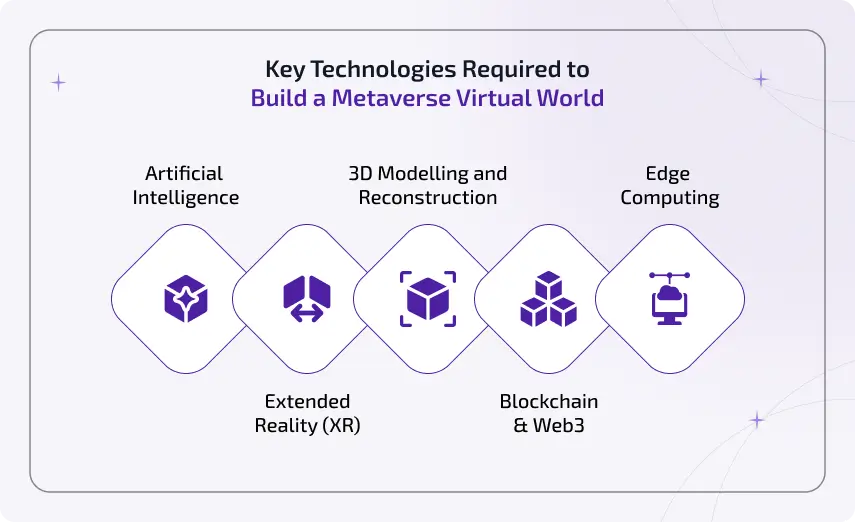
A metaverse virtual world requires integrating several cutting-edge tools and technological advancements that create a persistent and immersive 3D space. To make it truly look different from other online games, we have listed the top 5 key technologies to be followed in the metaverse virtual world development process.
Artificial Intelligence
The potential of AI is vast, and it is widely used in various fields, most probably in metaverse development.
This integration of artificial intelligence in the metaverse helps the majority of companies to replace human activities with proper automated algorithms and improved business strategies.
It enhances the user experience through avatar creation, NPCs and intelligent agents, natural language processing (NLP), voice recognition, and more personalized interactions.
Extended Reality (XR)
Extended Reality, a combination of AR, VR, and MR, creates an immersive digital landscape by shifting from 2D to 3D.
This extended reality acts as the primary interface, allowing users to directly enter and interact with the metaverse, bringing virtual objects into the real world.
Here, AR overlays the digital objects onto the real world directly, VR provides a fully immersive experience, and MR creates an interactive user experience.
3D Modelling and Reconstruction
One of the advanced methodologies of the metaverse is the concept of 3D reconstruction. It captures and reshapes the appearance of real objects and makes the metaverse a reality.
This technology creates more realistic and natural-looking spaces in the metaverse, making the 3D construction a vital component in the development of the metaverse.
It is widely used in the identification of digital twins of any location of physical buildings, creating high-quality 3D models using tools like Unity.
Blockchain and Web3
Blockchain is one of the most widely used technologies, which paves secure, decentralized transactions between the metaverse users.
The integration of NFTs, smart contracts, and crypto replaces the centralized concept of the metaverse and supports interactions within the virtual world without relying on a central authority.
Here, blockchain supports secure transactions, digital asset ownership, and decentralized governance across virtual worlds.
Edge Computing
Edge computing plays a big part in the metaverse virtual space. It creates high-quality content for the users and minimizes latency with immersive experiences.
Since milliseconds matter in the metaverse, edge computing brings the power of faster data, providing a better user experience.
This enhances scalability and reliability in the metaverse and processes with minimal risk of network failures.
Cost to Build a Metaverse Platform
The cost of constructing a metaverse is the next question that arises after understanding its possibilities. The cost normally rises due to the fusion of technologies such as blockchain, IoT, AR, VR, AI, machine learning, and so on. Despite the us of numerous technologies, the cost of building a metaverse can be significantly reduced. And this can be accomplished by addressing the following issues:
Infrastructure - It helps greatly if you can accurately estimate the infrastructure you'll need to build the metaverse. For instance, knowing exactly how many VR headsets, smartphones, PCs, and 5G networks you need can help you reduce development costs.
Digital avatars - A virtual representation of real people requires a lot of work. Understanding the user's requirements, such as whether they want to load an avatar that has already been created or make an exact replica of themselves, can have a big impact on the budget. The more complex the avatar's capacity for handling emotions and feelings, the more work developers will have to put in, which will increase the cost.
Security - Another area where building a metaverse can become very expensive. If you add security nets to your metaverse application, the production cost will rise.
Now, the price of a metaverse application also depends on its type. A gaming platform might require $30,000 to $300,000 or more. A social media application can cost anywhere between $25,000 and $400,000. Additionally, a real estate application can be created for anywhere between $15,000 and $300,000.
The costs at the upper end are almost equal here. It's because creating an entire functional metaverse application necessitates more resources.
Top Metaverse Business Models for Virtual World Development
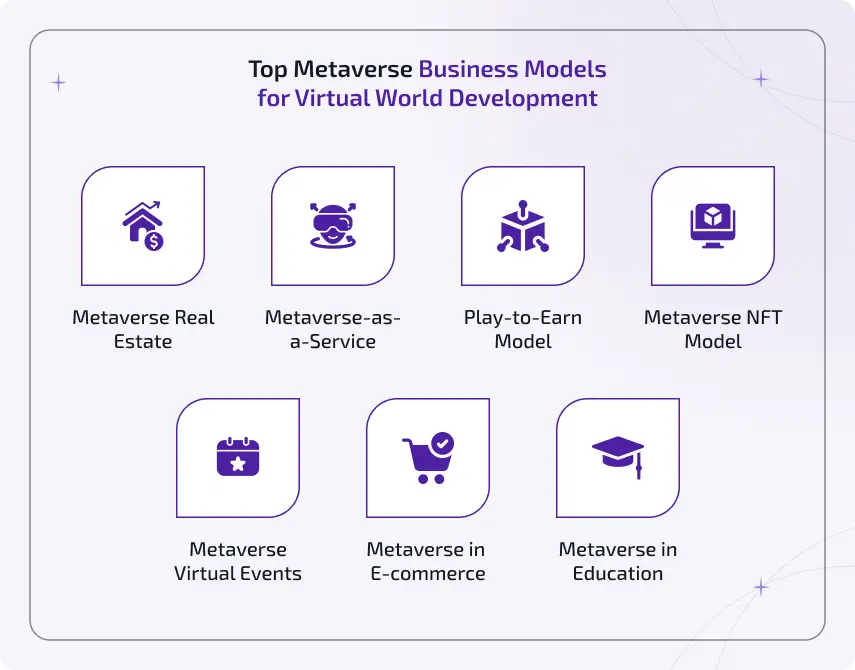
As the metaverse has undergone major advancements from 2025 to 2026, it mainly focuses on creating blockchain-backed ecosystems that truly generate endless revenue for users. Businesses opt for the metaverse and use innovative models to create a profitable virtual world. Below is a list of the popular and effective business models that reshape businesses with the next-gen platforms.
Metaverse Real Estate: This model includes the buying, selling, and trading of virtual assets in the digital landscape, creating a long-term ownership value.
Metaverse-as-a-Service: MaaS enables businesses to customize & build their own 3D virtual worlds using white-label or metaverse solutions, like SaaS.
Play-to-Earn Model: This model creates blockchain-based rewards, where users can earn tokens or NFTs through gameplay.
Metaverse NFT Model: An NFT-driven marketplace allows users to revolutionize digital assets & earn through asset listings, transactions, and more.
Metaverse Virtual Events: Businesses can easily host large-scale events and generate rewards from conferences, virtual concerts, social gatherings, etc.
Metaverse in E-commerce: Brands can easily create 3D virtual stores, mirroring real-world e-commerce with low operational costs.
Metaverse in Education: The integration of VR & AR Creates specialized, risk-free trading ecosystem, which delivers hands-on learning in this digital space.
Significant Standards and Needs for Developing the Metaverse
The internet is more than just a network that you see and use every day. There are numerous standards for rendering visual content, graphics, data transfer, communication, and a variety of other functions. The various protocols serve as the foundation for real-time communication between servers and browsers. Similarly,metaverse developmentwould rely on a highly resilient standard for facilitating persistent, seamless experiences with interoperability.
For specific metaverse project functionalities, some existing standards must be streamlined into smaller sets. Open standards can provide the benefit of improved interoperability across industries. Here are some noteworthy standards and other crucial requirements for developing decentralized metaverse platforms.
JavaScript, HTML, WebGP Shader Language, WebAssembly, WebXR, and other open programming languages are required.
Only massive computing power capable of supporting AI-related tasks, data processing, analytics, and other tasks can be used to create metaverse virtual world experiences.
The metaverse virtual world would also require open and interoperable standards for media and 3D applications. The standards are required to support audio, video, text, images, and 3D sequences, scenes, and objects in the metaverse.
Three-dimensional simulations with immersive experiences similar to real-world landscapes and environments would also be required.
Most interestingly, a metaverse development project would require a decentralized network of computers with high bandwidth. The network would support the metaverse's fundamental building blocks, such as real-time connections and decentralized data transfer.
Why Choose BlockchainX for Metaverse Development?
As a top blockchain and metaverse development company, BlockchainX excels in developing cutting-edge metaverse platforms using advanced technologies. Our hands-on experience in decentralization helps businesses to launch feature-rich virtual worlds, tailored to specific business needs. Deploy your Web3 with BlockchainX today.
We create tailored metaverse solutions aligning with each business's requirements, including their goals, frameworks, etc.
BlockchainX ensures a safe, scalable, and flexible metaverse architecture that prioritizes transparency and trustworthiness among users.
Uses deep blockchain technology to create scalable and decentralized metaverse ecosystems.
Our platforms come with high scalability and seamless access to assets and transactions, without compromising on their performance.
Our developers integrate NFTs and token rewards to create sustainable revenue opportunities with business-focused models.
We empower enterprises to create virtual ecosystems that come in connection with the future of growth and innovation.
To Summarize,
The final overview of creating your own virtual world in the metaverse summarizes a few steps. With the right technologies, you can build a virtual world in the metaverse that meets your goals. Most importantly, you must begin your virtual world creation journey by understanding the fundamental metaverse values. Many standards and prerequisites are also required for the metaverse to provide the functionalities that are gaining popularity. If you want to build your own virtual world in the metaverse, you must start from scratch.


