Explore Our Decentralized Exchange Development Guide in 2026
Listen to the Audio :
Is it even possible to trade your valuables anywhere at any time without relying on a bank or an intermediary person? The answer is yes, and it can be made possible with the help of decentralized exchange development platforms. This decentralized exchange development guide explains how a DEX works as an automated system that allows users to trade their assets or cryptocurrencies directly on an exchange without intermediaries.
During the initial phase, the DEX platforms were slow, complex, and expensive for the users, making them a less reliable source. However, technological advancements like high-performance solutions, non-custodial security, permissionless trading, and more have optimized the overall system, making it one of the most promising trends in the market today.
This blog will be an ultimate decentralized exchange guide, exploring their core features, types, real-world use cases, and more.
What is a Decentralized Exchange? Why is it Popular in 2026?
The Decentralized Exchange (DEX) platform facilitates peer-to-peer user transactions without dependence on a central authority using advanced system standards for its working mechanism, making it a safe and reliable environment for trading.
Many businesses today partner with a decentralized crypto exchange development company to build such platforms with enhanced security and scalability. The system follows smart contract automation that provides 24/7 seamless operations for trading in the marketplaces.
Unlike the traditional and centralized exchanges, the DEX platforms are completely user-controlled over the assets, providing non-custodial services without KYC checks using blockchain technology. This makes every process transparent, permissionless, and secure for the users and investors. Here are some of the important reasons behind the DEX platforms being popular in 2026:
Non-custodial ownership allows users to hold full control over their funds and data without relying on a custodial exchange.
Layer-2 solutions work over the main network, providing solutions with faster transactions, lower fees, and reducing the network congestion of the system.
This automated protocol, known as the Automated Market Maker (AMM), enables systematic trading and global operation without the need for an intermediary.
With the integration of cross-chain bridges, users can easily swap or transfer their assets across various networks, expanding their market accessibility.
DEX systems make the transactions smooth and easy to navigate for both new and experienced users, enhancing the overall experience.
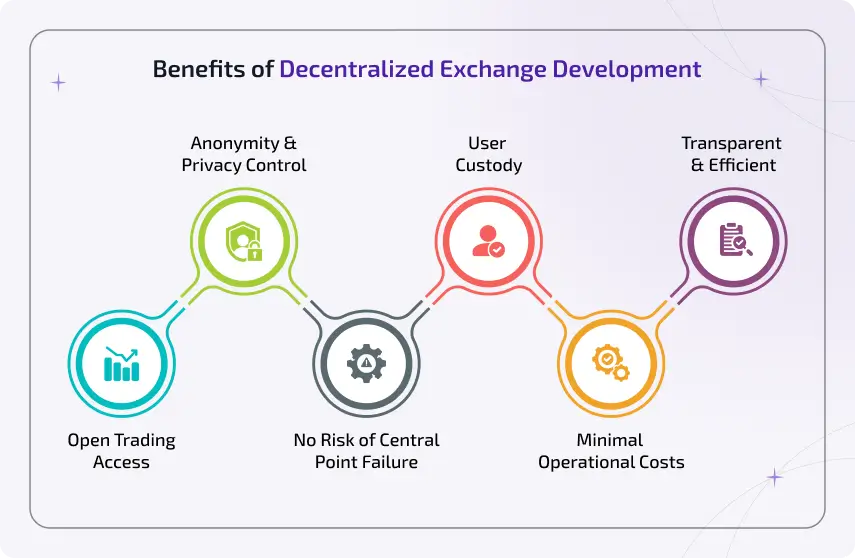
Benefits of Decentralized Exchange Development
Decentralized Exchange development offers various operational advantages and key benefits that eliminate the need for intermediary servers, harnessing smart contract automation to provide better user control, security, and openness for the usage of the platform. Here are some of the core benefits required to develop a DEX platform:
Open Trading Access:
Users can trade their assets across a global audience without any geographical restrictions or barriers, using a crypto wallet. The DEX platforms expand user access and flexibility and enhance market opportunities.
Anonymity and Privacy Control:
Most of the decentralized exchanges do not require any KYC/AML verifications, allowing the users to have great privacy controls over their assets. The users can trade anonymously without lengthy verifications or sharing personal information.
No Risk of Central Point Failure:
The blend of blockchain with smart contracts in decentralized exchanges ensures that the system doesn’t have a single point of failure. This eliminates the DEX platform from getting exposed to online hacks and vulnerabilities.
User Custody:
The user funds will be stored in crypto wallets, ensuring safety and transparency, giving full ownership control of their assets. This user custody gives strong security control and also prevents the funds from getting frozen, unlike centralized servers or banks.
Minimal Operational Costs:
The elimination of central authorities minimizes the unnecessary operational and transaction expenses involved. In addition, there is no third-party involvement to take care of the user funds, making it cost-efficient and a reliable source.
Transparent and Efficient:
Every transaction is recorded on a blockchain network instantaneously, using automated contracts, making sure it is transparent and verifiable. This system executes trading without any interventions, making it faster, safer, and more efficient.
Key Features of a DEX Exchange
To build a decentralized exchange, it is crucial to focus on the defining features that establish its functionality, performance, and overall user experience. These components ensure a smooth, traceable, and high-security trading environment. Let’s explore the notable features that shape a reliable DEX platform.
Token Swaps: Decentralized exchanges allow users to directly swap tokens using smart contracts or liquidity pools, eliminating the need for centralized order matching as used in traditional methods.
Balanced Liquidity Pool: Liquidity pools are collections of deposited tokens that ensure a well-balanced system to provide smooth trading liquidity for the users who want to trade their tokens within the DEX platform.
Token-Based Governance: Token holders can be a part of the decision-making process regarding the important updates/protocol changes and improvements within the DEX exchange through a governance voting mechanism.
Cross-chain Bridge: A virtual bridge that connects different blockchain networks, say Ethereum and a BSC system. This multi-chain interoperability powers the users to transfer assets across different blockchain ecosystems.
Oracle Linking: Integrating the blockchain oracles during DEX platform development will provide accurate and real-time data from outside sources from the real world, acting as a bridge that binds the on-chain and off-chain worlds together.
Staking and Incentive Systems: The yield farming and staking ecosystem allows users to lock or deposit their assets into the DEX platform, receiving incentives or rewards from passive income from the exchange.
Fiat Access Gates: The Fiat On and Off ramp feature allows users to directly convert fiat currencies into cryptocurrencies and vice versa. This enhances broader user investor engagement, making it a flexible platform for both beginners and experienced users.
Regulatory and Compliance Considerations for Advanced DEX
Every country is bound by its own rules and legal regulations to be followed by the DEX exchanges. Only permitted authorities can function within certain regions, which helps to build the overall user trust and credibility, providing DEX security solutions for operating within the platform. Here are the key regulatory and compliance considerations for an advanced DEX system:
KYC/AML Verification
Implementation of KYC/AML compliance measures prevents illegal activities like misuse or money laundering on the DEX platforms. This enhances the user's trust and credibility in the system.
Smart Contract Audits
These audits run a complete analysis to detect the vulnerabilities, logical flaws, and potential risks involved within the DEX system. Such security standards provide greater accountability to protect the user's funds.
Jurisdictional Laws
Every jurisdiction has different legal regulations that must be followed accordingly in DEX platform development. This enables lawful practices while reducing the regulatory risks involved in the ecosystem.
Data Management and Privacy
Protecting the user information and transaction details is crucial for platform operations. Adhering to these privacy laws increases user confidence, thereby providing a secure environment for trading purposes.
Taxation and Reporting
DEX platforms may be subject to taxation laws within their operating region. The rewards or profits from trading must be updated, and tax requirements should be followed to maintain legal compliance.
Role-Based Access Control
The accessibility of RBAC is limited based on the user roles and permission levels within the DEX platform. So only the authorized personnel can access and manage the platform operations, eliminating unapproved entries.
Real-World Examples in a Decentralized Exchange
Examining the case studies of decentralized exchanges provides insights into how the DEX platforms mould the trading operations and their overall performance levels. These highlights bring forth beneficial innovations such as the AMM model, liquidity pools, and a more optimized ecosystem. Here are some of the widely recognized DEX platforms in the market today:
Uniswap:
Uniswap is a popular and the largest decentralized exchange in the world operating on the Ethereum (ETC) blockchain network. This pioneered the automated market maker (AMM) model, enabling users to swap tokens seamlessly within the platform.
Challenge: The traditional use of order books to match buyers/sellers highly relies on the centralized entity for system operations, limiting its accessibility.
Solution: Introduction of the AMM model that used liquidity pools and smart contracts, which enabled direct and automated swapping of tokens without an intermediary.
SushiSwap:
Known for its incentive-driven systems and governance tokens, SushiSwap, one of the top decentralized exchanges, is built on multiple blockchain networks, expanding its market accessibility for users.
Challenge: Decision-making authority was given to a centralized organization, reducing audience engagement and influence.
Solution: Sushi established a community governance model, allowing users to be a part of the decision-making in development protocols or improvements.
PancakeSwap:
PancakeSwap is a top decentralized platform administered by the Binance Smart Chain (BNB) blockchain network. It works with low transaction fees and a fast processing mechanism, making it a popular choice among other exchanges.
Challenge: The high transaction gas fees and slow mechanism made it challenging for the users, reducing its efficiency and trading volume.
Solution: PancakeSwap encouraged active participation by operating on a BNB Smart Chain that enabled faster and cost-efficient transactions.
Curve Finance:
Being a highly ranked DEX platform, Curve Finance is well-known for its stablecoin trading, built primarily on the Ethereum network. Its AMM model is optimized precisely to provide high-efficiency and low-slippage trading for the users.
Challenge: Traditional DEX exchanges had high slippage and were not efficient enough to perform the trading operations during the swapping process.
Solution: Implemented a highly optimized system for low slippage and transaction fees, thereby enhancing the efficiency of the token swaps.
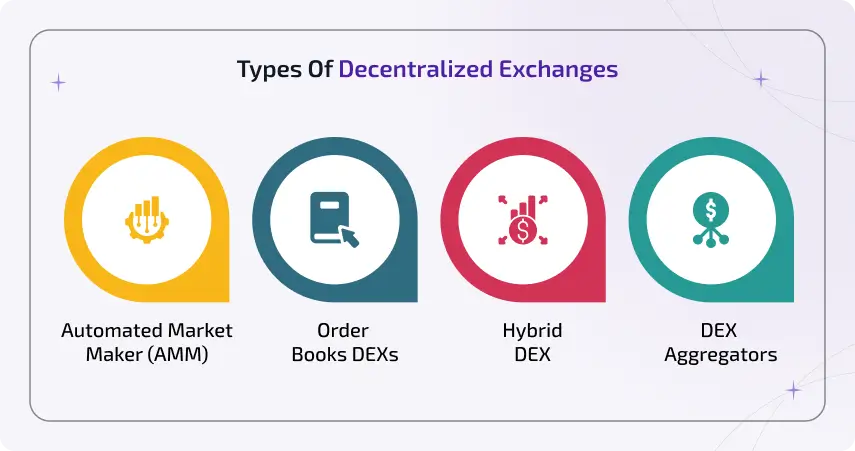
Types Of Decentralized Exchanges
Decentralized Exchange (DEX) platforms use different models, each developed with unique predefined programs to offer better trading options for the users based on the system functions. This influences the token pricing, trading liquidity, and overall performance of the system. Here are the four main types of decentralized exchanges that are ruling the ecosystem at present:
Automated Market Maker (AMM):
The AMM mechanism is programmed to use liquidity pools for trading, rather than traditional order books that match buyers and sellers. Businesses often rely on an Automated Market Maker Development Company to build and optimize these systems for efficiency and scalability. The prices are determined and updated continuously using algorithmic formulas in the model, based on token demand and supply.
Example: Curve Finance, UniSwap DEX
Order Books DEXs:
An order book DEX mimics the traditional model, where the trades are performed based on the buy or sell orders placed, matching their price requirements. It works on smart contracts that automate the order matching and trade execution without relying on a central authority.
Example: Hyperliquid, dYdX
Hybrid DEX:
By combining the AMM system with the order matching model, this approach offers a more versatile trading system for the users. It supports both direct token swaps through liquidity pools and specific price trading. It provides better trading control and user flexibility.
Example: IDEX, Binance DEX
DEX Aggregators:
Designed to interact with multiple decentralized exchanges, the DEX Aggregators identify the most favourable trading prices for the users. This reduces slippage, thereby enhancing the overall trading execution and performance by reaching out to different liquidity sources.
Example: ParaSwap, 1inch
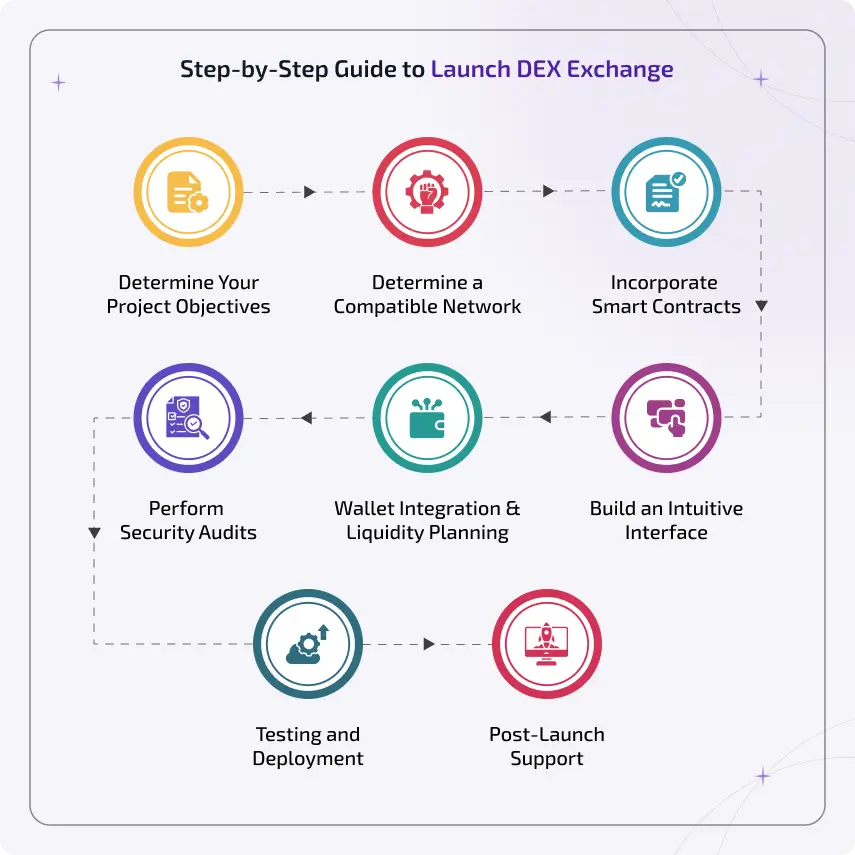
Step-by-Step Guide to Launch a DEX Exchange
The right strategies of built-in technical features, wallet connection, and liquidity planning are crucial for developing a decentralized exchange platform with enhanced security and seamless performance. From planning to post-launch support, every step counts and plays an important role. The steps given below will clearly define how to create your own decentralized exchange for launching in the mainstream markets.
Step-1: Determine Your Project Objectives
To launch a decentralized exchange (DEX), begin by establishing your project goals and the purpose, including its primary features and key functionalities. Focusing on trading volume, choose your appropriate exchange model that lays the foundation of the project that will be a key to enhancing the platform’s liquidity.
Step-2: Determine a Compatible Network
Selecting the compatible blockchain network, such as ETC or BNB Smart Chain, accordingly, as it must align with your decentralized exchange. The transaction speed, gas fees, security features, and scalability must be taken into consideration as the overall performance depends on the network.
Step-3: Incorporate Smart Contracts
Integrate secure smart contracts to handle the operations involved in the exchanges, such as liquidity pool management, staking, token swapping, governance and execution. Ensure to optimize the incorporated systems for seamless transactions and overall efficiency.
Step-4: Build an Intuitive Interface
Creating an interface with simplified access is mandatory for providing an easy response and navigation through the platform for new users. It must be simple, easy to respond to, and spontaneous for the beginners to get used to linking their wallet system, swapping tokens and making trades on a regular basis.
Step-5: Wallet Integration & Liquidity Planning
A wallet system must be connected to the DEX exchange to enable smooth and seamless user transactions. The chosen wallet should be compatible with the selected blockchain type and exchange model to ensure proper functionality. Simultaneously, design a strong liquidity plan to support the providers and traders.
Step-6: Perform Security Audits
In order to prevent any hacks, vulnerablities or system flaws, the DEX platform must go through multiple security audits, including complete smart contract reviews and bug detection programs. These measures will eliminate the potential risks involved builds the user confidence in the platform, encouraging active participation in the trading.
Step-7: Testing and Deployment
The designed platform must be thoroughly tested to validate its stability, performance, and system functionality through testnets and make sure to eliminate system glitches. After this, the tested platform can be officially mainstreamed for public access and trading in the market.
Step-8: Post-Launch Support
The post-launch support and maintenance are essential to regular monitoring of the system, detection of bugs/vulnerabilities and implementation of upgrades to enhance the sustainability and capabilities of the platform in the decentralized markets. This support is necessary as it would promote the functioning and long-term growth of the system.
Build Your DEX Platform with BlockchainX
Looking to build a brand-new DEX platform or just need a small upgrade? BlockchainX, a leading cryptocurrency exchange development company and decentralized crypto exchange development companies, comes with tailored solutions for both DEX development and system updates under one roof.
We have been excelling in this industry for about 8 years, with talented developers who possess expertise and knowledge in marketing, blockchain, and decentralized exchange systems. We develop platforms with pre-built modules or contracts to deliver the project without delays.
BlockchainX offers highly audited and personalized contract solutions according to your goal requirements. Our approach is to provide end-to-end support, including ongoing maintenance, to ensure a secure environment for the users. Build a faster, smarter, and scalable decentralized exchange platform with us today!
Conclusion
The decentralized exchange continues to reshape the digital world with its incredible features, innovation, and better accessibility without relying on any intermediaries. DEX platforms are thriving with user custody assets, empowering individuals with a more open and transparent environment. Launching a decentralized exchange will unlock new possibilities with enhanced security and advanced technology.
As mentioned in the blog, each and every plan in the development process counts. With the right approach and the ideal development partner, you can transform your vision into a powerful and future-ready decentralized exchange platform.
Get all the latest posts delivered straight to your inbox.
Get In Touch
Our expert team is professionally well-equipped with hands-on experience as a blockchain development company. Connect with us; at BlockchainX, we curate your desired sustainable solution!