Build a Trading App Like Robinhood: A Step-by-Step Guide
 By Yokesh Sankar
15 min read
Updated On
A Robinhood-style app pairs with a licensed broker API, KYC provider, and a market-data feed. These integrations power the essential functions users expect, from placing trades and verifying identities to accessing real-time stock prices. Commission-free trading platforms have simplified investing, with Robinhood becoming one of the most recognized examples. While the interface may look simple, several systems work together behind every transaction.
From there, four paths are open: a white-label clone script, a custom app on a broker API, your own broker-dealer with a clearing partner, and full self-clearing. Costs range from about $10K for a white-label build to $500K+ if you register your own broker-dealer. Use the decision table in this guide to choose your path, followed by its license, features, tech stack, and costs.
What Is Robinhood?
Robinhood is a US-based financial app that lets users buy and sell stocks, ETFs, options, and crypto from a phone without paying per-trade commissions. This app was launched in 2015 and became one of the first major platforms to support commission-free trading in mainstream markets and the model that pushed larger brokerages to drop their own trading fees.
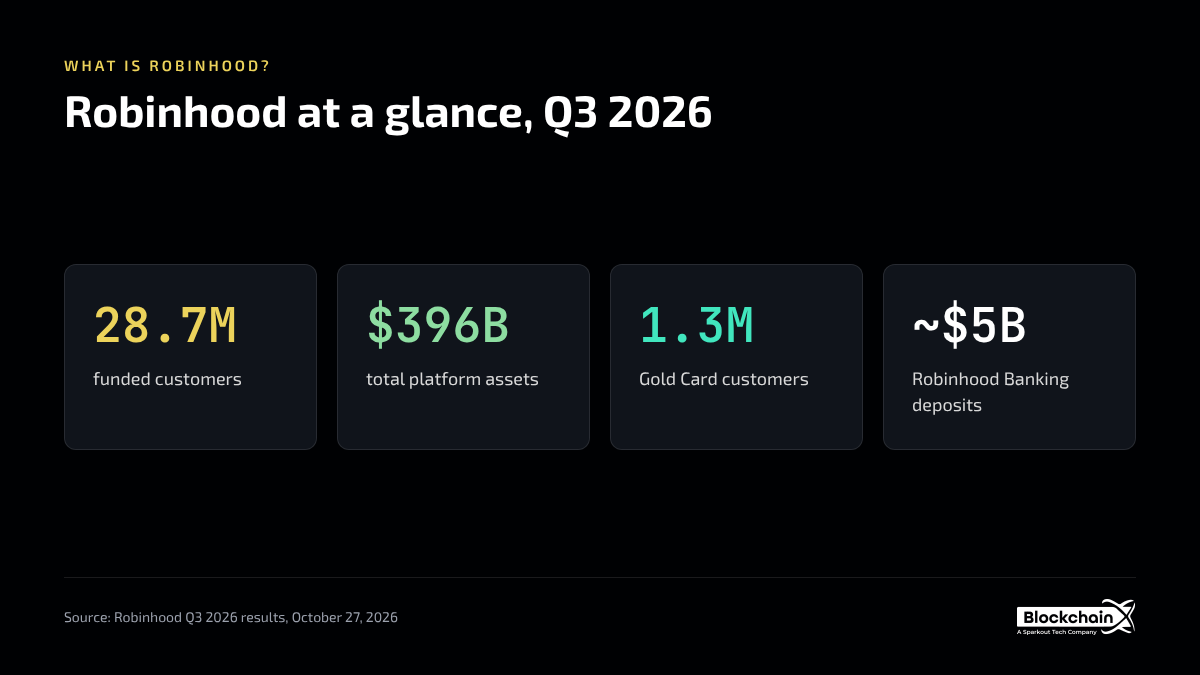
Today, it operates on a much larger scale than a typical fintech app, serving 28.7 million funded customers and holding $396 billion in total platform assets as of Q3 2026. With its growth from a stock-trading app into a broader financial platform, Robinhood lets you:
- Buy and sell crypto
- Trade stocks, ETFs, and options (including fractional shares)
- Trade event contracts (prediction markets)
- Use managed portfolios through Robinhood Strategies
- Spend with the Gold Card, which reached 1.3 million customers
- Use Robinhood Banking, which has nearly $5 billion in deposits
How Robinhood Works and Makes Money
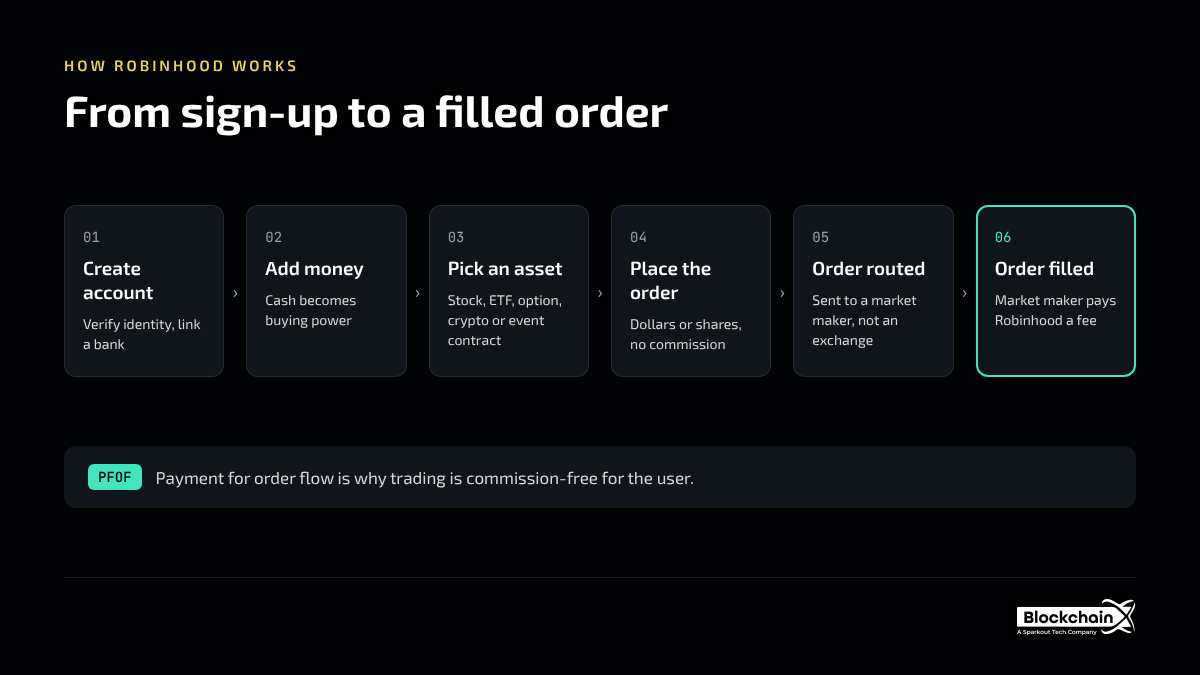
Robinhood is the app layer between you and the market. You use the app, and a licensed broker-dealer behind it handles the trade. From sign-up to trade, here is how it works and makes money.
Create an Account
First, sign up in the app and verify your identity, as required for every brokerage account. Then, link a bank account, which Robinhood uses to move money in and out of your account smoothly.
Add Money
You transfer money from the linked bank account into Robinhood, and the cash stays in your account until you invest it. It stays as buying power, ready-to-use on any ETF, stock, option, or crypto order you place.
Pick What to Buy
Once done, you can search for what you want to invest in, such as a stock, ETF, crypto asset, option, or an event contract. Each page shows its live price, key details, and chart, so you can decide before ordering.
Place the Order
You can buy or sell, enter the amount in dollars or shares, and confirm it. Fractional shares allow users to start with a small amount, and the app shows the estimated price and charges no commission before they submit.
Robinhood Routes the Order
Robinhood does not send your orders straight to an exchange. It sends them to a market maker, a firm that buys and sells securities continuously so that orders get filled quickly.
The Order Is Filled
The market maker takes the other side of your trade and fills it quickly. The result appears in the portfolio, and the market maker pays Robinhood a small fee for the order (PFOF: payment for order flow), which is why trading is commission-free in this app. Here, PFOF is banned in the UK and is phased out in the EU, so this model may not work in those markets.
How Robinhood Makes Money
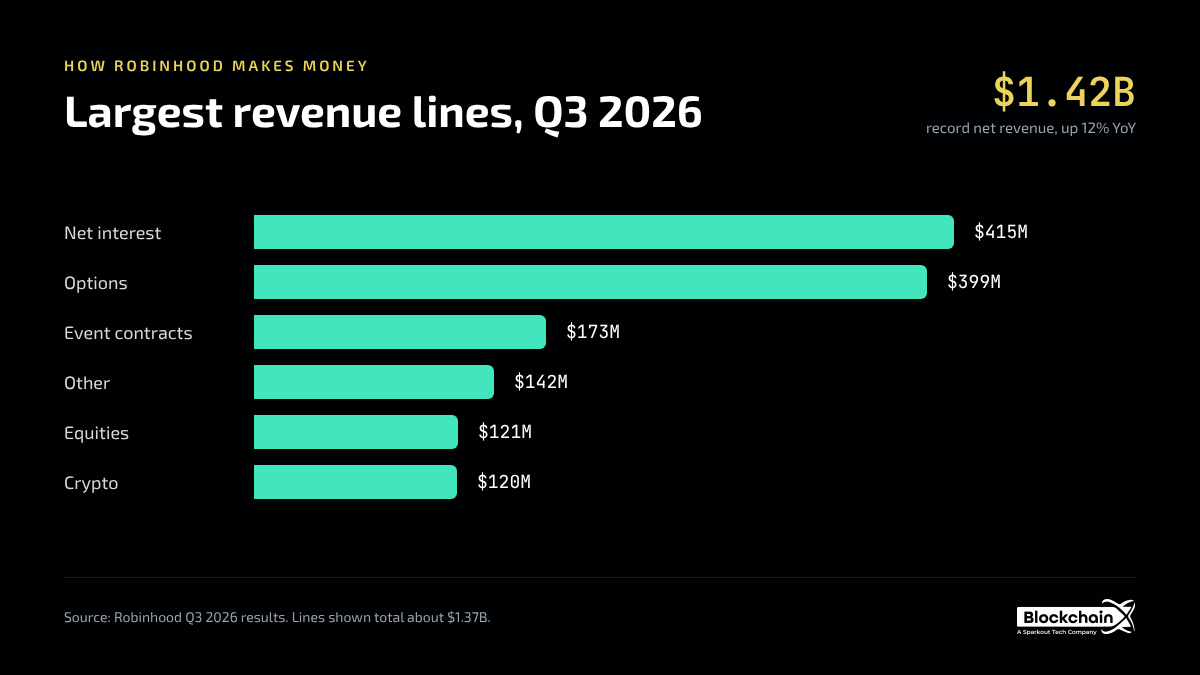
Commission-free trading doesn’t mean the platform doesn't make any money from trades. Robinhood posted record Q3 2026 net revenue of $1.42 billion, which is up to 12% year over year. Its highest revenue lines were net interest ($415 million), options ($399 million), event contracts ($173 million), others ($142 million), equities ($121 million) and crypto ($120 million). A few shifts stand out:
Event contract revenue is up over 7x from a year ago.
Crypto transaction revenue fell 55%, so the business is less dependent on crypto than it used to be.
Other revenue is driven by Gold subscriptions and grew to $142 million.
Robinhood Clone App Development: Four Build Paths Compared
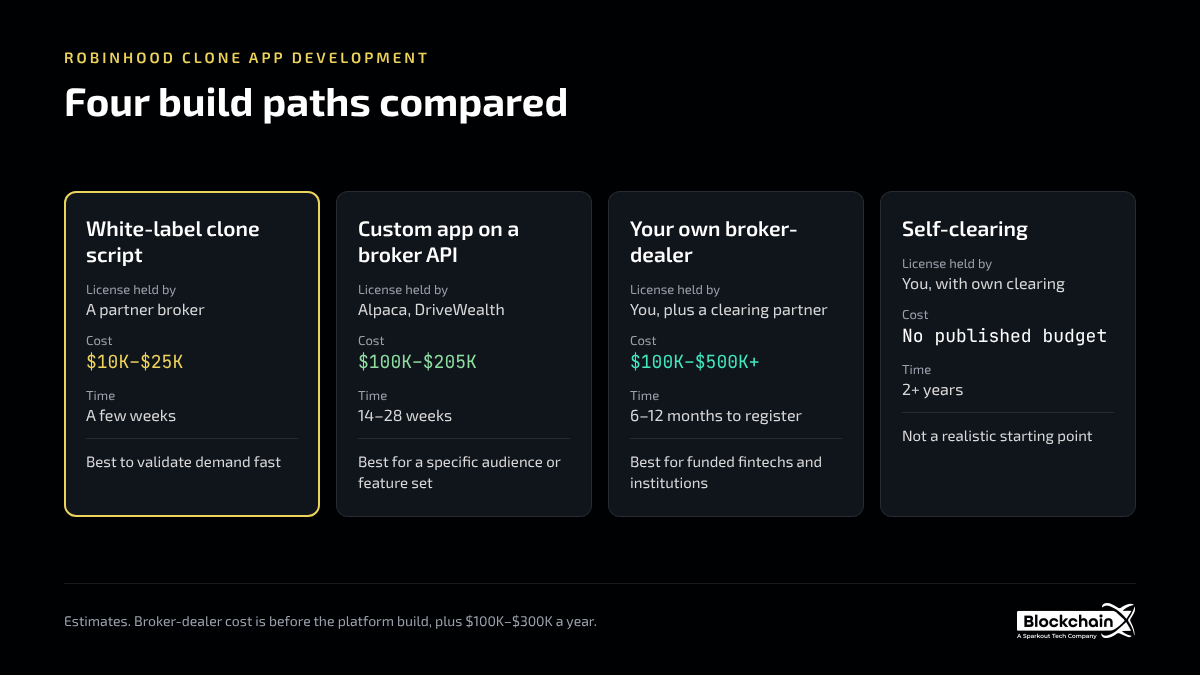
Every Robinhood-style app needs a registered broker-dealer to execute and settle trades. The right build path depends on who holds the license. Compare the four paths by who holds the license, how much you build, and what each costs in money and time.
| Path | Who Holds the License | What You Build | Typical Cost | Typical Time |
|---|---|---|---|---|
| White-label clone script | A partner broker | A rebranded app and admin panel, connected to the partner | $10K-$25K for a basic build | A few weeks (estimate) |
| Custom app on a broker API | A broker API provider such as Alpaca or DriveWealth | Your own app, design and features on top of their execution | $90K-$250K and complex builds can reach $500K | 14 to 28 weeks |
| Your own broker-dealer | You, with a clearing partner behind you | The platform, the registration and the compliance team | $100K-$500K+ to start, then $100K-$300K a year, before the platform build | 6 to 12 months to register |
| Self-clearing | You, with your own clearing operation | The platform and the clearing, custody and settlement systems | No published budget | 2+ years |
The white-label clone script fits founders who want to validate demand quickly and brokers, NBFCs, or banks that already have a broker relationship and still want a retail app on top of it.
The custom MVP suits a startup with a specific audience or feature set that a template cannot offer and that is willing to rent the broker license rather than hold one.
The broker-dealer path is perfect for well-funded fintechs and financial institutions that want to own the customer relationship, compliance, and pricing.
Self-clearing is not a realistic starting point. Robinhood has been self-clearing its own trades since 2018, and it holds about $396 billion in platform assets, which justifies the investment.
What License Do You Need to Build a Robinhood-Style App?
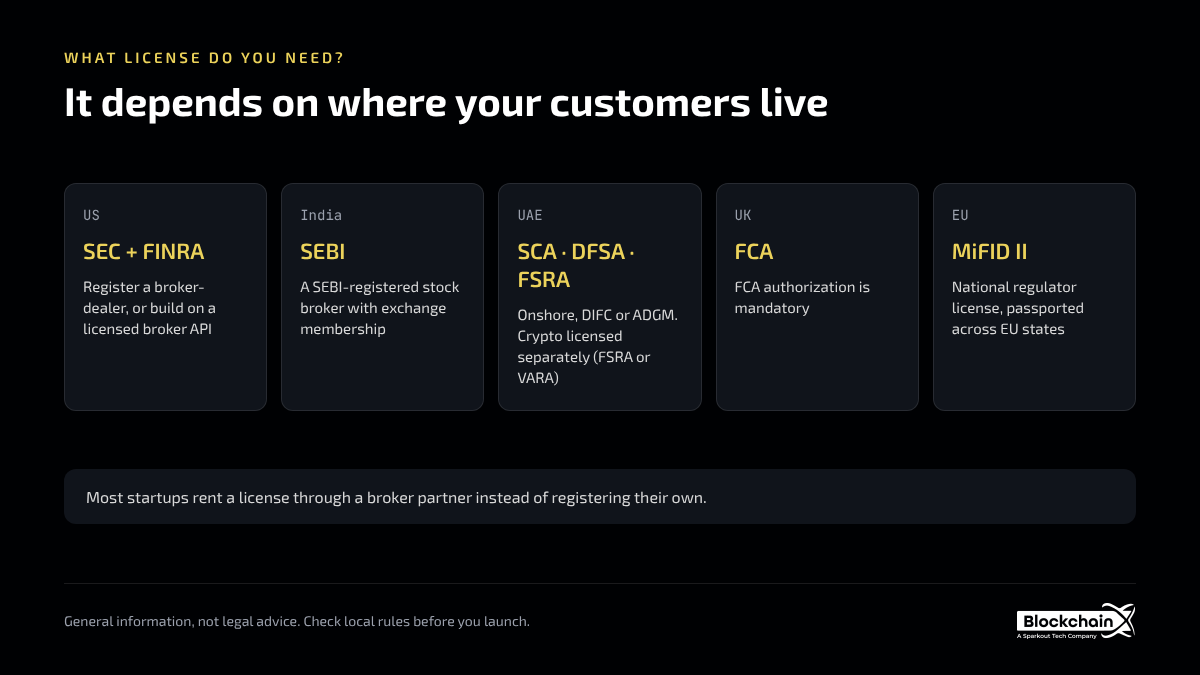
To launch a Robinhood-style app, a licensed broker plays a major role, and the license depends on where your customers live. Here is what you need to know and learn about what each market requires before building a Robinhood-style app.
United States
You need to register your own broker-dealer with the SEC and FINRA or develop on a licensed broker API.
The registration typically takes about 6 to 12 months, and the minimum net capital is $5K for an introducing broker that doesn’t receive customer funds, $50K for one that receives but doesn’t hold them, and $250K for a carrying broker (SEC Rule 15c3-1).
Broker API providers such as Alpaca and DriveWealth are registered broker-dealers, so most startups build on them instead of registering.
India
You need a SEBI-registered stock broker with exchange membership support.
Applicants go through a recognized stock exchange and must maintain the exchange’s minimum net worth, which is higher for self-clearing members than for trading members.
UAE
Robinhood received DFSA approval in October 2026 and plans to launch in the region in 2027.
For their own platforms, the regulators are the SCA onshore, the DFSA in the DIFC or the FSRA in ADGM.
Crypto is licensed separately under the FSRA or VARA virtual-asset regime.
UK and EU
For those who wish to launch in the UK, FCA authorization is mandatory.
In the EU, you need a MiFID II license from a national regulator.
The license can be passported to other EU states by notification, with an initial capital of €75K-€750K, depending on the services offered (EU Investment Firms Directive). The UK and EU don’t share a passport.
This is general information, not legal advice. Rules change regularly, so get local counsel before you build or launch.
Must-Have Features for a Robinhood-Like App
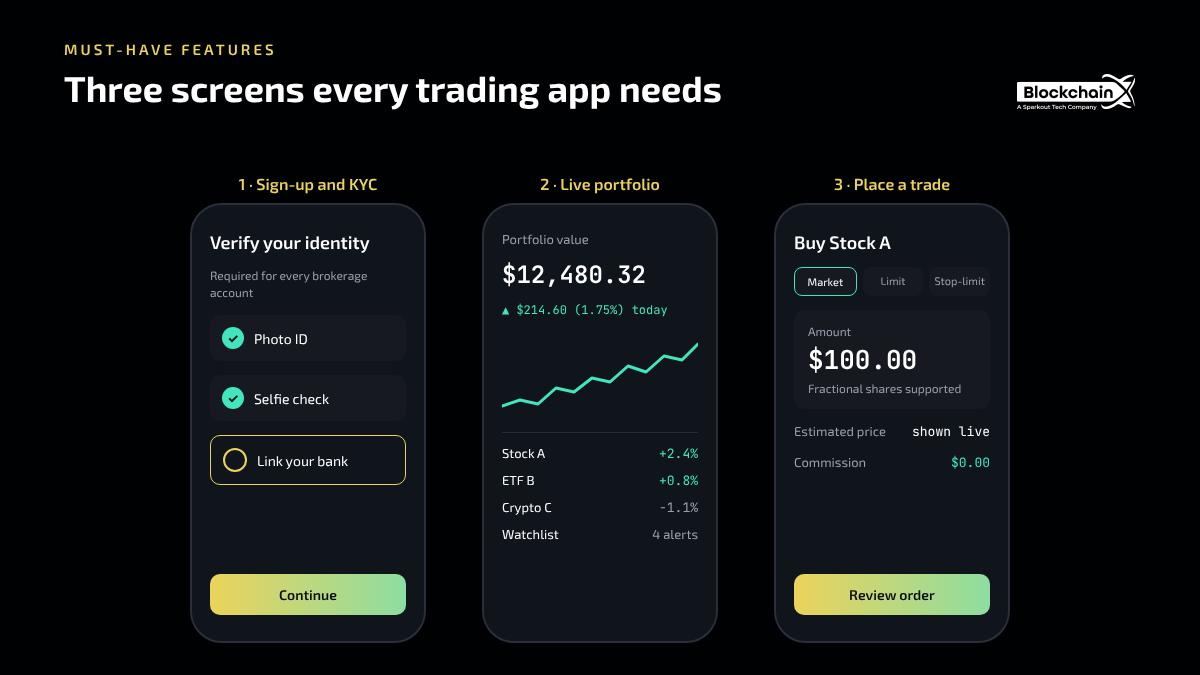
Trading apps have changed a lot in recent years. If you are planning a Robinhood-like app, these features definitely decide how modern it feels when you launch the application. They make it easy for users to sign up and place a first trade.
Investor App
Fast Signup and KYC: Users can verify their identity inside the app using ID verification and a selfie to cut down on paperwork. Slow approvals make some people drop out before their first deposit.
Order Types: Before confirming, users can easily place limit, market, and stop-limit orders at the estimated price shown. Beginners get a simple choice, and active traders get more control.
Bank Linking and Funding: Users can seamlessly connect a bank account and move money in and out of the app. Instant or near-instant deposits let users start their trading in the right way.
Watchlists and Price Alerts: Users save assets to a watchlist and set target prices to be notified. This brings them back to the app whenever it matters.
Live Portfolio and Charts: Robinhood’s home screen displays gains, losses, balances, and the price history in real time. This helps users easily monitor how their money is performing without leaving the app.
Account Security: The regulated financial app is secured with basic security requirements such as two-factor authentication, biometric login, and data encryption to protect users' accounts and money.
Push Notifications: Users get timely messages, order fills, and alerts for deposits, withdrawals, and the latest market news. This keeps them engaged within the app and builds strong trust.
Admin Panel
User and KYC Management: Your team consistently reviews identity checks and approves, rejects, or flags accounts. This keeps onboarding safe and compliant and stops fake or risky users early.
Risk and Margin Controls: Admins have access to set limits by asset or order size and can pause trading on a single asset. These controls protect the platform in volatile markets.
Order and Trade Monitoring: From placing to filling every order, its status is tracked to catch failed trades earlier and resolve user disputes quickly.
Compliance and AML Reports: Audit logs, regulator-ready reports, and suspicious-activity flags are built in to generate quick answers as per the audit and regulator’s request.
Analytics Dashboard: An all-in-one dashboard that comes with trading volume, signups, revenue, and retention. This lets admins see what is live and where it drops off.
Fee and Subscription Settings: Admins set premium plan pricing, markups, and promotions without changing the code.
Features that Set Leaders Apart
24/7 Trading: Robinhood’s 24-hour market lets users trade and select stocks overnight, five days a week, and at HOOD Summit 2026, it announced 24/7 trading of select US equities.
Fractional Shares: Users can easily invest in stocks and ETFs that cost hundreds or thousands of dollars with as little as $1.
AI Agents and Assistants: Robinhood started rolling out third-party AI agents in beta in May 2026, and its Cortex assistant is available to Gold subscribers.
Prediction Markets: Robinhood traded a record 16.4 billion event contracts in Q3 2026 alone, up over 7x year over year. Want to offer them in your own app? See our white-label crypto prediction markets.
How to Build a Robinhood-Like Stock Trading App, Step by Step
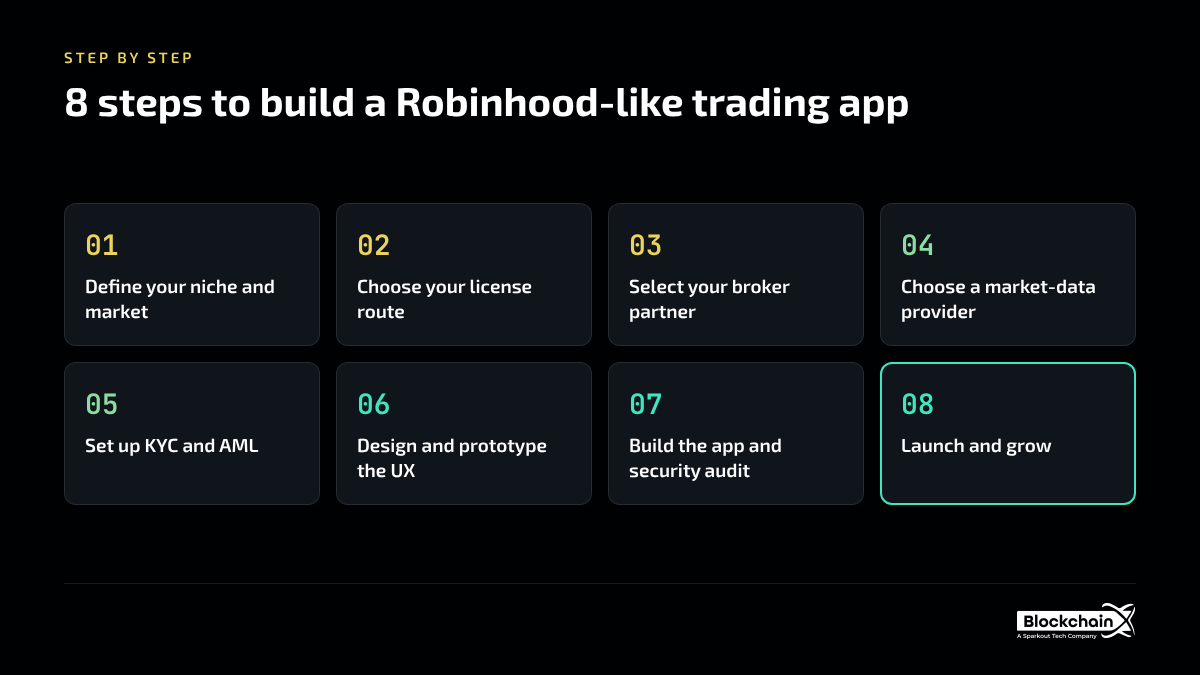
With so many trading apps available in the market, it’s been challenging to create a stock trading app that becomes the industry’s best. From picking your market to launching on the app stores, this guide outlines eight simple steps to develop a Robinhood-style stock trading app.
Step 1: Define Your Niche and Market
Initially, decide who needs the app, and then confirm their location. For example, first-time investors in India, active traders in the UAE, or crypto users who want stocks. Add a clear reason, like using a local language, lower cost, or easy trading. This completely determines your license, partners, and the first features of the application.
Step 2: Choose Your License Route
Decide whether to hold your own broker license or build on a licensed broker, based on your budget, market, and timeline. Renting a broker’s license through a partner is faster, which most of the startups wish to choose. You just need to confirm the choice with local counsel regarding the budget, time, and control.
Step 3: Select Your Broker Partner
Pick the firm that executes and clears trades and holds customer assets. Compare asset coverage, fees, API quality, trading hours and fractional share support. For example, consider Alpaca for REST and WebSocket API with paper trading for testing, and more. Make sure to get a sandbox and test an order before your confirmation.
Step 4: Choose a Market-Data Provider
Real-time prices, charts, and watchlists in the app depend on this feed. Check its market coverage, update time, and the cost of redistributing data to your users. Some brokers include data within their API, which can be minimal at the beginning.
Step 5: Set Up KYC and AML
Verify every user’s identity before they can trade. Perform sanctions screening and ongoing transaction monitoring to detect unusual activity. Your broker partner often sets the minimum standard, so check it before choosing a KYC vendor.
Step 6: Design and Prototype the UX
Map the four screens that matter the most, including sign-up, funding, portfolio, and first trade, and test them with real users before development begins. A clickable prototype is preferred to avoid confusion in steps before any code is written. A UX design and a prototype take about 3 to 8 weeks.
Step 7: Build the App and Security Audit
Build the investor app, admin panel, and backend, and then connect the broker, market data, KYC and payment services. Core development takes about 8 to 14 weeks, which covers the baseline, such as encryption, fraud monitoring, and multifactor authentication. Security and testing take another 3 to 6 weeks.
Step 8: Launch and Grow
Release a closed beta, then submit to the app stores, and closely watch the failed orders and support tickets in the first weeks. Once they are stable, add growth loops such as sign-up bonuses and referral programs, and set up a compliance team to review the rules for each.
What Tech Stack Do You Need to Build a Stock Trading App?
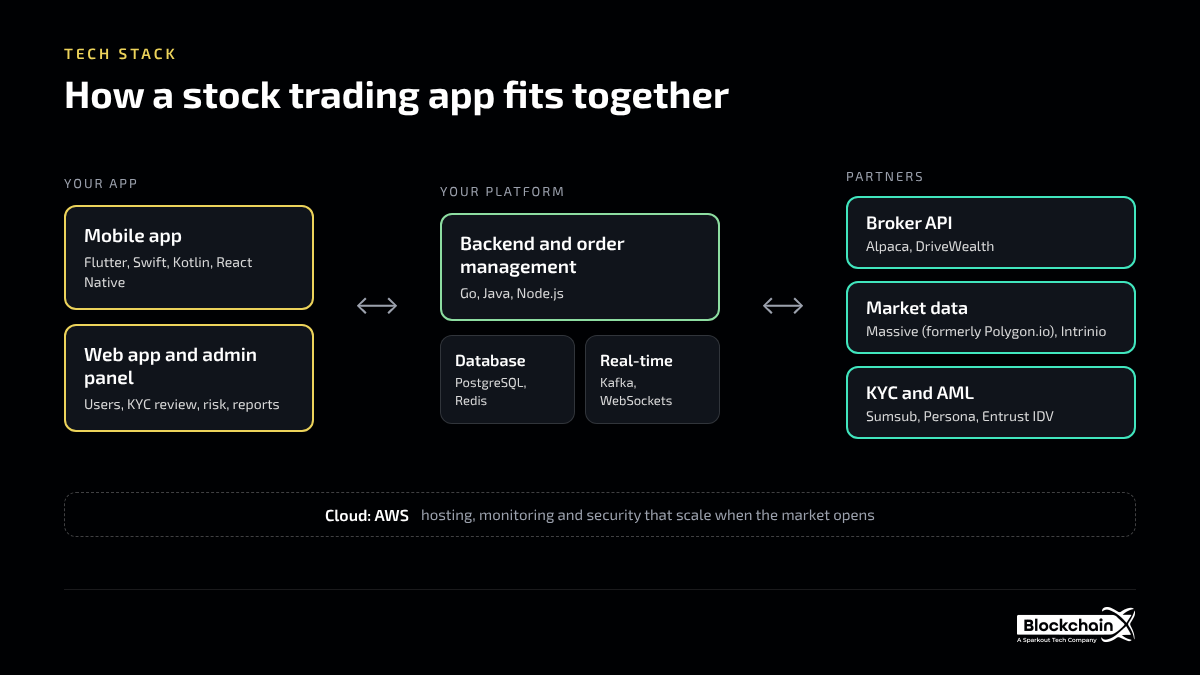
The right stack keeps orders fast, prices live, and data safe. Choosing the right tools is easier when you know what each tool or layer does. Here is a simple layout of the important eight layers of a Robinhood-style app that teams commonly use.
| Layer | Main Tool | What to Check |
|---|---|---|
| Mobile App | Flutter, Swift, Kotlin, React Native | Native is fast for live charts, and cross-platform lowers cost |
| Backend | Go, Java, Node.js | It must handle the spike in orders at the open market |
| Database | PostgreSQL, Redis | Order records need a complete audit trail |
| Real-Time Layer | Apache Kafka, WebSockets | Prices should update without users refreshing |
| Broker API | Alpaca or DriveWealth | Asset coverage, sandbox access, fees, and fractional share support |
| Market Data | Massive, formerly Polygon.io, Intrinio | Real-time access needs a paid plan |
| KYC and AML | Sumsub, Persona or Entrust IDV | Country coverage, AML screening, and liveness checks |
| Cloud | AWS | Data location rules and compliance certifications |
How Much Does It Cost to Build an App Like Robinhood?
A clear look at what it costs to build a trading app like Robinhood and what it costs to keep it running. A full custom build costs around $90K-$250K, and it can range up to $500K. Overall, the price depends on your build path, and it is covered in the table below.
One-Time Build Costs
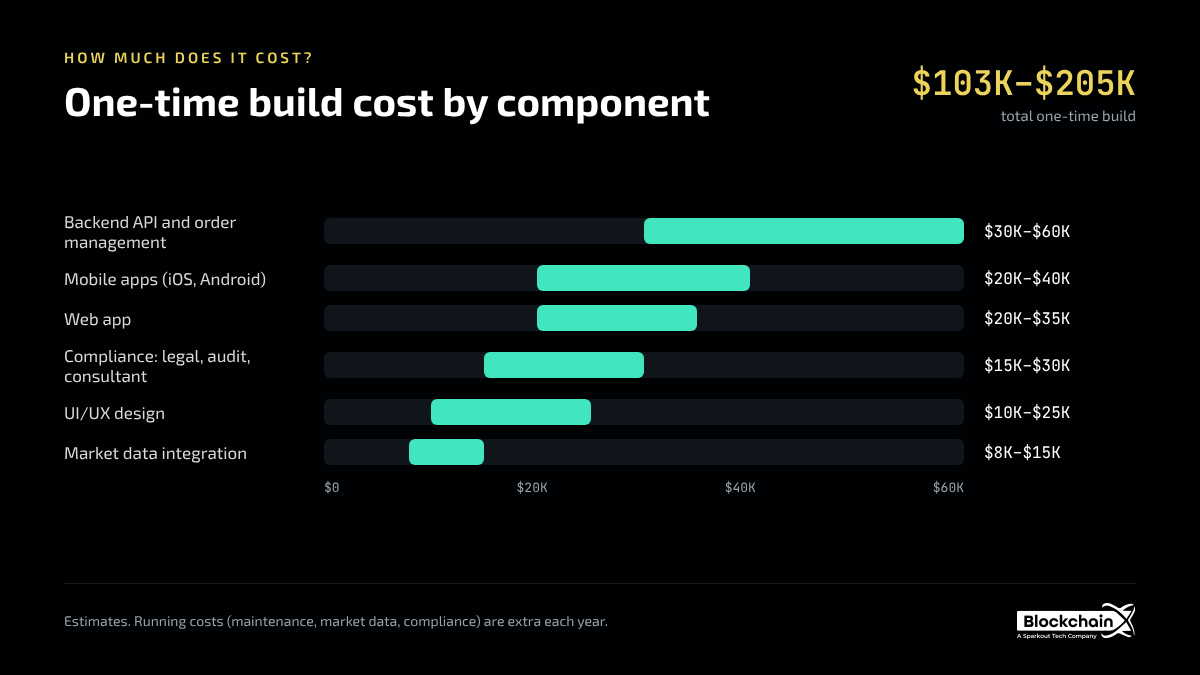
| Component | What It Covers | Typical Range |
|---|---|---|
| UI/UX Design | Screens, design system, and prototype | $10K-$25K |
| Backend API and Order Management | Accounts, orders and the broker connection | $30K-$60K |
| Web App | The browser version of the product | $20K-$35K |
| Mobile Apps | iOS and Android | $20K-$40K |
| Market Data Integration | Connecting the price feed | $8K-$15K |
| Compliance: Legal, Audit, and Consultant | Legal work, audit, and consultant fees | $15K-$30K |
Yearly Running Cost
| Component | What It Covers | Range |
|---|---|---|
| Maintenance | Updates, servers, security and regulatory changes | 15%-25% of the build cost per year |
| Market data with display rights | Showing prices to your own users | From $333 per month (Intrinio Startup, introductory price) or $2,499 per month (Massive Stocks Business) |
| Real-time exchange feeds | Direct trades and quotes from an exchange | Massive add-ons at $1,999 per month, with additional exchange fees |
| Own broker-dealer compliance | Compliance staff and fees | $100K-$300K per year |
| Cloud, monitoring and security testing | Hosting that scales when the market is open | Varies with users and trading volume |
Can Claude Trade on Robinhood? How AI Agents Connect to Trading Apps
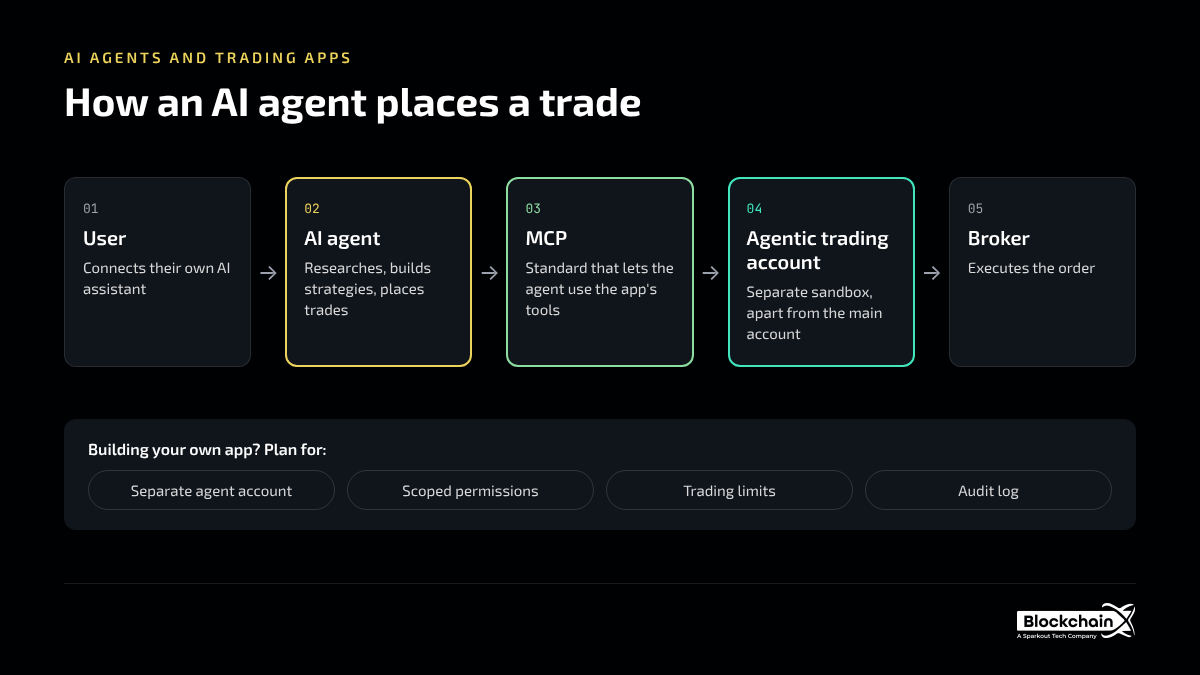
AI agents are becoming a new kind of user for stock trading apps, and here is how Robinhood handled it. The app lets its customers connect AI assistants that trade on their behalf. If you are building a similar app on your own, you should plan for that in advance. AI tools can speed up building a prototype, but they don’t speed up licensing. Three terms to know:
AI Agent: It is the AI assistant that takes actions such as placing a trade and answering questions.
MCP (Model Context Protocol): A standard that lets an AI assistant like Claude connect with other services and use their tools.
Agentic Trading Account: A new separate account that a user connects to an AI agent. It works as a controlled sandbox, separate from the user’s main account.
How Robinhood Opened Its App to AI Agents
In May 2026, Robinhood launched agentic trading, letting users connect their own third-party AI agents to the platform. This setup connects a separate agentic account via MCP to AI tools such as Claude Code or Codex.
On September 29, at the HOOD Summit 2026 in Houston, Robinhood announced that the AI agents built into the app can automatically develop strategies, trade, or conduct research. Over 200,000 customers have opened Agentic Trading Accounts, and agents now use Robinhood’s tools almost 30 million times a day.
Robinhood-Style Apps Around the World: How They Win in Different Markets
Robinhood is not the only model. Each market rewards something different, with different winning moves, and here is how it grew in its own markets.
India: Start Simple and Price Clearly
Zerodha made flat-fee broking mainstream, and Groww began in 2016 as a mutual fund investment platform. Groww now leads India with 13.75 million active clients, and Angel One has overtaken Zerodha for second place, with 6.99 million to Zerodha’s 6.76 million.
UK: Free Trading Is Not Enough
A commission-free app, Freetrade, was founded in 2018 and bought by IG for £160 million in 2025. Trading 212’s UK revenue rose 72% to £277.6 million. It also launched a card or interest with 1% cashback and zero foreign exchange fees.
Germany: Make Saving Automatic
Trade Republic reached about 10 million customers and €150 billion in assets by mid-2026, with a full banking license. Its flagship savings plans start at €1 per month, with no commission and no spread markup.
Robinhood in the UK and EU: Adapt the Product
UK customers trade through an FCA-authorized entity, with order routing, execution, and clearing handled by Robinhood Securities. Stock tokenization in the EU falls under MiFID II, where tokenized stocks are offered as derivative contracts for local rules from day one.
Lessons From Robinhood’s Story
Vlad Tenev and Baiju Bhatt founded Robinhood in April 2013; they had previously built high-frequency trading platforms for financial institutions in New York. The app launched in March 2015, and the company went public in July 2021, valued at about $32 billion.
In January 2021, the National Securities Clearing Corporation raised Robinhood’s daily deposit requirement by more than $3 billion. Robinhood restricted purchases of GameStop and other stocks, then raised $3.4 billion as additional capital. Later, it said that it raised the capital to lift the restrictions while staying compliant with its net capital and deposit requirements.
The clearinghouse stated it does not restrict which securities clients may trade. Its deposit demands depend on factors like a member’s concentration in volatile stocks and trading volume. A broker that clears its own trades needs enough capital for a day like this.
Conclusion
The right way to create a Robinhood-style app depends on your budget, market, and timeline. Simple design and clear pricing bring users in, and strong capital and compliance keep them safe. Pick the path that fits your budget, match your goals with it, check the rules in your target country, and start your launch. Book a live demo to see how a Robinhood-style app works and discuss which path fits your market. You can also build your own Robinhood clone script to launch faster with less technical risk and built-in features and functionality. Planning banking features too? See our crypto banking software development services.
FAQ
Not necessary if you build using a licensed broker partner, which executes trades and holds customer assets safely. You need a broker-dealer only if you launch the app on your own. In the US, this means having an SEC registration and a FINRA application with a minimum net capital of $5K for an introducing broker that doesn’t receive customer funds, $50K for one that receives but doesn’t hold them, and $250K for a carrying broker.
Your broker partner does, not your app. The broker-dealer holds custody, and if it fails, SIPC protects up to $500,000 per customer, including $250,000 for cash. This doesn’t cover market losses.
You can build the app regardless of the place, with a properly licensed partner or license of your own. In India, you need a SEBI-registered broker with exchange membership while in the UAE, the regulators are the SCA onshore, the DFSA in the DIFC, and the FSRA in ADGM. Robinhood has DFSA approval.
AI tools can speed up the prototypes and write most of the code, but they cannot replace the broker agreement, license, security audits, and the compliance review, which usually sets the launch date. Users can also connect their own AI assistants to trading apps like Robinhood through MCP.
Plan for data, maintenance, and compliance costs separately. Market data with display rights starts at about 333 per month, maintenance is estimated at 15 to 25% of the total build cost per year, and a license of your own adds $100K-$300K per year in compliance.
A white-label clone takes a few weeks. A custom app on a broker API takes 14 to 28 weeks, while registering your own broker-dealer adds 6 to 12 months.
Yes, it’s legal if you're partnered with a licensed broker or hold your own license. You just cannot copy Robinhood’s code, branding, or trademarks.
Clone script, custom app or your own broker-dealer?
Tell us your market, and we will get you the right path.
Our expert team is professionally well-equipped with hands-on experience as a blockchain development company. Connect with us; at BlockchainX, we curate your desired sustainable solution!


Follow us on


