 By Yokesh Sankar
8 min read
Published
Updated
By Yokesh Sankar
8 min read
Published
Updated
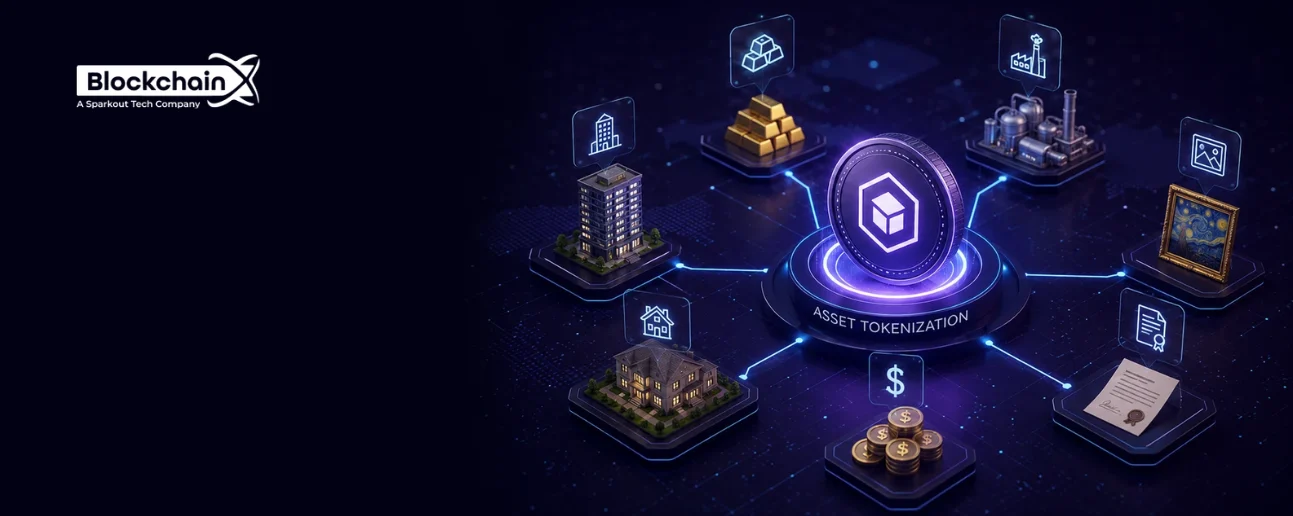
Asset tokenization is revolutionizing businesses and investors through its approach towards ownership and investment by converting real-world assets into blockchain-based digital tokens. What drives this urgency? The major three things that cover are liquidity, fractional ownership of illiquid asset classes, and enhanced accessibility. The result is a market where top asset tokenization companies emerge with their enterprise-grade performance.
The asset market is sized to project a reach of 24.5 trillion USD in 2033 from 2.1 trillion USD in 2026 with a CAGR of 42.1%. Here, in this blog, we have uncovered the top 10 asset tokenization companies that set a high standard in the market based on their terms and offerings.
A Quick Checklist
Here is the checklist for hiring asset tokenization company that comes with structured and evaluation-focused operational standards.
Understand the necessary licensing and digital asset regulations
Strong support for the popular token standards
Evaluation of smart contract audits and strong cybersecurity measures
Proven years of experience in specifying various asset classes
Efficiency in designing sustainable token models and revenue distribution systems
Flexibility of white label customization, workflow, and jurisdictional requirements
Integration with digital asset exchanges and liquidity management tools
Evaluate the company’s integration and API capabilities
Top 10 Asset Tokenization Companies Leading the Market in 2026
Considering various criteria, we have listed the 10 strongest options that are eligible to shape the future of the RWA ecosystem in 2026 and beyond. Each company stands in their unique services, features, and customization.
1. BlockchainX
BlockchainX is a trusted real-world asset tokenization development company, specialized in digitizing financial and physical assets into secure, compliant digital tokens. The company handles tokenization across a wide range of asset classes, including real estate, bonds, private credits, equities, and more.
They support white-label customization, letting businesses launch tokenization products under their own brand, with compliance structuring and multi-chain deployment across Solana, Ethereum, and more.
Backed by 150+ developers and 9+ years of experience, the company delivered live RWA projects like RealWorld.fi, an instant financing platform for your valuable assets, and Farmsent, an agri-supply chain platform through blockchain-based tokenization.
What separates BlockchainX is its tokenization platforms with compliance built in from the ground up, supporting advanced regulatory checks to help investors meet jurisdictional-specific regulatory requirements.
2. Tokeny Solutions
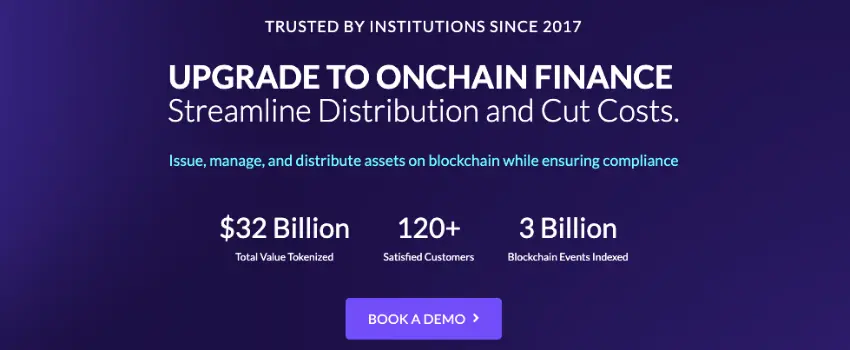
Since 2017,Tokeny has been a leading on-chain finance operating system, now backing institutions to issue, manage, and distribute tokenized securities like private equity, real estate, debt, and more directly on-chain. It created an open-source ERC-3643 standard , which is the official ERC standard for complaint tokenization.
The company has tied up with 120+ customers, with names like Apex Group, ABN AMRO, and more. Tokeny has built its reputation as the compliance-first standard in institutional RWA tokenization, with a trust by major asset managers and banks regulated by digital securities markets.
Their platform simplified the complexity of tokenization while adhering to global compliance standards, making them a preferred choice for enterprise and institutional clients.
3. Securitze
Securitize maintained its position as one of the top asset tokenization companies by AUM in 2026, serving major asset managers. Its ATS license makes it the only company to operate a regulated digital-securities infrastructure across both the EU and the US from issuance to investor exit.
They are well-known for their fully regulated environment, making complex compliance processes simple, seamless, and efficient for global businesses. What makes them unique is BUIDL, the largest tokenized financial product on public blockchains, running across popular networks such as Solana, Ethereum, Avalanche, and five others.
4. Tokensoft
Founded in 2017, the company specializes in providing a secured and compliant layer of tokenization rather than asset-specific platforms. It handles document signing, KYC/KYB, and accredited investor checks for every token issuer.
The company has facilitated a net worth of over $1 billion in fundraising for 100+ clients, with no compromise on token design and issuance. Their popular projects include Arbitrum, The Graph, Avalanche, and more.
For any team building a blockchain-based asset tokenization platform,Tokensoft’s platform supports token sales under Reg D, Reg A, and non-US offerings across multiple blockchains.
5. Polymath
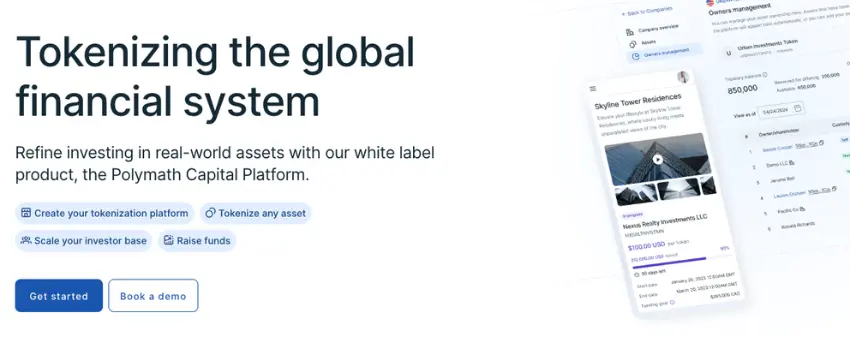
Polymath is a Toronto-based white label tokenization development company, which creates its own public-permissioned blockchain specifically for regulated securities. The company created the ST-20 token standard and has deployed 200+ tokens across border assets, including IP, precious metals, real estate, etc.
Their recent launch of Confidential Assets on Polymesh lets institutions transfer tokenized securities privately on a public chain while preserving auditability. Polymath’s open ecosystem empowers enterprises to tokenize their assets with built-in compliance tools and makes blockchain adoption more accessible for those who are entering tokenized markets.
Eventually, their potential to improve asset liquidity and transparency helped private equity platforms, fund managers, and government bond programs.
6. RealT
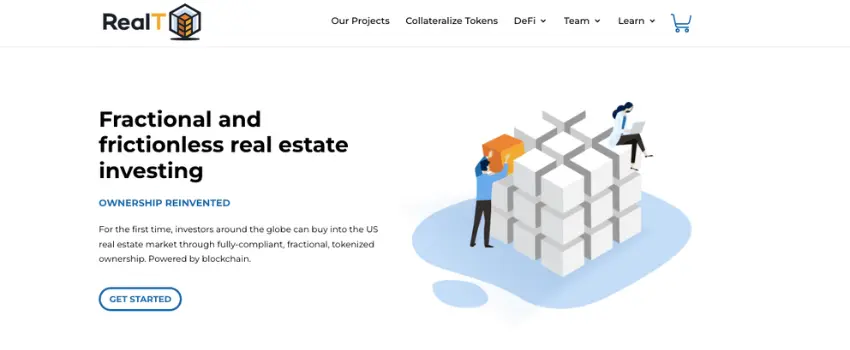
RealT is one of the most focused players tokenizing US rental properties, letting global investors buy legally compliant tokens. Since its launch in 2019, RealT has built an investor community of over 16,100 active investors across 154 countries, tokenizing more than 535 properties worth $101 million.
Their platforms are designed in a way with high versatility, transparency, and accessibility with various investment models for both investors and creators.
Investors of RealT receive their rental income directly in stablecoins to their Ethereum or Gnosis Chain wallets, with an average yield from 6% to 16%. Over, it is best for property funds or real estate firms, those who wish to offer fractional ownership to retail and semi-institutional investors.
7. Antier Solutions
With deep expertise across full-stack tokenization, Antier has built a reputation for tuning complex enterprise tokenization solutions into scalable-ready platforms. Their core services span across DeFi, exchange, and wallet development.
It has the ability to deploy custom asset tokenization platforms in as little as seven days, backed by a team of legal and technical experts with compliance-ready solutions. Antier has also built a dedicated vertical, and most probably, into AI-driven asset onboarding, valuation, and compliance workflows layered onto Web3-native.
The team backs robust smart contract deployment, making itself a single-asset specialist and a full-spectrum tokenization development partner for enterprises.
8. Suffescom Solutions
Suffescom offers RWA asset tokenization as a dedicated development service alongside AI and blockchain portfolios. Established in 2013, the company currently tokenizes 12+ asset classes across 30+ countries, covering gold, real estate, IP, luxury goods, in-game assets, etc.
The company excels in fractionalizing high-value assets with security token standards like ERC-1400 and ERC-3643. It also positions itself as a full-lifecycle partner from token design to secondary market liquidity.
Suffescom delivers white label platforms around $15K-$25K and enterprise multi-asset platforms with full regulatory compliance at $60K+, scaled accordingly with custom features.
9. Ondo Finance

Ondo Finance has established itself as a full-fledged player in tokenizing U.S. treasuries and equity products. Its major products OUSG (institutional treasury fund) and USDY (retail accessible yield-bearing note), gave global investors exposure to short-term US treasuries with 24/7 instant minting and redemption.
It created tokenized products compatible with both DeFi applications and institutional standards. The company offers cost-effective and highly customizable tokenization infrastructures, supporting businesses at every stage of their tokenization journey.
For teams building treasury-backed or equity tokenization products, Ondo brings the best platforms for production today.
10. Centrifuge
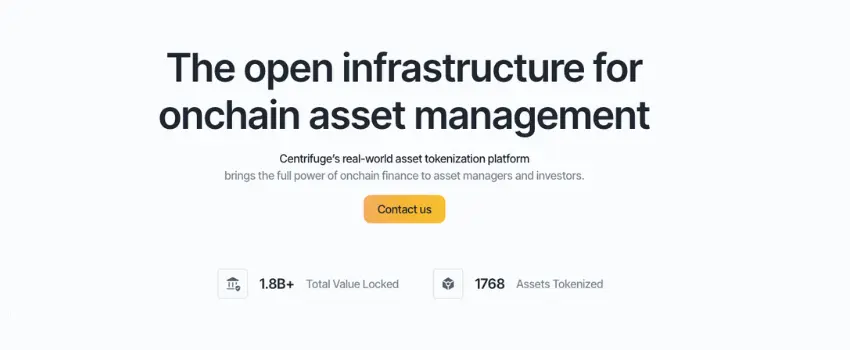
Centrifuge is a niche player in tokenizing real-world credit assets with off-chain asset tokenization for DeFi. Its native integration has turned out the company to let institutions tokenize funds, treasuries, and private credits either on their own or white-label, or through its full-service asset management.
The platform’s highly liquid trading environment creates a seamless path for institutional investors evaluating RWA tokenization services as a rare combination for credit-based assets.
Overall, Centrifuge stands as a compelling option for fintech companies and alternative lenders, those who are looking to bring their credit books on-chain efficiently.
Why Businesses Choose Asset Tokenization Companies
Asset tokenization companies play a major role by bridging the gap between traditional assets with blockchain technology. However, below are some of the reasons that insist on the importance of asset tokenization companies.
Technical Expertise:
Proficiency in blockchain and smart contracts ensures efficient and scalable tokenization platforms and processes.
Fractional Ownership:
Converts high-value assets into small tradable unit with wide accessibility to global investors.
Enhanced Liquidity:
Enables partial investment and secure trading with low transaction cost and reduced settlement time.
Improved Transparency & Security:
Smart contracts and blockchain ensure secure and tamper-proof ownership of asset records with unbreakable trust.
Rapid Commercialization:
Built-in frameworks and standards make the tokenized assets reach heights in the market rapidly.
Trust & Credibility:
Trust and well-managed transactions can minimize risk and build investor confidence.
Customization:
Flexible token design can increase the asset’s value, paving the way for more operational and investor needs.
Legal & Regulatory Compliance:
Commitment to strict security laws and regulatory compliance certifies both issuers and investors.
Tips For Hiring Asset Tokenization Companies
Tokenizing assets can unlock massive liquidity and global reach, but it demands partnering with the right tokenization company. To ensure a complaint-free, secure, and successful token launch, get through our evaluation criteria and hire the right partner aligning with your business goals.
Only a strong partner can treat tokenization as an evolving infrastructure with proven experience in audit practices, asset classes, and post-launch support. Getting into these quick guidelines will really save your cost of rework and protect investor trust in the future.
Evaluate technical depth
Assess blockchain proficiency
Prioritize regulatory compliance
Check for customization flexibility
Verify transparency & timelines
Review asset-class experience
Confirm liquidity support
Check client testimonials & reviews
Ask about security audits
Look for communication & trust
Key Functionalities of Asset Tokenization Companies
Asset tokenization companies are crucial in bridging traditional industries with blockchain technology; they extend their expertise, tools, and platforms to digitize real-world assets. The best asset tokenization service providers set few roles and functions as their primary key role in developing a full-fledged tokenization platform. Here are those.
Token Issuance & Smart Contract Deployment
This is the core stage where the creation and deployment of smart contracts define how a token behaves.
It typically includes supply limits, transfer rules, and ownership rights.
The best asset tokenization companies support multiple token standards, including ERC-20, ERC-1400, ERC-3643, and more based on the asset needs.
Compliance & Investor Verification
Every legitimate tokenization platform companies builds regulatory checks and identity verification directly onto the token layer and not as a separate one.
This includes everything like the transfer restrictions based on jurisdictions, investor accreditation checks, and the enforcement of securities regulations.
This makes no issuers to manually verify who qualifies to hold or trade a token.
Custody & Wallet Integration
Every asset digitized into a token represents a real value, which must be secured for proper issuance.
The blockchain asset tokenization companies integrate both custodial and non-custodial wallet solutions within a token for safe transfers.
They even enhance investors' confidence by integrating multi-sig security, encrypted key management, and protecting holdings from theft.
Secondary Market & Liquidity Infrastructure
After the tokens are issued and held, they are ready to trade on the secondary markets.
This covers listing on exchanges, peer-to-peer trading modules, and other modules to make it popular among investors.
Only the best asset tokenization service providers can change static digital verifications into something with real, ongoing liquidity.
Asset Portfolio Management & Dashboards
The investor interface is where software design and compliance intersect with human behavior
Beyond token issuance, they build real-time dashboards for tracking token performance, income distribution, checking compliance status, and full audits.
This gives investors and administrators transparent visibility on how the underlying asset is performing.
Global Regulatory Landscape for Asset Tokenization: A 2026 Overview
While asset tokenization is rapidly booming nowadays, regulation remains the biggest variable in 2026. No single framework defines how well a tokenized asset is classified, verified, licensed, and traded. Instead, asset tokenization regulations by country differ significantly, from the SEC’s securities-first approach in the U.S. to MiCA’s dual-track model in Europe.
Understanding these variations will be a crucial factor to mark your presence in this market growth.
1. United States
Regulator: SEC/CFTC
Approach: Securities-first approach. Tokenized assets are assessed under the Investment Contract Test
2026 Development: Issuance continues via Reg D/Reg A exemptions or SEC-regulated ATS platforms. The US is yet to follow the CLARITY Act, which divides digital asset oversight between the SEC and CFTC.
2. European Union
Regulator: ESMA/national authorities under MiCA
Approach: Dual-track method. MiCA for asset-reference tokens
2026 Development: Full passporting under Article 59 continues to position the EU as a major hub for cross-border tokenized fund and bond issuance. ESMA and the EBA have issued Level 2 regulatory technical standards this year, clarifying whitepaper requirements.
3. UAE (Dubai/DIFC)
Regulator: VARA/DFSA
Approach: Actively building sandbox-to-license pathways
2026 Development: April 2026 VARA guidance has gained popularity and sharpened. DFSA sandbox is converting pilots into full licenses in the upcoming years. Also, the DIFC is positioning itself as a live precedent for structured RWA tokenization frameworks.
4. Singapore
Regulator: MAS
Approach: Licensing under the Financial Services and Markets Act
2026 Development: MAS is expected to strengthen the digital token service provider licensing while supporting sandbox-based institutional tokenization pilots. Institutional platforms like ADDX continue to expand licensed access to tokenized private funds under MAS’s Capital Markets Product classification.
Conclusion
Asset tokenization is no longer an experimental concept; it’s becoming a core part in tokenizing illiquid assets globally. It continues to reshape traditional markets, creating new investment opportunities.
In this way, the asset tokenization companies are becoming an essential player in the modern financial ecosystem. They play a crucial role in ensuring seamless integration of blockchain into existing industries, driving forward a more inclusive, decentralized, and accessible economy in modern investments.
Choosing the right tokenization partner will adapt you to the growing regulations and help you position to capture the next wave of on-chain finance. The companies listed in this blog lead this space with full-service development and compliant-first infrastructures.
FAQ
The conversion of real estate, private credit, gold, art, or other high-value asset ownership rights into blockchain-backed digital tokens is called asset tokenization. This makes each token represent a fractional share of the underlying asset, making it easy to trade or transfer.
Choosing the best asset tokenization service providers comes with the easy process of evaluating their proven experience, regulatory and compliance knowledge, solid track of smart contract audits, customization level, case studies, post-launch support, and client testimonials.
As the demand for tokenization increases, the top asset tokenization companies must come up with in-depth knowledge in smart contract development, compliance-by-design infrastructure, multi-chain deployment, real-time portfolio dashboards, and growing adoption in AI-driven valuation tools.
An asset tokenization platform development cost varies based on blockchain network, technology stack, compliance requirements, customization, and more. Generally, a single-asset-class white-label platform costs around $15,000-$25,000, and enterprise-grade platforms with compliance features cost $50,000+.


